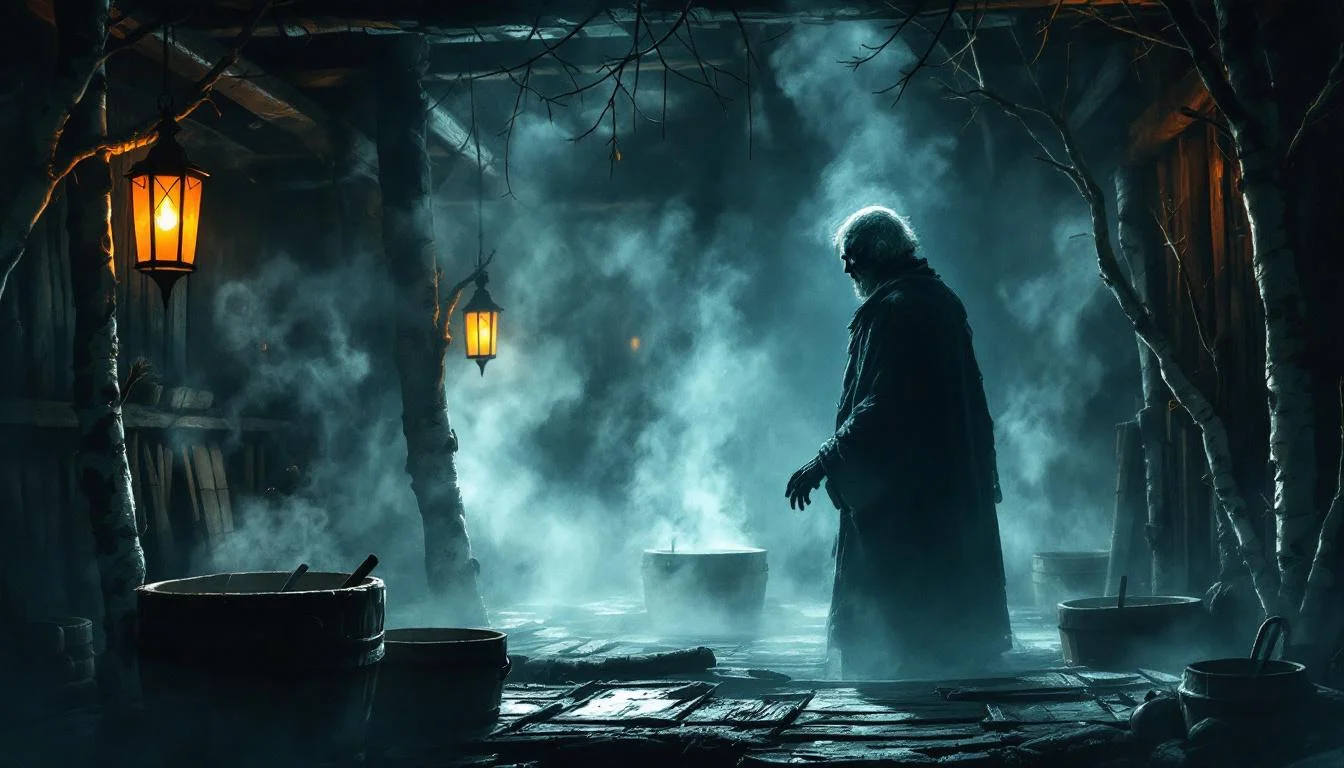
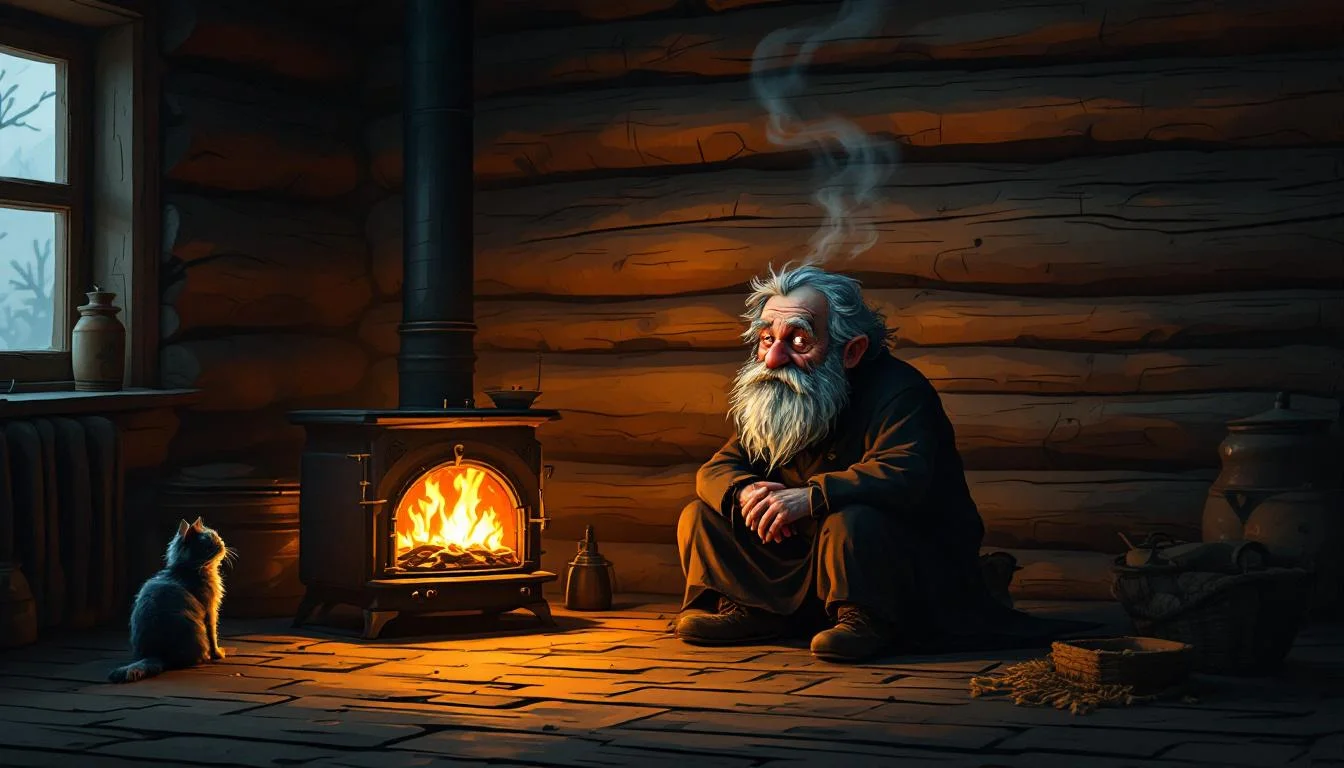
Something lives in the yard. Not in the house — the Domovoy claims that territory, enthroned behind the stove, warmed by the embers of ancestral memory. And not in the bathhouse, where the Bannik holds court in scalding steam and speaks prophecies through the touch of his invisible hands. This thing lives outside, in the cold air between the barn wall and the fence, in the shadows beneath the cattle trough, in the straw-lined dark of the stable where the horses shift and breathe. It moves at night. It has preferences. And if you have brought the wrong animal into its domain — the wrong color, the wrong coat, the wrong creature entirely — you will know by morning. The beast will be found drenched in sweat, its mane knotted into impossible tangles, its feed replaced with manure. Or it will not be found at all.
The peasants of Russia, Ukraine, and Belarus called this spirit Dvorovoy — from dvor, the yard. He was the master of everything between the threshold and the gate, the sovereign of the courtyard, the invisible herdsman who decided which animals thrived and which wasted away for no reason the veterinarian could name. He was the Domovoy's younger brother, his darker twin, and he was far less forgiving.
The Domovoy's Meaner Brother
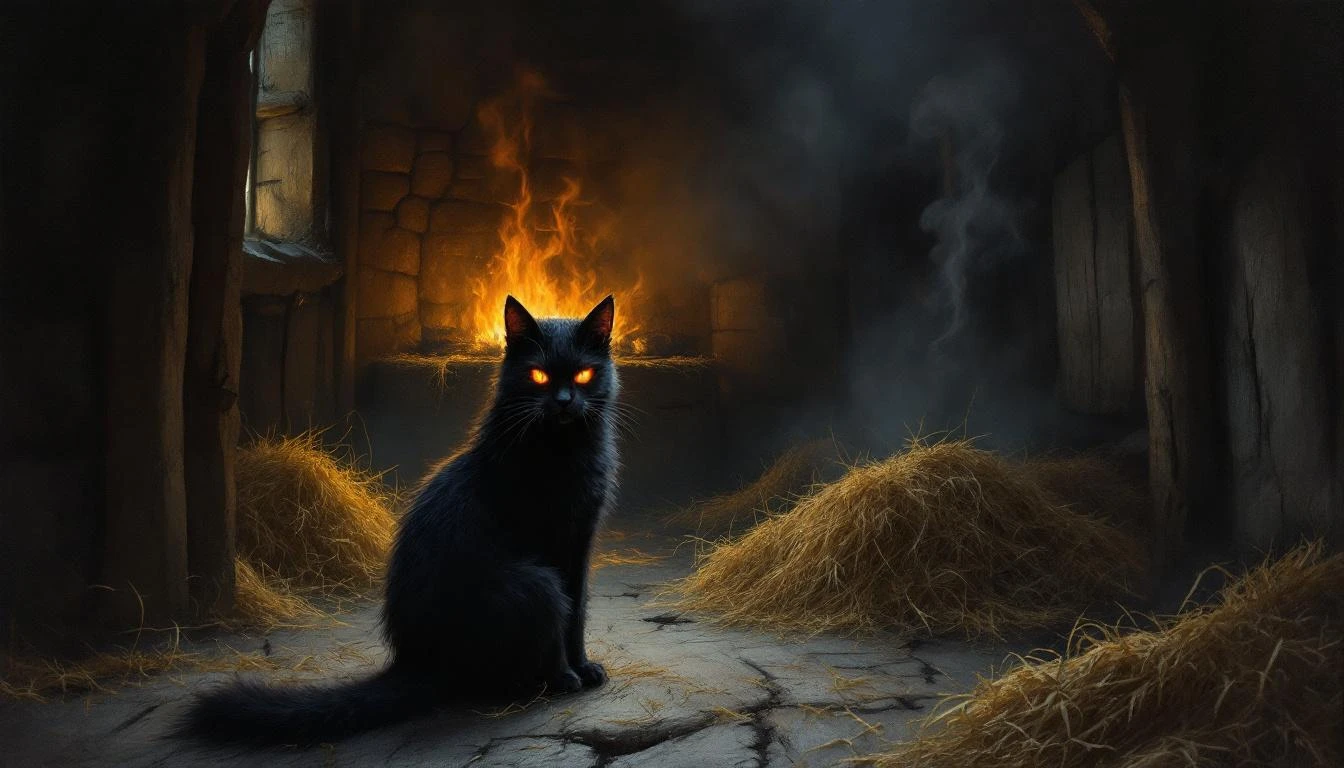
Every traditional Slavic homestead was a map of spiritual territories. The house belonged to the Domovoy. The bathhouse answered to the Bannik. The threshing barn — where grain was dried over open flame — fell under the terrifying jurisdiction of the Ovinnik, a shape-shifting black cat with eyes like embers who could burn your entire harvest if you stoked the fire on the wrong day. And the yard, the courtyard, the cattle shed, the stable, the space where animals were kept and tools were stored and the family's agricultural livelihood stood on four legs and chewed hay — all of this belonged to the Dvorovoy.
He was related to the Domovoy the way a feral dog is related to the one sleeping by the stove. Same bloodline. Same basic architecture. But the Dvorovoy was wilder, crueler, more openly demonic. The nineteenth-century Russian ethnographer S. V. Maksimov, who spent decades documenting the folk beliefs of the Russian countryside, classified the Dvorovoy as a spirit whose malicious nature was far more pronounced than his domestic counterpart. Where the Domovoy might pull your hair as a warning, the Dvorovoy would ride your horse to exhaustion and leave it trembling in a pool of its own sweat. Where the Domovoy soured milk when offended, the Dvorovoy starved your cattle by filling their feed troughs with dung and driving them in circles until they collapsed beneath the manger.
In some regions of Russia, the distinction between the two spirits was so blurred that peasants referred to the Dvorovoy simply as the "outdoor Domovoy." In others — particularly the northern provinces — the Dvorovoy was recognized as a fully independent entity with his own personality, his own feast day, and his own elaborate system of appeasement. The Belarusian tradition gave him a separate name entirely: khlevnik, the barn-keeper, emphasizing his dominion over the livestock shelter rather than the open yard. But across all East Slavic cultures, one fact remained constant: the Dvorovoy was not a spirit you could afford to ignore. Your animals depended on his goodwill. And his goodwill depended on things that no rational mind would consider negotiable — like the color of a horse's coat.
The Tyranny of Color
The Dvorovoy's most distinctive and disturbing trait was his absolute obsession with the color of livestock. This was not a preference. It was a law — enforced with the ruthless precision of a being who had no concept of mercy and all the time in the world.
Dark-coated animals were his favorites. Black goats, black dogs, dark bay horses, brown cattle — these creatures received the Dvorovoy's full protection. He groomed them in the night, braided their manes with invisible fingers, combed their coats until they gleamed, ensured their troughs were full and their water clean. A farmer who owned livestock that matched the Dvorovoy's taste would find his animals inexplicably healthy — smooth-coated, well-fed, fertile, calm. The neighbors would marvel. The farmer, if he was wise, would say nothing and leave an extra portion of bread in the barn that night.
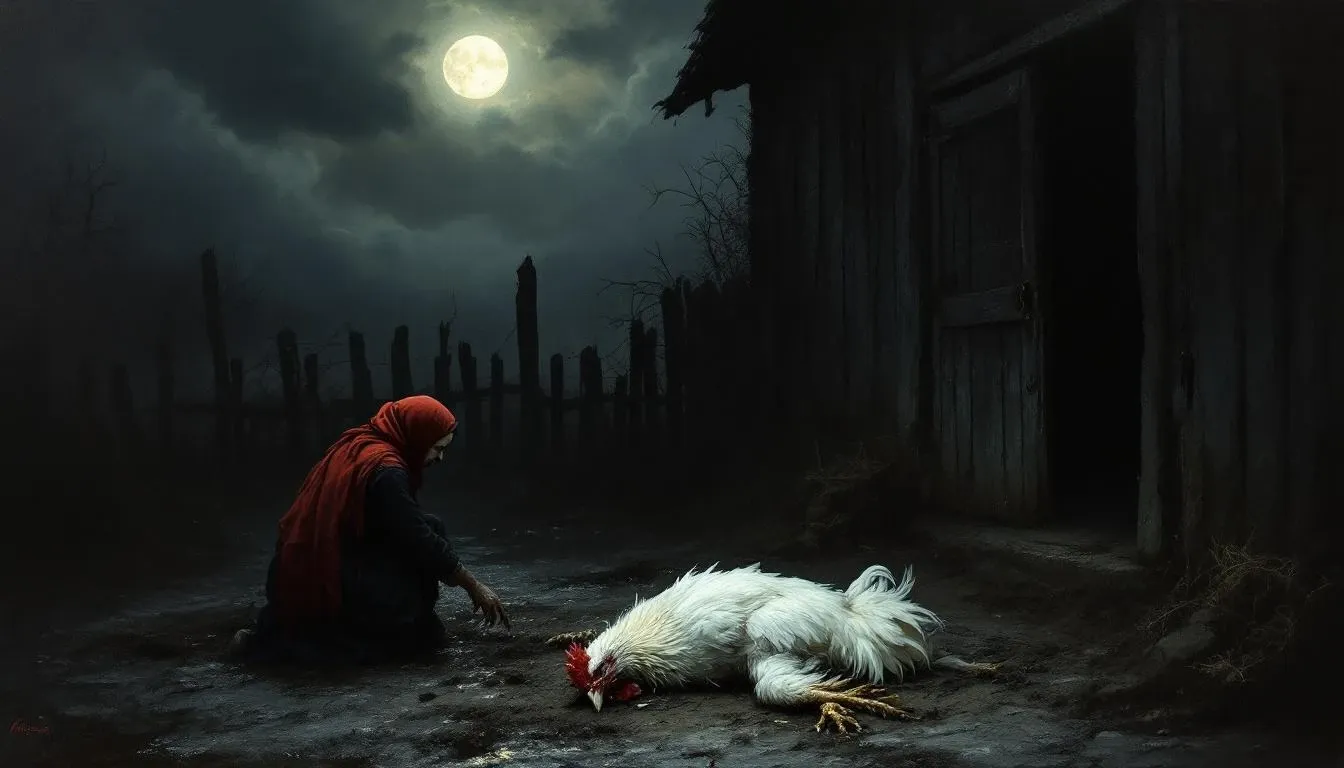
Light-coated animals were a different matter entirely. White horses, white dogs, white cats, palomino or golden-maned horses — these were not merely disfavored. They were targets. The Dvorovoy tormented them with a focused, patient cruelty that went beyond simple mischief. He chased them in circles around the yard after dark. He drove them under the mangers so they could not reach their feed. He tangled their manes and tails into knots so tight that no comb could undo them. He fouled their water. He scattered their hay and packed their troughs with manure. The animals grew thin, nervous, sick. They sweated in the night as though ridden by something unseen. Their coats dulled. Their eyes went flat with exhaustion.
Peasant farmers recognized the signs immediately. An animal that was "not to his court" — ne ko dvoru, the precise folk expression — had fallen out of the Dvorovoy's favor. There was no veterinary explanation, no disease, no injury. The animal simply did not match the spirit's aesthetic, and for this crime it would be slowly destroyed. The only rational response was to sell the animal before the Dvorovoy killed it. Keeping a white horse in a barn governed by a Dvorovoy who despised white horses was not stubbornness. It was cruelty — to the horse and to the spirit both.
Rituals of Appeasement and Protection
Living with the Dvorovoy required a sophisticated system of ritual negotiation. The offerings were simpler than those demanded by the Domovoy — no coals carried on iron pans, no ceremonial transfers during house moves — but they were no less essential. Neglect the Dvorovoy's offerings and your livestock paid the price. Every time.
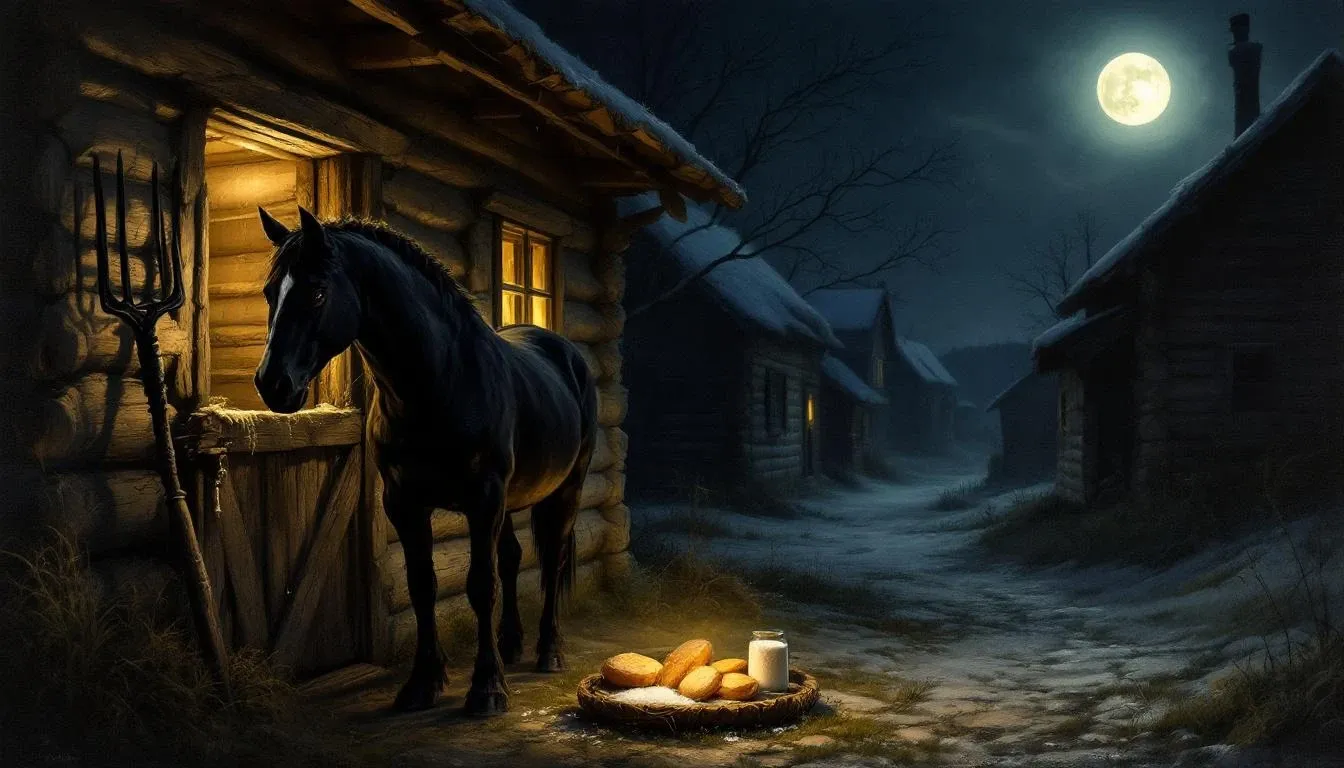
The most common offering was food left in the barn at night. Bread and salt — the universal currency of Slavic spiritual diplomacy — were placed near the cattle trough or on the threshold of the stable. Milk was poured into a shallow dish and set beside the manger. In some regions, the offering was more specific: food was presented on iron pitchforks, thrust into the hay of the manger itself, a gesture that combined feeding with a subtle display of respect for the spirit's domain. The iron was significant. In Slavic folk belief, iron carried apotropaic power — the ability to ward off malicious spirits. But the Dvorovoy was not being warded off. He was being fed. The iron pitchfork was an acknowledgment that this spirit occupied a space between the protective and the dangerous, and that the boundary between the two was maintained only through constant, careful attention.
On ritual days, the oldest woman of the house rose before dawn and carried a cup of beer into the yard. She left it on a roof that overhung the cattle shed. Around noon, the master of the house rode the Dvorovoy's favorite horse around the yard, while the old woman stood on the porch and waved her broom, calling out: "Father Dvorovoy, do not leave! Do not leave the yard empty, do not harm the animals! Keep the path blocked for those who would come with ill intent!"
The ritual for introducing new animals into the Dvorovoy's territory was particularly elaborate. When a farmer purchased a new horse or cow, the animal could not simply be led through the gate. It had to be presented. The farmer would bow at the threshold of the yard and speak aloud: "Father Dvorovoy, respected master, accept our new livestock, love it, feed it, keep it well." If the animal was dark-coated, this was usually sufficient. The Dvorovoy would accept the creature into his care, and within days the animal would settle, its coat growing thick and healthy under the spirit's invisible ministrations.
But if the animal was light-colored — if the farmer had no choice but to bring a white horse into a yard ruled by a spirit who despised white horses — the protective ritual escalated dramatically. The animal was led into the yard backwards, through the gate in reverse, so the Dvorovoy could not see it approach. A sheepskin coat was laid across the threshold with the fur facing upward, and the animal was walked over it, the fleece supposedly masking the creature's true color from the spirit's perception. In some villages, a dead magpie was hung on the barn wall or the fence post as an additional ward — a counter-charm against the Dvorovoy's wrath, the magpie's black-and-white plumage serving as a kind of spiritual camouflage.
These were not quaint superstitions performed with a wink. They were survival strategies. A farmer who lost his livestock lost everything. The Dvorovoy's preferences were as real and as consequential as drought or disease, and the rituals designed to manage those preferences were practiced with the same deadly seriousness that a modern farmer brings to vaccination schedules and feed ratios.
What the Dvorovoy Looked Like
Unlike the Domovoy, who appeared as a small, hairy old man resembling the family patriarch, the Dvorovoy's appearance was more explicitly monstrous. He was a shapeshifter, but his true form — the form he wore when he thought no one was watching — betrayed his demonic nature in ways the Domovoy's never did.
The most consistent descriptions across Russian and Ukrainian ethnographic records depict him as a small humanoid figure, roughly the height of a child, with dark coloring that matched his beloved dark-coated livestock. His hair was dark, his skin was dark, and his body was covered in coarse fur. So far, he might be mistaken for his more famous brother. But the feet gave him away. The Dvorovoy's feet were not human. They were the feet of a cat, a chicken, or a goat — the barnyard animals he lived among, whose forms he borrowed and whose territory he shared. This detail, recorded across multiple regions, marks the Dvorovoy as something fundamentally different from the Domovoy. The house spirit was an ancestor. The yard spirit was something older, something that belonged to the animal world as much as the human one.
He could also take the shape of the head of the household — appearing at night as a perfect duplicate of the master, walking through the barn, inspecting the livestock, running his hands along the horses' flanks. Servants and family members who encountered this figure in the dark reported a feeling of wrongness — the shape was right, but the presence was too cold, too still, too watchful. By morning, the real master would have no memory of the visit. The Dvorovoy had simply borrowed his face.
In Czech and Slovak folk traditions, a related spirit called the skriatok shared many of the Dvorovoy's characteristics. By day, it appeared as a black chicken — unremarkable, easily overlooked among the real birds in the yard. By night, it transformed into a fireball that streaked across the courtyard, illuminating the barn walls with a brief, unsettling glow before vanishing into the dark.
The Rules of the Yard
The Dvorovoy did not only punish the wrong-colored animals. He enforced a comprehensive code of conduct for everyone who entered his domain — human and animal alike. The rules were unwritten but universally understood, passed down through generations of rural families who had learned them the hard way.
You did not quarrel in the yard. Domestic arguments, shouting matches between spouses, disciplining children with raised voices — all of this enraged the Dvorovoy. The yard was his territory, and he demanded peace within it. A family that brought its conflicts outside was a family that would find its livestock suffering by morning. This prohibition was particularly strict in the barn itself. Shouting near the animals was considered a direct provocation, an insult to the spirit who cared for them.
You did not stand on the manure pile. This detail appears in multiple ethnographic sources from the Russian countryside, and its logic is both practical and spiritual. The manure pile was the physical residue of the Dvorovoy's charges — the animals he tended, fed, and groomed. Standing on it was an act of contempt, a statement that you considered the products of his labor beneath your feet. The Dvorovoy's response was swift and disproportionate.
Women did not exit the house into the yard with loose, unbound hair. This prohibition connected the Dvorovoy to a wider network of Slavic beliefs about female hair as a conduit for spiritual power. Loose hair was associated with mourning, with witchcraft, with the Kikimora — the malicious female house spirit who spun thread from tangled hair in the dead of night. A woman who walked into the Dvorovoy's domain with her hair down was essentially broadcasting a signal of disorder, and the yard spirit — who valued order above all — responded accordingly.
You did not work in the yard after dark. The night belonged to the Dvorovoy. He moved through his territory after sunset, inspecting the animals, checking the fences, patrolling the boundaries of the homestead. A human presence in the yard during these hours was an intrusion. Farmers who had no choice but to tend a sick animal after nightfall did so with spoken apologies, addressing the spirit aloud: "Forgive me, Father, I must tend to the cow." The apology was not optional.
And above all: you never called the Dvorovoy by the name "Domovoy." In regions where the two spirits were understood as distinct entities, this was considered a grave insult — the equivalent of calling a man by his brother's name, denying his individual existence. The Dvorovoy had his own identity, his own territory, his own feast day — November 8th by the old calendar, November 21st by the new. To collapse him into the Domovoy was to disrespect everything he was.
Why the Dvorovoy Matters
The Dvorovoy occupies a position in Slavic mythology that reveals something essential about how pre-Christian Eastern Europeans understood their relationship with the natural world. He is not a god. He is not a demon in the Christian sense. He is something more specific and more unsettling: a spirit whose power derives entirely from proximity to the things you depend on for survival.
The Leshy rules the forest — dangerous, but distant. You can choose not to enter the woods. Baba Yaga lives at the edge of the world — a threat, but an avoidable one if you keep to the roads. Even the Domovoy, for all his intimate presence behind the stove, can be managed with bread and salt and respectful words spoken in the dark. But the Dvorovoy sits between you and your livelihood. Your horses, your cattle, your goats, your chickens — every animal that feeds your family, pulls your plow, and carries you to market passes through his jurisdiction. You cannot avoid him. You cannot relocate him. You can only learn his rules and follow them with the precision of someone who understands that a single wrong-colored horse could mean the difference between a prosperous year and a ruined one.
This is the genius of Slavic folk demonology. It does not place its most dangerous spirits in distant caves or at the bottom of lakes. It places them in the barn. In the bathhouse. In the space between your front door and your fence. The Dvorovoy is a reminder that the most consequential supernatural forces are not the ones that live far away. They are the ones that live where you keep your animals, where you store your tools, where you walk every morning before the sun comes up. The yard is not neutral ground. It never was. Something lives there, and it has opinions about the color of your horse.
In the old villages, the farmers knew this. They left bread on the manger. They spoke the words of greeting when they brought new livestock through the gate. They hung spruce branches in the corners and kept their voices low after dark. They understood the contract: respect the yard, and the yard would provide. Violate it, and the Dvorovoy would make sure you felt every consequence in the hollow ribs of your starving cattle and the tangled manes of your exhausted horses.
That contract has not been formally cancelled. The Dvorovoy's feast day still falls in November. The old words still work. And in the barns that still stand in the Russian countryside, where the hay smells sweet and the horses shift in the dark, something still moves after midnight — checking the troughs, combing the manes, deciding which animals will thrive and which will waste away for reasons no one can explain.
He is the master of the yard. He always has been. And he does not forgive easily.