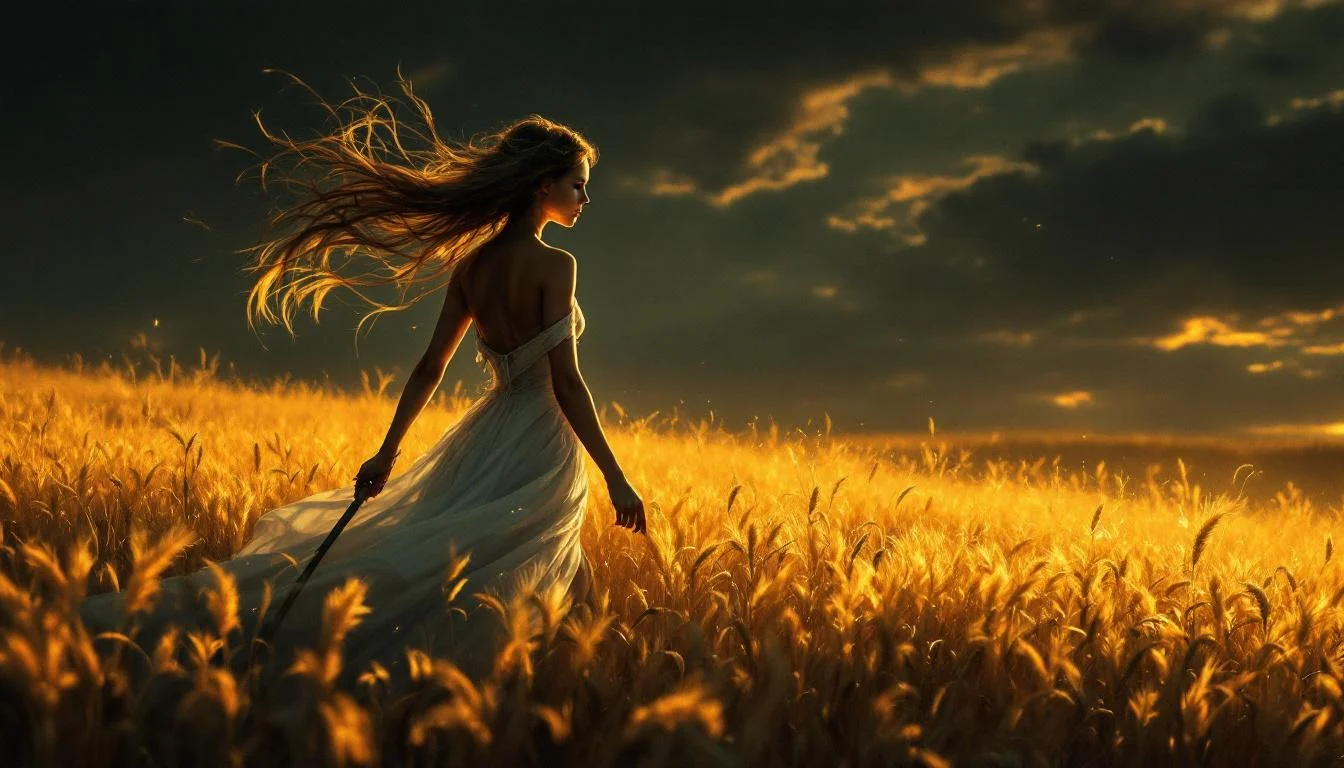
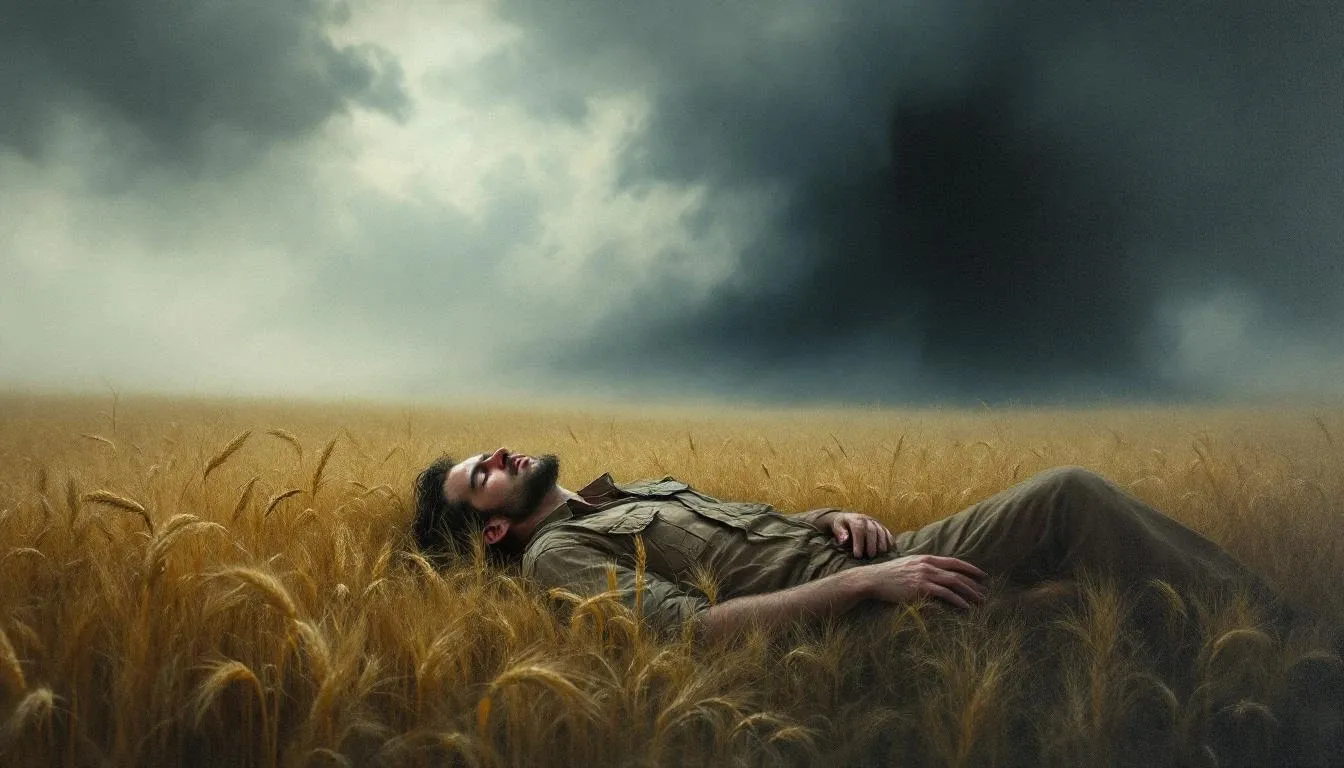
The wheat is tall in July. Chest-high, golden-headed, rustling with a sound like whispered conversation. You have been working since before dawn — scything, binding, stacking — and your body has reached the place beyond tired where everything feels distant and unreal. The sun is directly overhead. Noon. The air does not move. The field stretches in all directions, featureless, endless, shimmering with heat.
You sit down among the stalks. Just for a moment. Just to rest your back against the warm earth. Your eyes close.
This is how the Polevoy finds you.
The Polevoy — literally "the one of the field" — is the East Slavic spirit of cultivated agricultural land. He is the master of the wheat, the rye, the barley, the open spaces between the forest and the village where grain grows and humans labor. He is not malevolent in the way that the Vodyanoy drowns or the Bolotnik suffocates. He is something more complex: a taskmaster, a landlord, a spirit who tolerates human presence in his domain only as long as that presence involves hard work and proper respect. The moment you stop — the moment you rest when you should be laboring, the moment you sleep in his field at the wrong hour — the Polevoy's tolerance ends.
A Body Made of Earth
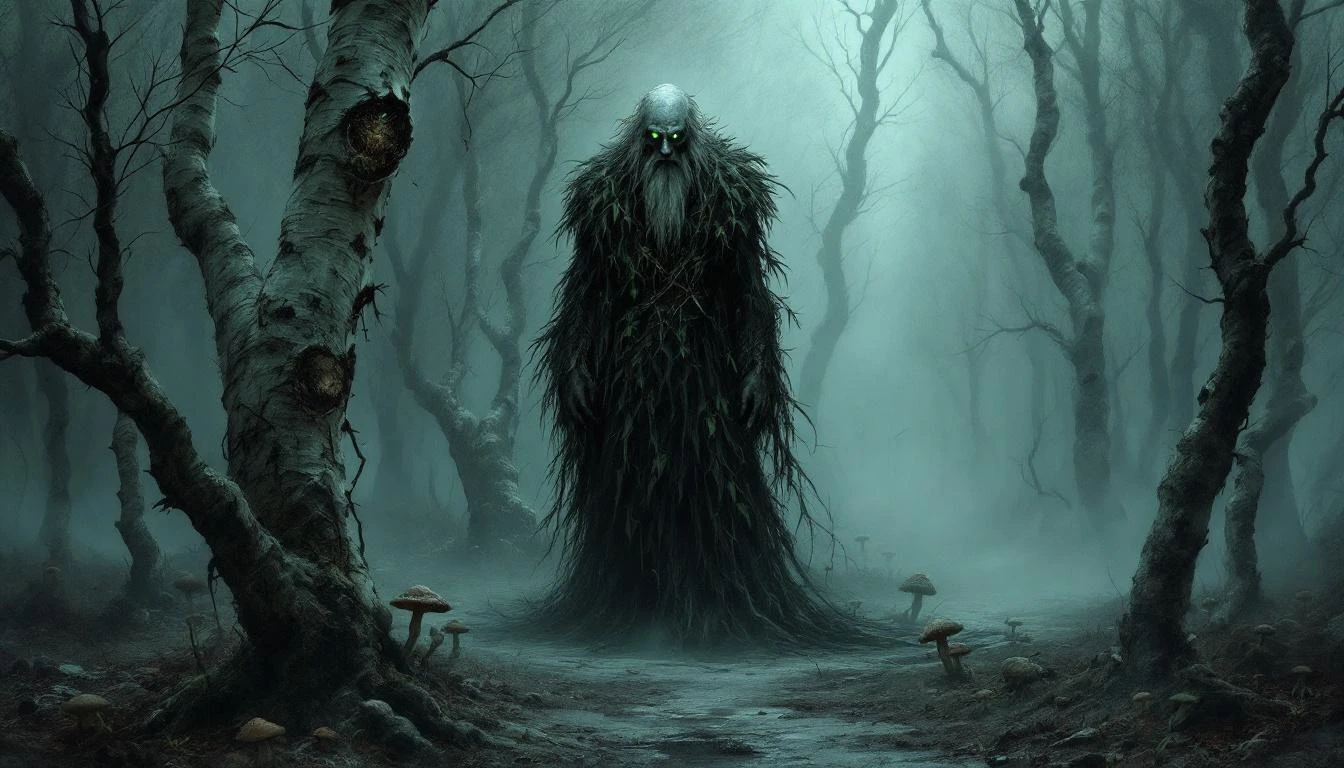
The Polevoy's appearance changes with the field itself. This is one of his most distinctive characteristics among Slavic nature spirits: he is not static. He transforms through the agricultural year, and his body reflects the state of the land he governs.
In spring, when the first shoots push through the soil, the Polevoy appears as a young figure — small, thin, green-tinged, barely visible against the emerging crops. In summer, at the height of growth, he is tall and powerful, his body dark as plowed earth, his hair the color of ripe grain. In autumn, after the harvest, he shrinks and ages — a bent old man, grey and dry as stubble. In winter, when the fields lie bare, some traditions say he retreats underground entirely, sleeping beneath the frozen soil until the spring thaw calls him back.
His physical features are remarkable. Multiple sources describe the Polevoy as having skin the color of dark earth — black or very dark brown, regardless of season. His hair is described as grass-like — long, green or golden depending on the growth stage of the surrounding crops, blowing in the wind just as the wheat does. Most distinctively, several ethnographic accounts give him heterochromatic eyes — one light, one dark, or one green and one brown. This asymmetry may reflect the uneven nature of the field itself: one side in shadow, one in sun; one half ripe, one half still green.
He is sometimes naked. Sometimes dressed in white — the color of the shirts peasants wore to work the fields. Sometimes he appears only as a disturbance in the grain — a line of movement in the wheat where no wind blows, stalks bending away from an invisible passage. You do not always see the Polevoy. But you can tell when he is watching by the way the field moves around you.
The Noon Danger
The Polevoy's most feared aspect was his connection to the noon hour — polden', the moment when the sun stood directly overhead and shadows disappeared. In Slavic folk belief, noon was not simply the middle of the day. It was a liminal time, a threshold moment as dangerous in its way as midnight. At noon, the ordinary world became thin. Spirits moved freely. The rules changed.
The Polevoy was at his most powerful and most aggressive at noon. A farmer who fell asleep in the field during the noon hour was in mortal danger. The spirit would find the sleeper and punish him — by strangling, by suffocating with earth packed into his mouth and nostrils, by "riding" him (pressing on his chest until he could not breathe), or simply by driving him mad with nightmares from which he could not wake.
This noon-danger connects the Polevoy directly to Poludnitsa, the Lady Midday — the fearsome female spirit who walked the fields at noon, asking questions of farmers and beheading those who could not answer or who stopped working. The relationship between Polevoy and Poludnitsa is debated among folklorists. Some consider them husband and wife — co-rulers of the field during the dangerous noon hour. Others see Poludnitsa as the Polevoy's enforcer, or as an independent spirit whose domain overlaps his during the midday period. In either reading, the message to the farmer was identical: noon is not a time for rest. Noon is the most dangerous hour in the field. Keep working. Keep moving. Do not close your eyes.
The practical function of this belief is transparent. Heatstroke, heat exhaustion, and sunstroke are genuine risks for agricultural laborers working in open fields during the hottest part of the day. A farmer who fell asleep at noon in July, exposed to direct sunlight without shade, might well die or suffer permanent damage. The Polevoy's noon-attack encoded a real warning: sleeping in the open field at the height of summer heat is dangerous. The spirit provided a narrative reason to heed a physical truth.
Running Horses to Death
The Polevoy had a particular relationship with horses — and it was not a gentle one.
In multiple East Slavic traditions, the field spirit was blamed for a specific and terrifying phenomenon: horses found dead in the morning in their pastures, their bodies covered in sweat, their legs tangled as though they had been running frantically throughout the night. The cause, folk belief held, was the Polevoy. He rode them. He mounted the horse in the night and drove it in endless circles through the field until the animal collapsed from exhaustion and died.
This "riding" of horses connects the Polevoy to a broader Slavic (and indeed pan-European) belief about spirits who ride animals and humans at night. The Kikimora was said to ride chickens. The Mora — the nightmare spirit — rode sleeping humans, pressing on their chests. The Polevoy's version was agricultural: he rode the working animals of the farm, the horses that pulled the plow, and he rode them to death.
The protection against this was specific: horses pastured near the field at night should have their manes braided. The braids — sometimes interwoven with iron nails or blessed thread — prevented the Polevoy from gripping the mane to mount. A horse with an unbraided mane left in the field overnight was an offering the farmer was too careless or too poor to protect.
Some traditions extended this to cattle. Cows found with tangled tails, or producing less milk after being pastured in a particular field, were said to have been disturbed by the Polevoy. The spirit was not simply a danger to humans. He was a force that could damage the entire agricultural operation — livestock, crops, and workers alike — if not properly respected.
The Last Sheaf
The most important ritual associated with the Polevoy centered on the harvest — specifically, on the last sheaf of grain cut from the field.
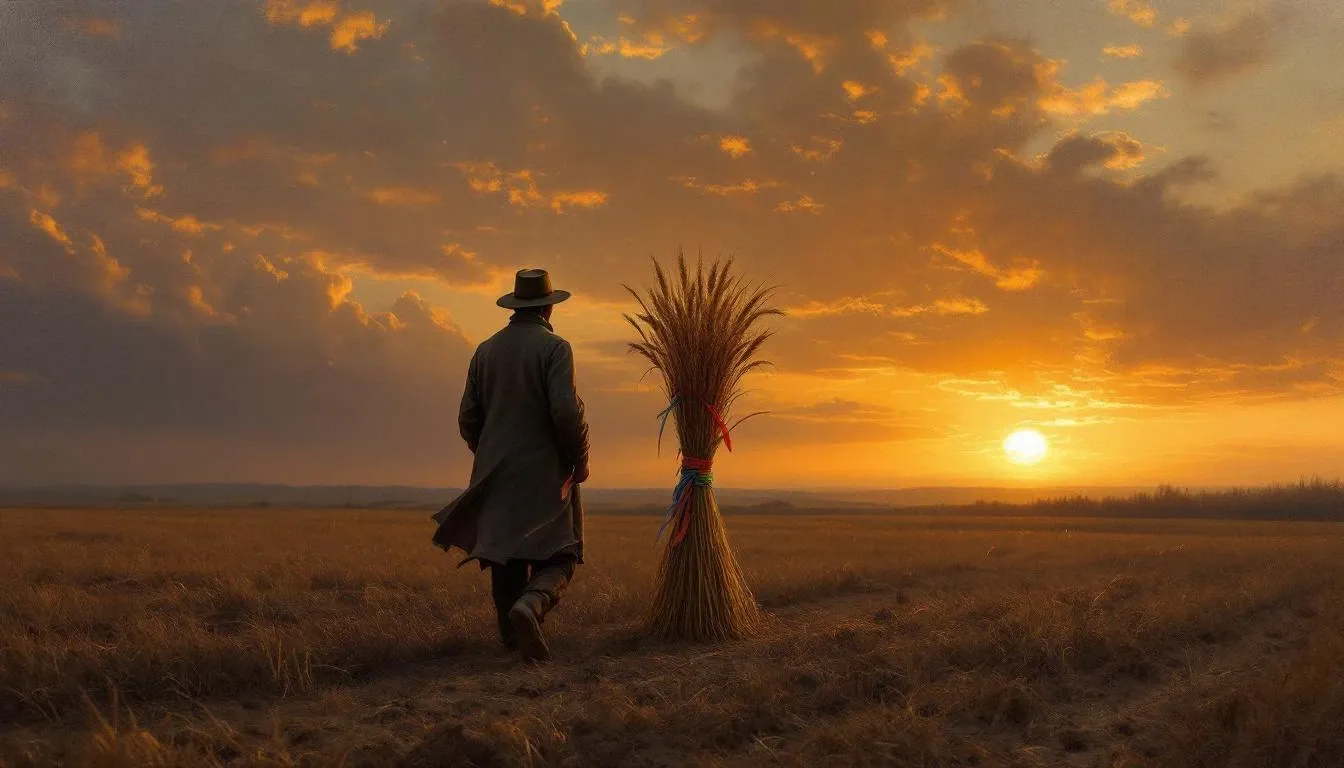
Across the East Slavic world, the final stalks standing in a harvested field were treated with extreme care. They were not simply cut and bundled like the rest. They were the Polevoy's portion — his payment for permitting the harvest, his shelter for the winter, his guarantee that spring would come and the cycle would continue.
In some regions, the last sheaf was left standing uncut in the center of the field, tied with a red ribbon. Food was placed beside it — bread, salt, eggs. This was explicitly described as an offering to the Polevoy: "This is for you, master of the field. Be satisfied. Leave us in peace until spring."
In other traditions, the last sheaf was cut ceremonially but not taken home immediately. It was shaped into a human figure — a rough doll of bound grain, sometimes dressed in a shirt or crowned with wildflowers. This figure was the Polevoy's representative, his body made visible in the material of his domain. It was carried home with songs and placed in a position of honor until the next planting, when it was returned to the field — either plowed directly into the soil or burned and scattered as ash.
The Domovoy required offerings to maintain his goodwill. The Leshy required respect from those who entered his forest. The Polevoy required the last sheaf — and the acknowledgment that the field was never truly the farmer's. The farmer worked the Polevoy's land. The grain grew at the Polevoy's pleasure. The harvest was the Polevoy's gift, and the last sheaf was the farmer's recognition of that debt.
The polevoy is the complete master of the field, and the field belongs to him rather than to the farmer who cultivates it. The peasant works the land at the spirit's sufferance. When this is forgotten — when the offering is not made, when the last sheaf is taken with the rest — the polevoy makes his displeasure known through blighted crops, dead livestock, and the strange disappearances of men who fell asleep in the wrong field at the wrong hour.
Polevik, Polevoy, Polevik: The Naming Question
The spirit of the field appears under several names across the East Slavic linguistic landscape, and the distinctions — where they exist — reveal regional variations in how the being was conceived.
Polevoy (полевой) is the most widespread East Russian term, functioning as an adjective-turned-noun: "the field one." Polevik (полевик) is an alternate formation using a different suffix, found more commonly in northern Russian dialects. In most contexts, these two names refer to the same entity. However, some folklorists — notably Zelenin — suggested that regional traditions occasionally distinguished between them, with the Polevik being a lesser, more mischievous spirit (closer to a field-imp) and the Polevoy being the full master-spirit of the territory.
In Ukrainian tradition, the equivalent is Polovyk or Polyovyk. In Belarusian folklore, the spirit appears as Paliavik. The South Slavic traditions have fewer direct analogues — the agricultural spirits of Serbian and Bulgarian folklore take different forms and carry different functions. But the East Slavic Polevoy has no shortage of regional variants, each adding local detail to the shared core: a spirit of the field, born from the earth, shaped like the grain, dangerous at noon, demanding respect at harvest.
The female equivalent — the Poludnitsa, Lady Midday — is sometimes described as the Polevoy's wife, but she has her own extensive mythology, her own independent character, and her own article on this site. Her noon terrors complement the Polevoy's dominion rather than duplicating it.
The Agricultural Calendar and the Spirit's Year
The Polevoy's activity mapped precisely onto the agricultural cycle. He was not a year-round threat but a seasonal one, and his calendar mirrored the farmer's calendar with unsettling precision.
Spring (sowing): The Polevoy wakes. The first plowing disturbs him. Farmers in some regions made offerings before the first furrow was cut — pouring grain or milk into the soil, asking the spirit's permission to work his land for another season. A failed sowing — seeds that did not germinate, seedlings destroyed by late frost — was attributed to the Polevoy's displeasure at insufficient offerings or improper conduct during plowing.
Summer (growth): The Polevoy is at maximum power. The field is his kingdom in full bloom. Noon danger is at its peak. Horses ridden at night. Workers who disrespect the field — urinating in the grain, cursing during labor, falling asleep at noon — face immediate consequences.
Autumn (harvest): The critical period. The last sheaf ritual. The Polevoy watches to ensure his portion is honored. A farmer who takes everything — who cuts the last stalk and carries it away without ceremony — has stolen from the spirit. The consequences arrive the following spring: poor germination, blight, withered crops, dead animals.
Winter: The Polevoy sleeps. The field is bare. Snow covers his domain. He is not entirely absent — some traditions say he can be glimpsed on moonlit nights, walking the frozen furrows like a thin grey shadow — but he is dormant, waiting, storing the memory of the previous year's treatment and deciding whether the next year's farmer deserves his cooperation.
Between Forest and Home
The Polevoy occupied a middle position in the Slavic spirit world that reflected the field's own middle position in the landscape. The field was not wild — it was cultivated, worked, shaped by human hands. But neither was it domestic — it was outside the fence, outside the yard, outside the protection of the Domovoy and the household saints. It was human-touched wilderness, domesticated nature — and its spirit reflected that ambiguity.
The Leshy was entirely wild. The Domovoy was entirely domestic. The Polevoy was both and neither — a spirit of the space where human effort met natural force, where the farmer's will struggled against soil, weather, and the unknowable mechanics of growth. The field was a collaboration between human labor and something else. The Polevoy was the face of that something else.
This is why the Polevoy's relationship with humans was neither purely hostile (like the Bolotnik) nor purely protective (like the Domovoy). It was conditional. Transactional. You could work his land. You could take his grain. But you did so on his terms, according to his calendar, within his rules. Break the contract — skip the offering, disrespect the noon, take the last sheaf — and the Polevoy terminated the arrangement.
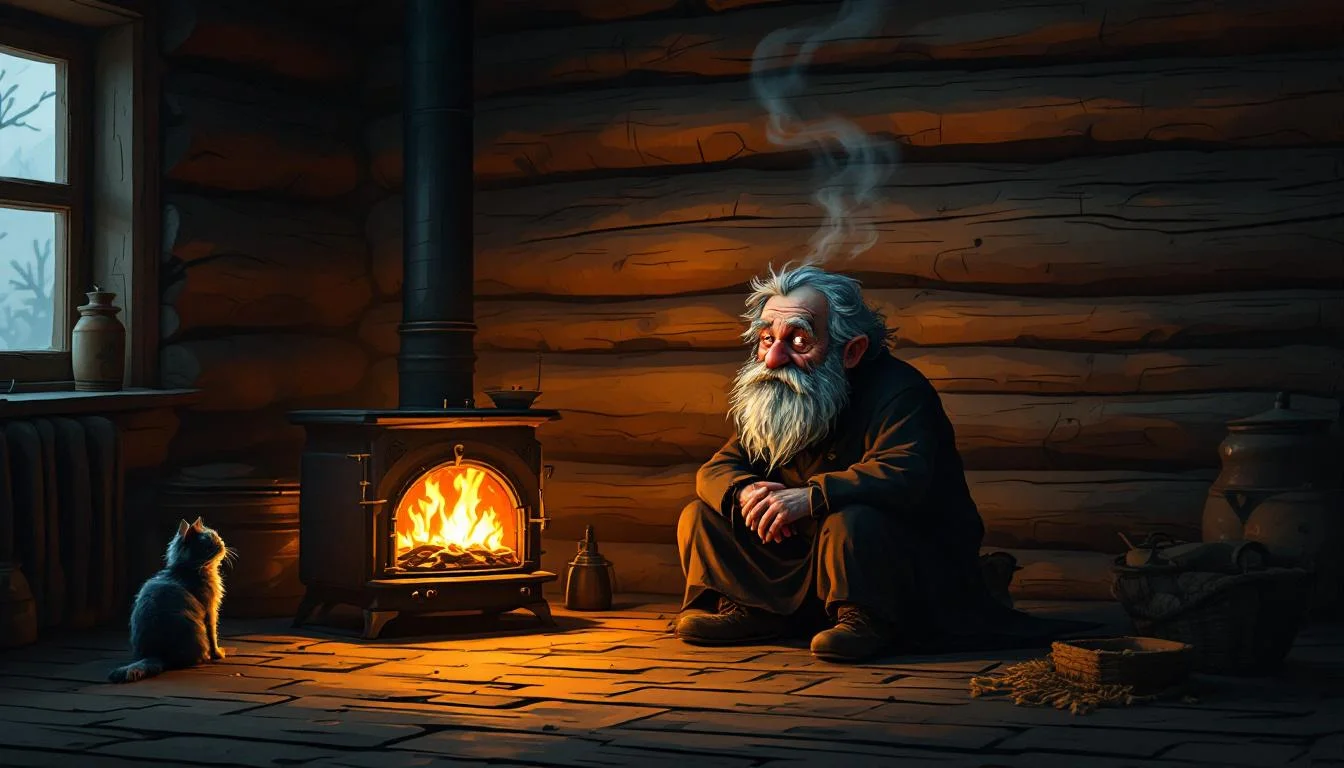
The field is quiet now. The combines have replaced the scythes, and the GPS-guided tractors do not stop at noon. No one leaves the last sheaf standing anymore. No one braids the horses' manes against spirit-riders in the night.
But the wheat still rustles when there is no wind. The heat still shimmers above the furrows at midday, making shapes that are almost — but not quite — the shape of a dark figure standing among the stalks. And if you lie down in the field at noon, in July, when the sun is white and the air is still, there is still a weight on your chest that has nothing to do with fatigue.
The Polevoy does not forget. The field does not forgive. And the debt of the last sheaf remains unpaid.