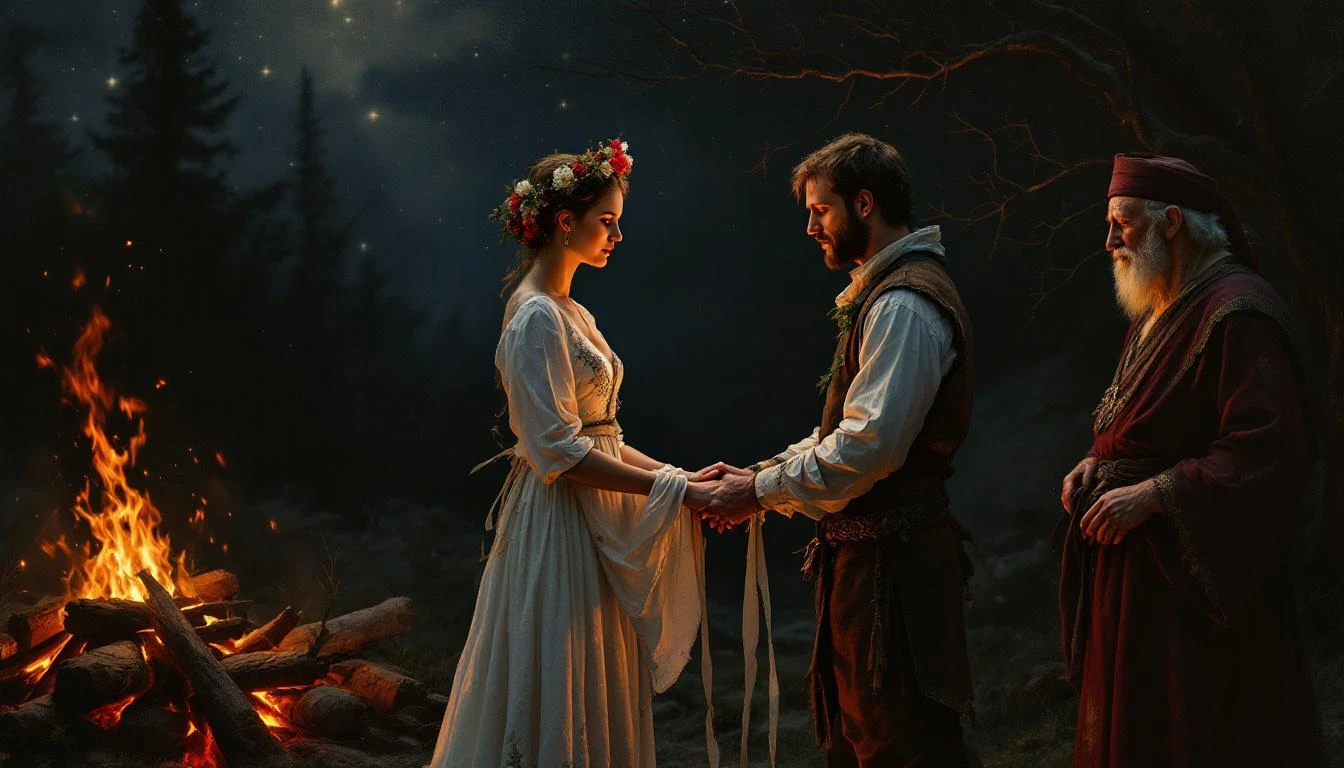
A child is born. The mother bleeds and screams and the midwife works with rags and water and whatever prayers she remembers. The father waits outside, or in another room, or in the field where he went because the screaming was too much. The child draws its first breath. The cord is cut. The room exhales.
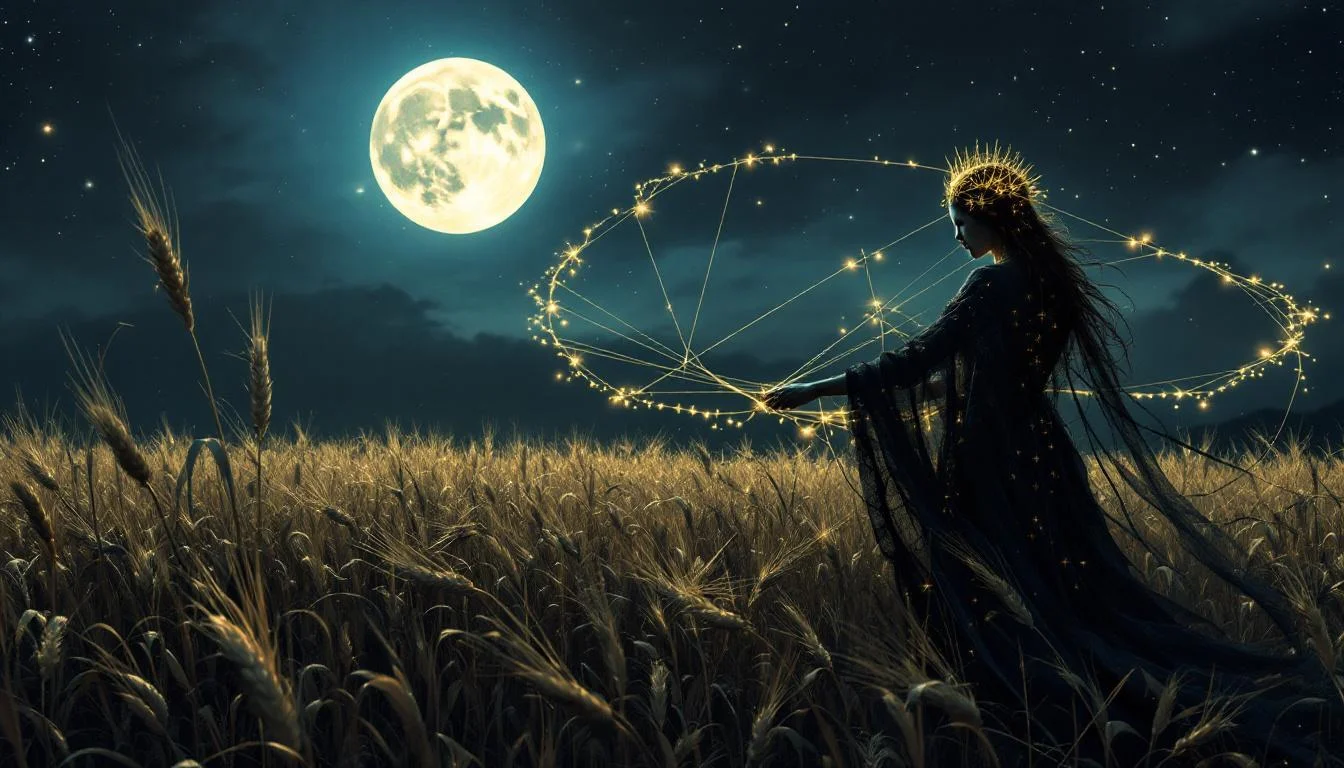
And then, according to the oldest stratum of Slavic belief, three women arrive who were not invited. They come to the cradle — or to the bed where the child lies against its mother's chest — and they bring with them a spindle, a measure, and a blade. One spins the thread. One decides its length. One cuts it.
What they decide cannot be changed. Not by the father's wealth, not by the mother's love, not by the prayers of priests or the offerings of princes. The Rozhanitsy have spoken, and their word is the architecture of a life.
They are among the oldest figures in all of Slavic religion — older than the named gods of the princely pantheon, older than the carved idols Vladimir erected on his hill in Kyiv, older perhaps than the Slavs themselves. Because the Rozhanitsy are not uniquely Slavic. They belong to a pattern that stretches across the entire Indo-European world, from the Greek Moirai to the Norse Norns to the Roman Parcae to the Baltic Laimas. Wherever the peoples of this linguistic family settled, they brought with them the conviction that three women determine the shape of every human life at the moment it begins.
The Slavs called these women the Rozhanitsy — from rozhat', to give birth. Their name contains their function. They are the ones who attend the birth. They are the birth itself, elevated to divine status — the moment when a new life enters the world and must be assigned its portion of joy, suffering, length, and manner of ending.
The Texts That Preserved Them
We know about the Rozhanitsy primarily because the medieval Church could not shut up about them.
Between the eleventh and fourteenth centuries, East Slavic churchmen produced a series of polemical texts — homilies, sermons, penitential guides — aimed at stamping out persistent pagan practices among their nominally Christian congregations. These texts were not works of scholarship. They were weapons. Their authors did not care to document Slavic religion accurately. They wanted to destroy it. But in the process of denouncing what the people were doing, they recorded it, and those records are now the primary source material for reconstructing pre-Christian Slavic belief.
The most important of these texts for the Rozhanitsy is the Word of a Certain Christ-Lover and Zealot of the True Faith, probably composed in the twelfth century. This sermon is furious. Its author has clearly been losing the battle against the old practices for years, and he is not taking it well.
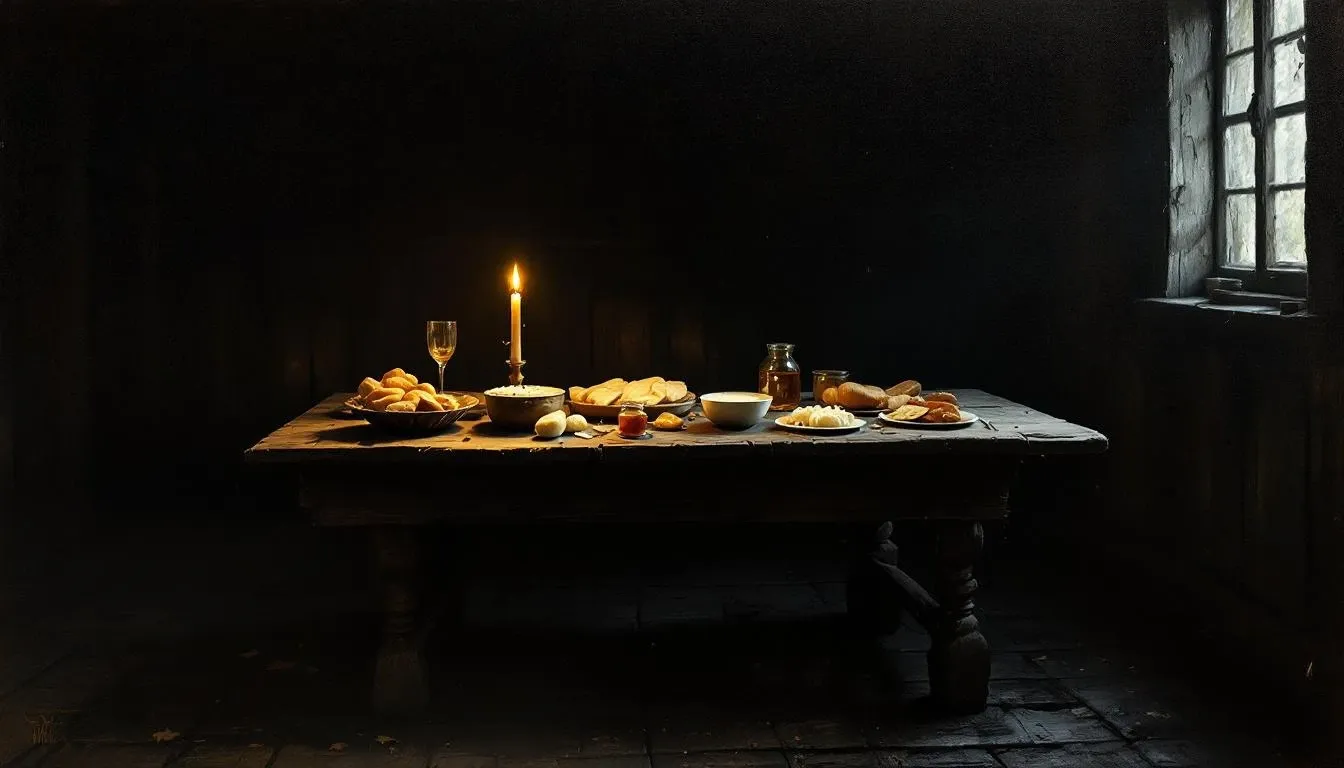
Even now, in the borderlands, they pray to the cursed god Perun, and to Khors, and to Mokosh, and to the Vila... and they set the table for Rod and the Rozhanitsy... they set out bread and cheese and mead, and whatever else they have, and call upon the Rozhanitsy with their food and drink. This they do secretly, and not openly.
Secretly, and not openly. That phrase tells us everything about the Rozhanitsy cult's persistence. By the twelfth century — more than a hundred and fifty years after Vladimir's official Christianization of Kyiv in 988 — people were still performing these rituals. They had simply moved them indoors. The public temples were gone, the hilltop idols smashed. But in the birthing room, in the back of the house, at the table set with bread and porridge and mead, the old faith continued in whispers.
A second key text, the Word of St. Gregory the Theologian about How Pagans Bowed to Idols, describes the evolution of Slavic worship in three stages: first the Slavs sacrificed to spirits, then to Rod and the Rozhanitsy, and finally to Perun. This chronological sequence — whether accurate or not — places Rod and the Rozhanitsy in the middle layer, between animism and the organized state religion of the princely era. They belong to the deep past, to the time before gods had war-names and silver moustaches.
Rod and the Rozhanitsy: The Pairing
In every medieval text that mentions the Rozhanitsy, Rod appears alongside them. The pairing is consistent across multiple texts, multiple centuries, and multiple redactions. It is never "Rod" alone or "the Rozhanitsy" alone. It is always both, joined at the conjunction like a married name.
This has generated centuries of scholarly debate. Who is Rod in relation to the Rozhanitsy? Is he the father figure to their maternal function? The ancestor deity whose bloodline the Rozhanitsy manage? The cosmic principle of generation that the Rozhanitsy particularize into individual fates?
Boris Rybakov, the Soviet archaeologist who shaped popular understanding of Rod more than any other scholar, argued that Rod was a supreme creator deity — the primordial god who preceded the entire Slavic pantheon. In this reading, the Rozhanitsy are his attendants, subordinate beings who carry out the cosmic function of assigning destinies under the authority of the great ancestor god.
The more conservative position, held by Leo Klejn and others, is simpler and perhaps more convincing. Rod means "kin." The feasts described in the homilies were ancestor-veneration rituals — meals set for the dead of the family line. The Rozhanitsy, in this reading, are the specific supernatural agents who appear at birth to connect the newborn to that ancestral chain. They do not serve Rod as a deity. They serve the concept of rod — the lineage, the bloodline, the unbroken thread of descent from the first ancestor to the child just born.
Either way, the pairing reveals a worldview in which birth and ancestry are inseparable. You are not born alone. You are born into a chain. The Rozhanitsy assign your fate, and they do so within the context of who your people are, where they come from, and what debts — spiritual, moral, karmic — they carry forward through the generations.
Three Women at the Cradle
The number three recurs with suspicious consistency across all the sources, both textual and ethnographic. Three Rozhanitsy. Three Moirai. Three Norns. Three Parcae. Three Laimas in Baltic tradition. Three ursitoare in Romanian belief.
This is not coincidence. It is structure. The number three maps onto a specific model of fate: one who begins, one who measures, one who ends. Past, present, future. Spinning, measuring, cutting. Birth, life, death. The triple fate is one of the most persistent religious ideas in the Indo-European world, and the Slavic Rozhanitsy are a local expression of it.
In Greek mythology, the Moirai are Clotho (the spinner), Lachesis (the allotter), and Atropos (the inflexible, the cutter). In Norse mythology, the Norns are Urd (the past, what has become), Verdandi (the present, what is becoming), and Skuld (the future, what shall be). The Slavic sources do not preserve individual names for the three Rozhanitsy — the churchmen who wrote about them were not interested in theological precision. But the ethnographic record from later centuries fills in some of the gaps.
In Russian folk tradition, the three fate-women were sometimes called by descriptive names: the one who spins, the one who decides, the one who cuts. In some regions they were conflated with other supernatural beings — the sudenitsy (judges), or the dolya (lot, portion), a personified figure of good or bad fortune that accompanied a person from birth. In Ukrainian tradition, the dolya was sometimes described as a separate being assigned to each person at birth — a kind of personal fate-spirit, a shadow-self that walked beside you and determined whether your enterprises prospered or failed.
The Rozhanitsy Table
The most concrete evidence of Rozhanitsy worship comes from the ritual meal — the trapeza or table set in their honor.
The medieval texts describe this practice with enough detail to reconstruct it. When a child was born, a table was laid with specific foods: bread, porridge (kasha), cheese, and mead or beer. In some descriptions, honey is mentioned. The table was set near the mother and child, and the foods were left as offerings to the Rozhanitsy. The family did not eat from this table — it was for the invisible guests.
This practice survived the Christianization of the East Slavs by centuries. Ethnographers collecting folk customs in the nineteenth and early twentieth centuries found versions of the birth-table still being prepared in Russian, Ukrainian, and Belarusian villages. The foods had shifted — the mead was often replaced by vodka, the porridge types varied — but the structure was the same. Food was set out for beings who would come to determine the child's fate. The table had to be ready when they arrived. To neglect the preparation was to risk the Rozhanitsy's displeasure, and a displeased Rozhanitsy meant a cursed child.
The Church's response to this practice was sustained and furious. Penitential texts from the thirteenth and fourteenth centuries specifically ask confessors to inquire whether their parishioners have "set tables for Rod and the Rozhanitsy." The question appears alongside inquiries about fortune-telling, consulting sorcerers, and other condemned practices. It is listed as a sin, sometimes a serious one. And yet the penitentials kept asking the question generation after generation, which means generation after generation the answer was yes.
The persistence of the practice points to something the Church understood but could not address: the Rozhanitsy cult was not a matter of theology. It was a matter of terror. A woman in childbirth — surrounded by blood, pain, and the very real possibility of death for herself or her baby — was not thinking about which god was officially approved. She was thinking about survival. She was thinking about the beings who, according to every grandmother and midwife she had ever known, would come to her child's cradle and decide everything. She set the table because the alternative was unthinkable.

Mokosh and the Spindle
The Rozhanitsy do not spin fate in isolation. The imagery of spinning — the thread, the spindle, the distaff — connects them directly to Mokosh, the great goddess of the Slavic pantheon, the only female deity in Vladimir's official six.
Mokosh was, among other things, the goddess of spinning and weaving. Ethnographic records from the nineteenth-century Russian North describe Mokosha as a tall woman with a large head and long arms who spins flax at night and shears sheep while households sleep. Women were forbidden from spinning on Friday — Mokosh's day — lest they anger the goddess. The spindle was Mokosh's instrument, and the thread it produced was not merely wool or flax. It was fate itself, the thread of life that connected the mortal world to the cosmic order.
The overlap with the Rozhanitsy is too thorough to be accidental. Mokosh governs the spindle. The Rozhanitsy use the spindle to determine fate. The most likely reading is that the Rozhanitsy are subordinate figures within Mokosh's domain — agents of the spinning goddess who carry out the specific task of fate-assignment at birth, while Mokosh herself governs the broader principle of fate, weaving, and the cyclical processes of life and death.
Some scholars have gone further, suggesting that Mokosh herself was originally the chief Rozhanitsa — the head spinner among the three — and that the Rozhanitsy were simply Mokosh in her multiplied, tripartite form. This is speculative, but it accounts for the persistent association between the two and for the fact that the Rozhanitsy, unlike Mokosh, never appear as a single figure. They are always plural, always three, as if they are an emanation of a single principle rather than independent deities.
The Church's War
The Christian campaign against the Rozhanitsy is one of the most sustained religious persecutions in medieval Slavic history — remarkable not for its violence but for its futility.
The strategy was straightforward. Church authorities substituted the Rozhanitsy with the Virgin Mary. The birth of Christ became the authorized replacement for the birth-rituals that had previously invoked Rod and the Rozhanitsy. The feast of the Nativity of the Theotokos (September 8 in the Orthodox calendar) was promoted as the proper occasion for the kinds of communal meals that had previously been dedicated to the Rozhanitsy. The logic was elegant: if people insist on celebrating birth as a sacred event, redirect their celebration toward the birth that matters — the birth of the Mother of God.
It did not work. Or rather, it worked on the surface and failed underneath. People attended the church feast on September 8, and then they went home and set the table for the Rozhanitsy when their own children were born. They did both. The Church got the public ritual. The Rozhanitsy got the private one. And since the Rozhanitsy's entire domain was the intimate, domestic space of the birthing room — a space the male clergy could not enter and could barely police — their cult continued in the one place the Church's authority was weakest.
This pattern — official Christianity on the surface, pre-Christian practice in the home — defines the religious history of the Slavic world for centuries after the formal conversion. The Rozhanitsy are one of its clearest examples. They survived because they lived where the priests did not go: in the women's quarters, in the darkened room where a new life arrived and the old powers were called upon to protect it.
The Indo-European Thread
The Rozhanitsy are not an isolated Slavic invention. They are the Slavic branch of a family tree that spans the Indo-European world.
The Greek Moirai appear in Homer and Hesiod, spinning the thread of each mortal's life. The Norse Norns sit at the base of Yggdrasil, the world tree, carving runes into its trunk that determine the fate of gods and men. The Roman Parcae, adopted from the Greek model, appear in Virgil and Ovid. The Baltic Laimas — known from Lithuanian and Latvian tradition — visit newborns and assign their fates in a manner almost identical to the Rozhanitsy. The Romanian ursitoare arrive on the third night after birth, just as the South Slavic Sudice do.
The consistency of this pattern — three women, a birth, a thread, a fate — argues strongly for a common Proto-Indo-European origin. Somewhere in the deep past, before the Slavs and the Greeks and the Norse had separated into distinct peoples, there was a belief that three supernatural women determined the course of every human life. This belief traveled with the migrating peoples, adapting to local conditions and local languages but retaining its essential structure: three, birth, thread, fate, unchangeable.
The Rozhanitsy are the Slavic expression of this ancient idea. They are not a borrowing from the Greeks or an imitation of the Norse. They come from the same source, carried in the same cultural DNA, expressing the same fundamental conviction: that the most important moment in a human life is the first one, and that what happens in that moment is decided by powers no mortal can negotiate with.
What the Rozhanitsy Mean
The Rozhanitsy express a worldview that modern sensibilities find uncomfortable. The idea that your fate is decided at birth — that no amount of effort, virtue, or cleverness can alter what three women decided over your cradle — runs counter to every modern narrative about free will, self-determination, and the power of individual choice.
But the Slavs who believed in the Rozhanitsy were not naive. They were farmers and mothers and midwives who lived in a world where infant mortality was catastrophic, where a bad harvest meant starvation, where a healthy child could be dead from fever within a week. They did not believe in the Rozhanitsy because they lacked the concept of free will. They believed in the Rozhanitsy because their daily experience told them that some things cannot be explained by effort or merit. Some children thrive and some children die, and the difference is not always in the parents' hands.
The Rozhanitsy provided a framework for that helplessness. They did not eliminate the terror of childbirth. They gave it a shape. If three women decided your child's fate, then at least fate had agents — beings you could address, feed, propitiate. The alternative was worse: the possibility that suffering was random, that there was no pattern at all, that children died for no reason and luck was distributed by accident.
The table set for the Rozhanitsy was not superstition. It was the opposite of superstition. It was an attempt to impose meaning on the most meaningful and most terrifying moment in human experience — the arrival of a new life into a world that offered no guarantees.
The bread and porridge and mead laid out for invisible guests were not payments. They were acknowledgments. We know you are here. We know you hold the thread. We ask you — not demand, not command, but ask — to be kind.
That is the religion of the Rozhanitsy. It is very old, and it is very human, and in the quiet hours of a difficult birth, it has never entirely stopped being practiced.