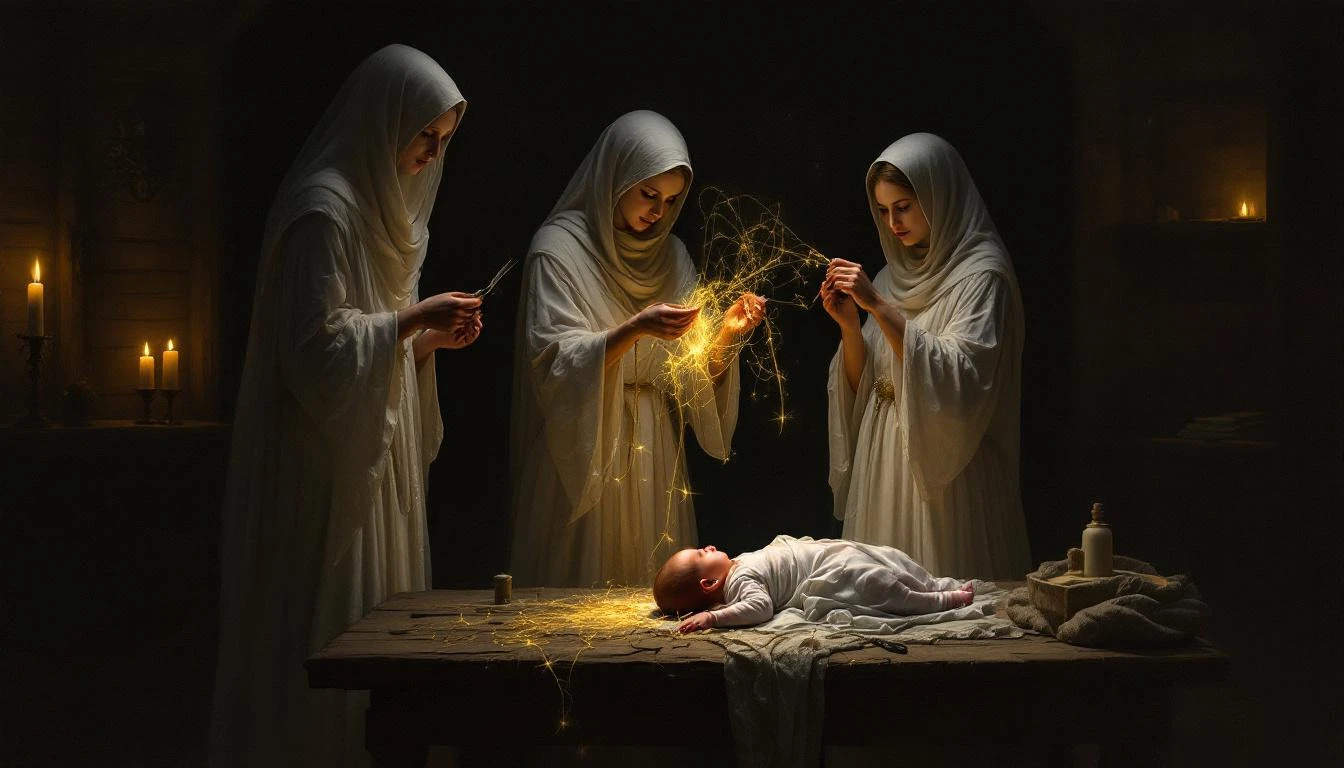
On the third night after a child is born, do not sleep. Light a candle. Set the table with bread, salt, wine, and honey. Leave three places empty at the table. Leave three chairs pulled out from the wood. Then sit in the far corner of the room and keep your mouth shut, because the Sudice are coming, and if you overhear what they say, you cannot unhear it.
This is the instruction that South Slavic grandmothers gave their daughters for centuries — in Serbia, Croatia, Bosnia, Slovenia, Bulgaria, North Macedonia. The details shifted from village to village. The candle was sometimes three candles. The bread was sometimes a special loaf baked only for this occasion. The wine was sometimes water. But the core was always the same: three supernatural women will visit the newborn on the third night of its life, and they will decide everything.
The word sudice comes from the verb suditi — to judge. These are not goddesses of fate in the passive, thread-spinning sense. They are judges. They arrive at the cradle, examine the child, confer among themselves, and pronounce a verdict. The verdict covers the whole of a human life: how long it will last, what kind of fortune it will hold, what manner of death will end it. When the Sudice leave, the child's future is sealed.
No appeal. No revision. No mercy.
The Third Night
Why the third night? The number three saturates Slavic ritual like water through limestone. Three days between death and burial. Three crossings of the threshold in wedding ceremonies. Three times around the fire in seasonal rites. The number marks transitions — moments when a being passes from one state to another and is temporarily unprotected, suspended between what it was and what it will become.
A newborn on the third night of life is precisely this kind of transitional being. In South Slavic folk belief, the first days after birth were a liminal period — a gap in reality through which supernatural forces could reach the child. The infant was not yet fully in the world. It had arrived, yes, but it had not been claimed. It belonged to neither the living nor the dead, neither the human world nor the spirit world. It was uncategorized, undefined, awaiting its assignment.
The Sudice came to make that assignment. Their visit was the moment the child's life became real — the moment its trajectory was fixed in the cosmic record. Before the Sudice spoke, the child was pure potential. After they spoke, it was a person with a destiny.
This belief had practical consequences. Across the South Slavic world, the first three days after birth were treated as a period of extreme vulnerability and heightened ritual observance. Visitors were restricted. Certain actions were forbidden — no sweeping the floor (you might sweep away the child's luck), no lending household items (you might give away the child's fortune), no counting the child's fingers or toes aloud (you might draw malevolent attention). The mother and child were kept in the darkened room, shielded from the outside world, until the Sudice had come and gone.
What the Sudice Look Like
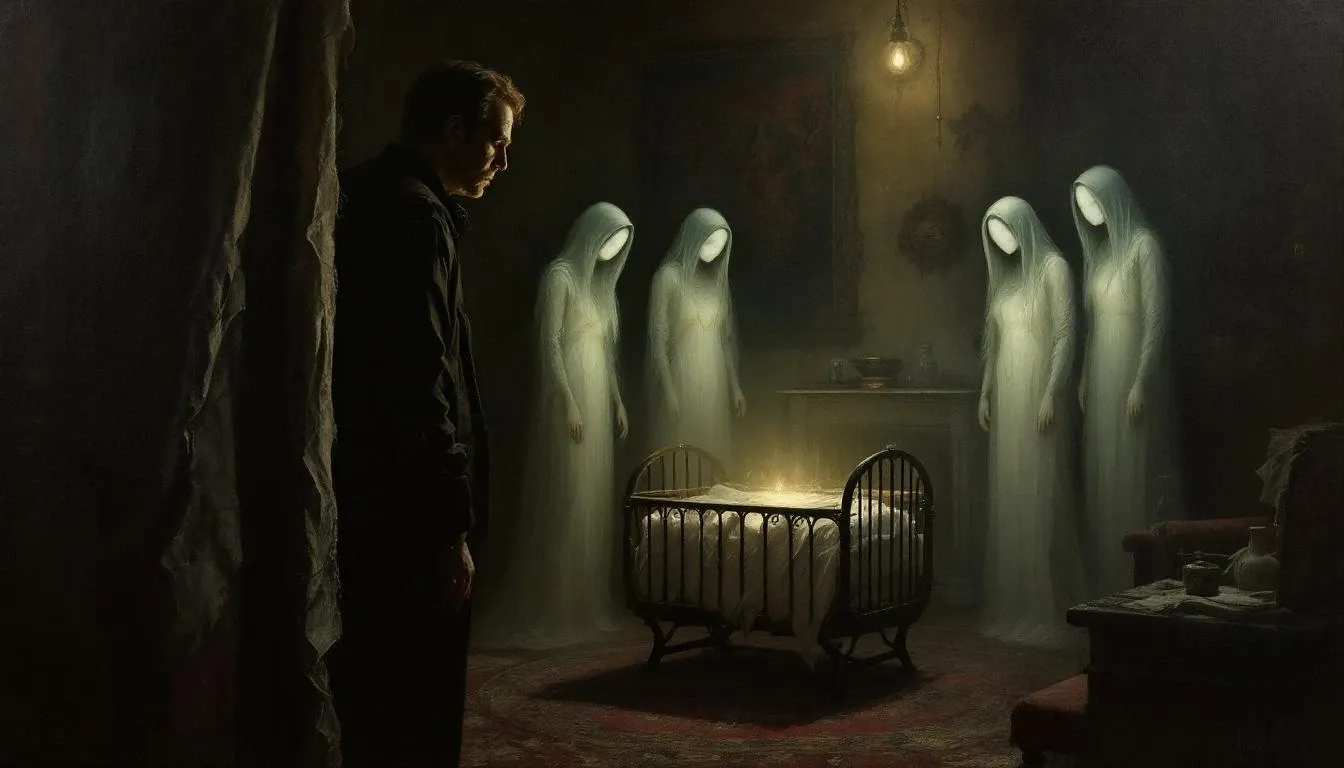
The folk tradition is not consistent on their appearance, which is itself revealing. Beings that exist primarily in whispered household tradition rather than in organized temple worship tend to resist standardization. Different villages, different families, different storytellers gave the Sudice different faces.
In some Serbian traditions, the Sudice appear as three old women dressed in white — pale, solemn, with an authority that has nothing to do with physical strength. They enter the room silently, sometimes through the door, sometimes simply appearing at the cradle as if they had always been there. In other traditions, they are young and beautiful, radiant figures whose beauty is somehow terrible rather than inviting. In Croatian coastal regions, they were sometimes described as dressed in black, like mourners, which gave their visit the character of a funeral as much as a christening.
The number three is near-universal, though some regional variants mention two or seven. Three remains the dominant number because of its structural logic: one Sudica speaks good fortune, one speaks misfortune, and one decides the balance. Or alternatively: one speaks the beginning of life, one speaks the middle, one speaks the end. The tripartite model creates a dialectic — thesis, antithesis, synthesis — that gives the Sudice's verdict its character of comprehensive judgment rather than simple blessing or curse.
In Slovenian tradition, they were called sojenice or rojenice (the latter name linking them directly to the East Slavic Rozhanitsy). In Bulgarian tradition, they were called narachnitsy or orisnitsy (from oris — fate, destiny). In each case, the core identity was the same: supernatural women who come to the newborn and decide.
The Serbian ethnographer Vuk Stefanovic Karadzic, whose nineteenth-century collections remain foundational for South Slavic folklore, recorded the belief with characteristic precision:
Sudjenice are, in the belief of our people, three women who come to every child on the third night after birth, and determine what will happen to it throughout its whole life, and when and how it will die. What the sudjenice determine cannot be altered by any force.
The Overheard Prophecy
The most widespread and most psychologically devastating motif in Sudice folklore is the overheard prophecy — the story of a parent or relative who hides in the room on the third night, listens to what the Sudice say, and then spends the rest of their life trying to prevent the fate they heard pronounced.
These stories follow a pattern as rigid as the fate they describe. A parent — usually the father — hides in the room on the third night. He hears the Sudice speak. The first speaks well: the child will be healthy, or clever, or beautiful. The second speaks well: the child will prosper, or marry well, or gain wealth. The third speaks the catch: the child will die on its wedding night. Or drown in a river on its twentieth birthday. Or be killed by a specific animal at a specific time.
The father, horrified, devotes his life to preventing the prophecy. He builds walls around the river. He forbids the child from marrying. He kills every animal of the specified type within a hundred miles. And on the appointed day, in the appointed way, the prophecy fulfills itself anyway — through a crack in the wall, through a chance encounter, through the one animal he missed.
The message of these stories is absolute and unambiguous: you cannot outrun what was spoken over your cradle. The Sudice's verdict is not a prediction. It is not a probability. It is a fact that has not yet happened. The future is already written, and the only thing human effort can change is the path by which you arrive at the predetermined end.
This is not fatalism as modern people understand it — the resigned shrug, the passive acceptance of whatever comes. This is something harder. It is the conviction that fate is an active, intelligent, and implacable force that will use your own efforts against you. The father who tries to prevent the prophecy becomes its instrument. The wall he builds creates the vulnerability. The precaution he takes sets up the condition for the fulfillment. Fate does not merely happen to you. It happens through you.
The Candle
One of the most striking and specific motifs in Sudice folklore is the candle of life.
In Serbian and Croatian tradition, the Sudice sometimes bring a candle to the cradle. They light it when they arrive and blow it out when they leave. The length of time the candle burns — or the length of candle remaining when it is extinguished — represents the length of the child's life. Some versions hold that each Sudica brings her own candle, and the three candles represent three possible lifespans, with the one left burning being the one that prevails.
In other versions, the family itself sets out a candle, and the Sudice blow it out at the moment they finish speaking. The stump that remains is kept, sometimes hidden in a secret place, and the family watches it — not literally, but symbolically — as a gauge of the child's remaining time.
This motif appears with remarkable consistency across the Balkans and is not limited to the Slavic peoples. The Romanian ursitoare — fate women who visit on the third night, identical in function to the Sudice — also bring or respond to a candle. The motif appears in German folk tradition (the Märchen of the death-candle) and in broader European folklore wherever fate-women visit newborns. The candle serves as a material anchor for an abstract concept: the idea that each life has a finite, predetermined length, visible only to the beings who assigned it.

Sudice and the Greek Moirai
The parallels between the Sudice and the Greek Moirai are too extensive to be coincidental, and too divergent to be simple borrowing.
Both are groups of three supernatural women. Both determine fate at birth or near birth. Both use imagery of thread and spinning (the Moirai more explicitly, the Sudice more allusively — though the thread motif connects both to Mokosh, the Slavic goddess of spinning and fate). Both pronounce verdicts that cannot be overturned by any power — human, heroic, or divine. In Greek mythology, even Zeus cannot alter what the Moirai have decreed. In South Slavic tradition, no saint, no prayer, no act of God can change what the Sudice have spoken.
But the differences are significant. The Moirai in their classical Greek form are cosmic figures who sit at the spindle of Necessity (Ananke), spinning the fates of all beings from a position outside time. They are abstract, distant, philosophical. You do not set a table for the Moirai. You do not light candles for them. They are principles as much as persons.
The Sudice are intimate. They come to your house. They sit at your table. They eat your bread. They are domestic beings, not cosmic ones — even though their power is absolute. They operate at the scale of the family, not the universe. Each birth gets its own visit. Each child gets its own verdict. The Sudice are retail fate, not wholesale. And that intimacy is what makes them terrifying in a way the Moirai are not. The Moirai spin fate somewhere far away, at the edge of the cosmos. The Sudice do it in your kitchen, three nights after you gave birth, while you pretend to be asleep.
The most likely explanation for the similarities is common inheritance. The Moirai and the Sudice both descend from a Proto-Indo-European belief in three fate-women, a belief that predates the separation of the Greek and Slavic branches by millennia. Each tradition developed the inherited model according to its own cultural logic — the Greeks toward philosophical abstraction, the Slavs toward domestic ritual — but the skeleton remained the same.
The Verb That Contains the Belief
Suditi — to judge. The word runs through all South Slavic languages and carries a weight that the English word "judge" does not fully convey. In English, a judge is a person who evaluates evidence and renders a decision that can be appealed. In South Slavic, suditi carries overtones of finality and cosmic authority. Sud is not merely judgment. It is fate, destiny, the decree that stands. Sudbina — destiny — is literally "that which has been judged." Sudnji dan — Judgment Day — uses the same root.
The Sudice are not called the spinners or the weavers or the allotters. They are called the judges. Their function is juridical. They do not create fate mechanically, as thread on a spindle. They pronounce it, as a verdict from a bench. This gives the Sudice a different character from their East Slavic cousins, the Rozhanitsy, who are more closely associated with the imagery of spinning and birth. The Rozhanitsy spin. The Sudice judge. The Rozhanitsy create. The Sudice decree.
This distinction may reflect a real difference in the way the two branches of Slavic culture understood fate. East Slavic fate-women are tied to the imagery of textile production — the spindle, the thread, the act of weaving life from raw fiber. South Slavic fate-women are tied to the imagery of law — the verdict, the pronouncement, the irrevocable decree. Both arrive at the same conclusion (fate is fixed at birth), but they get there through different metaphors. One says fate is made. The other says fate is spoken.
Survival Through Conversion
Like the Rozhanitsy in the east, the Sudice survived Christianization by going underground — not literally, but domestically. The belief retreated from public discourse into the private space of the home, the birthing room, the whispered conversation between women.
The medieval South Slavic church, like its East Slavic counterpart, attempted to suppress the Sudice cult. Penitential texts and confessional guides from the Serbian and Bulgarian medieval periods ask about belief in fate-women and condemn the practice of setting tables for them. But the church faced the same structural problem in the south as in the east: the Sudice's domain was the space of childbirth, a space that was by definition female, private, and resistant to clerical oversight. A priest might thunder from the pulpit against belief in the Sudice. He could not follow the midwife into the birthing room.
In some regions, the Sudice were partially Christianized — reinterpreted as angels, or as the souls of dead saints who came to bless the newborn. This was a compromise: the structure of the belief (three visitors, third night, cradle-side pronouncement) stayed intact, but the identity of the visitors was updated to be theologically acceptable. Whether the women in the birthing room believed the visitors were really angels or still secretly thought of them as the Sudice is a question no historical source can answer. Probably both. Probably at the same time. Human belief is capacious enough to hold contradictions, especially in the dark, especially when a new life is at stake.
The Weight of What Cannot Be Changed
The Sudice — like Rod and the Rozhanitsy in the east, like the dark certainty of Morana's winter — belong to a class of beliefs that modern culture has largely abandoned: the conviction that some things are decided for you, before you, without your input, and cannot be altered by any act of will. This is not popular. It does not sell books or motivational seminars. It does not fit the narrative of self-creation that modernity prefers.
But it corresponds to an experience that has not gone away. Every parent knows the moment — the scan, the test, the diagnosis, the phone call — when something about their child's life is revealed to be already determined, already in motion, beyond the reach of love or money or effort. The gene was there before the child was born. The condition was present from the first cell division. The thread was already measured.
The Sudice are the mythological form of that experience. They give it a face — three faces — and a ritual — the table, the candle, the bread — and a story that contains the most difficult truth any parent must learn: that you cannot protect your child from everything, because some of the everything was decided before you knew there would be a child to protect.
On the third night, they come. What they say, they say. And the candle burns exactly as long as it was meant to burn.