In the great trading city of Novgorod, where the Volkhov River runs north toward Lake Ilmen and the air smells of tar and salt fish and money, there lived a man who owned nothing but a gusli and the skill to play it. His name was Sadko. He was poor. He was proud. And he was about to make the worst bargain in the history of Russian music.
The bylina of Sadko — one of the oldest and most celebrated epic poems of the Novgorod cycle — is not a hero tale in the usual sense. There are no dragons to slay, no bogatyrs to wrestle, no armies bearing down on the motherland. Sadko's story is about something the merchants of Novgorod understood far better than swords: commerce, risk, and the catastrophic difference between being lucky and being wise. He wagered his freedom against the wealth of the sea itself, and what he won nearly drowned the world.
The Musician at the Feast
In the opening passages of the bylina, Sadko is a guslyar — a player of the gusli, the ancient Slavic psaltery, a flat stringed instrument held across the lap and plucked or strummed with both hands. The gusli is one of the oldest instruments in Eastern Europe, mentioned in chronicles as early as the 11th century, carved from maple or spruce, strung with gut or bronze wire. It was the instrument of court poets, wandering bards, and the mythological heroes of the byliny themselves — Dobrynya Nikitich was famous for his gusli playing, and the instrument appears in tales stretching back to the earliest layers of Slavic oral tradition.
But a gusli player without a patron is just a man with a wooden box and hungry fingers. Sadko lives by being invited to feasts — the great banquets of Novgorod's merchant guild, where fortunes are boasted about over vats of mead and ale, where deals are struck between courses, and where a talented musician can earn enough kopecks to eat for a week. When the invitations come, Sadko plays. When they stop, he starves.
One day, the invitations stop. For three days running, no one calls for Sadko. No feast, no kopecks, no supper. He takes his gusli and walks to the shore of Lake Ilmen — not to perform, but because a man with nowhere else to go will always end up near water.
He sits on a white stone at the water's edge and begins to play. Not for money. Not for an audience. He plays because it is the only thing he knows how to do, and when a man has been stripped of everything else, the last thing left is the thing that defines him. The music rolls out across the flat grey surface of the lake, and the water listens.
The water does more than listen. It moves.
The surface of Lake Ilmen begins to churn. Waves build where there was no wind. The reeds flatten. The shore birds scatter. And from the depths, something rises — not a creature, not a shape, but a presence, a pressure, a sense that the lake has become aware of the man sitting on its edge.
Sadko plays for hours. When he stops, the lake goes still. He goes home with empty pockets. The next day, the same. The third day, the same — except this time, the water parts, and the Sea King speaks.
The Wager on the Golden Fish
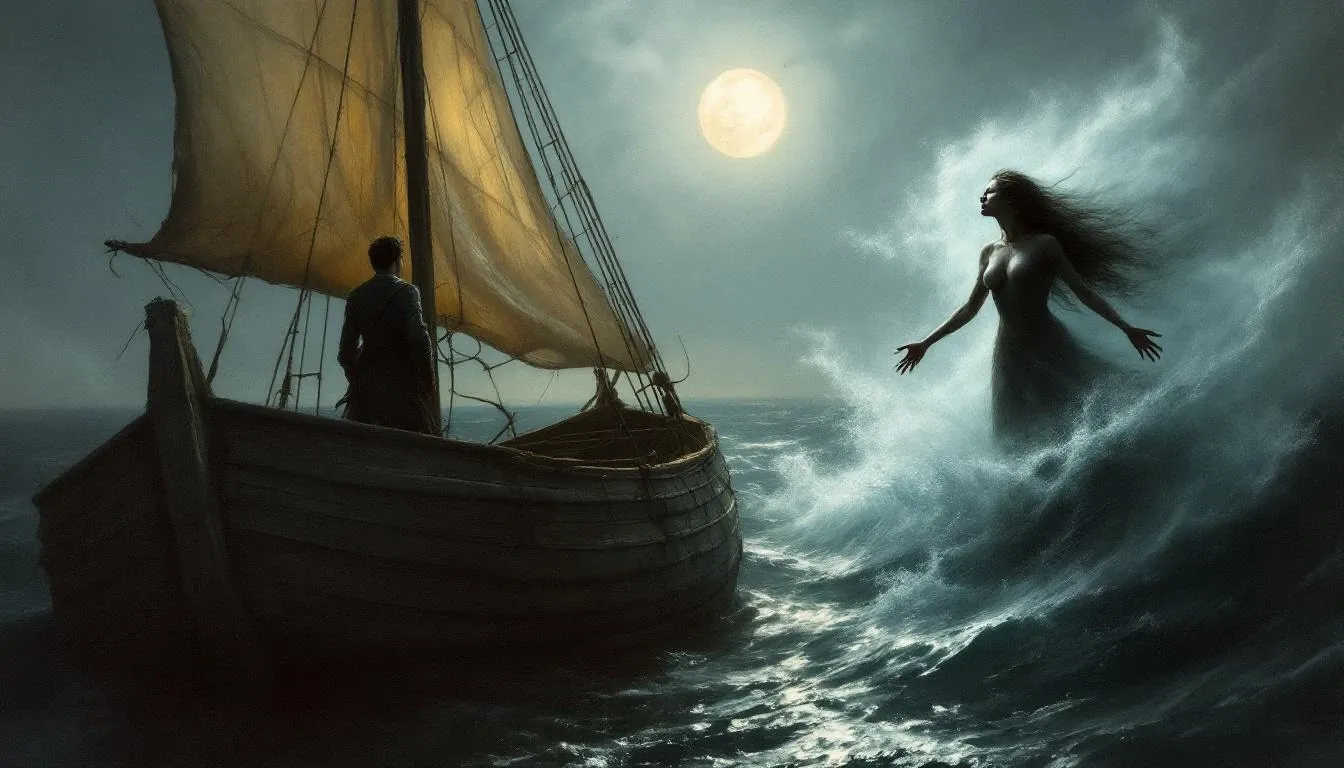
The Sea King — Morskoi Tsar, the Sovereign of All Waters — is not the Vodyanoy, the territorial pond spirit who drowns careless swimmers. He is something vaster and older: the ruler of the ocean floor, the monarch of every river and lake that feeds into the sea, a figure who sits at the boundary between the mortal world and the cosmological deep. In some versions of the bylina, he is depicted as an enormous man with a beard of foam and eyes the color of deep water. In others, he is simply a voice from beneath the surface — authoritative, amused, and dangerous.
The Sea King tells Sadko that his music has delighted the underwater court. As a reward, he offers a prophecy: go to the merchants of Novgorod and wager your head — literally, your life — that there are fish with golden scales living in Lake Ilmen. The merchants will bet their shops, their warehouses, their ships. And you will win.
This is not generosity. This is a transaction. The Sea King is investing in Sadko the way a venture capitalist invests in a startup, and the expected return will come due later, in a currency Sadko has not yet been told about.
Sadko does as instructed. He walks into the guildhall where Novgorod's wealthiest merchants are feasting, interrupts the evening, and announces his bet. The merchants, who know Sadko as a penniless musician with more talent than sense, laugh and take the wager. Three of the richest men put up their goods against Sadko's head.
They go to the lake. They cast the nets. They pull up three fish with scales of solid gold.
Sadko collects his winnings. Overnight, he transforms from a hungry musician into one of the wealthiest men in Novgorod. He buys ships. He builds warehouses. He hires crews and sends trading expeditions across the known world. He becomes exactly the kind of man who used to hire him to play at feasts — and the bylina makes sure you notice the irony.
The Contest With Novgorod
Wealth changes Sadko the way it changes everyone: it makes him want more. Specifically, it makes him want to prove that he is not merely rich but the richest — that his fortune, granted by the sea itself, exceeds the accumulated capital of an entire city.
He issues a challenge to the merchants of Novgorod: he will buy every piece of merchandise in the city. Every bolt of cloth, every barrel of salt, every skin of fur, every ingot of iron. If he succeeds, the city acknowledges him as the greatest merchant who ever lived. If he fails, he pays a massive forfeit.
For three days, Sadko sends his agents through the markets with open purses. They buy everything. The stalls empty. The warehouses are stripped. But Novgorod is a trading city at the crossroads of Europe and Asia, and every morning, new ships arrive with new cargo. The goods replenish faster than one man can buy them. On the third day, Sadko concedes defeat. He cannot outspend a city.
This episode, which some scholars believe was added to the bylina later as a separate tale woven into the Sadko cycle, serves a specific narrative purpose. It teaches Sadko — and the audience — that individual wealth, no matter how supernaturally acquired, cannot overcome collective enterprise. Novgorod is greater than any one merchant. The city is the organism; Sadko is just a cell. He can be rich within it, but he cannot replace it.
The lesson should have stuck. It did not.
The Voyage and the Storm
Sadko loads thirty ships with Novgorod's finest goods and sets sail across the sea. The fleet is magnificent — red sails, gilded prows, holds packed with furs and honey and amber. For days, the wind is fair. Then it stops.
The ships stand motionless on a flat, glassy sea. No breath of wind. No current. The sails hang limp. Days pass. The water is so still it looks solid, like a floor of dark metal stretching to every horizon. The crew begins to panic.
Sadko understands what is happening. The Sea King has come to collect his debt.
He orders his men to throw barrels of gold into the water — tribute, payment, a bribe. The gold sinks without a ripple. The sea remains still. They throw silver. Nothing. Precious stones. Nothing. The sea does not want Sadko's merchandise. The sea wants Sadko.
The crew draws lots to determine who must go overboard. In the bylina's most pointed moment, Sadko rigs the lottery — he uses a wooden lot while everyone else uses stone, ensuring his will float. But the sea is not fooled by tricks learned in the marketplace. Three times the lots are cast. Three times, by honest draw or supernatural intervention, the lot falls to Sadko.
He takes his gusli. He asks for a plank of oak to be cast onto the water. He steps onto it, and the ships immediately catch wind and sail away, leaving him alone on the surface of the endless sea.
The plank sinks.
The Court Beneath the Waves
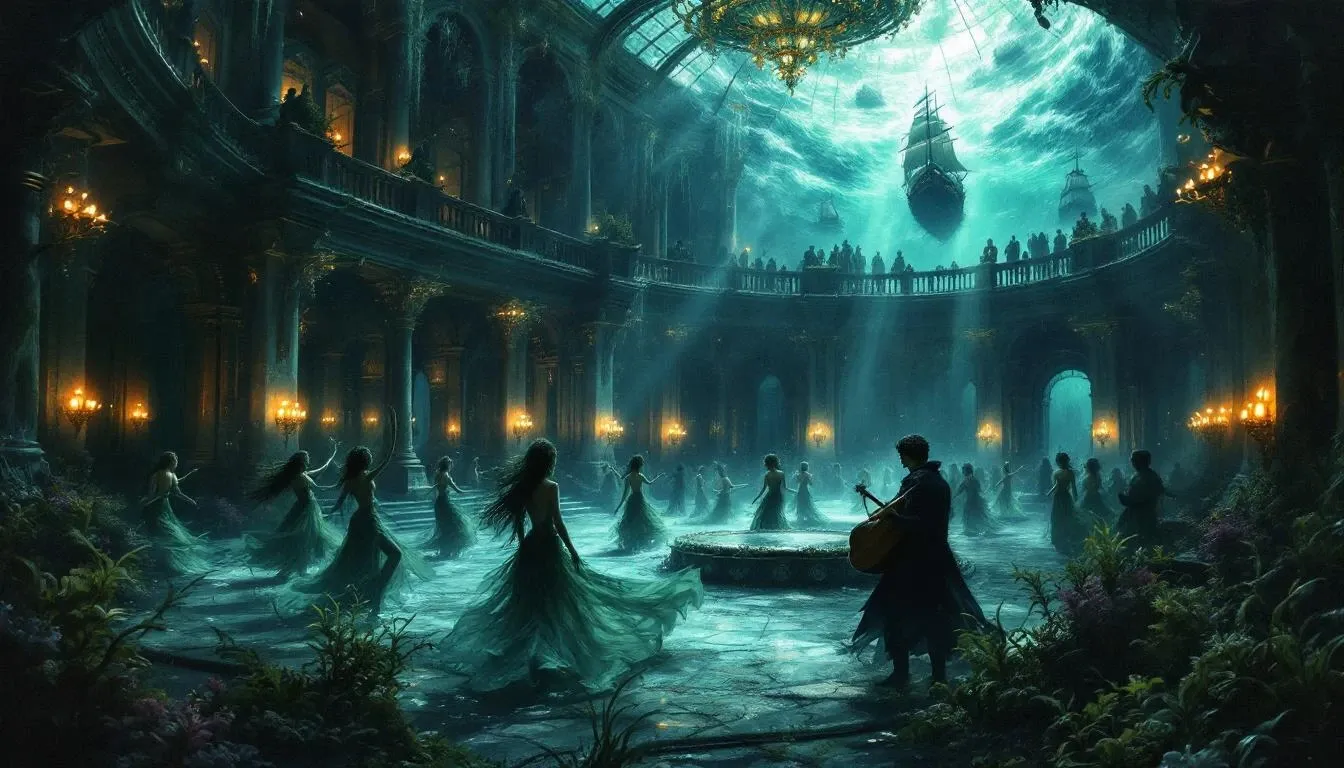
Sadko descends to the bottom of the sea and finds himself in a palace built of coral and pearl and the bones of ships. The Sea King sits on a throne of green stone, surrounded by his court — sea maidens, fish-warriors, creatures of the deep arranged in ranks like the court of an earthly tsar. Everything gleams with a cold, submarine light. Everything moves slowly, as if the water itself has thickened into something between liquid and glass.
The Sea King is delighted. He did not summon Sadko to punish him. He summoned him to play.
And Sadko plays. He plays the gusli as he has never played before — not for kopecks, not for merchants, not for survival, but for an audience that has waited years to hear him again. The music that rolled across Lake Ilmen and stirred the waters now fills the palace of the deep, and the Sea King begins to dance.
This is where the story turns from fairy tale to catastrophe.
When the Sea King dances, the sea itself dances with him. Above, on the surface, storms erupt from nowhere. Waves the height of buildings crash across shipping lanes. Ships capsize. Harbors flood. Fishermen drown. The entire ocean convulses in rhythm with Sadko's music, and every note he plays is a death sentence for someone on the surface world he can no longer see.
Sadko does not know this. He knows only that the king is pleased, that the court is applauding, that his music has found the audience it deserves — an immortal one, a powerful one, one that will never stop inviting him to the feast. He plays for a day. He plays for a night. He plays until his fingers bleed and the strings of the gusli hum with a resonance that makes the palace walls vibrate.
"And Sadko played upon his gusli, and the Sea King began to dance. And so he danced that the blue sea was stirred, and ships upon the sea were broken, and many folk upon those ships were drowned."
Above, on the surface, a saint intervenes. In most versions of the bylina, it is Mikola Mozhaisky — Saint Nicholas of Mozhaisk, the patron saint of sailors, the protector of travelers on water. Nicholas appears to Sadko in the form of an old man who touches his shoulder and whispers: stop playing. Break the strings. If you do not, the Sea King will dance the world to death.
Sadko snaps the strings of his gusli. The music stops. The Sea King, furious and breathless, slumps back onto his throne.
The Bride Beneath the Sea
The Sea King, his tantrum interrupted, shifts tactics. He cannot force Sadko to play, so he offers a different bargain: stay here, in the kingdom beneath the waves. Marry one of my daughters. Become a prince of the deep. You will never want for anything. You will never be poor again. You will never sit on a shore playing for an audience that does not come.
It is, on the surface, a generous offer. A palace. A princess. Immortality of a kind — the underwater world does not age the way the surface does. And Sadko, who spent years scraping for kopecks and has only recently tasted wealth, is tempted. The deep is beautiful. The court is magnificent. The Sea King's daughters are lovelier than anything he has seen in the markets of Novgorod.
Saint Nicholas appears again, this time with specific instructions: when the Sea King parades his daughters before you, do not choose a beauty. Do not choose a jewel-laden princess with coral in her hair and pearls on her throat. Choose the last one in the line — the plain one, the quiet one, the one named Chernava. She is your way home.
Sadko obeys. He chooses Chernava — the dark one, her name derived from chernyi, black — the girl the court overlooks, the daughter who carries none of her father's radiance. They are married that night in a ceremony of cold light and silence.
And then, following the saint's final instruction, Sadko does not consummate the marriage. He lies beside Chernava and does not touch her. He falls asleep on the ocean floor, in a palace of coral and bone, next to a wife he chose precisely because she was the one who did not belong.
He wakes on the bank of the Volkhov River, outside the walls of Novgorod, with his gusli beside him and the salt taste of the deep still on his lips.
Rimsky-Korsakov and the Opera
In 1898, Nikolai Rimsky-Korsakov premiered his opera Sadko at the Solodovnikov Theatre in Moscow, transforming the bylina into one of the most ambitious spectacles in Russian musical history. The opera had been years in the making — Rimsky-Korsakov had first composed a symphonic poem on the Sadko theme in 1867, thirty years before he expanded it into a full seven-scene opera — and it drew on the composer's lifelong obsession with the sea, with Russian folk melody, and with the boundary between the natural and the supernatural.
The opera keeps the skeleton of the bylina but adds flesh that the oral tradition left bare. Volkhova, the Sea King's daughter whom Sadko chooses (renamed from Chernava in this version), is not the plain last girl in line but a figure of heartbreaking beauty who genuinely loves Sadko and whose sacrifice — dissolving into morning mist to become the Volkhov River itself — gives the opera its emotional center. The Sea King's underwater court becomes a ballet sequence of extraordinary visual ambition, with fish-maidens and sea creatures dancing in choreographed waves.
Rimsky-Korsakov understood something essential about the Sadko story: it is a tale about music's power to move forces that should not be moved. His orchestration for the underwater scenes uses shimmering whole-tone harmonies, cascading harp arpeggios, and a liquid fluidity in the string writing that sounds like water given voice. The Song of India, sung by a Hindu merchant in the opera's fourth scene, became one of the most performed concert pieces of the early 20th century — a melody so seductive it proved the bylina's own point about the danger of beautiful music.
The opera also crystallized Sadko's position in Russian cultural memory. Before Rimsky-Korsakov, Sadko was one bylina hero among many — less famous than Ilya Muromets, less dramatic than Dobrynya Nikitich. After the opera, he became the defining figure of Novgorod's mythological identity: the merchant-musician who bridged the human and supernatural worlds with nothing but strings and ambition.
Novgorod and the Merchant Epic
Sadko's bylina is inseparable from its city. Novgorod — Veliky Novgorod, Novgorod the Great — was not like other Russian cities of the medieval period. While Kiev and later Moscow were ruled by princes and grand dukes who derived their authority from lineage and military force, Novgorod was a republic. From the 12th to the 15th century, it governed itself through a veche — a popular assembly of free citizens who elected their leaders, set their laws, and maintained a degree of civic independence that was unique in the Slavic world.
The power in Novgorod belonged not to warriors but to merchants. The city's position at the northern end of the trade routes connecting the Baltic to Byzantium made it fabulously wealthy. Furs from the Arctic, honey and wax from the forests, amber from the coast, silver from the East — all of it flowed through Novgorod's markets. The Hanseatic League maintained a permanent trading post in the city. Foreign merchants from Gotland, Lübeck, and Constantinople walked its streets alongside Russian traders whose wealth rivaled that of minor princes.
The Sadko bylina is a product of this mercantile culture. Its hero is not a warrior but a businessman. His quests do not involve slaying monsters but making deals. His antagonist is not evil but transactional — the Sea King operates on the logic of debt and payment, investment and return. Even the moral of the story is commercial: do not confuse luck with skill, do not bet what you cannot afford to lose, and remember that the house — whether it is Novgorod's guildhall or the Sea King's palace — always wins in the end.
This is what makes Sadko unique among the bylina heroes. Ilya Muromets represents the strength of the Russian people. Dobrynya Nikitich represents the educated nobility. Sadko represents something the other heroes never touch: the restless, calculating, endlessly ambitious spirit of Russian commerce — and the recognition that even commerce, pushed far enough, leads you to the edge of the world and asks you to jump.
The Return and the Gusli's Silence
Sadko returns to Novgorod and finds his ships already in harbor, his crews safe, his cargo intact. The storm that his music caused has passed. The city is whole. His wife — his earthly wife, the one he left behind — is waiting.
He builds a church to Saint Nicholas on the bank of the Volkhov. He never sails again. And in the most telling detail of the entire bylina, he never plays the gusli again.
This is not a happy ending in the way that fairy tales offer happy endings. Sadko survives, but he is diminished. The thing that made him extraordinary — his music, his ability to move the waters and the hearts of kings — has been silenced, not by force but by understanding. He has seen what his gift can do when amplified by supernatural power. He has watched the sea dance and the ships break and the surface world convulse to the rhythm of his fingers on the strings. He knows now that some instruments are too dangerous to play.
The gusli sits in a corner of his house, unstrung, gathering dust. Novgorod's richest merchant was born from music and chose to die in silence. The sea, for its part, went quiet too — but anyone who has read enough Slavic folklore knows that the sea never forgets a debt, and silence from the deep is not the same thing as peace.