Somewhere in the forests of Eastern Europe, before the churches came, before the chronicles were written, before anyone thought to write any of it down — there was a mythology as vast and violent and strange as anything Greece or Scandinavia ever produced. Gods who hurled lightning from chariots pulled by goats. A witch who lived in a house that walked on chicken legs. Spirits in every river, every barn, every crossroads where the dust smelled wrong after dark. A cosmos divided into three worlds, held together by a single enormous oak tree whose roots drank from the river of the dead.
You have probably heard of Zeus. You know Thor. You might even know Odin, Loki, Aphrodite, Anubis. But ask most people to name a single Slavic god and you will get silence. This is not because Slavic mythology is minor or thin. It is because the Slavs never wrote it down. Their entire cosmology — gods, demons, creation myths, funeral rites, the architecture of the afterlife — was carried in spoken words, in songs sung at harvest, in stories told beside winter fires. When Christianity arrived, those fires were put out. The songs were forbidden. The wooden idols were chopped apart and thrown into rivers. And for a thousand years, the mythology of nearly three hundred million people became the most overlooked tradition in Europe.
This guide is your way in. No background required. No prior reading. Just the understanding that what follows is not a children's fairy tale — it is the spiritual framework of a civilization, and it has teeth.
Why Slavic Mythology Stayed Hidden
Every mythology suffers during religious conversion. The Norse had their sagas banned, the Celts had their druids killed, the Romans absorbed Greek gods and renamed them. But the Slavs faced a particular problem that none of those cultures shared: they had no writing system before Christianization. The Greeks had Homer. The Norse had the Eddas, written down by Snorri Sturluson in the thirteenth century from older oral sources. The Slavs had nothing comparable. Their mythology existed entirely as oral tradition — passed from grandmother to grandchild, from village elder to young farmer, embedded in rituals and customs whose original meaning was slowly forgotten even as the rituals continued.
When Prince Vladimir of Kyiv officially converted the East Slavs to Christianity in 988 AD, the old religion did not vanish overnight. Christianization of the rural countryside dragged on for centuries — some scholars argue it was never truly completed at the popular level, even by the start of the twentieth century. But what did happen was that the framework was destroyed. The idols on the hill outside Vladimir's palace were torn down. Priests replaced the volkhvy (pagan shamans). The old feast days were overlaid with Christian saints' days. Perun, the thunder god, became Saint Elijah. Veles, the lord of the dead and of cattle, became Saint Blaise. The mythology did not die — it went underground, woven into folk songs, embroidery patterns, wedding customs, and bedtime stories that no one recognized as theology anymore.
The reconstruction of Slavic mythology is therefore a detective's task. Scholars work from fragments: a paragraph in the Byzantine historian Procopius, a mention in the Primary Chronicle, comparative analysis with other Indo-European traditions, and above all, the massive body of Slavic folklore collected in the nineteenth and twentieth centuries. What emerges is incomplete — there are genuine gaps that may never be filled — but what we do have is extraordinarily rich, deeply strange, and far darker than most people expect.
The Three Worlds: How the Slavic Universe Was Built
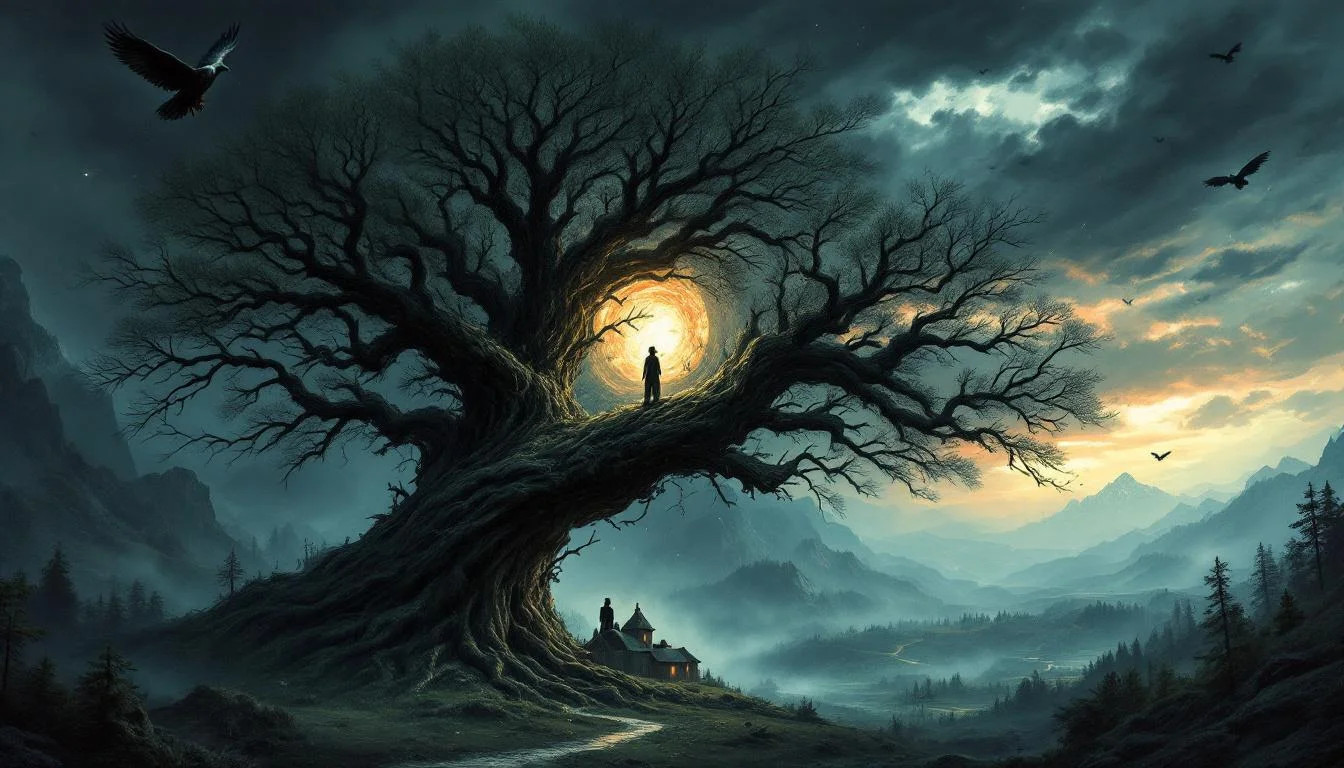
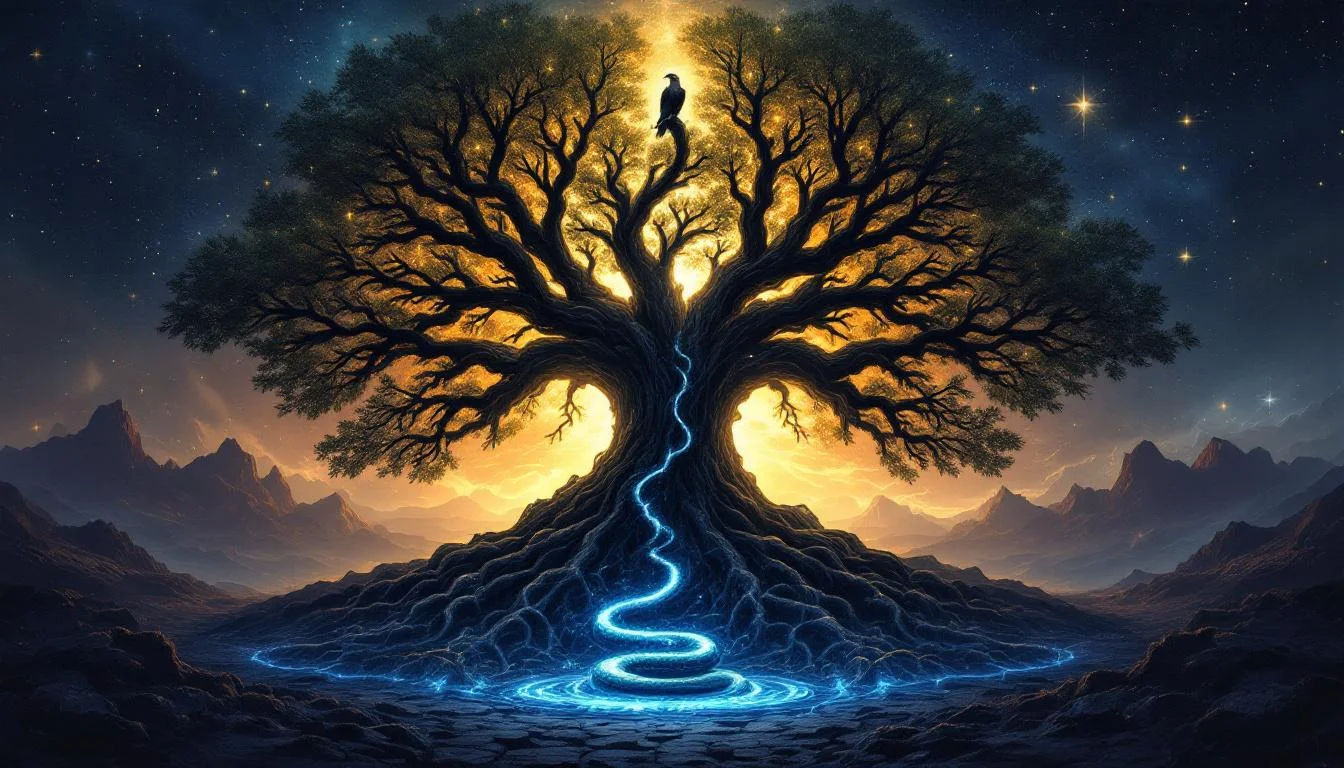
Slavic cosmology was not flat. It was vertical — three layers of reality stacked on top of one another, connected by a great World Tree that grew through all of them. The tree was usually described as an oak, though some traditions called it an ash or a birch. Its roots plunged into black water. Its trunk rose through the world of the living. Its crown reached into the sky where the gods enforced cosmic law. Everything in the universe had its place on this tree, and everything that happened — storms, harvests, births, deaths — was a transaction between its layers.
The three worlds were called Yav, Nav, and Prav. Yav was the visible world, the realm of the living, the trunk of the tree. It is related to the Slavic root for "manifest" or "evident" — that which you can see and touch. Fields, rivers, forests, villages. But Yav was not considered more real than the other two worlds. It was simply the battlefield where their forces collided.
Nav was the underworld, the realm of the dead, the roots of the tree. The word comes from Proto-Slavic navь, meaning "corpse." It was wet, dark, cold — but not evil. This is critical to understand. The Slavic underworld was not hell. There was no punishment there. Nav was simply where things went when they left the visible world: souls, seasons, warmth, the dying year. Veles ruled there, receiving the dead the way a shepherd receives his flock at evening. In parts of Belarus, mourners would pour water on the ground at funerals, saying they were "watering Veles's meadow." Between Yav and Nav lay the Smorodina River — a river of fire in some versions, black water in others — crossed only by the terrifying Kalinov Bridge.
Prav was the highest world, the crown of the tree, the realm of cosmic law. The word shares its root with the modern Russian pravda (truth) and pravilo (rule). Prav was not heaven. No one went there when they died. It was the principle of order itself — the structure that kept the universe from collapsing into chaos. Perun enforced its will from the treetop, but even he was subject to it. When the seasons turned correctly, that was Prav functioning. When an oath was kept, that was Prav manifesting. It was not a place. It was the reason anything made sense.
The Gods: Perun, Veles, Mokosh, and the Rest
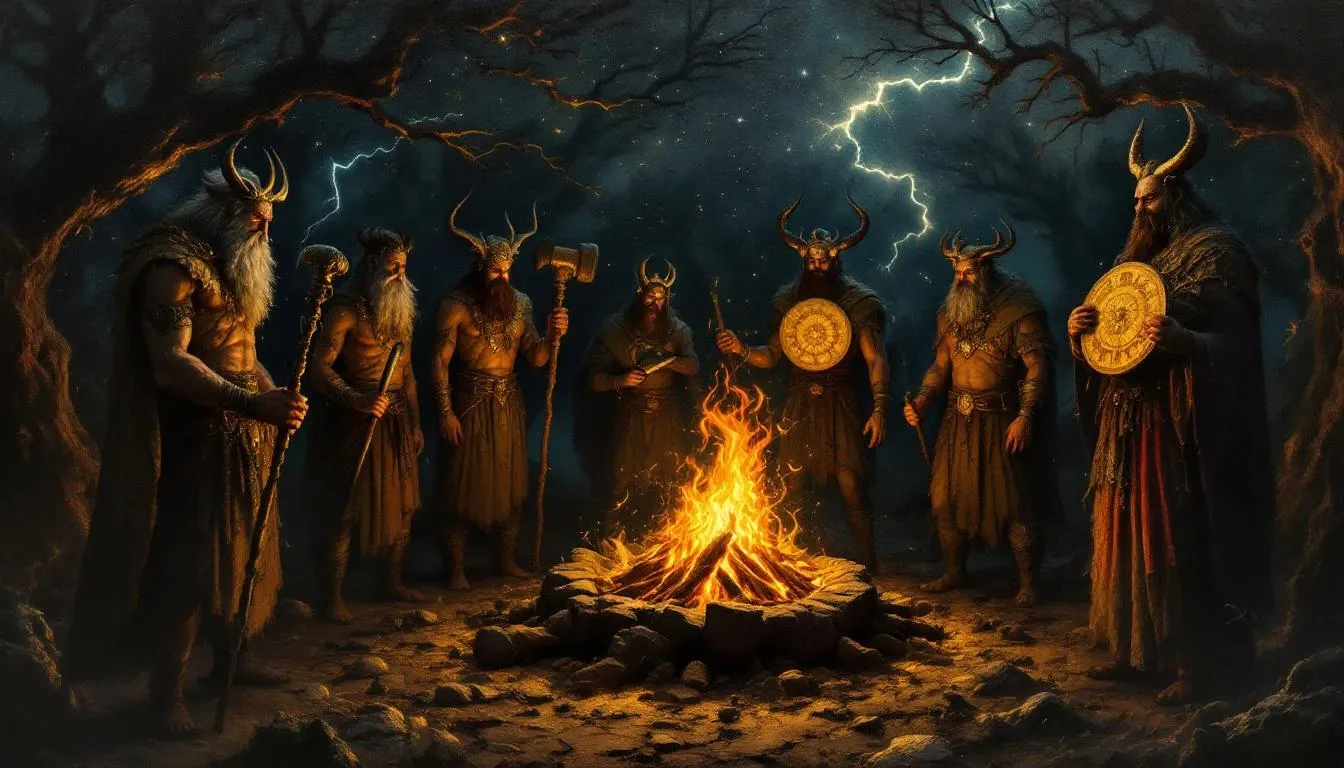
The Slavic pantheon was polytheistic, with gods governing thunder, earth, sun, wind, fertility, and death. Unlike the neatly organized Greek Olympians, the Slavic gods are harder to systematize — regional variations were enormous, and many deities were worshipped only by specific tribes or in specific areas. Still, certain figures recur across nearly all Slavic traditions, and three of them form the backbone of the entire system.
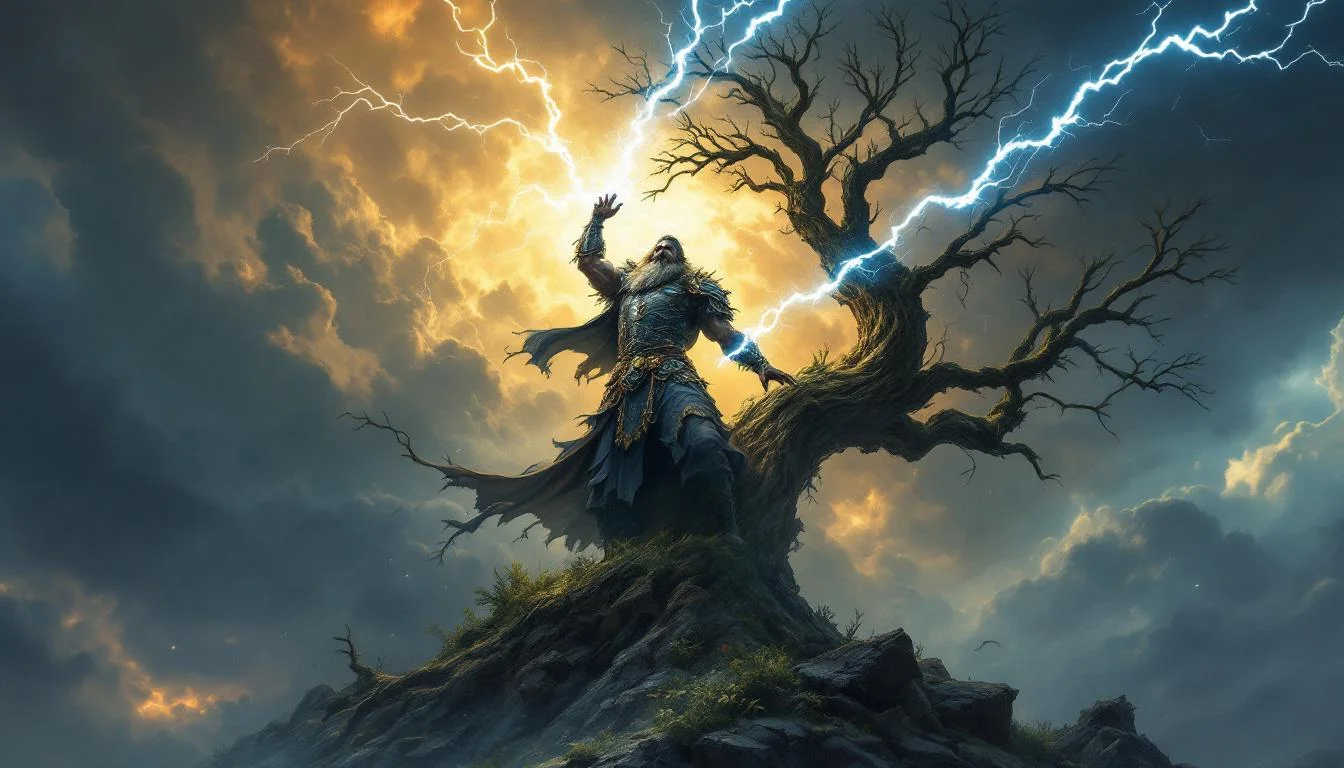
Perun stood at the top. He was the god of thunder, lightning, storms, war, and the enforcement of oaths. He carried an axe or hammer made of stone and fire, rode a chariot pulled by a goat, and had a copper beard with a golden mustache. His sacred tree was the oak, his sacred day was Thursday, and the places where lightning struck were considered holy ground. Small axe-shaped amulets found across Eastern Europe from the tenth to twelfth centuries are believed to be protective charms invoking his power — the Slavic equivalent of wearing a miniature Thor's hammer.
Veles was Perun's opposite and eternal adversary. God of the underworld, cattle, wealth, water, and magic, Veles ruled everything below — the roots of the World Tree, the waters, the wet earth, the dead. He was depicted as a shaggy, bearded figure, sometimes taking the form of a great serpent or dragon. The central myth of the entire tradition — the one that scholars like Ivanov and Toporov consider the foundational narrative — is the eternal battle between Perun and Veles. Veles steals from the sky (Perun's cattle, his wife, or the waters of heaven) and hides beneath the earth. Perun pursues him with thunderbolts. The chase rips the sky open. Rain falls. The world is renewed. Then Veles rises again, because Veles always rises again. This is not good versus evil — it is the mechanism by which seasons change, by which drought breaks, by which the cosmos maintains its balance.
Mokosh was the only goddess in Vladimir's Kyiv pantheon. She was the great mother — goddess of earth, fertility, weaving, and the fate of women. Her name may derive from the Proto-Slavic word for "wet" or "moist," connecting her to the life-giving dampness of fertile soil. She was the protector of sheep-shearing and spinning, and in folk tradition she was believed to visit homes at night, spinning thread that determined the fate of the household. After Christianization, her worship transferred almost entirely to the Virgin Mary and to Saint Paraskeva — the Friday saint — and her feast days continued under new names for centuries.
Beyond these three, the pantheon included Svarog, the celestial smith and father of Dazhbog, the sun god; Stribog, god of wind; Morana, goddess of winter and death; Yarilo, the wild spring fertility god; and Rod, the primordial creative force that some scholars consider the supreme being above all other gods.
They believe that one god, the maker of lightning and lord of all, is the only god, and they sacrifice to him cattle and all kinds of victims. They know nothing of fate, nor do they admit that it has any part in human affairs.
The Spirits: A World That Was Never Empty
If the gods were the rulers of the Slavic cosmos, the spirits were its population. Every element of the natural and domestic world had its own guardian being — not abstract, not symbolic, but specific, local, and demanding. You could go your entire life without seeing Perun. You could not go a single day without crossing paths with a spirit.
Domovoy was the house spirit, imagined as a small, hairy old man who lived behind the stove or in the cellar. He protected the family, watched over the cattle, and predicted the future through sounds and touches. If treated well — with offerings of bread or porridge left by the hearth — he kept the household healthy. If neglected or insulted, he turned vicious: tangling hair, breaking dishes, suffocating sleepers in the night. When a family moved to a new house, they carried embers from the old stove to invite the domovoy along. Leaving him behind was considered an act of betrayal that brought ruin on the new home.
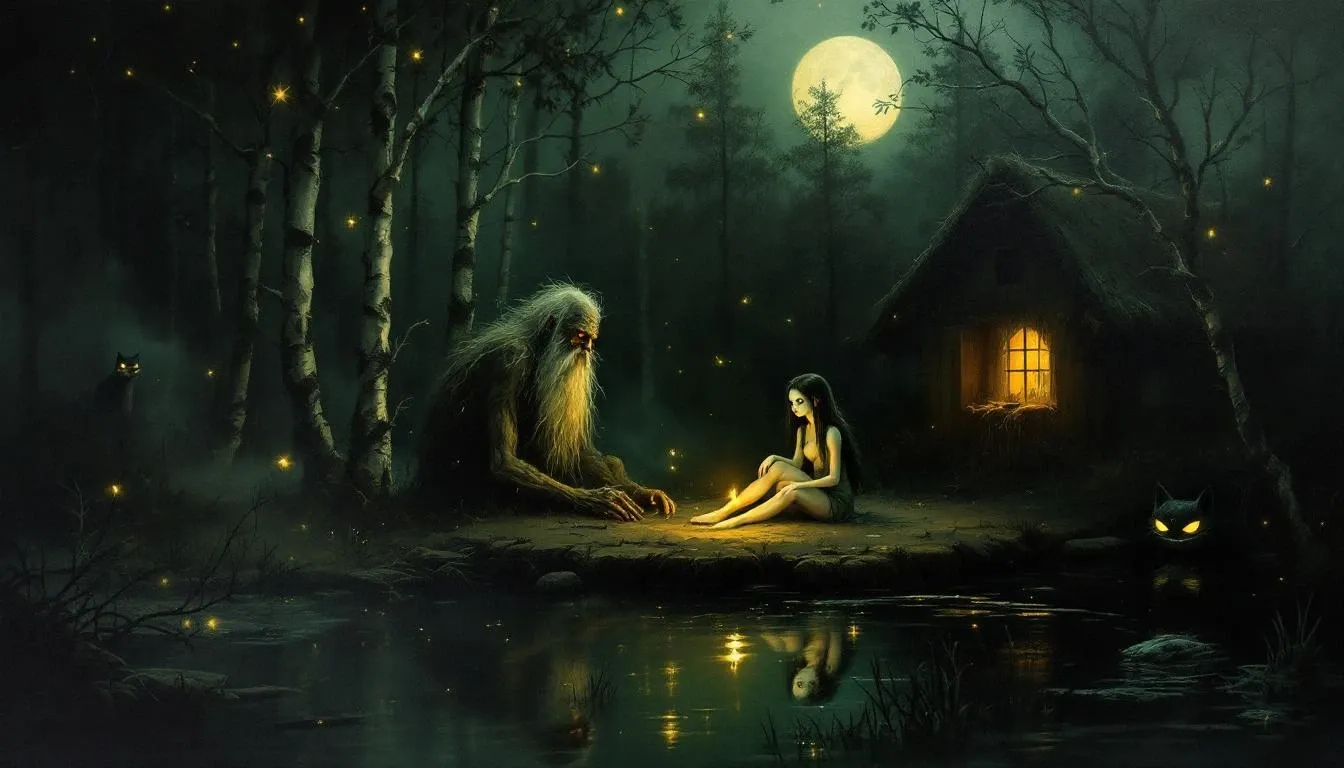
Leshy ruled the forest. He was tall as the treetops when standing among pines, short as grass when crossing a meadow. He had a long green beard, glowing eyes, and could imitate any sound — the cry of a child, the call of a friend, the voice of your own mother. He led travelers off paths and into swamps, drove men mad with laughter, and stole children who wandered too far from the village edge. But he was also the protector of wildlife, the keeper of the ecological balance. Hunters who killed more than they needed answered to the leshy.
Rusalka haunted the rivers and lakes. In most traditions she was the restless spirit of a young woman who drowned — often a suicide, often a bride who died before her wedding. She was pale, wet-haired, beautiful, and lethal. During Rusalka Week in early summer, they rose from the water to dance in fields and forests, and any man who joined their circle dance would dance until he died. Farmers believed the rusalki's moisture made the crops grow, so their presence was both feared and needed — another example of the Slavic refusal to separate danger from necessity.
And then there was Baba Yaga — the iron-toothed crone of the deep forest, who flew in a mortar and pestle, swept her tracks with a broom, and lived in a hut that stood on chicken legs and spun to face those who spoke the right words. She was not a goddess and not exactly a spirit. She was something older. In some tales she devoured children. In others she helped heroes, but only after testing them with impossible tasks. She guarded the border between the living world and the dead, and every young person who came to her door was making a choice about whether they had the courage to cross it.
The Myths That Survived: Stories You Should Know
Slavic mythology does not come in a single compiled volume like Ovid's Metamorphoses or the Prose Edda. Its stories are scattered across hundreds of folktales, songs, and customs. But certain narratives recur with such consistency across Slavic cultures that scholars treat them as genuine mythological material. Here are the ones every beginner should know.
The battle of Perun and Veles, already described above, is the foundational myth. Its echoes appear in folk songs from Serbia to Russia, in weather proverbs, in the pattern of feast days across the agricultural calendar. The spring thunderstorm that ended winter drought was Perun striking Veles. The autumn rains that flooded rivers were Veles rising again.
The tale of Koschei the Deathless is one of the most haunting in all European folklore. Koschei is a skeletal sorcerer who cannot be killed because his death is hidden — literally, physically separated from his body and locked inside a needle, inside an egg, inside a duck, inside a hare, inside a chest, buried under an oak on a distant island. The hero Vasilisa or Ivan must find each container, break each layer open, and snap the needle to destroy him. This nested structure of hidden mortality may encode older beliefs about the separability of the soul.
The Firebird appears in tales from Russia to the Czech lands — a glowing bird of paradise whose single feather can illuminate a dark room, and whose pursuit leads the hero through a chain of increasingly impossible tasks. The firebird is beauty and danger fused into one creature: to possess even a piece of it is to invite catastrophe and wonder in equal measure.
And the great folk heroes — Ilya Muromets, Dobrynya Nikitich, and Alyosha Popovich — form a cycle of warrior tales called the byliny, which carry the same weight in Slavic culture that the Arthurian legends carry in Britain. Ilya sat paralyzed on a stove for thirty-three years before receiving supernatural strength and riding out to defend the Slavic lands against monsters, invaders, and the serpent Zmey Gorynych.
Where to Go From Here
You are standing at the edge of a forest. The path splits in a dozen directions, and each one leads somewhere worth going.
If the cosmic structure fascinates you, read about the Three Worlds and the World Tree — the vertical axis that holds the Slavic universe together.
If you want the gods, start with Perun and Veles — their eternal war is the engine of the entire mythology. Then explore Mokosh, the earth mother, and Morana, the goddess of death and winter.
If the spirits draw you, meet the Leshy in his forest, the Rusalka in her river, the Domovoy behind your stove. Learn why every body of water had a Vodyanoy and every field had a Poludnitsa — the Lady Midday who drove reapers mad under the summer sun.
If it is the monsters you want, begin with Baba Yaga, then find Koschei the Deathless and his hidden needle of mortality. Follow the Firebird into the dark garden. Cross the Kalinov Bridge over the river of fire and see what waits on the other side.
And if you want to understand how all of this collided with Christianity — how a thousand-year-old faith was officially destroyed but actually survived in the songs, customs, and superstitions of hundreds of millions of people — read about the Christianization of the Slavs and the festival of Kupala Night, which is still celebrated with bonfires and flower wreaths across Eastern Europe every June.
This mythology was never meant to be read on a screen. It was meant to be spoken around a fire while the wind tested the walls. It was meant to be whispered at crossroads when the light failed. But it will speak to you all the same, if you are willing to listen. The forest is old, and the forest remembers.