Not everything in the Slavic spirit world is grand. Not every demon commands storms or rules forests or presides over the death of men with the gravitas of ancient gods. Some spirits are small. Some are petty. Some are simply mean — nasty in the way a stray cat is nasty, spiteful in the way a biting fly is spiteful, dangerous not because they wield cosmic power but because they are everywhere, invisible, and have nothing better to do than ruin your day.
The Shishiga is one of these. Small, ugly, disheveled, and vicious in a low-stakes way that makes her more unnerving than many of the grander horrors of Slavic mythology. She does not destroy villages. She does not command armies of the dead. She lurks in the reeds at the edge of the pond and waits for a drunk to stagger past. She hides behind the bathhouse door and grabs at women who come to wash alone. She is not a catastrophe. She is an ambush — minor, personal, and deeply unpleasant.
What Shishiga Is (And Is Not)
Defining the Shishiga precisely is difficult because she sits at an intersection of several better-known spirit categories without belonging entirely to any of them.
She is sometimes classified as a water spirit — a creature of ponds, streams, and marshy areas who drowns people. In this form, she overlaps with the Vodyanoy and the Bolotnik. She is sometimes classified as a bathhouse spirit — a creature who lurks in the banya and attacks bathers. In this form, she overlaps with the Bannik. She is sometimes classified as a household nuisance — a small hairy creature that creates disorder, tangles thread, and breaks dishes. In this form, she overlaps with the Kikimora.
But the Shishiga is none of these things exactly. She is something smaller than all of them — a minor demon, a low-ranking spirit of the nechistaya sila (unclean force), a creature that occupies the cracks between the larger spirits' domains. Where the Vodyanoy rules the river, the Shishiga lurks in the puddle. Where the Bannik commands the bathhouse, the Shishiga hides behind its door. She is not a ruler of anything. She is a squatter, a pest, a presence that exists at the margins and attacks from the margins.
The name itself — shishiga — may derive from the word shish, meaning a pointed shape (like a cone or spike), or from an old word for "demon" found in various Turkic and Finno-Ugric languages absorbed into Russian. The etymological uncertainty mirrors the creature's own uncertain nature: not quite categorizable, not quite locatable, not quite one thing or another.
The Face of the Shishiga
When she chooses to be visible — and, unlike the more dignified spirits, the Shishiga sometimes appears deliberately to frighten — she is uniformly described as ugly. Not frightening in the way a dragon is frightening, or majestic in the way a storm demon is majestic. Ugly in the mundane, repulsive sense. Small. Dirty. Wrong.
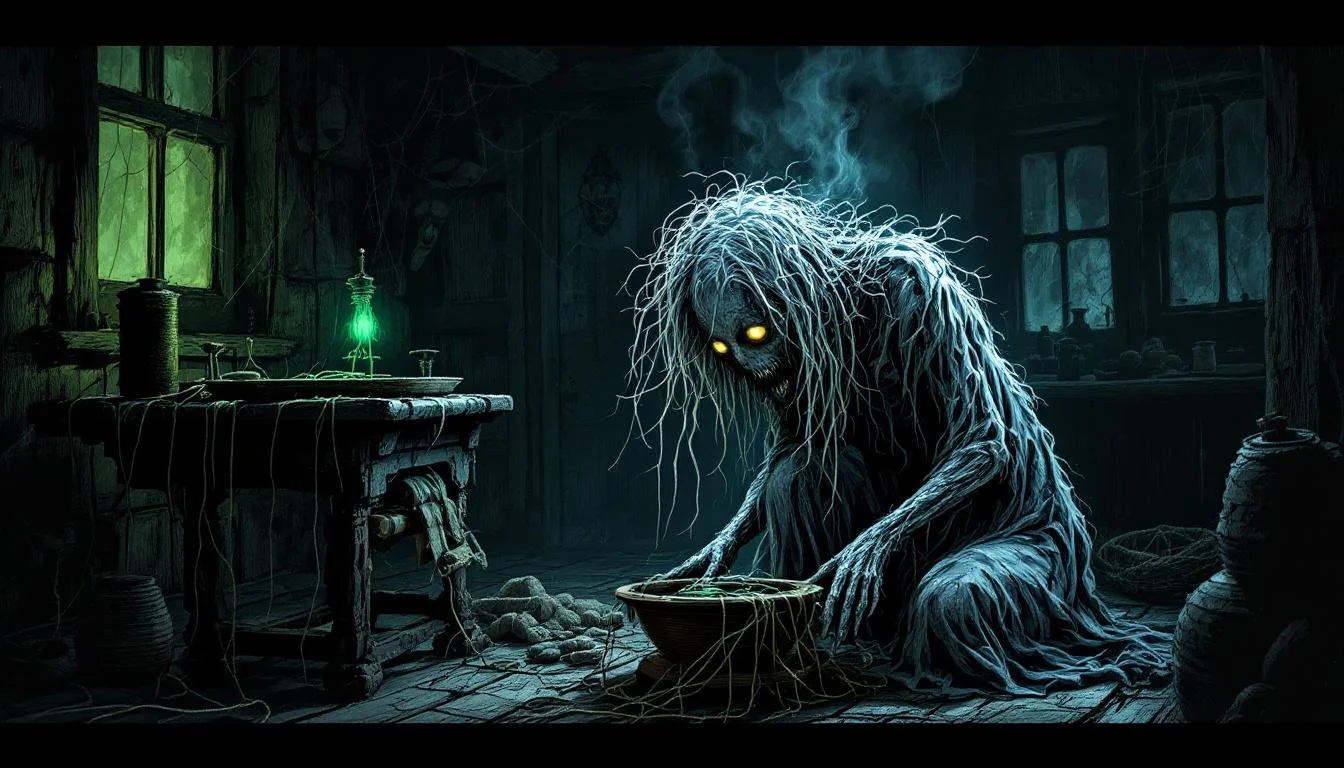
She is described as short — the size of a child, sometimes smaller. Her body is thin and covered in matted hair — not fur, exactly, but the unkempt, snarled hair of something that has never been clean. Her face is asymmetrical in most accounts: one eye larger than the other, nose crooked, mouth too wide. Her fingers are long relative to her body — grabbing fingers, clutching fingers, the fingers of something that snatches and holds.
Her hair — the hair on her head, as distinct from her body hair — is her most commented-upon feature. It is wild, standing outward in all directions, tangled beyond any possibility of combing. In some descriptions it is dark; in others, an unnatural reddish or greenish hue. It is always uncombed, always matted, always suggesting a creature that does not groom, does not rest, does not care about its appearance because its appearance is, itself, a weapon — a way to horrify by being seen.
The Shishiga is naked or nearly so. Sometimes described in rags, sometimes in nothing at all. Her nudity is not the seductive nudity of the Rusalka or the Bolotnitsa. It is uncomfortable, confrontational, the nudity of something that should not be seen and knows it — and shows itself anyway, precisely because being seen disgusts you.
The Dual Domain: Water and Bathhouse
The Shishiga's territory splits between two environments that share a common element: water.
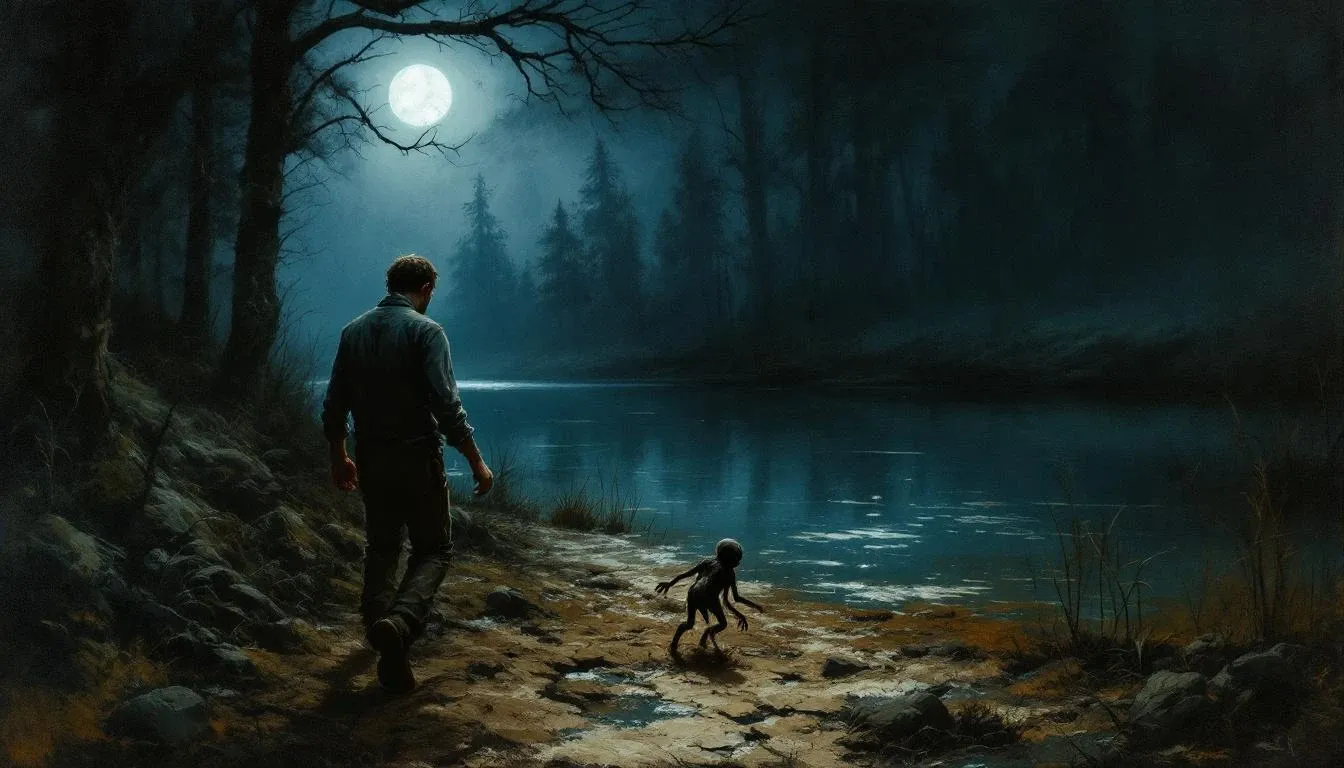
In the wild, she lives near ponds, streams, marshy areas — the smaller, stagnant water that larger water spirits do not bother to claim. She hides in the reeds. She lurks under bridges that cross streams. She sits on rocks at the water's edge, combing her terrible hair with a fish bone and waiting for someone to come close enough to grab.
Her preferred victims in the water-domain are drunks. This is specific and consistent across multiple sources. The Shishiga targets intoxicated men who wander near water at night. A sober man might see her and flee. A drunk man stumbles, falls, reaches for something to steady himself — and finds her hand instead of a branch. She pulls him in. The water is never deep where the Shishiga operates. A sober man could stand in it. But a drunk man, facedown, grabbed by thin strong fingers, drowns in six inches of pond water.
The folklore is blunt about this: if you drink and walk near water at night, the Shishiga will get you. The moral coding is more explicit than with most Slavic spirits. The Vodyanoy drowns fishermen — men engaged in legitimate work who simply failed to appease the spirit. The Shishiga drowns drunks — men who have already transgressed socially, whose intoxication marks them as vulnerable and, in the folk-moral framework, deserving of consequence.
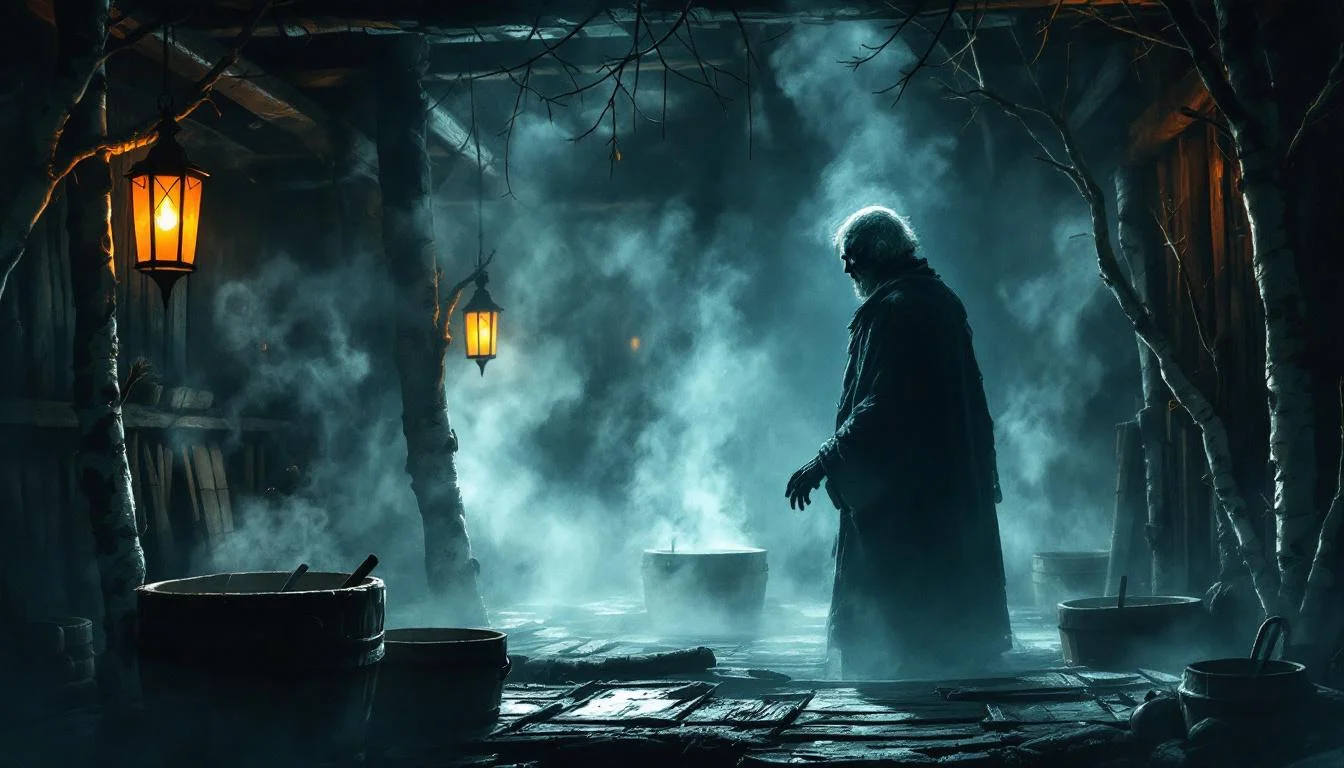
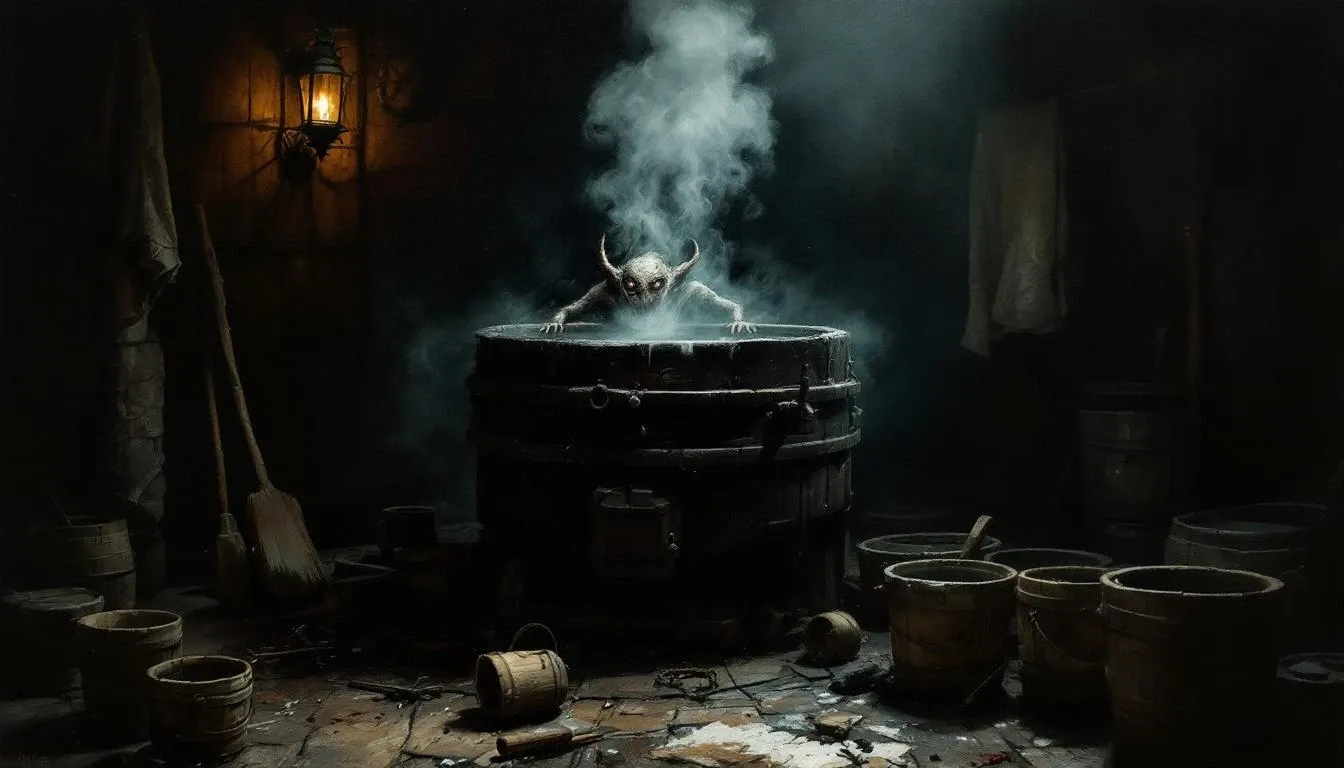
In the bathhouse, the Shishiga is a creature of the margins — present in the Bannik's domain but subordinate to him, hiding in corners and under benches rather than commanding the space. She attacks bathers who come alone, particularly women. Her attacks in this context are less about drowning and more about terror: sudden grabs at ankles, hair pulled from behind, the sensation of being watched by something in the steam. She does not kill in the bathhouse typically — that is the Bannik's prerogative. She frightens. She harasses. She makes the space feel unsafe in a personal, intimate way.
The Shishiga and the Kikimora
The relationship between the Shishiga and the Kikimora — the domestic female spirit — is complex and regionally variable. In some traditions, they are clearly separate entities: the Kikimora lives inside the house, behind the stove or in the walls, while the Shishiga lives outside, near water or in the bathhouse. In other traditions — particularly in northern Russia — the names are used interchangeably, or the Shishiga is described as a type of Kikimora that has been expelled from the home and now lives in the wild.
The shared features are notable. Both are female. Both are ugly and disheveled. Both are associated with spinning and thread (the Kikimora tangles spinning; the Shishiga, in some accounts, steals yarn left to dry near water). Both target women specifically, though the Kikimora targets them indoors and the Shishiga targets them outdoors.
The distinction, where it exists, is one of domestication. The Kikimora is a house spirit — unpleasant but contained, a known quantity within a defined space. The Shishiga is a wild spirit — uncontained, unpredictable, encountered in the open where the rules of the household do not apply. If the Kikimora is the pest inside your walls, the Shishiga is the pest waiting outside your door.
Some folklorists have proposed that the Shishiga represents a "degraded" Kikimora — a version of the domestic spirit that has lost its connection to a specific household and become feral. A spirit without a home is a spirit without rules, and a spirit without rules is dangerous in a way that a properly bound house-spirit cannot be. This reading positions the Shishiga as what happens when a domestic spirit goes homeless: it becomes mean, desperate, and indiscriminate in its attacks.
Drowning Drunks: The Moral Function
The Shishiga's targeting of intoxicated men is not incidental. It is the core of her social function within the belief system.
East Slavic communities treated drunkenness with deep ambivalence. Alcohol was central to social ritual — celebrations, funerals, religious holidays, and agricultural milestones all involved drinking. But excessive drunkenness — the kind that left a man staggering home alone through the dark, incapable of defending himself, a liability to his family — was viewed as a moral failure. The drunk man was out of control, out of his proper place, out of the social framework that protected and defined him.
The Shishiga was the consequence that the community projected onto this failure. She was not a natural disaster or a cosmic punishment. She was a mean little creature who attacked mean little failures. There was no dignity in being killed by a Shishiga — no epic struggle, no tragic heroism. Being drowned by a Shishiga was shameful in a way that being taken by the Vodyanoy was not. The Vodyanoy killed competent men who simply made a ritual mistake. The Shishiga killed fools who could not walk straight.
This shame-function was the Shishiga's real power. She was not a spirit to be propitiated or respected. She was a spirit to be embarrassed by. The threat of the Shishiga was not "you will die" — it was "you will die stupidly, killed by something ugly and small, and your family will know why." The social deterrent was not the death itself but the manner of it.
"Shishiga" as Insult
The word shishiga has survived in modern Russian long after the belief system that produced it has faded. It persists as a colloquial insult — mild but specific, used primarily to describe a woman who is disheveled, unkempt, wild-haired, and generally disreputable in appearance.
"Ty kak shishiga!" — "You look like a shishiga!" — means, approximately, that someone's hair is a disaster, their clothes are in disarray, and they look like they have been living in a bush. The insult carries no supernatural weight anymore. It is simply a descriptive comparison: you look like that thing from the folklore that was small, ugly, and covered in matted hair.
The survival of the word as an insult reveals something about the Shishiga's position in the folk imagination. She was never a figure of awe or reverence. She was always, at some level, ridiculous — repulsive but also somewhat pathetic, dangerous but also somewhat absurd. The Leshy commands respect even as an insult would be unthinkable. The Vodyanoy inspires fear. But the Shishiga inspires a grimace — the facial expression you make when something is ugly and bothersome and will not go away.
This is, paradoxically, what makes her effective as a folk-belief. The grand spirits inspired respect and ritual. The Shishiga inspired disgust and avoidance. You did not propitiate the Shishiga. You avoided the circumstances under which she appeared: don't drink to excess, don't wander near water at night alone, don't go to the bathhouse without company. Her prevention was behavioral modification, not ritual offering. She was not a god to be worshipped but a consequence to be dodged.
Shishiga — a restless, evil spirit; a small demon that lurks in the reeds and near bathhouses. To call a person shishiga is to say they are unkempt, wild, and unfit for decent company. The word carries the sense of something both repulsive and trivial — a nuisance elevated to the supernatural.
The Hierarchy of Small Evils
The Shishiga's position in the Slavic spirit hierarchy is instructive precisely because it is low. Not every supernatural being is a king. Not every spirit commands territory or demands worship. The folk imagination populated the world with spirits at every scale — from Perun in the thunderclouds to the Shishiga in the puddle behind the banya.
This scaling is important. The Domovoy, the Leshy, the Vodyanoy — these are the lords of their respective domains. They are large, powerful, capable of killing or blessing in equal measure. They have rituals. They have priests, in a sense — people who know how to appease them, who maintain the relationship between human and spirit.
The Shishiga has none of this. No rituals. No offerings. No specialist who knows her ways. She is beneath propitiation. She is simply there — in the reeds, behind the door, at the edge of the pond — and the only defense against her is not being stupid enough to encounter her. Do not be drunk near water. Do not bathe alone. Do not give her an opportunity.
This makes the Shishiga, in some ways, more modern than her grander cousins. She does not require belief in a spiritual world-order to function as a cautionary figure. She is simply the personification of a bad outcome — the thing that happens when you make poor decisions in dangerous environments. She is less a god than a meme: "Shishiga will get you" means, stripped of its supernatural content, "something bad happens to people who behave carelessly."
The reeds still grow at the pond's edge. The bathhouse still stands at the corner of the yard. Drunken men still walk home alone in the dark, past water they cannot see clearly. The Shishiga does not need your belief. She only needs your carelessness. And that — unlike the old gods, unlike the grand spirits of forest and river and storm — is something that never goes out of supply.