There are two Vasilisas in Russian fairy tales. Most people know only one. Vasilisa the Beautiful — the girl with the magic doll, the stepdaughter sent to Baba Yaga's hut, the one who survives through obedience and her dead mother's blessing. She is gentle. She is enduring. She does what she is told and waits for the dark to pass.
The other Vasilisa is nothing like her.
Vasilisa the Wise — Vasilisa Premudraya, where premudraya means not merely wise but surpassingly wise, overwhelmingly wise, wise beyond any reasonable expectation — does not survive through obedience. She survives through power. She is a shapeshifter, a sorceress, a woman who can transform the fabric of reality with a gesture and who treats the obstacles placed before her not as tests of endurance but as problems beneath her intelligence. She does not wait. She acts. She does not ask for help. She provides it — to the man who, without her, would be dead within the first three tasks.
In the hierarchy of Russian fairy-tale heroines, Vasilisa the Wise stands at the top. Not because she is the most popular — she is not — but because she is the most powerful. Marya Morevna commands armies. Vasilisa the Beautiful endures impossible suffering. But Vasilisa the Wise commands magic itself, and she does it with a competence so total that the stories built around her are essentially studies in what happens when the smartest person in the room is the woman and everyone else — the tsar, the advisors, the husband — must either accept that fact or be destroyed by it.
The Frog Princess Is Vasilisa the Wise
The most famous tale in which Vasilisa the Wise appears is "The Frog Princess" — Tsarevna-Lyagushka — one of the best-known stories in the entire Russian fairy-tale canon, collected by Alexander Afanasyev and classified as Aarne-Thompson tale type 402, The Animal Bride.
The setup is deceptively simple. A tsar tells his three sons to shoot arrows into the distance and marry whoever their arrows find. The eldest marries a nobleman's daughter. The middle marries a merchant's daughter. The youngest — Ivan Tsarevich, because the youngest is always Ivan — watches his arrow arc across the landscape and land in a swamp, where a frog sits holding it in her mouth.
Ivan marries the frog. He does not want to. His brothers mock him. The court pities him. But the tsar's word is law, and the arrow has spoken.
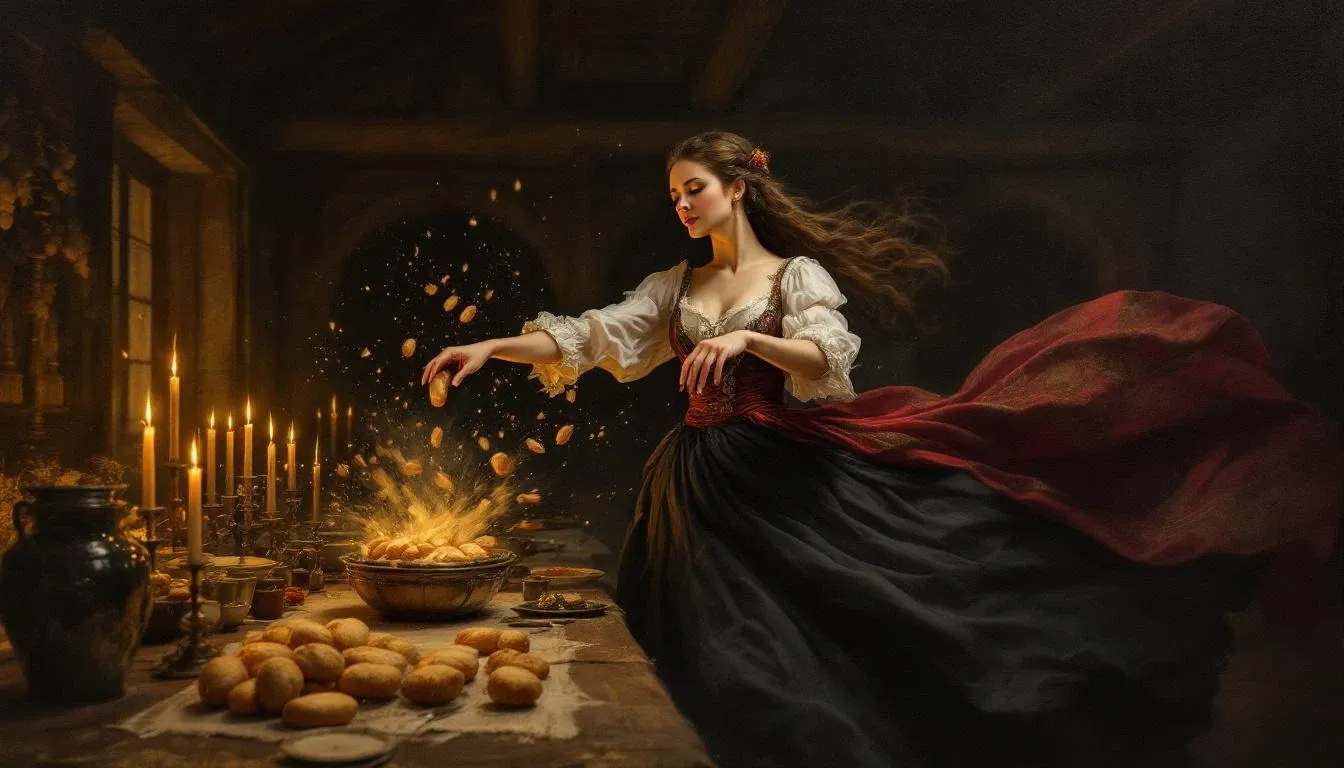
Then the tsar sets tasks for his daughters-in-law. Bake bread by morning. Weave a carpet by morning. Appear at the royal feast in person. The nobleman's daughter and the merchant's daughter produce mediocre bread and mediocre carpets. Ivan's frog wife produces bread so beautiful that it could only be served at Easter feasts and a carpet woven with the entire kingdom's landscape in thread so fine it looks alive.
She does this by stepping out of her frog skin at night, becoming a woman of such beauty and magical power that the kitchen and the loom bend to her will. She claps her hands and summons rivers that carry the dough. She stamps her feet and forests grow into tapestries. Then she puts the skin back on and returns to being a frog before dawn.
The woman inside the frog skin is Vasilisa the Wise. And the moment Ivan discovers her secret — the moment he sees her in human form and cannot bear to lose her — he commits the act that drives the entire second half of the story.
The Burning of the Skin
Ivan watches his wife shed her frog skin and become a woman of impossible beauty and power. He is overwhelmed. He is terrified that she will put the skin back on, that he will wake beside a frog again, that the magic will reverse. So he does the only thing a fairy-tale prince can think to do when confronted with something he cannot control: he destroys it.
He takes the frog skin and throws it into the fire.
The skin burns. Vasilisa shudders, turns to her husband, and says the words that set the rest of the story in motion: "Oh, Ivan Tsarevich, what have you done? If you had waited just three more days, I would have been yours forever. Now you must search for me in the thrice-ninth kingdom, at the edge of the world, in the palace of Koschei the Deathless."
And she vanishes.
This is the central moral engine of the Frog Princess, and it runs on a principle that is specific to the tale of Vasilisa the Wise: she was in control the entire time. The frog skin was not a prison. It was a strategy. Vasilisa had been cursed by her father — in most variants, her father is a powerful sorcerer or sea king — to spend three years as a frog. The curse was nearly expired. Three more days and it would have ended naturally, on her terms, through the completion of a process she understood and had managed from the beginning.
Ivan's destruction of the skin did not free her. It sabotaged her plan. He acted out of love, or impatience, or the male refusal to wait for a woman to finish what she was doing — and his action made everything worse. Vasilisa was taken to Koschei's realm not because the skin was destroyed but because the careful magical schedule she had been maintaining was disrupted. Ivan broke her spell by trying to break her curse, and the difference between those two things is the entire point of the story.
The Quest and the Helpers
What follows is Ivan's journey to find Vasilisa — and it is, by design, a journey he cannot complete alone. He walks through forests that have no paths. He crosses fields that have no end. He wears through iron boots and gnaws through iron bread — the fairy-tale shorthand for a journey so long and hard that it destroys the tools meant to sustain it.
Along the way he encounters animals — a bear, a pike, a hare, a duck — and in each case spares their lives when he could have killed them for food. This is the exchange economy of the Russian fairy tale: mercy given now, help received later. The animals will return in the climactic scene to perform the one task that Ivan's human strength cannot accomplish.
He also encounters Baba Yaga. In the Frog Princess variants, the witch is not an antagonist. She is an informant — a figure who sits at the border between the human world and Koschei's realm and who, for reasons she does not explain, tells Ivan where to find Vasilisa and how to kill the thing that holds her captive. The needle inside the egg inside the duck inside the hare inside the chest at the top of the oak tree on the island across the sea. Koschei's death, disassembled into nested impossibilities.
But here is the thing that the Frog Princess tale makes structurally clear: Ivan needs the animals to retrieve Koschei's death. He needs Baba Yaga to tell him where it is. He needs a series of lucky encounters and divine interventions to reach the thrice-ninth kingdom at all. Vasilisa the Wise, by contrast, needed nothing. She managed her curse alone. She performed the tsar's impossible tasks alone. She would have freed herself in three more days — alone.
The entire quest is the consequence of Ivan's interference with a woman who had the situation under control.
Premudrost: What Kind of Wisdom
The epithet Premudraya — the Exceedingly Wise — is not the same as the English word "wise." In Russian fairy-tale vocabulary, mudrost' carries specific connotations that go beyond knowledge or good judgment. Mudrost' is arcane knowledge. It is the kind of understanding that allows a person to transform matter, to see through illusions, to manipulate the hidden machinery of the world. A mudrets is not a sage who gives good advice. A mudrets is a magician who knows how things work at a level invisible to ordinary perception.
When the tales call Vasilisa Premudraya, they are saying she is the supreme practitioner of this arcane knowledge. Her wisdom is not philosophical. It is operational. She knows how to turn a frog skin into a palace disguise. She knows how to bake bread that makes the tsar weep with its beauty. She knows the exact schedule of her own curse and how to manage it to her advantage. She knows things that Koschei does not know, that her sorcerer-father did not anticipate, that the entire masculine power structure of the fairy-tale world cannot match.
In variants where Vasilisa is not the Frog Princess but the daughter of the Sea King (Afanasyev No. 219-226), her wisdom is even more explicitly magical. She advises the hero — again named Ivan — through a series of tasks set by her father: sort grains, build a palace overnight, find the one identical girl among twelve identically dressed sisters. In each case, Ivan would fail without Vasilisa's instructions. She tells him exactly what to do, and her instructions work perfectly, because she understands the rules of the magical world her father governs in ways that her father himself does not fully realize.
This is the premudrost' of Vasilisa the Wise: knowledge that is deeper than authority, power that operates from below the surface, intelligence that does not need a throne because it is already running the kingdom from behind the curtain.
The Shapeshifter
Vasilisa the Wise is one of the most prolific shapeshifters in Russian fairy tales. Her transformations are not passive — she is not turned into things by curses. She transforms herself, deliberately, as an expression of her magical competence.
In the Sea King variants, Vasilisa and Ivan flee her father's palace together. The Sea King sends pursuers. Vasilisa responds by transforming the world around her — she strikes the ground and turns herself and Ivan into a field of wheat and its farmer. Or a church and its priest. Or a lake and a duck swimming on it. Each transformation is perfectly chosen to deceive the specific pursuer sent after them. Each one holds until the pursuer returns to the Sea King empty-handed. It is only when the Sea King himself gives chase that Vasilisa must deploy her full power, transforming into something the king cannot cross — a river too wide, a forest too dense, a distance too great.
The frog skin itself is a form of shapeshifting, though an imposed one. But even within the imposed transformation, Vasilisa demonstrates mastery. She does not merely endure the frog form. She operates within it — accepting tasks from the tsar through Ivan, completing them in her human form at night, and returning to the frog skin by morning with a discipline that suggests she finds the arrangement inconvenient but manageable. The frog skin is not her prison. It is her commute.
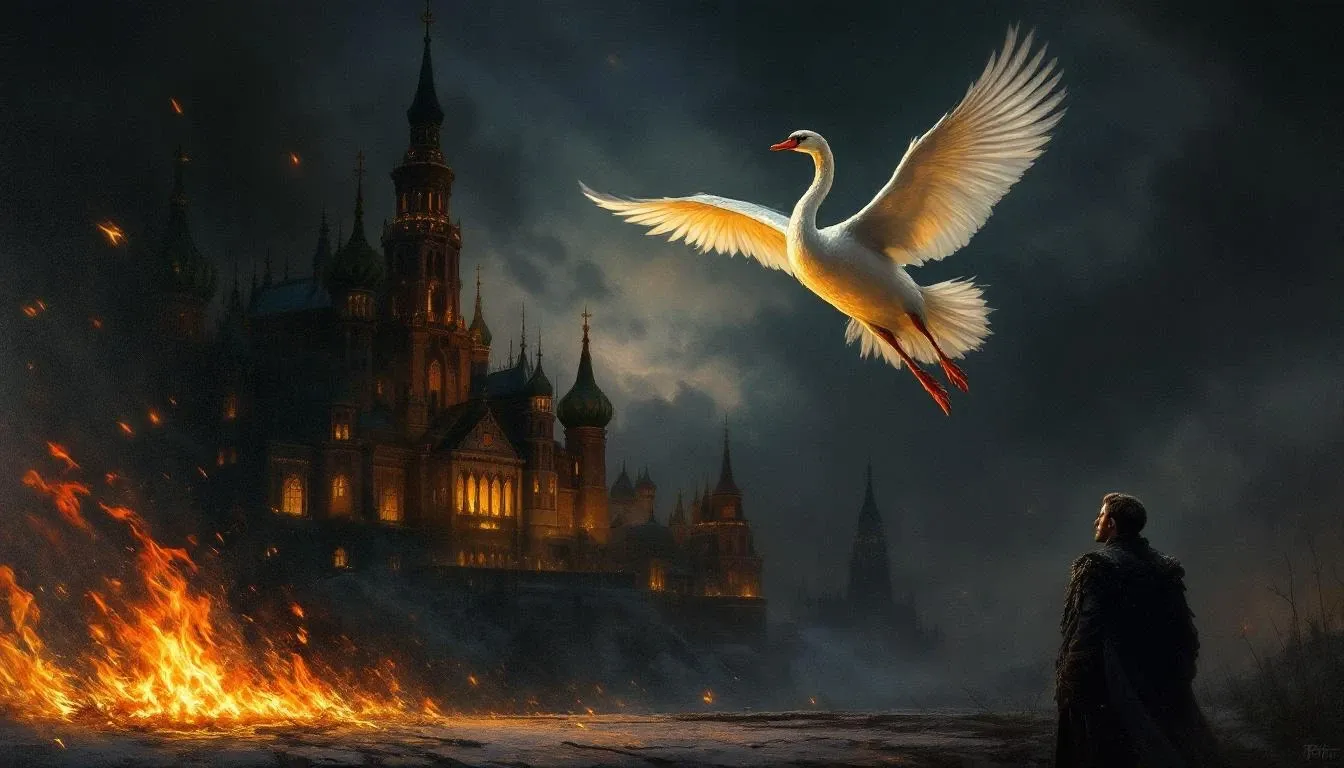
She struck the ground, turned into a white swan, and flew away. The prince wept and went on his way. He walked one year, walked a second, walked to the edge of the world, and there she was — sitting in a garden of golden apples, weaving a cloth of silver thread, and she looked at him and said: "Well, Ivan, you have come at last. Three more steps and you would have been too late."
Vasilisa the Wise vs. Vasilisa the Beautiful
The distinction between the two Vasilisas is not merely nominal. It reflects a deep structural divide in Russian fairy-tale femininity.
Vasilisa the Beautiful operates through endurance. Her strength is passive — she survives the stepmother, survives Baba Yaga, survives the impossible tasks, because she possesses a magical helper (the doll) and the patience to use it. Her defining quality is beauty, which in the fairy-tale lexicon is a form of moral virtue: to be beautiful is to be good, to deserve rescue, to merit the prince's attention. Vasilisa the Beautiful does not rescue herself. She endures until rescue arrives.
Vasilisa the Wise operates through competence. Her strength is active — she transforms reality, outsmarts sorcerers, engineers escapes, and solves problems that would defeat any man in the story. Her defining quality is intelligence, and the tales are explicit that her intelligence exceeds her beauty, her beauty exceeds any other woman's, and the combination exceeds everything. She does not need rescue. She is the rescue.
The fairy-tale tradition preserves both types because both served as models for different aspects of women's experience. Vasilisa the Beautiful spoke to the reality of women's lives in patriarchal village culture — the need to endure suffering, to survive through quiet resilience, to use whatever small tools were available. Vasilisa the Wise spoke to the fantasy — or the buried memory — of a different kind of feminine power: the sorceress, the shapeshifter, the woman whose knowledge of the hidden world made her more powerful than any tsar.
It is not accidental that the fairy tales never pit the two Vasilisas against each other. They occupy different narrative spaces, answer different questions, and serve different psychological needs. But if one had to choose which Vasilisa the folk tradition admired more, the answer is embedded in the epithet: Premudraya. The surpassingly wise. The one whose name means not beauty but power.
The Feminist Reading and Its Limits
Modern scholars — including Jack Zipes, Sibelan Forrester, and Helena Goscilo — have read Vasilisa the Wise as a proto-feminist figure, and the reading is not wrong. She is smarter than the tsar. She is more magically powerful than Koschei. She solves every problem the story presents. She is punished not for her own failures but for the failures of the men around her — her father's curse, Ivan's impatience, Koschei's possessiveness. The narrative consistently locates intelligence, agency, and power in the female character and incompetence, impulsiveness, and dependence in the male.
But the feminist reading has limits, and acknowledging them is important. Vasilisa the Wise operates within a fairy-tale structure that ultimately rewards marriage. Her power is demonstrated in service of a romantic union — she endures the curse, she bakes the bread, she weaves the carpet, she appears at the feast, all within the framework of proving herself as a wife. Her escape from the Sea King is an escape toward Ivan, not toward independence. Her wisdom is exercised within a story that ends with "and they lived happily ever after," not with "and she ruled the kingdom alone."
The tales do not imagine a Vasilisa without an Ivan. This is not a failure of imagination — it is a reflection of the cultural logic in which these stories were told. In the village world of oral fairy tales, a woman alone was a woman in danger. The fantasy the tales offered was not autonomy but partnership — a marriage in which the woman's intelligence was recognized, valued, and necessary. Vasilisa the Wise does not overthrow the patriarchy. She makes it depend on her.
Whether that is enough is a question the fairy tales leave for their listeners to answer. The stories themselves are busy with the next task: the next transformation, the next pursuit, the next moment when the cleverest person in the room turns the world inside out and waits for everyone else to catch up.
The Legacy in Language
The phrase Vasilisa Premudraya has entered Russian as an idiom. To call a woman Vasilisa Premudraya is to say she is dangerously smart — smart enough to make the people around her uncomfortable, smart enough to solve problems they cannot see, smart enough that her intelligence is itself a kind of magic. It is not always a compliment. In a culture that has historically been ambivalent about female intelligence, the epithet carries an edge: admiration on one side, wariness on the other.
But the fairy tales themselves are unambiguous. Vasilisa the Wise is the hero. Not the hero's helper. Not the hero's reward. The hero — the person whose intelligence drives the plot, whose power resolves the crisis, whose absence would make the entire story collapse. Ivan walks. Ivan suffers. Ivan destroys the skin and spends three years in iron boots. But Vasilisa is the one who knows. And in the fairy-tale universe, knowing is the only power that matters.