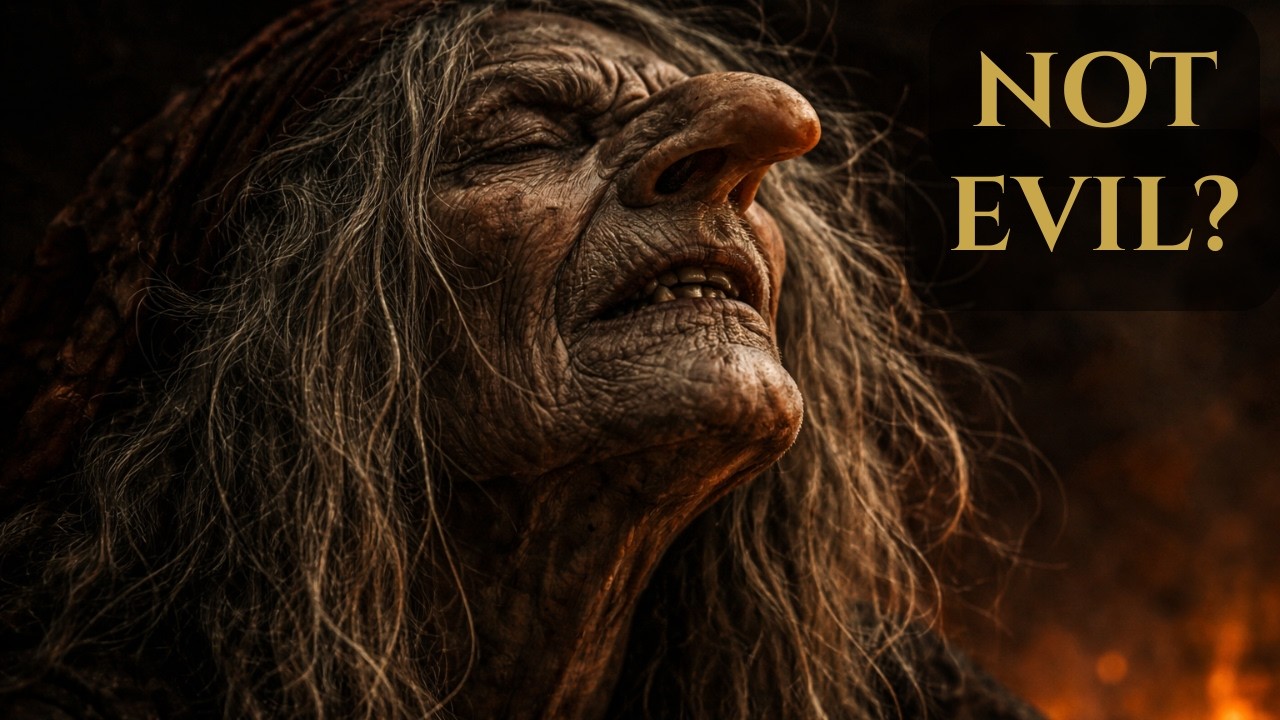
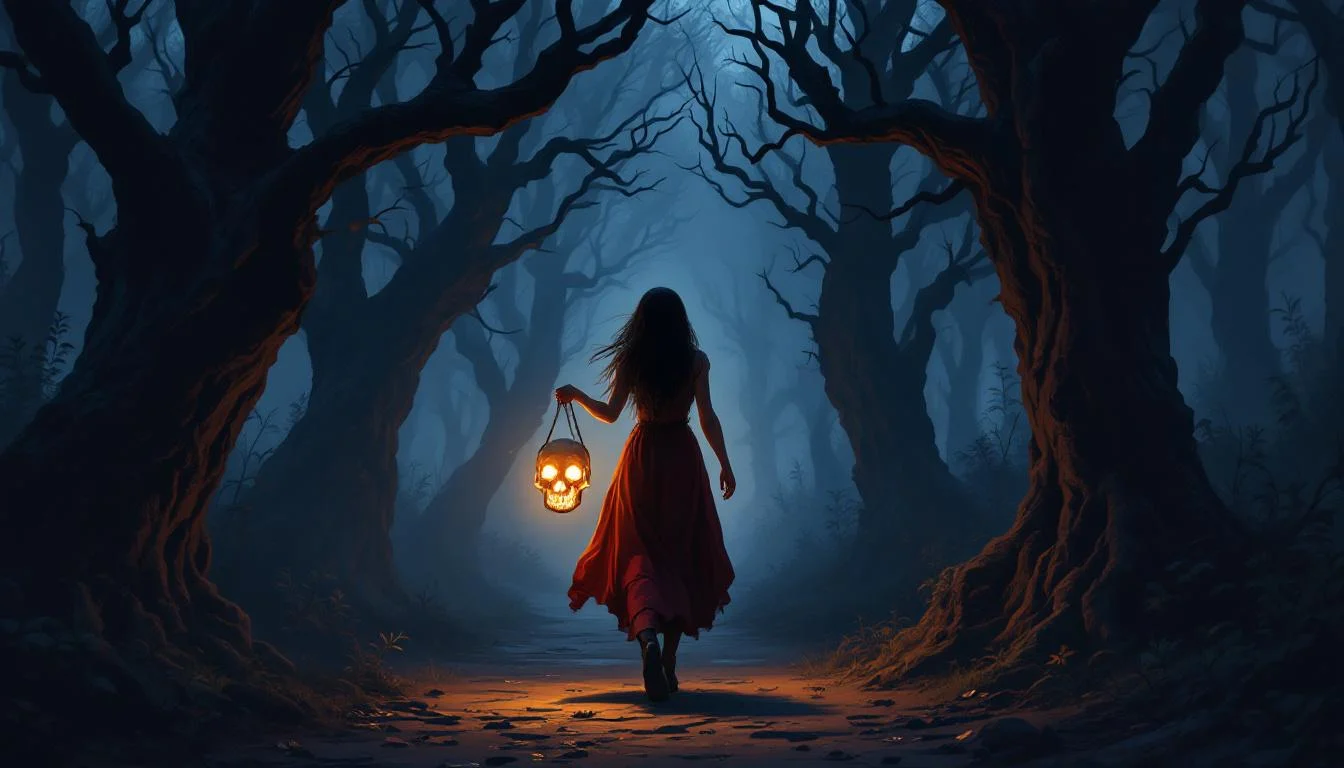
A tsar has three sons. He gives each of them an arrow and tells them to shoot into the distance. Wherever the arrow falls, there they will find a wife. The eldest son's arrow lands in a boyar's courtyard, and he marries the boyar's daughter. The middle son's arrow strikes the porch of a wealthy merchant, and he marries the merchant's daughter. The youngest son — Ivan, because the youngest son is always Ivan — watches his arrow arc over the houses, over the fields, over the edge of the known world, and land in a swamp.
He walks to where it fell. A frog is sitting on a moss-covered log, holding his arrow in its mouth.
Ivan looks at the frog. The frog looks at Ivan. And thus begins the strangest, most psychologically brutal love story in all of Russian folklore — a tale about what happens when you are given something you do not understand, when you destroy it because you cannot wait, and when the cost of getting it back is measured in years of walking through places where no living person was ever meant to go.
The Arrow and the Swamp
The tale of the Frog Princess — Tsarevna-Lyagushka in Russian — was collected by Alexander Afanasyev in his monumental Narodnye russkie skazki and exists in dozens of regional variants across Russia, Ukraine, and Belarus. It belongs to the Aarne-Thompson tale type 402 (The Animal Bride), a story pattern found across the world — from Norway to Japan — but nowhere with the particular darkness and moral weight that the Slavic version carries.
The arrow test is not random. In the logic of Russian fairy tales, the arrow is fate itself, a projectile the hero cannot control once released. The eldest brother's arrow finds respectable wealth. The middle brother's finds commercial prosperity. Ivan's arrow finds a swamp — the borderland between solid ground and water, between the human world and the domain of spirits like the Vodyanoy and the Rusalka. The swamp is where things decompose and transform, where the boundary between categories dissolves. It is the worst possible place for an arrow to land, and it is exactly where fate needs Ivan to go.
His father orders him to marry whatever his arrow has found. Ivan protests. His brothers laugh. His father is immovable: a tsar's word is a tsar's word, and an arrow does not lie. Ivan takes the frog home and marries it.
The wedding night, presumably, is not discussed.
The Three Tests
The tsar, possibly to amuse himself, possibly to test his new daughters-in-law, assigns three tasks. Each wife must demonstrate her skill.
The first task: bake a loaf of bread. The elder brothers' wives — the boyar's daughter and the merchant's daughter — set to work with flour and butter and ovens, producing respectable loaves. Ivan goes home in despair. He is married to an amphibian. What bread can a frog bake?
He falls asleep. In the night, the frog sheds its skin.
What steps out is not a frog but a woman — Vasilisa the Wise, a sorceress of extraordinary beauty and terrifying competence. She is not to be confused with Vasilisa the Beautiful of the Baba Yaga tale, though the names overlap deliberately: in the Russian fairy tale tradition, the name Vasilisa signals a woman of power, a figure who operates on a different level from the men around her. This Vasilisa calls to her nurses and nannies — supernatural servants from her enchanted life before the frog skin — and commands them to bake the kind of bread her own father ate. By morning, there is a loaf on the table so beautiful it looks like a city: towers of crust, rivers of honey, gardens of spun sugar. The tsar has never seen anything like it. The elder brothers' wives throw their loaves to the dogs.
The second task: weave a carpet. The same pattern. Ivan despairs. The frog sheds its skin in the night. Vasilisa commands her servants to weave the kind of carpet her father walked on. By morning, a carpet so intricate it makes the tsar weep lies rolled on the floor. The elder wives' carpets are thrown across horse troughs.
The third task: appear at the royal feast. This is the test Vasilisa has been waiting for, and the one Ivan has been dreading. How can he bring a frog to a banquet? His brothers' wives will be there in silk and gold. He will arrive with a green creature on his arm.
The frog tells Ivan to go ahead without her. When you hear thunder, she says, do not be afraid. Tell them: that is my little frog coming in her little box.
Ivan goes to the feast alone. His brothers smirk. Then thunder rolls across a clear sky, and a golden carriage pulled by six white horses draws up to the palace steps. Out steps Vasilisa the Wise — no longer in frog skin but in full glory, dressed in a gown that shimmers like starlight on water, her hair braided with pearls, her beauty so overwhelming that the entire court falls silent.
She walks to Ivan's side, sits down, and begins to eat. The bones from her meat she slips into her left sleeve. The dregs of her wine she pours into her right sleeve. The elder brothers' wives, watching closely and understanding nothing, do the same.
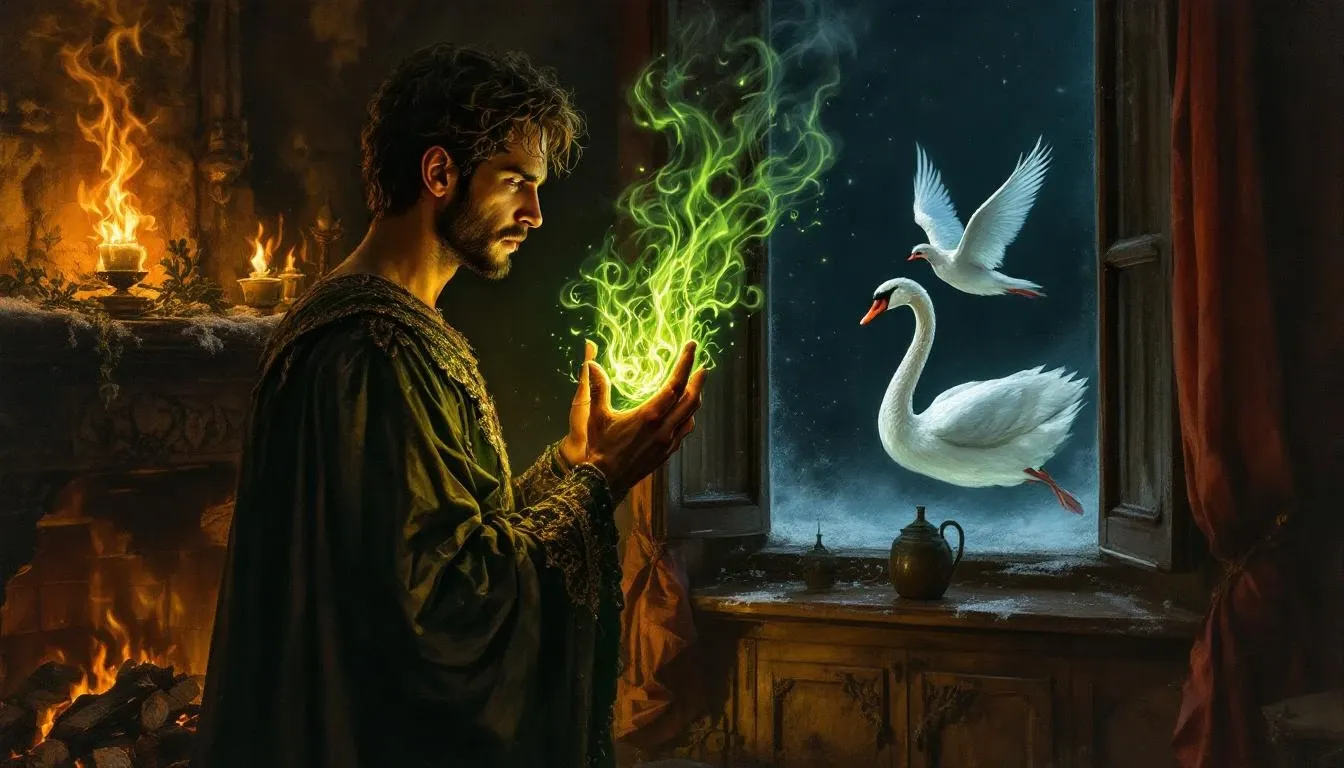
When the music begins, Vasilisa dances. She waves her left arm and a lake appears in the middle of the hall. She waves her right arm and white swans glide across its surface. The court gasps. The elder wives, desperate to replicate the trick, wave their sleeves — and spray bones and wine dregs across the tsar and his guests.
The Burning of the Skin
This is the moment the fairy tale pivots from comedy to tragedy. This is where the story earns its darkness.
Ivan, having seen his wife in her true form — radiant, powerful, magnificent beyond anything he imagined when he found a frog in a swamp — cannot bear the thought of her returning to the skin. While Vasilisa dances, he slips away from the feast, runs home, finds the discarded frog skin, and throws it into the fire.
The skin burns. The spell should be broken. Ivan has freed his wife from her enchantment, and they should live together in the fullness of her beauty forever.
Vasilisa walks through the door, sees the ashes, and her face changes. What have you done, she says. If you had waited three more days, I would have been free. My curse would have ended. But you could not wait.
She tells him the truth: she was cursed by Koschei the Deathless, the immortal sorcerer who covets her power and her beauty. The frog skin was not a prison but a disguise — a hiding place that kept her beyond Koschei's reach. As long as she wore the skin, he could not find her. Now that it is burned, there is nothing between her and the creature who has hunted her for longer than Ivan has been alive.
She turns into a grey cuckoo and flies out the window. Her last words to Ivan are the cruelest sentence in all of Russian folklore: Seek me beyond the thrice-nine kingdom, in the thrice-ten realm, in the palace of Koschei the Deathless. You wore out three pairs of iron boots and gnawed through three iron loaves before you found me.
She is gone. Ivan is alone. And the magnitude of what he has destroyed — not by malice but by impatience, by the inability to endure three more days of uncertainty — settles over him like the first frost of autumn.
"Oh, Ivan Tsarevich! What have you done? If you had waited but a little longer, I would have been yours forever. Now seek me in the thrice-nine kingdom, beyond the thrice-ten lands, at the palace of Koschei the Deathless. Three pairs of iron boots shall you wear out, three iron staffs shall you break, three iron loaves shall you gnaw through, before you find me."
The Journey to Koschei's Palace
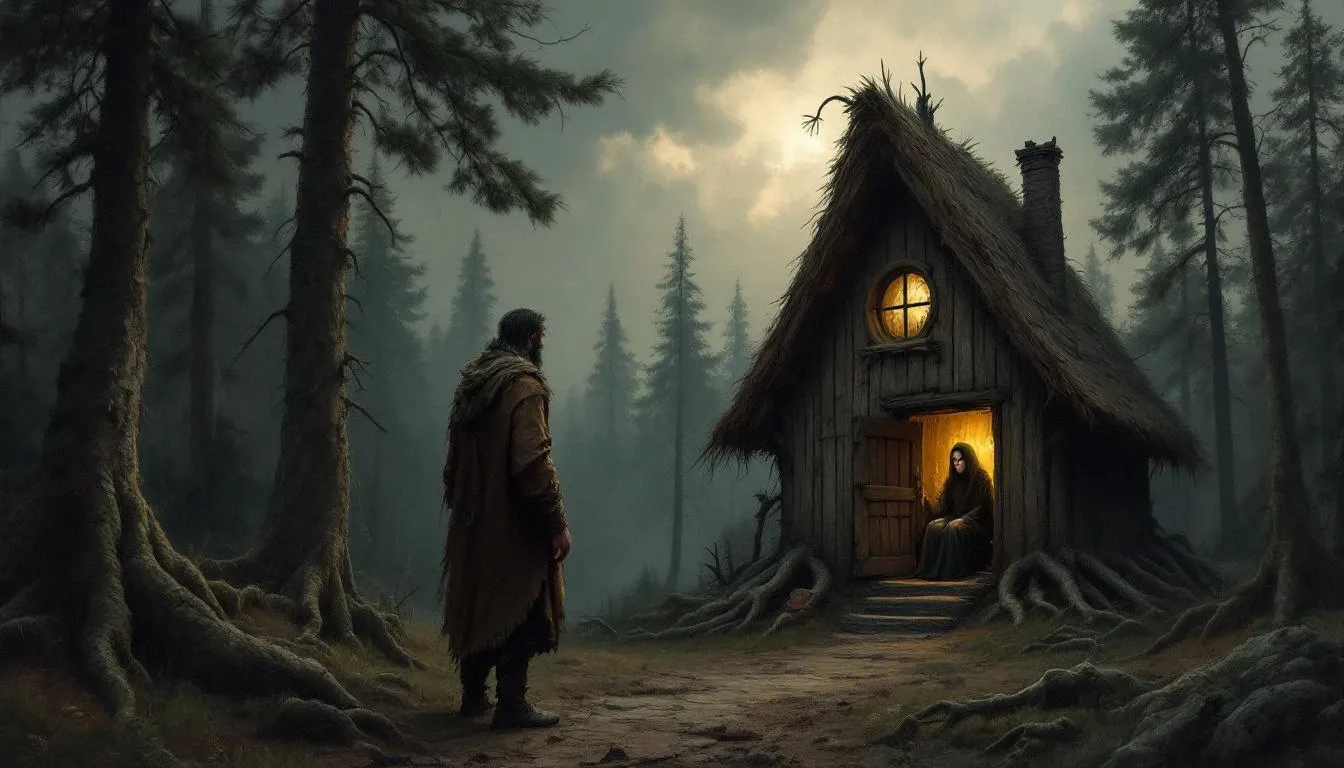
Ivan sets out with nothing — no horse, no army, no magical helpers. Just the iron boots his wife described, which he puts on and walks until the iron wears through, and then he puts on the next pair and walks some more. The fairy tale measures distance not in miles but in destruction: three pairs of boots reduced to scraps of metal, three staffs snapped from leaning on them, three loaves of iron bread gnawed to nothing by a man too desperate to notice he is eating rust.
Along the way, he encounters the old woman who appears in every Russian fairy tale when the hero has run out of options: Baba Yaga. She lives, as always, in a hut on chicken legs, behind a fence of bones, and she knows where Koschei keeps his death — because Baba Yaga knows everything about death, being the gatekeeper between the worlds of the living and the dead.
She tells Ivan the secret. Koschei's death is hidden according to the nesting principle that appears throughout East Slavic mythology: his death is at the point of a needle, the needle is inside an egg, the egg is inside a duck, the duck is inside a hare, the hare is inside an iron chest, and the chest is buried beneath a great oak tree on the island of Buyan — the mythical island beyond the edge of the ocean where the winds are born and the dead go to rest.
This is the same death-hiding structure described in the tale of Marya Morevna, and it is Koschei's signature: the externalization of mortality, the separation of the self from its own end, layer after layer of protection designed to make death impossible. To reach the needle, Ivan must crack the chest, catch the hare, catch the duck, catch the egg, and finally break the needle — each step requiring its own miracle.
And the miracles come, because Ivan has earned them. Along his journey, he spared a bear he could have killed for food. He spared a pike he found gasping on the riverbank. He spared a hawk he could have shot for feathers. Now these animals return: the bear tears open the chest, the hare is caught by another hare, the duck is caught by the hawk, and when the egg falls into the sea, the pike retrieves it.
Ivan holds the egg. Inside it, the needle. He breaks it.
Somewhere far away, Koschei the Deathless crumples like a puppet whose strings have been cut. His flesh, sustained for centuries by the externalized death, collapses into dust and bone. The palace falls. The enchantment shatters. Vasilisa is free — truly free this time, not hiding in a frog skin but released from the source of the curse itself.
The Death Hidden in an Egg
The death-in-an-egg motif is one of the most analyzed symbols in comparative folklore. It appears not only in the Frog Princess and the Koschei tales but across the entire Indo-European storytelling tradition — from the Finnish Kalevala, where the world is born from an egg, to Hindu mythology, where the cosmic egg (Brahmanda) contains the universe.
In Slavic cosmology, the egg occupies a peculiar position. It is the container of life — the shell that separates possibility from reality, potential from existence. In Easter traditions across the Slavic world, decorated eggs (pysanky in Ukrainian, pisanki in Polish) were not mere ornaments but ritual objects believed to contain protective power. The egg was the world in miniature: the shell was the sky, the white was the air, the yolk was the earth.
For Koschei to hide his death inside an egg is therefore an act of grotesque inversion. The container of life becomes the container of death. The symbol of creation becomes the vessel of annihilation. And the fact that the egg itself is hidden inside a duck, inside a hare, inside a chest — a series of natural containers enclosed in an artificial one — suggests a sorcerer who has studied the architecture of existence and learned how to reverse it.
Ivan, by breaking the egg and snapping the needle, is not simply killing a villain. He is restoring the natural order. Death belongs inside the body, not hidden on an island at the edge of the world. Mortality is not a flaw to be engineered away but the fundamental condition that makes life meaningful. Koschei's immortality is not a triumph but a perversion — and the tale of the Frog Princess, for all its surface charm, is ultimately a story about what goes wrong when someone refuses to accept the terms of being alive.
What the Frog Skin Means
The burning of the frog skin is the hinge of the entire tale, and its meaning has been debated by folklorists for over a century.
On the simplest level, it is a story about patience. Ivan was given a gift he did not understand — a wife disguised as something ugly — and instead of trusting her and waiting for the enchantment to end on its own terms, he forced the transformation by destroying the skin. His impatience did not free Vasilisa. It exposed her. It ripped away the protection she had built for herself and left her vulnerable to the very enemy she had been hiding from.
On a deeper level, the frog skin represents the gap between appearance and reality that runs through all of Russian fairy tales. The hero who judges by surfaces — who sees a frog and despairs, who sees beauty and acts rashly — is the hero who creates his own disaster. The brothers who married human women got exactly what they expected: competent, ordinary wives. Ivan, who married the incomprehensible, got something beyond ordinary — but only if he had the discipline to let it reveal itself in its own time.
The Frog Princess is not a love story in the romantic sense. It is a story about the cost of control — about the male impulse to master, to unveil, to force things into the shape you want them to be. Ivan did not burn the skin out of cruelty. He burned it out of love, or something that felt like love. But love that cannot tolerate mystery, that must strip away every disguise and expose every secret, is love that destroys the thing it claims to cherish.
Three pairs of iron boots. Three iron loaves. The full breadth of the world walked on bleeding feet. That is the price of one moment's impatience — and in the economy of Russian folklore, it is considered a fair rate.
The tale ends where all the great Slavic tales end — with a reunion that costs more than it should have, in a world that has been made briefly right by sacrifice, and with the quiet understanding that the happy ending was always available, if only someone had been willing to wait three more days.