The Slavs did not write their theology down. They had no sacred texts, no illuminated manuscripts, no parchment codices locked in monastery vaults. What they had instead were signs — carved into the lintels of doorways, scratched into the handles of spinning wheels, pressed into wet clay on the sides of funeral urns, hammered into silver pendants that women wore against their chests and men carried into battle. These signs were not decoration. They were language. They were the entire theological library of a civilization that trusted wood and metal more than ink, and understood that a symbol cut into the right surface at the right moment could hold back the dark.
The modern word for these protective signs is obereg — from the Old Slavic root oberegat', meaning to guard, to shield, to watch over. An obereg was not a lucky charm in the way a rabbit's foot is a lucky charm. It was a contract. A binding agreement between the wearer and the forces that governed the cosmos: the sun, the storm, the turning seasons, the gods themselves. You carved the sign. You wore the sign. And the god whose mark it was — Perun, Mokosh, Svarog, Rod — extended a thread of protection over your life. Break the sign, insult the god, and the contract was void. The darkness came back in.
What follows is an account of the most important of these symbols: what they looked like, which gods they belonged to, and what they were supposed to do. Not all of them have clean archaeological pedigrees. Some are well-attested in medieval artifacts. Others appear primarily in nineteenth-century ethnographic collections, recorded from peasant embroidery and folk practice centuries after Christianization drove the old faith underground. A few — and this must be said honestly — were systematized or even invented by modern reconstructionists working from fragmentary evidence. The boundaries between ancient symbol, medieval folk survival, and modern Rodnovery reinterpretation are not always clear. What is clear is that the impulse behind them — the need to mark the world with sacred geometry as a shield against chaos — is as old as the Slavic peoples themselves.
The Kolovrat: Wheel of the Unyielding Sun
The Kolovrat is the most recognized of all Slavic symbols, and also the most contested. Its name comes from kolo (wheel, circle) and vrat (to turn) — the turning wheel, the solar wheel, the sign of the sun's eternal rotation across the sky. Visually, it is a circle containing six, eight, or occasionally four curved rays radiating from a central point, each bending in the same direction like the spokes of a wheel caught mid-spin. The eight-rayed version is the most commonly depicted, and the direction of the rays matters: bent rightward (clockwise), the Kolovrat is called Posolón and represents the rising sun, growth, life, and masculine energy; bent leftward (counterclockwise), it is the Kolyadnik or Ladinets, associated with the setting sun, introspection, and feminine energy.
The symbol is linked to the great solar gods of the Slavic pantheon. An eight-rayed Kolovrat belongs to Svarog, the celestial smith who forged the sun disc and hung it in the sky. A six-rayed version is associated with Perun, the thunder god, because six is Perun's sacred number across several Slavic and Baltic traditions. A four-rayed Kolovrat — the simplest form, almost a pinwheel — is sometimes connected to Dazhbog, Svarog's son, who carried the sun across the heavens each day.
As a protective sign, the Kolovrat was carved into roof beams, stamped onto pottery, and embroidered onto clothing at points of vulnerability: the collar, the cuffs, the hem — every opening through which evil spirits might enter. The logic was straightforward. The sun is the supreme enemy of darkness. Its image, reproduced in wood or thread or metal, carries a fraction of that enmity. Wear the sun's wheel and you wear the sun's authority. Nothing that fears light will come near you.
The controversy around the Kolovrat must be acknowledged. Scholars such as Roman Jakobson and Vyacheslav Ivanov documented solar wheel motifs across Slavic archaeological sites — on pottery from the Chernyakhov culture (second through fifth centuries), on fibulae from medieval Rus', on spinning whorls from Novgorod. But the specific term "Kolovrat" as a name for this particular symbol arrangement appears primarily in modern Rodnovery (Slavic neopagan) literature. The motif is ancient. The branding may not be. This does not make the symbol meaningless — it means the symbol's meaning has been reconstructed, and the reconstruction draws on genuine tradition.
The Gromovnik: Perun's Thunder Branded Into Wood
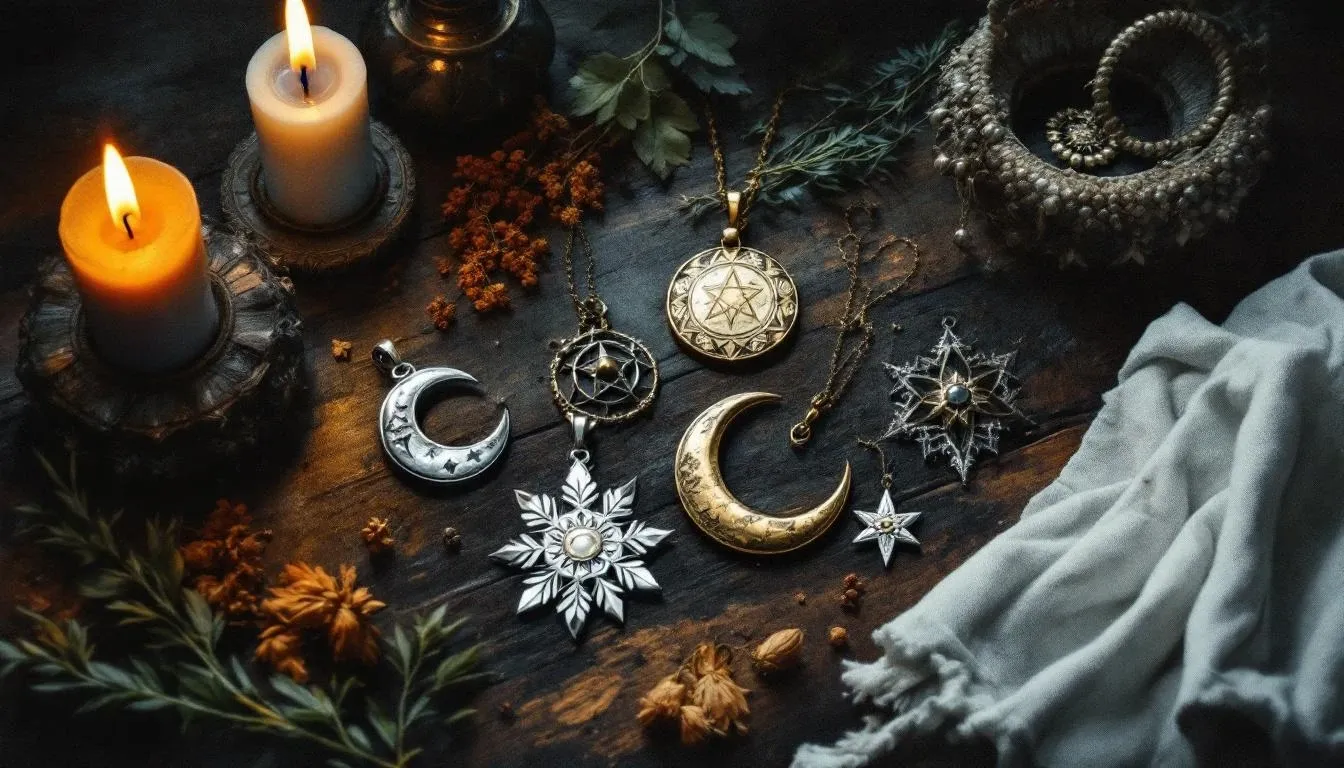
If the Kolovrat is the sun's signature, the Gromovnik — the Thunder Mark, the Thunderwheel, Perun's sign — is the storm's. It is a hexagonal figure: a circle divided into six equal sectors by straight lines radiating from the center, sometimes with additional geometric embellishment at the points where the lines meet the circumference. Where the Kolovrat's rays curve like flame, the Gromovnik's radiate straight and sharp, like the frozen image of a lightning bolt caught at the moment of branching.
This was Perun's mark, and it was not gentle. The Gromovnik was carved above doorways and on the gables of houses — particularly on the roofline, the part of the structure closest to the sky and therefore closest to the god of storms. Its purpose was dual. First, it served as a literal lightning ward: by placing the thunder god's own symbol on the roof, the homeowner was claiming divine patronage, asking Perun to recognize his own sign and direct his bolts elsewhere. Second, it was a ward against evil in general. The Slavs believed that evil spirits — unclean dead, demons, creatures of Chernobog's domain — feared thunder above all things. Lightning was not just weather. It was divine judgment. A bolt that struck a tree split it open not by accident but because something unholy had hidden inside it, and Perun had found it.
Warriors carried the Gromovnik on their shields and armor. The Primary Chronicle and later byliny (heroic songs) describe warriors painting or carving protective signs on their equipment before battle, and while the texts do not always specify which signs, the thunder mark is the most logical candidate. You went to war under Perun's protection or you did not go at all. A man wearing Perun's Gromovnik was declaring himself a soldier of the storm god — subject to his law, shielded by his wrath.
The archaeological record supports the symbol's antiquity. Six-petaled rosettes matching the Gromovnik pattern have been found on pendants, amulets, and architectural carvings from Kievan Rus' and from earlier Slavic settlement sites. In northern Russian wooden architecture — the extraordinary carved houses and churches that survived into the nineteenth and twentieth centuries — the thunder mark appears on virtually every roofline, preserved by rural builders who no longer knew its name but never stopped carving it.
Lunnitsa: The Crescent That Guarded Women in the Dark
Turn from fire to water, from the sky to the body, from the gods of war to the goddess who spun fate in the darkness, and you find the Lunnitsa. It is a crescent — a slim, downward-facing curve of metal, usually bronze or silver, shaped like the moon three days after new. The horns point downward. The surface is often decorated with fine granulation, filigree, or stamped geometric patterns: triangles, dots, tiny circles within circles.
The Lunnitsa was Mokosh's sign. Mokosh — the only goddess in Vladimir's pantheon of 980, the Great Mother, the spinner, the keeper of women's fate — claimed the moon as her domain the way Perun claimed the storm. Where Perun's symbols were aggressive, outward-facing, meant to frighten enemies both human and spiritual, the Lunnitsa was intimate. It hung around a woman's neck on a chain or cord, resting against the chest, hidden beneath clothing. Its power was private. It dealt with matters men were not supposed to understand: fertility, pregnancy, childbirth, menstruation, the cycles of the female body that tracked the cycles of the moon.
Archaeologists have recovered Lunnitsa pendants from hundreds of burial sites across Eastern Europe, dating from the tenth through the thirteenth centuries. Three distinct types have been classified: narrow two-horned crescents (the oldest and simplest), wide two-horned crescents with elaborate surface decoration, and the rarer three-horned variant that some scholars interpret as a synthesis of lunar and solar symbolism. The geographic distribution is enormous — from the Novgorod lands in the northwest to the steppe borderlands in the south — confirming that Lunnitsa worship was not a local folk practice but a pan-Slavic tradition with deep roots.
The lunnitsa was one of the most popular types of pendants in Rus' from the 10th to 13th centuries. Despite Christianization, these crescent-shaped amulets continued to be produced and worn alongside crosses — sometimes on the same necklace — suggesting a prolonged coexistence of pagan and Christian protective symbolism rather than the abrupt replacement traditionally assumed by earlier scholarship.
This coexistence is revealing. A woman in twelfth-century Novgorod might wear a baptismal cross and a Lunnitsa on the same chain, and see no contradiction. The cross protected her soul. The crescent protected her body. Christianity addressed the afterlife. Mokosh's moon addressed the matters of this one — the child growing in the womb, the safe passage of birth, the husband's return from trade routes, the harvest that would feed the family through winter. Different concerns, different signs, same neck.
The Star of Alatyr: Eight Points at the Navel of the World
At the center of the Slavic cosmos there is a stone. It sits on the island of Buyan in the middle of the primordial ocean, and from beneath it flow all the rivers of healing, all the waters that sustain the living world. The Slavs called it the Alatyr — the white stone, the burning stone, the father of all stones, the navel of the earth. Its symbol is an eight-pointed star, formed by overlaying two squares rotated forty-five degrees against each other, creating a shape that radiates outward from a single center in perfect geometric equilibrium.
The Alatyr star belongs to Rod — the primordial god, the creator deity, the ancestor of everything. Rod existed before the other gods, before the world, before separation itself. He divided light from darkness, the living from the dead, the earthly realm of Yav from the heavenly realm of Prav and the underworld of Nav. The Alatyr is his marker — the point where creation began, the fixed anchor around which the three worlds of the Slavic cosmos rotate.
As an obereg, the Alatyr star was one of the most versatile symbols in Slavic practice. Unlike the Gromovnik, which was strictly masculine, or the Lunnitsa, which was strictly feminine, the Alatyr was universal. Men, women, children, elders — anyone could wear it, carve it, embroider it. Its power was not martial and not connected to fertility. It was existential. The eight-pointed star represented completeness, the totality of creation radiating from a single origin. Wearing it meant placing yourself at the center of divine order, connecting yourself to the source of all things. It brought wisdom, harmony, balance, and — according to folk belief — the protection of the entire ancestral line, the accumulated spiritual weight of every generation that came before you.
Svarog's Square and the Rusalka's Comb: The Smith's Fire and the Water Spirit's Claim
Two more symbols deserve attention, each from opposite ends of the Slavic spiritual spectrum.
Svarog's Square — also called the Star of Rus' — is a masculine symbol of the celestial forge. It depicts a square with two interlocking ellipses passing through it, their pointed ends extending beyond the square's borders in four directions. The visual effect is of a shape simultaneously contained and breaking free — a fitting representation of fire held within a forge but radiating heat outward. Svarog was the sky-smith, the god who hammered the sun into shape and gave humanity fire, iron, and the plow. His square was the symbol of creation through labor — not the effortless creation of a god who speaks the world into existence, but the sweating, hammering, sparks-flying creation of a blacksmith who makes things with his hands. Warriors and craftsmen wore it. So did anyone who understood that survival in the Slavic world was not granted by the gods but forged, with effort and heat and the ringing of iron.
The Rusalka's Comb is darker and stranger. Rusalki — the water spirits of Slavic folklore, the drowned girls, the unquiet dead who haunt rivers and forests during Rusal'naia Week — were not protective beings. They were dangerous. They lured men into the water with singing. They tickled victims to death. They dragged children below the surface. And yet their symbol — a stylized comb, sometimes depicted as a small rake-like pendant — appeared among the protective amulets excavated from medieval burial sites. The comb was an offering. You did not wear the Rusalka's sign to invoke her protection — you wore it to appease her, to signal that you acknowledged her power and did not intend to cross her. It was a diplomatic token left at the border of a hostile territory, saying: I know you are there. I respect what you can do. Let me pass.
Archaeological evidence supports this interpretation. Eleventh- and twelfth-century burial assemblages from the Novgorod and Smolensk regions include miniature combs, keys, spoons, and small axe-shaped pendants strung together on chains — what scholars call an obereg set, a collection of symbolic tools meant to address different supernatural threats simultaneously. The comb among them was for the water. The axe was for Perun. The spoon was for domestic abundance. Together, they formed a portable theology — a necklace that was also a prayer to every force that mattered.
The Rod Symbol: The Root of All Kinship
Rod's sign is the oldest and perhaps the most fundamental of all Slavic symbols, though also among the hardest to pin down archaeologically. It is typically described as a circle containing a symmetrical pattern of six petals — a rosette, sometimes with a small circle at the center representing the seed of creation. Variations include four petals, eight petals, and more complex branching patterns that resemble a family tree spreading outward from a single trunk.
Rod was the ultimate ancestor. Not just the ancestor of humanity but the ancestor of the gods themselves — the being who existed before existence, who separated the worlds and set the cosmos spinning. His symbol was therefore not a petition to a distant deity but a claim of kinship. Wearing Rod's sign meant declaring: I am connected to the source. My blood carries the original spark. My ancestors stand behind me, and behind them stands the god who made everything.
The protective function of Rod's symbol was communal rather than individual. While the Gromovnik protected a warrior, and the Lunnitsa protected a woman's body, Rod's sign protected the family line — the rod, which in Russian literally means "kin, lineage, genus." It was carved into hearth stones, embroidered onto wedding garments, painted onto the walls of homes where multiple generations lived together. Its power was continuity. As long as the sign remained intact, the family line remained intact. As long as the symbol was remembered, the ancestors were not truly dead.
Slavic Symbols as Tattoo Art
The resurgence of interest in Slavic symbols has found one of its most visible expressions in tattoo culture. The Kolovrat, the Alatyr star, and Perun’s thunder mark have become popular choices among people seeking tattoo designs rooted in pre-Christian European tradition — an alternative to the more widely known Norse rune tattoos.
The “Slavic Core” aesthetic trend that emerged on TikTok and Instagram in the mid-2020s accelerated this movement. Young people across Eastern Europe and the Slavic diaspora began reclaiming these symbols as markers of cultural identity — embroidered patterns on clothing, protective symbols as jewelry, and ancient motifs adapted for modern tattoo work.
This revival is not without controversy. Some of these symbols — particularly the Kolovrat — have been co-opted by far-right groups, which has created tension between those who view them as heritage and those who associate them with extremist ideology. The historical reality is that these symbols predate any modern political movement by centuries. The Kolovrat appears on medieval pottery, church carvings, and folk textiles across the entire Slavic world, from Serbia to Siberia, with no political meaning whatsoever. Reclaiming them as what they originally were — protective signs, solar symbols, marks of belonging to a culture and a cosmos — is itself an act of cultural preservation.
What Survived and What Was Lost
Christianity did not destroy these symbols. It absorbed some, ignored others, and drove the rest underground into the textile arts, the woodcarving traditions, and the folk practices of rural communities that nominally attended church on Sunday but carved Kolovrats into their roof beams on Monday. For centuries, the two systems coexisted — not peacefully, exactly, but functionally, like two languages spoken in the same household where the official language is used in public and the old language is used when it matters.
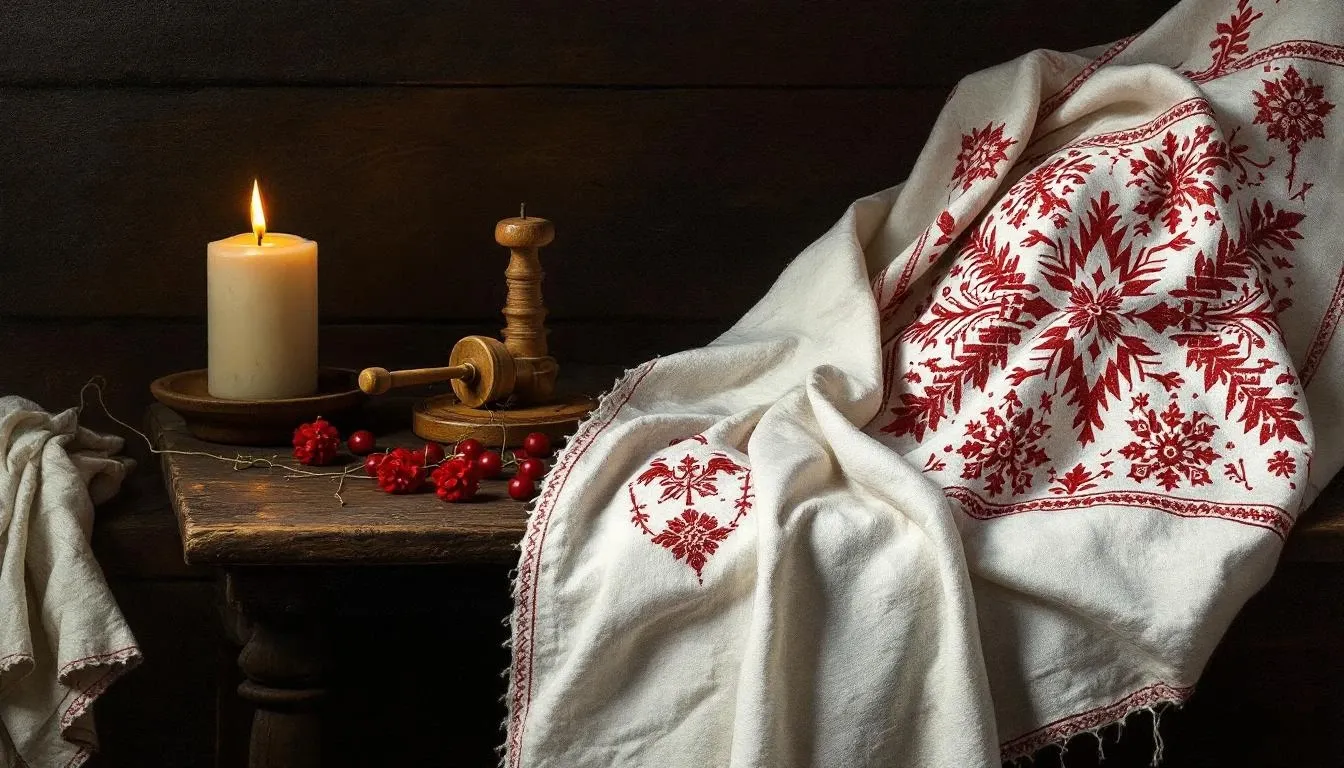
The nineteenth-century Russian ethnographers — men like Alexander Afanasyev, Vladimir Dal, and Ivan Sakharov — arrived in the villages just in time to record what was vanishing. They documented embroidery patterns that encoded solar wheels and thunder marks in red thread on white linen. They sketched the carvings on peasant houses where six-petaled rosettes covered every window frame and gable. They transcribed folk charms that invoked the Alatyr stone by name. But by the time they published their findings, industrialization and mass education were already erasing the contexts that gave the symbols meaning. A grandmother knew that the pattern on her spinning cloth was Mokosh's sign. Her granddaughter knew it was pretty.
Today, these symbols circulate widely in Slavic neopagan (Rodnovery) communities, in jewelry shops, on tattoo parlor walls, and across the internet. Some of this revival is scholarly and careful. Some of it is not. The essential thing to understand is that the symbols themselves — the solar wheel, the thunder mark, the crescent, the eight-pointed star — are genuinely old. The specific systematizations, the tidy charts assigning each symbol to a god with a clean line of attribution, are frequently modern. The ancient Slavs did not publish reference guides to their sacred geometry. They carved it into cradles and coffins, and expected you to learn what it meant by watching the people who came before you.
That transmission broke. What we have now are the fragments — recovered from earth, from fabric, from the carved faces of houses that stood for centuries in forests where no one thought to look until it was almost too late. They are not complete. They are not undamaged. But they are real. And the impulse that created them — the conviction that a line drawn in the right shape at the right moment could hold back the darkness — that impulse has not broken at all. It is carved into every culture that has ever looked at the night and decided to answer it with geometry.