Andrzej Sapkowski has said, more than once, that it would be easier to list the mythologies he didn't draw from than the ones he did. Fair enough. The Witcher books pull from Arthurian legend, Arabian folklore, Norse sagas, and Grimm fairy tales. But the backbone — the monsters that gave the franchise its texture, its dread, its cultural fingerprint — is Slavic.
The question that most articles get wrong is a simple one: which creatures did Sapkowski adapt faithfully, which did he twist beyond recognition, and which have nothing to do with Slavic folklore at all?
This is the full accounting. Ten creatures. Rated for accuracy. No hand-waving.
The Striga — Folklore Accuracy: 9/10
The striga is Sapkowski's masterpiece of adaptation, and it is the creature that launched the entire franchise. The very first Witcher short story, The Witcher (1986), centers on Geralt lifting a striga curse from a princess. The Netflix series opened with the same story. CD Projekt Red built an entire cinematic around it.
The source material is the Polish strzyga — a person born with two souls, two hearts, and sometimes two rows of teeth. When a strzyga died, one soul departed normally. The other remained, reanimating the corpse into a predatory revenant that fed on human blood and flesh. The belief was documented across Poland, Silesia, and Moravia from the medieval period through the early twentieth century.
What Sapkowski changed was the origin mechanism. In folklore, the strzyga was born, not made. You could identify her in the cradle by the double row of teeth or the caul over the face. Sapkowski turned it into a curse — specifically, a curse born from incest and political malice. The underlying creature, though, is remarkably faithful: the nocturnal hunting, the coffin emergence, the possibility of reversal through ritual.
The archaeological record backs the fear. In 2022, a seventeenth-century burial was unearthed in the Polish village of Pien: a young woman with a sickle pressed across her throat and a padlock on her toe, positioned so that any attempt to rise would result in self-decapitation. She was buried as a suspected strzyga.
What the games got right: Almost everything. The striga's appearance, behavior, and the concept of lifting the curse by surviving until dawn are all grounded in authentic belief.
What they changed: The curse origin. Folklore strzygi were born, not cursed.
Read the full entry: The Striga
The Leshen (Leshy) — Folklore Accuracy: 6/10
The Witcher 3's Ancient Leshen is one of the most visually striking boss encounters in gaming history — a towering antlered figure wreathed in roots and crows, commanding wolves and controlling the forest itself. It is genuinely terrifying. It is also a significant departure from the original.
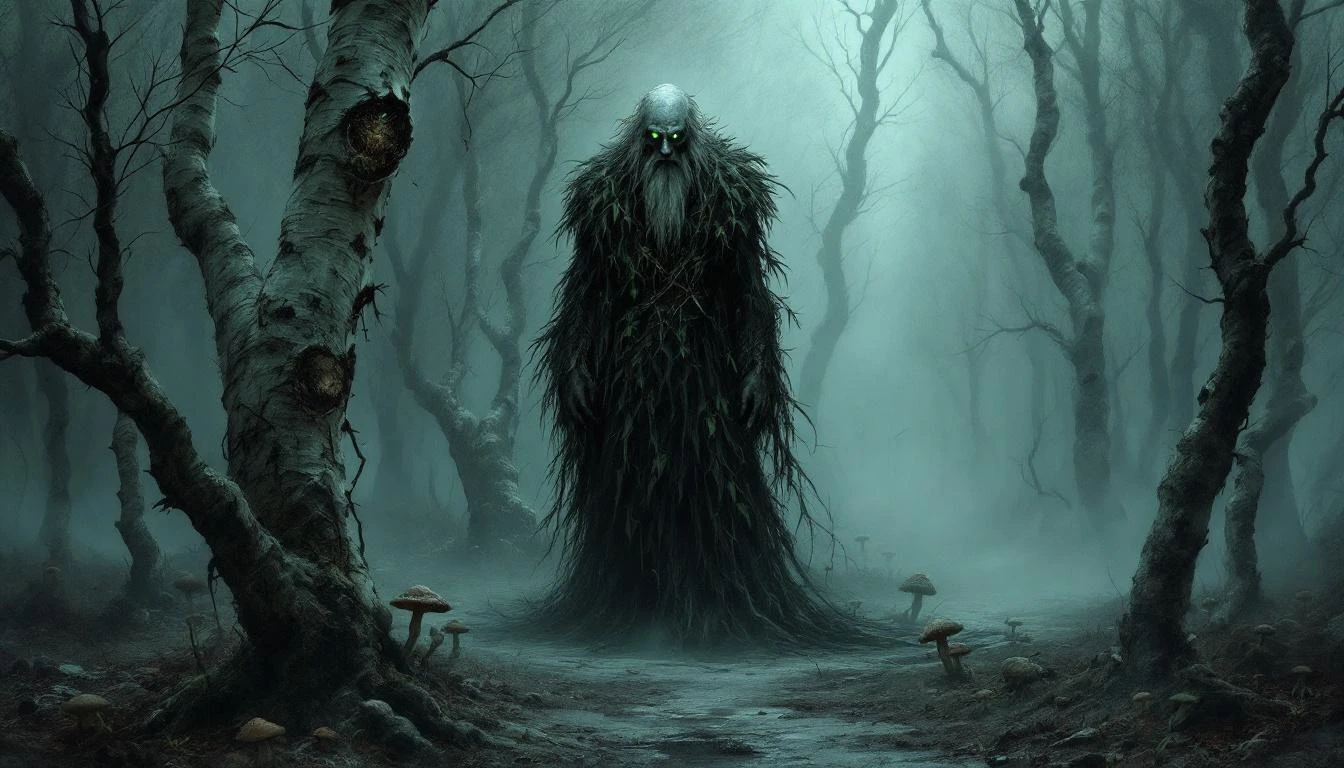
The Slavic leshy (Polish leszy, Russian леший) is the master and protector of the forest. He appears in ethnographic records from Russia, Poland, Belarus, and Ukraine as far back as the medieval period. In most accounts, the leshy is a shape-shifter who can appear as a tall peasant, a moss-covered giant, a whirlwind, or a bear. He leads travelers astray, steals children, and strikes bargains with shepherds and hunters.
But — and this is the crucial difference — the leshy was not inherently hostile. Villages that respected the forest could coexist with their local leshy. Hunters who took only what they needed, who avoided cutting trees without necessity, who left offerings of bread and salt at the forest edge, could expect the leshy's tolerance and sometimes even his protection. He punished greed, not existence.
The Witcher 3 stripped away this ambiguity. The Leshen is a territorial predator, pure and simple. The questline involving it forces a binary choice — kill the Leshen or sacrifice a villager to appease it — that flattens the folklore into a standard boss encounter. The visual design, with its skull-like face and antler crown, borrows more from modern folk horror aesthetics than from any historical description.
What the games got right: The leshy's deep connection to a specific forest territory, its command over animals, and its ability to appear and disappear at will.
What they changed: The leshy's moral complexity, its shapeshifting nature, and the possibility of peaceful coexistence. The antler design is a modern invention.
The Kikimora — Folklore Accuracy: 1/10
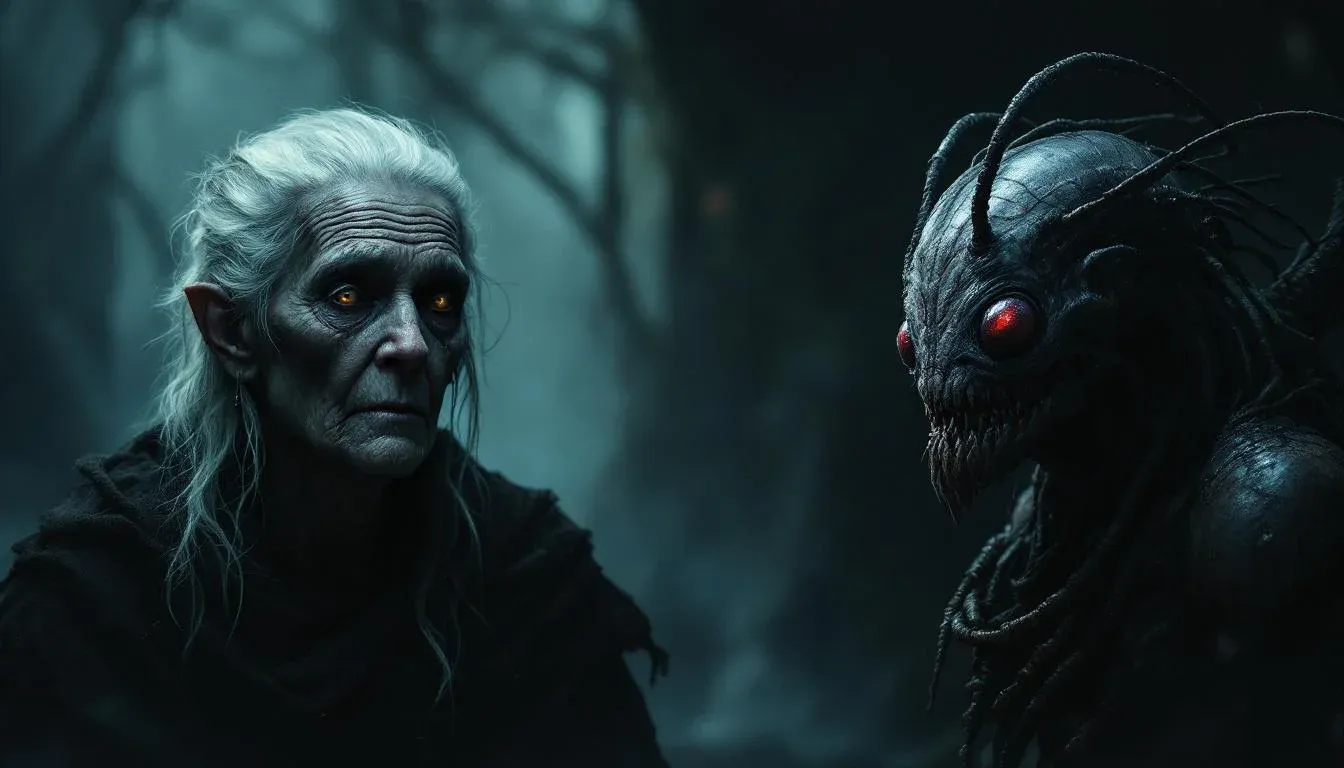
This is the most dramatic departure in the entire franchise. The Witcher presents kikimoras as giant insectoid monsters — think alien xenomorphs living in swamps, organized into hive structures under a bloated queen. Geralt fights one in the opening scene of the Netflix series, and the games feature them as common low-level enemies.
The real kikimora bears absolutely no resemblance to any of this.
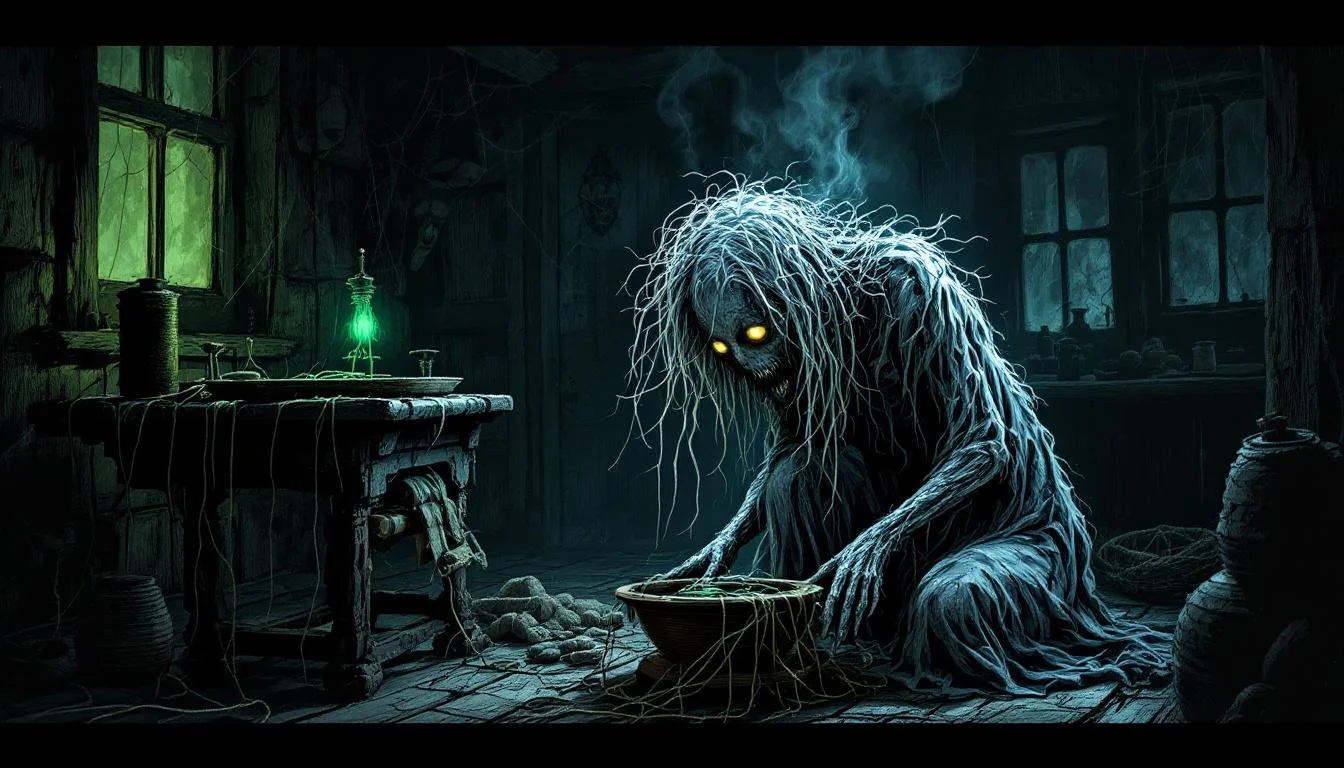
In East Slavic folklore, the kikimora is a household spirit — a thin, elderly woman, sometimes described as small and wizened, sometimes as a figure glimpsed only at the edge of sleep. She was associated with spinning, weaving, and the domestic space. A kikimora who was satisfied with the household would finish spinning left unfinished overnight. One who was displeased would tangle thread, break dishes, disturb the chickens, and torment sleeping residents with nightmares and the feeling of pressure on the chest.
Some regional traditions connected the kikimora to the spirits of stillborn or unbaptized children. Others described her as the wife or companion of the domovoy — the male house spirit. In a few accounts from northern Russia, a marsh variant called the kikimora bolotnaya (swamp kikimora) existed, which lured travelers into bogs. This marsh variant is likely where Sapkowski found his conceptual thread, but the leap from "swamp-dwelling old woman" to "giant insect queen" is enormous.
What CD Projekt Red did with the kikimora is what the industry calls nominal borrowing. They took a name saturated with Slavic cultural resonance and attached it to a creature of pure invention. It works as game design. It has nothing to do with folklore.
What the games got right: The name. The swamp habitat, loosely.
What they changed: Everything else. The kikimora is not an insect.
The Drowner (Utopiec) — Folklore Accuracy: 7/10
Drowners are the cannon fodder of The Witcher 3 — pale, bloated humanoids that swarm the banks of every river, lake, and swamp in Velen and Skellige. Players kill hundreds of them without much thought. But the utopiec of Polish folklore deserved more respect than that.
The word utopiec (or topielec) literally means "the drowned one." In Polish and broader West Slavic belief, these were the spirits of people who died by drowning — suicides, murder victims, unbaptized infants thrown into rivers by desperate mothers, sailors lost in storms. The death had to be violent and the body unrecovered or improperly buried for the transformation to occur.
Unlike the mindless game enemies, the folklore utopiec was cunning. It could mimic human voices, call travelers by name, appear as a drowning person in need of rescue. When someone reached into the water to help, the utopiec would drag them under. In some accounts, the only way an utopiec could find peace was to drown a replacement — transferring the curse to a new victim.
The topielec conceals himself just beneath the surface and waits. He can imitate the cries of a child, the voice of a friend, even the lowing of cattle. Those who approach the water's edge to investigate are seized by the ankles and pulled under with such force that witnesses report seeing the victim's hat float to the surface while the body is already gone.
What the games got right: The aquatic habitat, the drowned-human origin, the aggression toward the living, the bloated physical appearance.
What they changed: The intelligence. Folklore utopce were tricksters and mimics. Game drowners are shambling brutes.
The Noonwraith (Poludnitsa) — Folklore Accuracy: 8/10
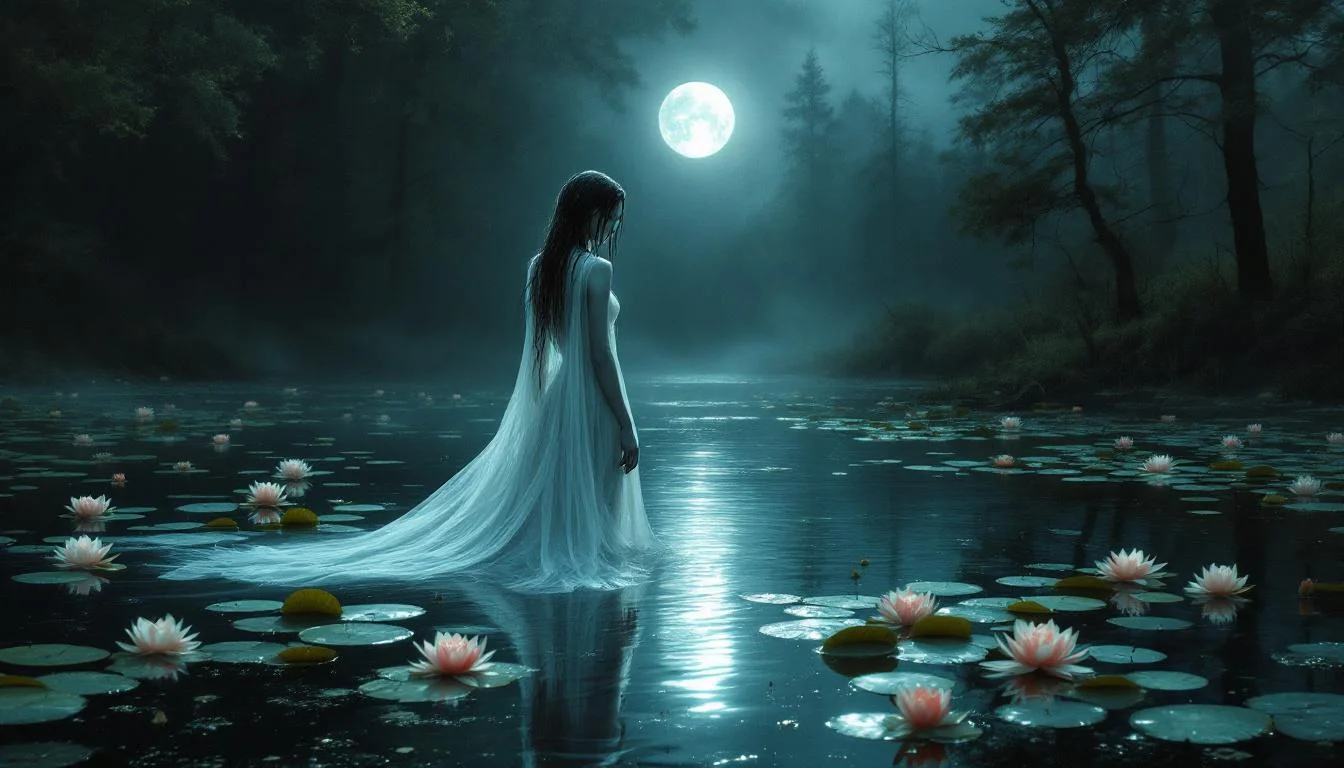
The Witcher 3 quest Devil by the Well introduces players to the noonwraith — a spectral woman in white who appears in fields under the midday sun, killing farmers and travelers. The game's version is a solid adaptation.
The południca (Lady Midday) is one of the most distinctive figures in Slavic demonology. Unlike nearly every other supernatural being in European folklore, she appears not at night but at noon, during the hottest part of the summer day. Field workers who labored through the midday rest period — a time when custom demanded everyone retreat from the sun — risked encountering her.
The południca would approach a lone worker and engage them in conversation, often asking questions about farming, flax cultivation, or similar topics. The catch: you had to keep answering correctly and keep the conversation going for a full hour, until the church bells rang one o'clock. If you stumbled, contradicted yourself, tried to run, or simply ran out of things to say, she would strike you dead — by strangulation, neck-twisting, or madness. Some accounts describe the victim being found perfectly intact but lifeless, as if struck by sunstroke.
The noonwraith in The Witcher 3 preserves the core elements: the daytime appearance, the white clothing, the connection to agricultural land, and the spectral nature. What the game removes is the conversational component — the terrifying idea that the monster kills you not with claws but with questions you cannot answer.
What the games got right: The daytime manifestation, the field setting, the appearance as a woman in white, the connection to the dead.
What they changed: The killing method. Folklore południca killed through failed conversation, not combat.
The Vodyanoy — Folklore Accuracy: 8/10
The vodyanoy appears in the first Witcher game as one of its more memorable encounters — an underwater civilization of frog-like humanoids that Geralt can either ally with or fight. The portrayal is surprisingly nuanced for a 2007 game.
In East Slavic folklore, the vodyanoy (водяной) is the master of a particular body of water in the same way the leshy is master of a specific forest. He appears most commonly as an old man with a fish tail, webbed hands, and a body covered in algae and river mud. He lives in a palace at the bottom of his lake or river — some accounts specify it is made of crystal or ice.
The vodyanoy could be dangerous: he drowned careless swimmers, pulled boats under, and demanded respect from fishermen and millers. But he could also be propitiated. Fishermen poured vodka into the water for him. Millers kept his favor because the vodyanoy was believed to control the flow of water to the mill. Like the leshy, the vodyanoy operated on a system of reciprocity — respect the water, and the water's master would let you work in peace.
What the games got right: The aquatic domain, the capacity for both hostility and alliance, the intelligence and civilization of the creature, the connection to specific bodies of water.
What they changed: The visual design shifted from an old man to amphibian humanoids, but the behavioral pattern is faithful.
The Rusalka — Folklore Accuracy: 5/10
The rusalka in The Witcher appears as a beautiful, dangerous water spirit — essentially a Slavic mermaid-siren who lures men to watery deaths with her beauty and song. This is the popularized, romanticized version. The folklore is considerably darker and more complex.
The earliest ethnographic records, particularly from Ukraine and southern Russia, describe rusalki as the spirits of young women who died unnatural deaths connected to water — drowning victims, suicides, murder victims, or women who died during Rusalka Week (Rusal'naia nedelia), the period around Pentecost. They were not beautiful seductresses by default. Many accounts describe them as pale, waterlogged, with green hair tangled with pondweed, cold to the touch, sometimes visibly decomposed.
Their danger was not seduction but proximity. During Rusalka Week, they left the water and entered fields and forests. Anyone who encountered them — man, woman, or child — could be tickled to death, dragged underwater, or driven mad. The "tickling to death" motif is persistent across multiple regional traditions and appears in no Western folklore equivalent.
The Witcher franchise collapsed the rusalka into a generic siren archetype, losing the seasonal restrictions, the tickling motif, the connection to wrongful death, and the agricultural rituals communities performed to appease them.
What the games got right: The aquatic setting, the female spirit, the danger to men, the connection to drowning.
What they changed: The appearance (too beautiful), the method of killing (seduction instead of tickling), and the entire seasonal and ritual framework.
The Botchling (Poroniec) — Folklore Accuracy: 9/10
The Bloody Baron questline in The Witcher 3 is widely considered one of the greatest narrative sequences in gaming history, and at its center is the botchling — a hideous fetal creature born from the improper burial of a stillborn or miscarried child.
This is the poroniec of Polish folklore, adapted with remarkable fidelity. In traditional belief, a stillborn child that was not properly buried would transform into a poroniec — a small, vicious spirit that returned to torment its mother, draining her strength and killing subsequent pregnancies. The creature fed on blood, hiding under the bed or in the ceiling beams.
The folklore also provided the cure. A poroniec could be transformed into a benevolent kłobuk — a protective household spirit — by being given a proper name, wrapped in cloth, and buried beneath the threshold of the family home. The Witcher 3 reproduces this exactly: Geralt can either kill the botchling or perform the naming ritual, burying it at the threshold, where it becomes a lubberkin that guides him to the missing family.
What the games got right: The origin (improperly buried stillborn), the behavior (tormenting the mother), the cure (naming + threshold burial + transformation into protective spirit). This is one of the most faithful folklore adaptations in the entire franchise.
What they changed: Almost nothing of substance. The visual design is original, but the mythology is intact.
The Fiend (Bies) — Folklore Accuracy: 3/10
In The Witcher 3, the Fiend is a massive, deer-like creature with a third eye that can hypnotize opponents. It is one of the game's most impressive encounters visually — a towering beast that feels ancient and primordial.
The Polish name bies refers to something entirely different. In pre-Christian Slavic belief, biesy were formless evil spirits — personifications of undefined malevolent forces in nature. They were among the oldest and most dangerous demons in the Central and East European tradition, predating the organized pantheon of Slavic gods.
After the Christianization of Slavic territories between the tenth and fourteenth centuries, the bies was reinterpreted as a devil-figure, essentially merged with the Christian concept of a demon or fallen angel. The word became a near-synonym for czort (the Slavic devil). The bies had no physical form, no antlers, no third eye, no deer-like body.
CD Projekt Red took the name and the vague concept of "ancient Slavic demon" and built an entirely original creature around it. The visual design draws more from Celtic stag imagery and modern creature design than from any Slavic source.
What the games got right: The sense of something ancient and pre-Christian. The name.
What they changed: Everything physical. The bies was a formless spirit, not a giant deer.
The Werewolf (Wilkolak / Vukodlak) — Folklore Accuracy: 7/10
Werewolves in The Witcher function roughly as expected — cursed humans who transform into wolf-like beasts, aggressive and difficult to kill. The franchise treats them as a fairly standard monster type, which is both a strength and a missed opportunity.
The Slavic werewolf — wilkołak in Polish, vukodlak in South Slavic languages — has a richer tradition than the Western version. The name literally translates to "wolf-skin" or "wolf-pelt." In the oldest East Slavic accounts, transformation was achieved through sorcery: reciting specific incantations, somersaulting over a knife stuck into a particular tree, or passing through a magical hoop or belt made of human skin.
Critically, the Slavic werewolf was not always evil. Some traditions, particularly from the Balkans and Ukraine, describe werewolves who fought against vampires or protected their communities while in wolf form. Others describe involuntary transformation as a curse laid by a sorcerer, where the victim retained human consciousness inside the wolf body and suffered immensely. The South Slavic vukodlak further complicates things by sometimes referring not to a werewolf but to a type of vampire — the categories overlap in ways that have no Western parallel.
What the games got right: The curse mechanism, the human-to-wolf transformation, the concept of involuntary lycanthropy.
What they changed: The moral complexity. Some Slavic werewolves were protectors, not just predators. The overlap with vampire lore is also absent.
Sapkowski's Approach: Adaptation, Not Transcription
The pattern across all ten creatures reveals a consistent creative method. Sapkowski and CD Projekt Red use Slavic folklore as a starting vocabulary — names, habitats, basic behavioral sketches — and then reshape each creature to serve narrative and gameplay purposes. The most faithful adaptations (striga, botchling, noonwraith, vodyanoy) tend to be the ones where the original folklore already contained strong dramatic potential. The least faithful (kikimora, fiend) are cases where the name was evocative but the original creature did not translate well into a combat-oriented fantasy setting.
Sapkowski himself has pushed back against the label of "Slavic fantasy writer," arguing that his work draws from all of European mythology and that the Witcher world is not meant to be a Slavic setting. This is both true and somewhat disingenuous. The monsters that define the franchise — the ones that distinguish it from Tolkien, from Dungeons and Dragons, from every other fantasy property — are overwhelmingly Slavic. Without the strzyga, the południca, the leshy, and the vodyanoy, the Witcher would be just another medieval fantasy. With them, it became something no Western studio could have invented.
The real achievement is not accuracy. It is accessibility. Before Sapkowski, these creatures existed in ethnographic records read by scholars and in oral traditions fading with each generation. After the Witcher — the books, the games, the show — millions of people who had never heard of a strzyga or a południca now carry some version of them in their imagination. Distorted, simplified, adapted for entertainment, yes. But alive. And for folklore, alive is what matters.