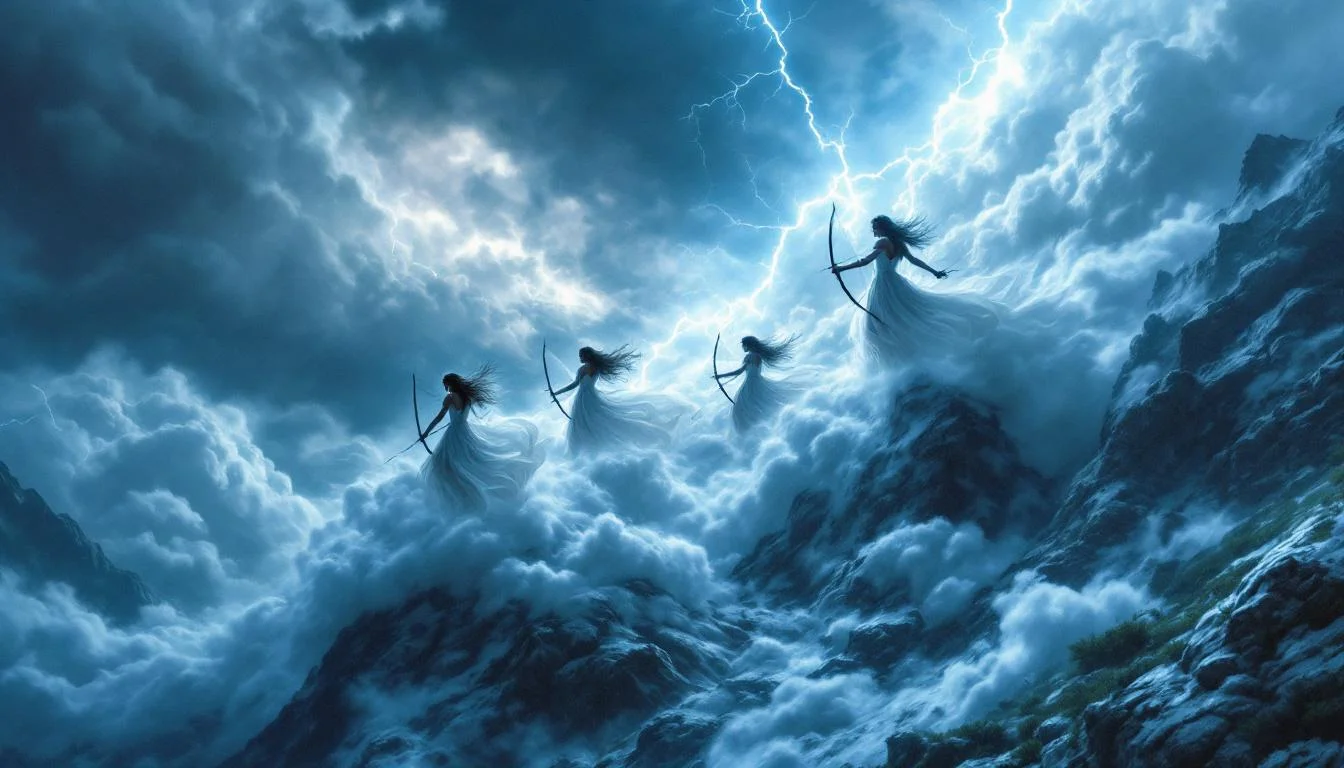
There is a lake in the mountains. It sits in a basin of grey stone, fed by snowmelt and rain, and its surface is so still that it reflects the sky with a fidelity that makes you uncertain which is the real sky and which is the copy. The water is clear enough to see the bottom, but the bottom is far enough away that what you see there — dark shapes, shifting colors, the suggestion of movement — could be anything. Rocks. Weeds. Something else.
You stand at the edge. The sun is behind you. Your shadow falls forward, across the wet stones, across the shallow water at the margin, and out onto the surface of the lake.
Something beneath the surface reaches up and takes it.
Not your arm. Not your reflection. Your shadow. It peels away from the water like a layer of paint lifting from wood, and it sinks. Down through the clear water, past the dark shapes on the bottom, into whatever lives below. You feel nothing. You see your shadow vanish. And then you stand in full sunlight, casting no shadow at all, and you understand that you have less than a year to live.
The thing that took your shadow is a Yuda. And she has been waiting in that lake for a very long time.
What a Yuda Is
The Yuda (Юда, plural yudi) is a supernatural being of Bulgarian folk belief — a water spirit associated with mountain lakes, springs, and remote bodies of water in the highlands of the Balkan peninsula. She is female, beautiful, and lethal, and she belongs to a broad category of South Slavic fairy-like beings that includes the Samodiva, the Vila, and, in some taxonomies, the Rusalka of East Slavic tradition.
But the Yuda is not a Samodiva, and the distinction matters.
The Samodiva is a creature of forests and meadows. She dances in moonlit clearings, she rides deer, she has hair that shines like spun gold, and her power is bound up in that hair — cut it, and she loses her supernatural nature. The Samodiva is social. She dances in groups. She interacts with shepherds, hunters, and heroes. She can be bargained with, tricked, even married under certain desperate circumstances.
The Yuda does not dance in meadows. She does not ride deer. She does not negotiate. She lives in water — specifically in the high, cold, still lakes of Bulgaria's mountain ranges, the places where the air is thin and the silence is the kind that presses on your ears. She does not come to you. You come to her. You approach her lake. Your shadow touches her water. And that is the transaction, complete and final, requiring no negotiation because there is nothing to negotiate. The shadow is taken. The death follows.
The Yuda is the Samodiva's colder, deeper, more dangerous cousin. Where the Samodiva is fire — passionate, volatile, capable of both love and fury — the Yuda is water. Patient. Still. Waiting.
The Shadow
The shadow-stealing is the Yuda's signature act, and it has no precise parallel anywhere else in Slavic folklore. Other spirits kill, drown, seduce, deceive, curse, possess. Only the Yuda steals the shadow — and only the shadow, nothing else. She does not touch the body. She does not enter the mind. She takes the one thing that is both part of you and separate from you, the dark companion that follows you everywhere the light reaches, and she pulls it down into the water.
The consequences of losing your shadow are described with remarkable consistency across Bulgarian folk sources. A person without a shadow sickens. They grow pale. Their appetite fails. Their eyes lose focus. They do not die immediately — the process takes weeks or months, sometimes as long as a full year. But they die. Without fail. The shadowless person is already dead; the body simply has not been informed yet.
The folk logic of the shadow's importance draws on a belief system in which the shadow is not merely an optical phenomenon but a component of the self — an external soul, a visible manifestation of the life force. To lose your shadow is to lose the part of your vitality that the world can see. You become, in a sense, transparent — present but diminished, alive but fading, a person-shaped absence walking through a world that has already begun to forget them.
"The yuda takes the shadow from a person who stands near her water in sunlight. The person does not feel it. But from that day forward, they begin to waste away. No healer can save them. No prayer reaches them. They are as good as dead from the moment the shadow is gone."
This is not possession. It is not a curse that can be broken. It is a subtraction — something fundamental removed from the equation of a human life, and the remainder is not enough to sustain existence. The Yuda does not hate you. She simply takes what she takes, the way water takes whatever falls into it.

The Healing Waters
Here is the contradiction that makes the Yuda one of the most interesting figures in Slavic water mythology: the same waters where the Yuda steals shadows are also the waters that heal.
Bulgarian mountain springs and lakes have been used for healing purposes since before recorded history. The mineral-rich waters of the Rhodope, Pirin, and Rila mountains were believed to cure skin diseases, joint pain, fever, and infertility. Pilgrims traveled to specific lakes and springs to bathe in waters that were understood to have therapeutic properties — properties that modern chemistry would later attribute to mineral content, temperature, and the physiological effects of cold-water immersion.
The folk healing tradition did not separate the curative power of mountain water from the supernatural beings who inhabited it. The water healed because the Yudi lived in it. The Yuda's presence charged the water with a force that could restore or destroy depending on the circumstances of the encounter. Approach the water correctly — at the right time, with the right offerings, without casting your shadow on the surface — and the healing flowed. Approach incorrectly, and the Yuda took her payment.
This dual nature — healing and killing from the same source — is characteristic of how Bulgarian folk belief understood the supernatural. Power was not good or evil. It was dangerous. The same fire that warms you burns you. The same water that heals you drowns you. The Yuda was the personification of this principle applied to the mountain waters: a spirit who embodied both the cure and the disease, depending entirely on whether you knew the rules and followed them.
The rules were specific. Never visit a Yuda's lake at noon, when shadows are shortest and the sun is directly overhead — the shadow falls straight down into the water, and the Yuda can take it most easily. Early morning and late evening were safer, when the shadow fell long and away from the water's edge. Never approach a mountain lake alone — the Yuda preferred solitary victims. Never speak the Yuda's name aloud near her water — naming her was an invitation. And always, always leave an offering at the water's edge: a coin, a thread from your clothing, a piece of bread. The offering acknowledged the Yuda's sovereignty over her domain and bought passage through it.
The Three Yudi
In some Bulgarian folk traditions, the Yuda appears not as a solitary being but as a trinity — three sisters who share a single lake, each controlling a different aspect of the water's power.
This triadic form connects the Yuda to one of the most persistent structures in Slavic mythology: the triple goddess, the three sisters, the three fates. The Rozhanitsy — the Slavic birth-goddesses who determined a child's destiny — were traditionally depicted as three. The Sudice, the South Slavic fate-spirits, came in threes. The Zorya, the dawn and dusk sisters associated with the movements of the sun, were two or three depending on the tradition. Something about the number three spoke to the Slavic imagination at a level deeper than narrative convenience.
The three Yudi, when they appear together, are sometimes differentiated by age — the maiden, the mother, the crone — echoing the triple-goddess archetype that appears across Indo-European mythologies. The maiden Yuda is the one who sings, whose voice carries across the water on still evenings and draws travelers toward the lake. The mother Yuda is the one who takes the shadow — she is the active agent, the one whose hand reaches up from the water. The crone Yuda is the one who keeps what was taken — she guards the stolen shadows in the deepest part of the lake, where the light never reaches, and it is she who determines whether the victim's death comes quickly or slowly.
This structure is not universal to the tradition — many accounts present the Yuda as a single being, and the triadic form appears to be regional rather than canonical. But where it does appear, it adds a dimension of complexity that transforms the Yuda from a simple water predator into something approaching a localized goddess — a triple deity of the mountain lake, ruling from the water with a sovereignty that even the Samodivi of the surrounding forests did not challenge.
The Greek Connection
The Yuda sits at a crossroads of cultural influence. Bulgaria's position — south of the main Slavic heartland, north of Greece, on the fault line between Slavic, Thracian, and Greek cultural zones — means that its folk beliefs carry layered sediment from multiple traditions.
The Greek Nereids — water nymphs of springs and streams, daughters of the sea god Nereus — share significant characteristics with the Yudi. Both are beautiful. Both are associated with specific bodies of water. Both are dangerous to mortals who approach their domain incorrectly. And both exist in a spectrum between benevolence and lethality that defies simple moral categorization.
The connection is not merely structural. Greece ruled parts of what is now Bulgaria during the Byzantine period, and Greek folk beliefs about nymphs, naiads, and water spirits circulated in Bulgarian-speaking regions for centuries. The Bulgarian word neraida — borrowed directly from the Greek nereis — appears in some folk accounts as a near-synonym for the Yuda, suggesting that the two traditions recognized their own kinship and partially merged.
But the Yuda's shadow-stealing has no Greek parallel. The Nereids drown. They enchant. They lure. They do many things that water spirits across the Mediterranean do. They do not steal shadows. This detail is specific to the Bulgarian tradition — an indigenous contribution that neither Greek mythology nor standard Slavic folklore provided. The shadow-stealing is the Yuda's own invention, the element that marks her as distinctively Bulgarian rather than generically South Slavic or syncretically Greek.
The Thracian substrate — the pre-Slavic, pre-Greek cultural layer of the Balkans — is the most speculative and least documented possible source. The Thracians venerated water. They built sanctuaries at springs. They associated specific bodies of water with specific deities. But the Thracians left no literary tradition, and their religious practices are reconstructed almost entirely from archaeology and from the accounts of Greek observers who may have misunderstood what they saw. The possibility that the Yuda descends from a Thracian water goddess is plausible but unprovable — one of those tantalizing historical doorways that leads to a room with no floor.

The Yuda in Bulgarian Folk Song
The Yuda survives most vividly not in prose accounts but in folk songs — the narodni pesni that constituted the primary oral literature of Bulgarian village culture until the twentieth century. Bulgarian folk songs are among the most musically and textually complex in Europe, and their treatment of the Yuda reveals aspects of the tradition that prose accounts miss.
In the song tradition, the Yuda is beautiful. This is stated directly and without the ambivalence that characterizes prose descriptions. She has white skin, dark hair, and a voice that carries across the water with a clarity that no human voice can match. She sings, and her songs are about loss — about the things that sink beneath the surface and do not come back. The songs are beautiful. The songs are the trap.
The folk song "Yuda calls from the lake" — preserved in multiple variants across the Rhodope region — describes a young shepherd who hears a Yuda singing from a mountain lake. He approaches. She asks him to come closer, to sit at the water's edge, to rest. She promises that the water will refresh him, that his flock will be safe, that no harm will come. The shepherd sits. His shadow falls on the water. The Yuda's song changes — from invitation to lament, from welcome to mourning. She sings for the shepherd who is already dead, whose shadow she has already taken, who simply does not know it yet.
The structure of the song — the gradual shift from invitation to dirge — enacts the Yuda's method in real time. The listener of the song undergoes the same experience as the shepherd: drawn in by beauty, lulled by promise, arriving at horror too late to turn back. The folk song does not warn against the Yuda the way a prose account does. The folk song is the Yuda — a beautiful thing that draws you in and delivers you to understanding only after the critical moment has passed.
Yuda vs. Rusalka: The Water Spirit Spectrum
The Yuda and the Rusalka both live in water, both are female, both are lethal to men. But the differences between them reveal fundamentally different cultural attitudes toward water, death, and the female supernatural.
The Rusalka was once human. She is the spirit of a drowned woman — a specific woman, with a history, a death, a reason for anger. Her violence is revenge. She drags men underwater because men (or the world that men built) drove her to the river. The Rusalka's story is, at its root, a story about injustice and its consequences.
The Yuda was never human. She is not a transformed woman or a restless ghost. She is an indigenous spirit of the water — a being who exists because the lake exists, who has been in the mountain waters since before humans arrived, who takes shadows not out of revenge but out of nature. The Yuda has no backstory. She was not wronged. She was not drowned. She was not betrayed. She simply is.
This distinction has profound implications for how the two spirits are understood. The Rusalka can be pitied. Her tragedy is human tragedy; her anger is justified anger. Scholars from Zelenin to Propp analyzed the Rusalka within frameworks of social injustice and gender violence, and these frameworks illuminate genuinely. The Rusalka speaks to the human condition because she came from it.
The Yuda cannot be pitied because she has nothing to pity. She is not suffering. She is functioning. She takes shadows the way a lake takes rain — because that is what she does, because it is her nature, because the universe made her this way. There is no social commentary in the Yuda's shadow-stealing. There is no gender critique. There is only the cold observation that some beautiful things in the natural world will kill you, not because they are angry but because killing is what they do.
The Vila of the Western Balkans occupies a middle position — she is more personable than the Yuda, more volatile than the Rusalka, and capable of both alliance and destruction depending on the specific narrative. The three figures together — Rusalka, Vila, Yuda — form a spectrum of Slavic water spirits that ranges from the tragically human to the utterly inhuman, with the Vila at the midpoint where the human and the alien can still negotiate.
Why She Persists
The Yuda has not survived in modern Bulgarian culture with the same visibility as the Samodiva, who appears in pop culture, literature, and national identity narratives with some regularity. The Yuda is quieter. She belongs to the mountain communities — the shepherds, the herbalists, the people who lived close to the high lakes and knew their dangers firsthand. As those communities urbanized and modernized through the twentieth century, the Yuda receded from active belief into the folk song archive and the ethnographic record.
But the lakes remain. The Rhodope mountains still have pools of water so still and so cold that standing at their edge produces a chill that has nothing to do with temperature. The silence at those elevations is oppressive — not peaceful but watchful, as if the landscape is aware of your presence and has not yet decided what to do about it. Your shadow falls on the water, and for a moment — a fraction of a second, easily dismissed, easily rationalized — you feel as though something has noticed.
The Yuda persists because the experience she embodies persists. The unease at the edge of deep, cold water. The sense that beauty and danger are the same thing wearing different faces. The awareness, at the limbic level below rational thought, that the natural world is not neutral — that it has preferences, that it takes what it wants, and that what it wants might be the part of you that proves you are alive.
She is not waiting for you. She does not need to wait. She is the lake, and you come to her, and you bring your shadow with you, and the rest is between you and the water and the light.