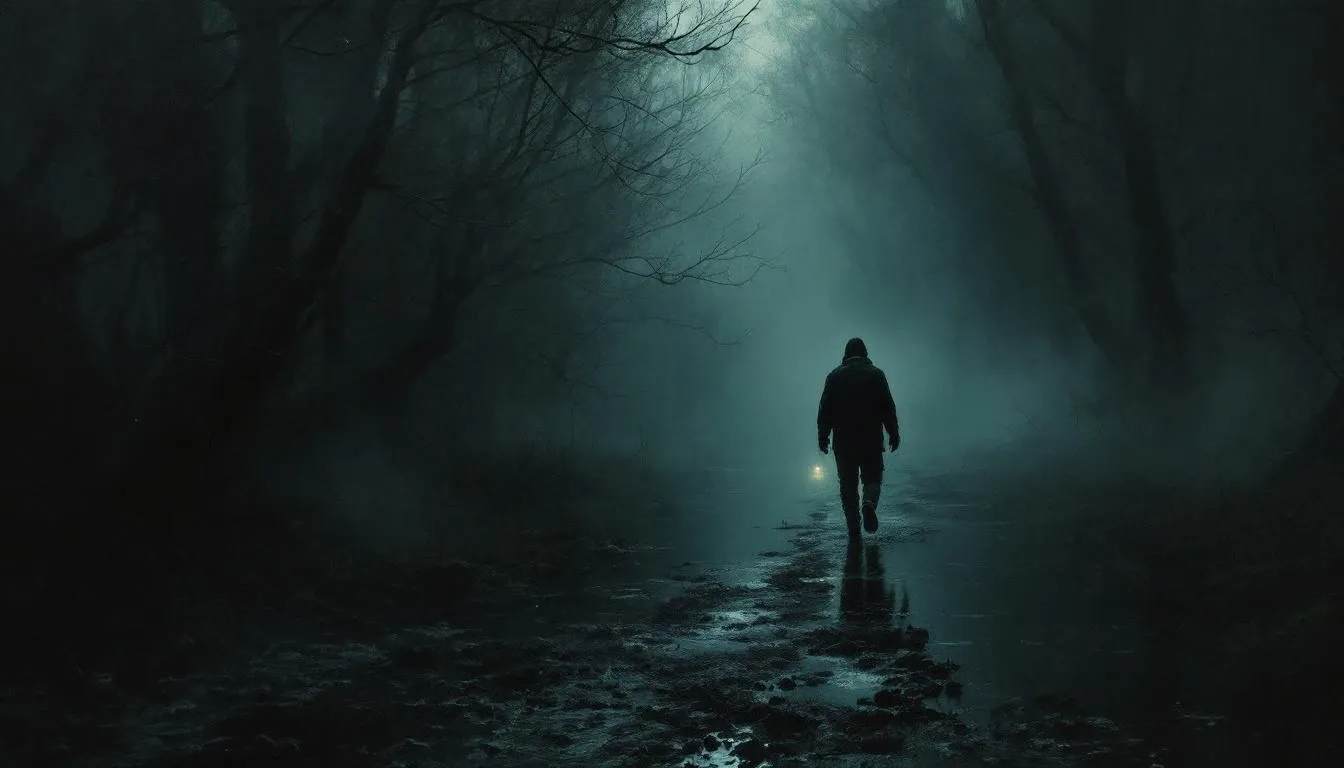
You lost the path an hour ago. The birch trees thinned, then disappeared. The ground turned soft under your boots — not wet exactly, but yielding. Wrong. You kept walking because turning back meant admitting you were lost, and the village was just beyond the next rise. It had to be.
Then the light appeared.
A pale blue glow, hovering above the ground ahead of you. Steady. Not a lantern — too cold for flame, too still for a torch carried by a moving hand. But a light meant a person, and a person meant a path, and a path meant home. You stepped toward it.
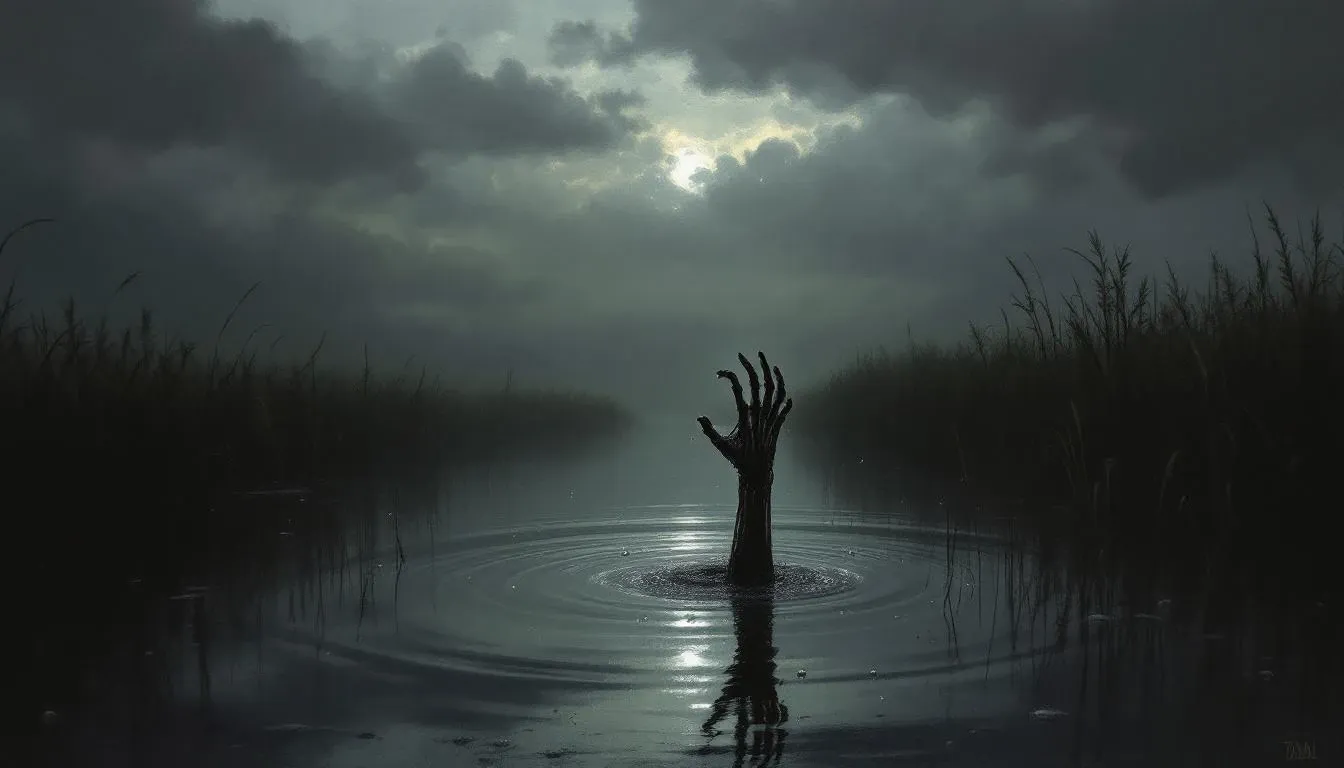
The ground opened its mouth and swallowed you to the waist.
The Bolotnik has been waiting at the bottom of the East Slavic bog for centuries. He is the master of the swamp — its guardian, its predator, its oldest resident. He does not come to you. He has never needed to. He makes you come to him.
The Lord of Dead Water
In the taxonomy of Slavic nature spirits, every environment has its master. The Leshy rules the forest. The Vodyanoy claims the rivers and lakes. The Domovoy guards the home. The Bolotnik — from boloto, the Russian word for swamp or marsh — holds dominion over the wetlands, the bogs, the places where water and earth refuse to separate.
His territory is specific and precisely bounded. The Bolotnik does not claim rivers — that is the Vodyanoy's domain. He does not claim forests — that belongs to Leshy. He claims the land that is neither solid nor liquid, the terrain that deceives the foot, the places where the ground pretends to be trustworthy and then betrays you. The distinction matters. The Vodyanoy can be propitiated by fishermen who share their catch. The Leshy can be appeased by travelers who leave bread at the forest's edge. The Bolotnik cannot be appeased because you are never supposed to be in his territory at all. The swamp is not a place for humans. It never was.
This is the fundamental difference between the Bolotnik and his better-known relatives: the Vodyanoy lives where humans work (rivers, fishing lakes), and the Leshy lives where humans travel (forest paths, hunting grounds). The Bolotnik lives where humans are already making a mistake simply by being present. His domain is inherently transgressive to enter. You cannot be in the swamp without already being in danger, already being where you should not be.
What the Swamp-Master Looks Like
When the Bolotnik chooses to be seen — and he rarely does, because visibility defeats his purpose — the accounts are consistent in their revulsion.
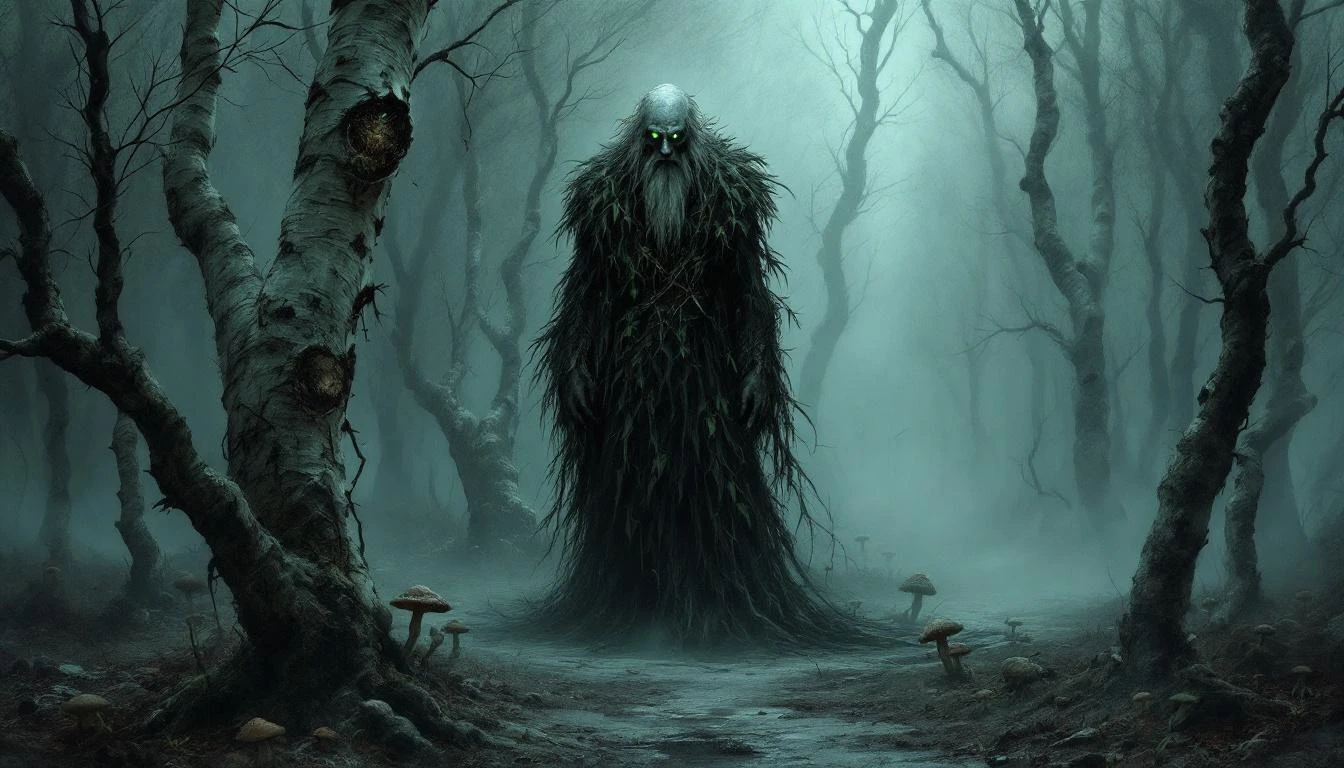
He is enormous, bloated, swollen with the black water of his domain. His skin is not skin in any recognizable sense but a layer of decomposing vegetable matter — peat, rotting moss, the slick brown surface of waterlogged wood. His body is covered in algae and pond scum. Mud cakes in the folds of what might be flesh. His eyes, where they exist, are described as pale and pupilless — like the eyes of a fish left too long in dead water.
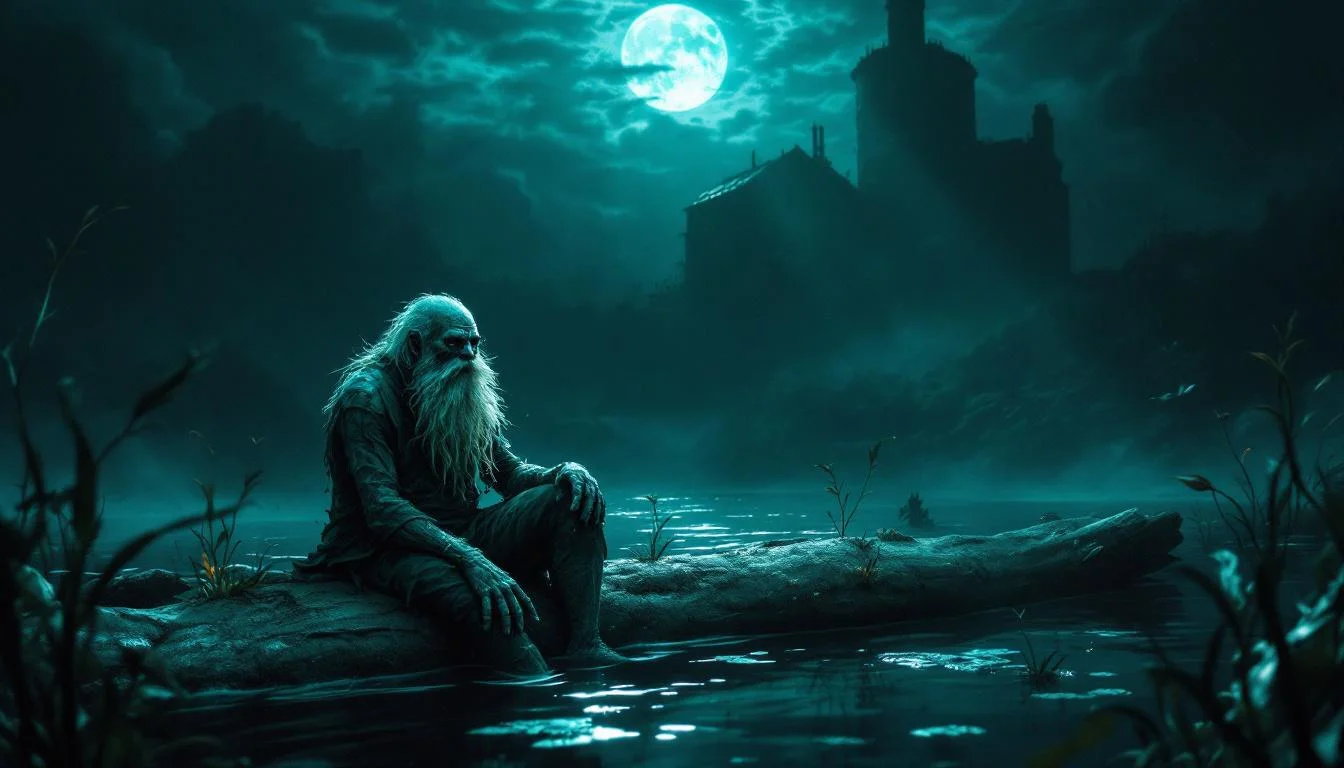
Some traditions give him a more anthropomorphic appearance: a massively fat old man, naked, sitting in the deepest part of the bog with only his head above the waterline. His beard is made of water weeds. His hair is duckweed. He does not move. He watches. Waiting is his primary activity.
Other accounts describe him as barely distinguishable from the swamp itself — a shapeless mass of mud and rotting reeds that only reveals itself as alive when it grabs your ankle. This is perhaps the more frightening version: not a creature in the swamp but the swamp itself becoming predatory, the bog discovering intent.
The distinction from the Vodyanoy is important here. The Vodyanoy — the river and lake spirit — is typically described as an old man with a fish tail, green skin, and aquatic features that mark him clearly as a water being. The Bolotnik is not a water being. He is a decay being, an entity of stagnation and rot, of water that does not flow, of earth that does not hold. The Vodyanoy's domain is living water — rivers with current, lakes with fish. The Bolotnik's domain is dead water — pools that do not drain, surfaces that do not support, depths that do not end.
The Will-o'-the-Wisp: His Fishing Line
The Bolotnik's primary weapon is the bluzhdayushchiy ogonyok — the wandering light, known across European folklore as the will-o'-the-wisp, ignis fatuus, or jack-o'-lantern. In East Slavic tradition, these pale flames that hover above marshland were not random atmospheric phenomena. They were the Bolotnik's lures.
The mechanism was understood clearly by peasant communities who lived near swampland. The light appeared at the bog's edge — at the boundary between safe ground and the Bolotnik's territory. It hovered, steady and beckoning, positioned to look like a lantern in a cottage window, or a campfire, or the torch of a fellow traveler. A person lost in the dark, disoriented, frightened, would see the light and move toward it. Each step took them deeper into the marsh. The ground softened. The water rose. By the time they realized there was no lantern, no cottage, no fellow traveler — only cold blue flame hanging above empty air — they were already waist-deep in the sucking mud, and the Bolotnik was already reaching up from below.
The will-o'-the-wisp was understood in parallel as a natural phenomenon and a supernatural weapon. The rational explanation — methane released from decomposing organic matter, igniting upon contact with air — was not unknown to rural communities. They observed the correlation between the lights and the presence of rotting material. But this did not make the lights less dangerous. If anything, it confirmed the Bolotnik's nature: he was the spirit of decay, and his weapon was the flame that decay produces. The explanation did not domesticate the phenomenon. It made it worse. The swamp itself was producing the bait.
The Bolotnitsa: His Counterpart
Where there is a Bolotnik, there is often a Bolotnitsa — his female counterpart, the swamp-woman. She operates differently from her partner, using seduction rather than simple entrapment.
The Bolotnitsa appears at the swamp's edge in the form of a beautiful young woman — pale, with long loose hair, sometimes naked, sometimes in a white shift. She calls to men who pass near the marsh. She waves. She laughs. She appears to be in distress, standing in shallow water, asking for help. The man who wades in to assist her discovers that the shallow water is not shallow, that the woman is not a woman, and that the hand gripping his wrist is not letting go.
In some versions, the Bolotnitsa is a specific type of Rusalka — a drowned woman whose spirit became bound to the swamp. In others, she is an entirely separate entity, the Bolotnik's wife or daughter, a being that was never human. The distinction varies by region, but the function is consistent: she is the human-shaped lure for targets that the will-o'-the-wisp cannot reach. The light catches the lost. The woman catches the curious.
The Bolotnitsa's most distinctive feature in many accounts is her skin. From a distance, she appears beautiful and pale. Up close — if a victim gets close enough to see clearly before the mud takes him — her skin is tinged with green, her hair is tangled with pond weed, and her eyes have the same dead-fish quality as the Bolotnik himself. She smells of rot. But by the time you can smell her, you are already in the water.
How to Survive the Bog
East Slavic folk tradition was not merely a catalogue of terrors. It was a survival manual encoded in narrative. The stories about the Bolotnik carried specific, practical warnings — and, crucially, specific protective strategies.
Do not follow lights in the marshland. This is the primary rule, repeated so consistently across regions that it constitutes the single most important piece of swamp-survival folklore in the Slavic world. Any light in a bog is a lie. If you see a glow in the marsh, turn your back to it and walk the other way. Even if it looks like your own village. Even if you think you recognize the shape of a building behind it. There is no building. There is no village. There is only the Bolotnik.
Carry iron. Iron — a knife, a nail, a horseshoe — was the universal protective metal against unclean spirits in Slavic tradition. Driven into the ground at the marsh's edge, it created a boundary the Bolotnik could not cross. Held in the hand, it burned spirits who tried to grasp you. Some travelers drove iron stakes into the path before them when crossing marshy ground, creating a corridor of safety through the spirit's territory.
Do not enter the swamp at night. This seems obvious, but the principle extended further: specific times were more dangerous than others. Noon — the "dead hour" when Poludnitsa walked the fields — was dangerous in the swamp as well. Midsummer nights, when the veil between worlds thinned, made the bog essentially impassable without supernatural protection.
If you fall in, do not struggle. This is both practical (struggling in a bog accelerates sinking) and spiritual (thrashing attracts the Bolotnik's attention). The recommended response was to spread your weight, move slowly, and pray — specifically, to pray aloud, because the sound of Christian prayer was believed to weaken the Bolotnik's grip. The spirit could not hold a man who was actively invoking divine protection. Whether this worked against the mud's physics is a separate question.
Bog Bodies and the Memory of the Swamp
The Slavic terror of the swamp has a material basis that extends beyond the obvious drowning risk. Throughout northern and eastern Europe, peat bogs have preserved human remains for thousands of years. The phenomenon of the "bog body" — a corpse preserved by the acidic, oxygen-free conditions of the peat — has been documented extensively in Scandinavia, Britain, Germany, and the Baltic. Similar finds occur in Slavic territories, though less famously catalogued.
The connection between bog bodies and swamp spirits like the Bolotnik is not difficult to draw. A community living near a bog occasionally discovered perfectly preserved human remains — bodies that looked fresh despite being centuries old, skin tanned dark by the peat acids, features still recognizable. These discoveries would have reinforced the belief that the swamp was a place that consumed people and kept them. The Bolotnik did not merely drown his victims. He preserved them. He collected them. They did not decay in his domain because his domain was already at maximum decay — it could not decompose things further. It could only hold them, suspended, forever.
This gives the Bolotnik a quality that the Vodyanoy lacks. The river spirit's victims wash downstream, disappear, eventually surface bloated and unrecognizable. The swamp spirit's victims are kept. They remain in his bog, intact, indefinitely. The swamp remembers every person it has taken. The Bolotnik has a collection.
The bolotnik is among the most feared of the nature spirits precisely because his domain offers no return. The drowned man in a river may be found and buried. The man taken by the bog vanishes completely — no body to bury, no grave to visit, no certainty that he is truly dead. The swamp takes and does not give back. This is what the peasant feared above all: not death, but disappearance.
The Ecology of Fear
The Bolotnik belief served a measurable ecological function. Swamps and bogs in the East Slavic landscape were genuinely dangerous environments — sources of disease (malaria was endemic in many marshy regions of Russia until the twentieth century), sites of accidental drowning, and navigational nightmares where a wrong step could mean a slow death in sucking mud. Communities needed a mechanism to enforce avoidance of these areas, particularly among the young and the reckless.
The Bolotnik was that mechanism. He was a terror calibrated precisely to the danger he represented. The will-o'-the-wisp warning addressed the most common way people were led into bogs. The prohibition against nighttime entry addressed the period of maximum danger. The description of the spirit's patient waiting — his refusal to leave his territory, his reliance on the victim coming to him — accurately reflected the actual threat model: the swamp does not chase you. You walk into it yourself.
As with the Leshy and the forest, the Bolotnik encoded survival knowledge in a form that was memorable, transmissible, and emotionally compelling. "Don't walk into the swamp at night" is advice that a teenager might ignore. "The Bolotnik is waiting in the bog with the preserved bodies of everyone who walked in before you" is a story that sticks to the bones.
The Bubbling Dark
The East Slavic swamp is a landscape of deception. The ground looks solid until it moves. The water looks shallow until it swallows you. The light looks real until you realize it has no source. Everything in the bog is pretending to be something else — something safe, something familiar, something navigable.
The Bolotnik is the personification of that deception. He does not attack. He does not pursue. He simply waits, patient as the peat itself, while the swamp does its work of looking trustworthy. His only active intervention is the light — and even that is passive, in a sense. He places the lure and waits. The victim does the rest.
This patience is what makes the Bolotnik so deeply unsettling within the Slavic spirit hierarchy. The Leshy can be tricked. The Vodyanoy can be propitiated. The Bannik can be appeased with offerings. The Bolotnik offers no negotiation because he requires no effort. He does not need to be clever or powerful or fast. He only needs to be where he is — at the bottom of the bog, in the dark, surrounded by everyone who came before you.
The swamp bubbles. A light flickers at the edge of your vision — pale blue, steady, impossibly still. It looks like a window. It looks like safety. It looks like home.
It is none of those things. It has never been any of those things. And the Bolotnik has never been in a hurry.