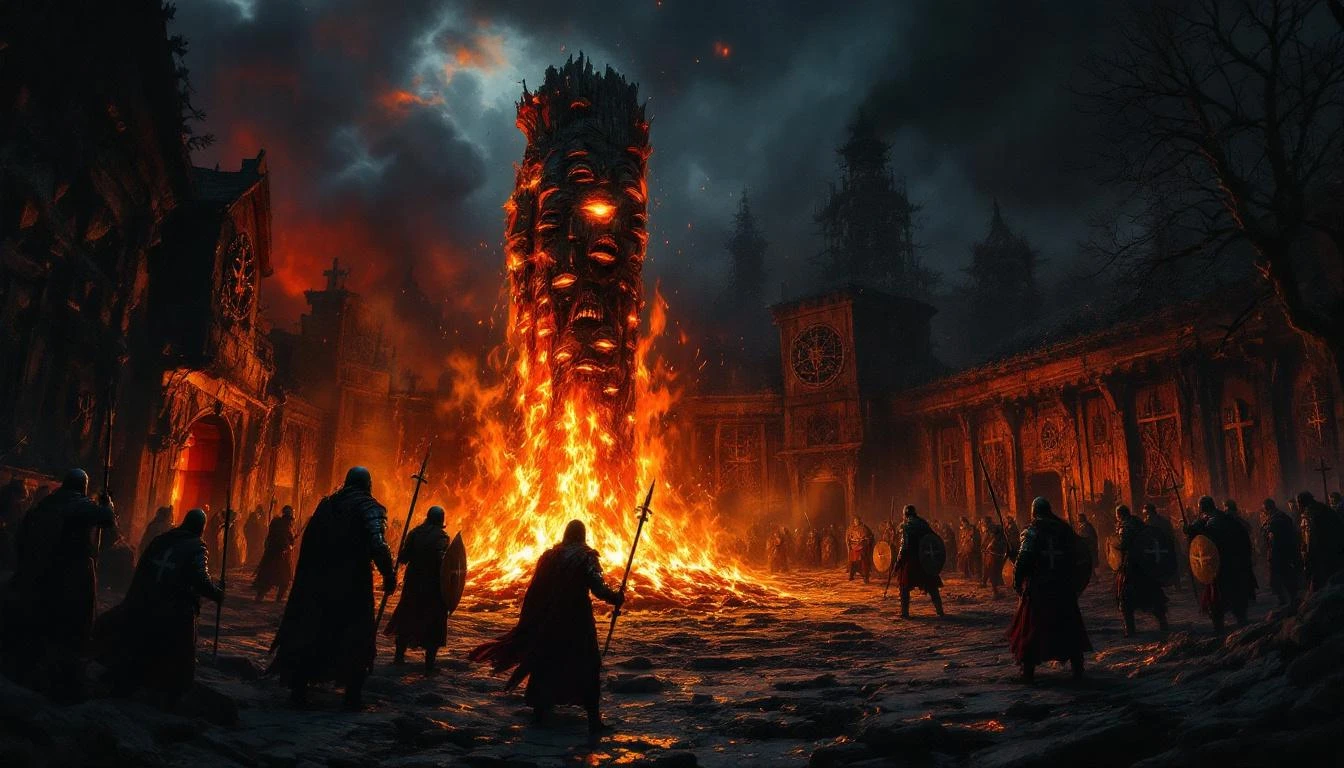
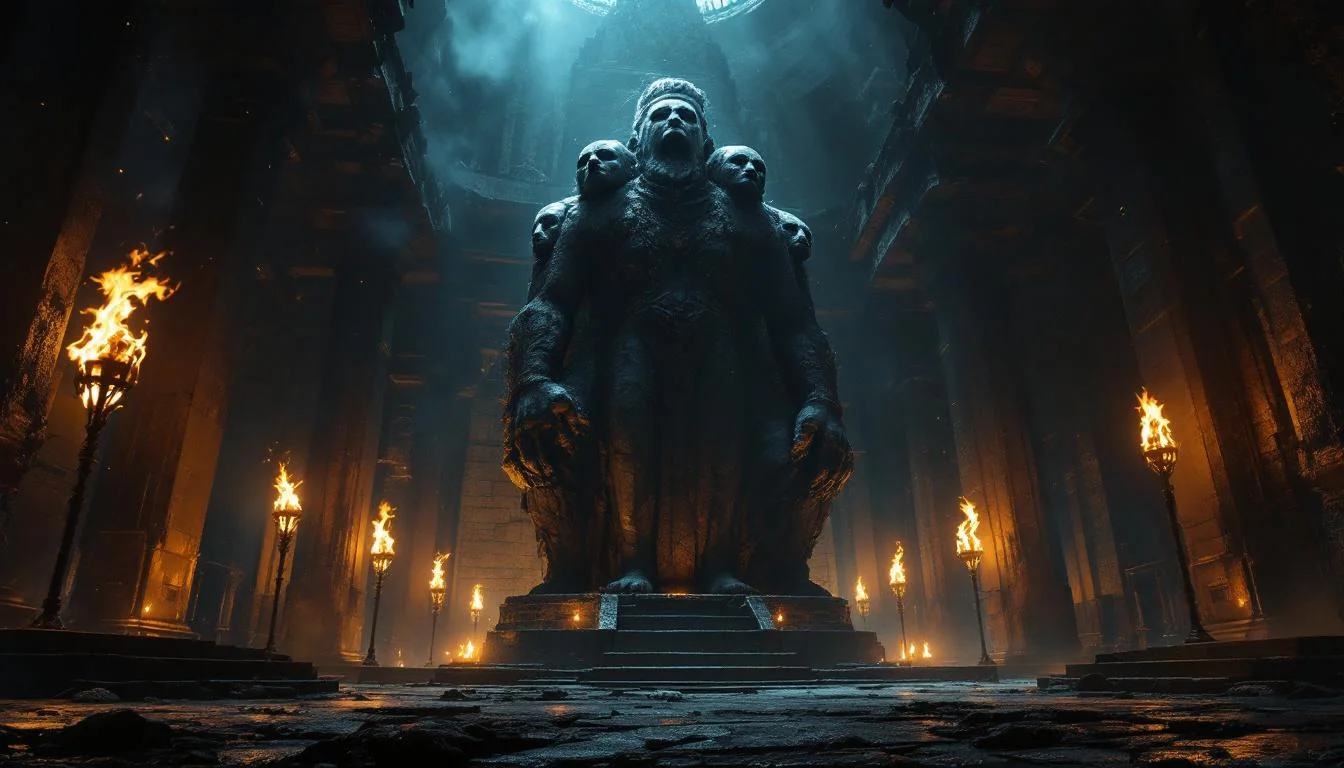
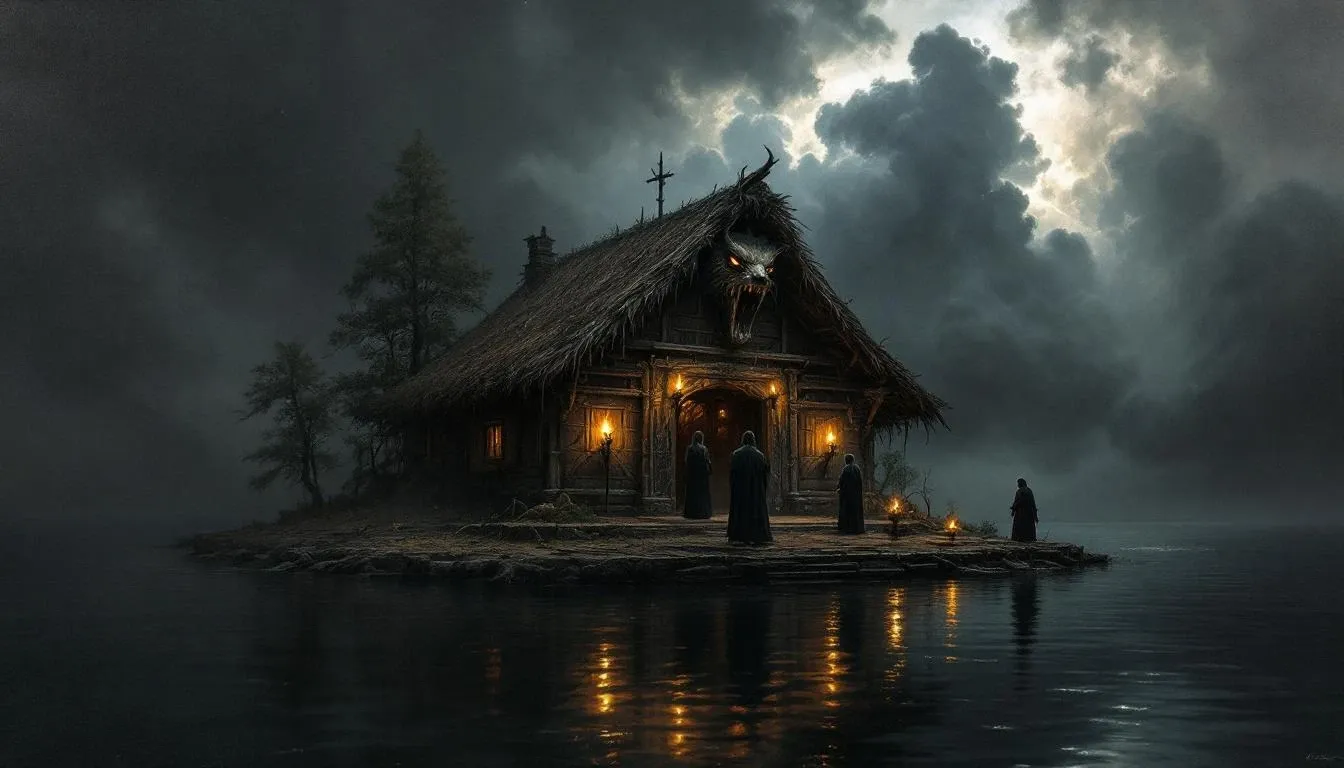
Somewhere beneath the farmland and birch forests of Mecklenburg, in what is now the northeast corner of Germany, lies the site of a temple that medieval chroniclers described with a mixture of fascination and horror. It stood on an island in a lake, accessible by a single wooden bridge. Its walls were carved with the images of gods and goddesses, each one painted in colors so vivid that the figures seemed ready to step off the timber. Inside, among trophies of war and banners stained with old blood, stood a golden idol wearing armor and carrying a shield embossed with the head of a bull.
The temple belonged to the Redarii — the most powerful of the Polabian Slavic tribes who inhabited the lands between the Elbe and the Oder rivers. The god was Radegast. And the temple at Rethra was, for a time, the most important religious center in the entire West Slavic world.
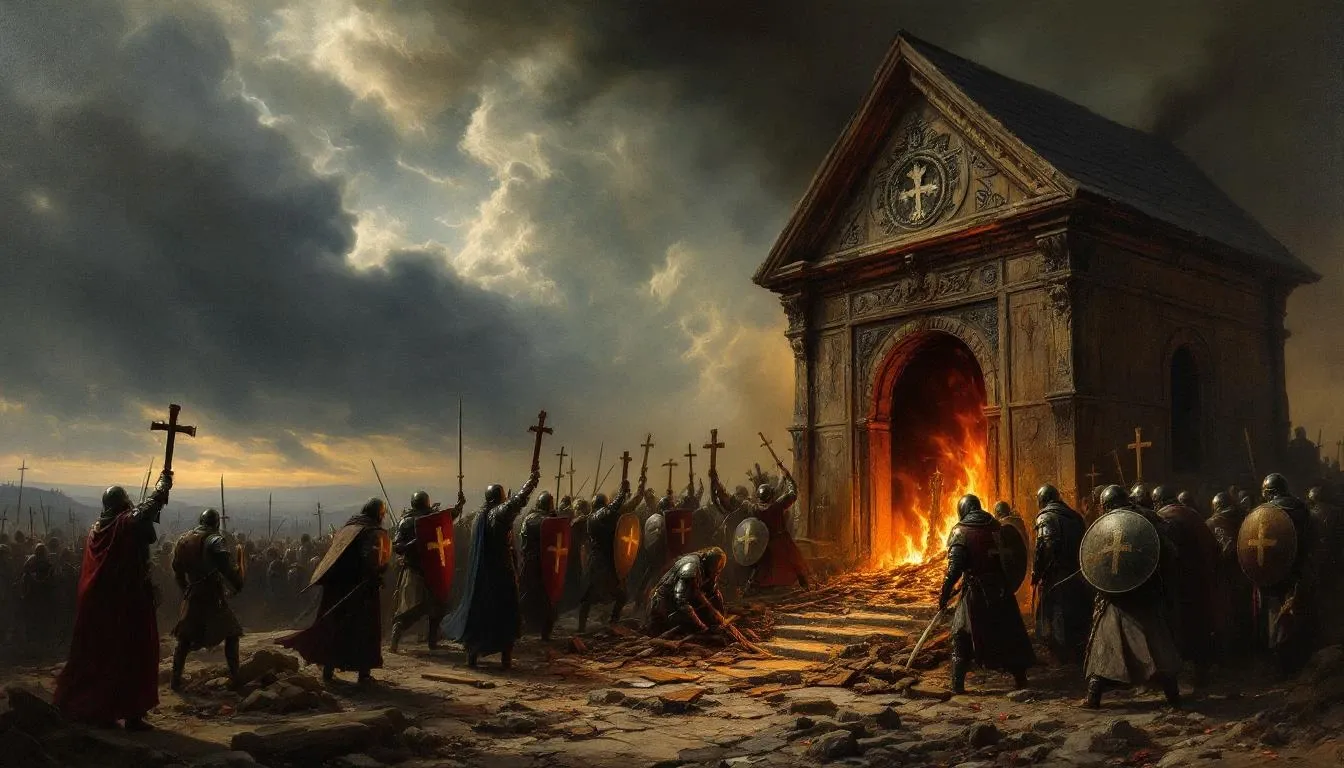
Then the Christians came, and the temple burned, and the location was forgotten so thoroughly that archaeologists have been searching for it for three hundred years without definitive success.
The Source: Thietmar and the Lake Temple
The primary account of Rethra comes from Thietmar of Merseburg, a Saxon bishop who compiled his Chronicle between 1012 and 1018 AD. Thietmar was not a disinterested observer. He was a churchman writing about pagans — enemies of God, worshippers of demons, people who needed to be converted or destroyed. But he was also meticulous, and his description of the temple at Rethra is one of the most detailed accounts of any West Slavic religious site.
In the land of the Redarii there is a fortress called Rethra, of triangular shape, with three gates. On all sides it is surrounded by a great forest, untouched and sacred in the eyes of the inhabitants. Two of the gates are open to all comers; the third, which faces east and is the smallest, leads to a path toward a lake lying close at hand, terrible to behold. In this fortress there is nothing but a temple skillfully constructed of wood, resting on a foundation of horns of various beasts. Its outer walls are adorned with various images of gods and goddesses wonderfully carved; within stand hand-made gods, each with a name graven beneath, fearfully clad in helmets and armour.
The details accumulate. A triangular fortress — unusual in Slavic architecture, suggesting deliberate ritual geometry. Three gates, one leading to a sacred lake. Walls built on a foundation of animal horns — a detail that implies centuries of sacrificial deposits, layer upon layer of bones and horn forming the literal base of the sanctuary. Carved images of gods covering every external surface. And inside, armored idols with names inscribed below them.
Thietmar identifies the chief god of this temple as Svarožič — a name that means "son of Svarog," the sky-father and celestial smith. This identification created a scholarly puzzle that took centuries to untangle, because later sources — particularly Adam of Bremen, writing around 1075 — identify the same temple's chief deity as Radegast.
The resolution, proposed by multiple scholars, is that Radegast was not originally a god's name but a place name. Rethra and Radegast may be variants of the same word, referring to the site rather than the deity. Over time, medieval chroniclers — working at a distance, relying on secondhand reports, writing in Latin about concepts they barely understood — confused the name of the place with the name of the god. Svarožič was the god. Radegast was the town, or the temple, or the fortress. By the time Adam of Bremen got hold of the information, the name had migrated from the building to the being inside it.
Or perhaps it was the other way around. Perhaps the people themselves had begun to call their god by the name of his greatest shrine, the way a king might be called by the name of his capital. The god of Rethra became Rethra's god, and then simply Radegast.
Either way, the name stuck.
The Bull and the Armor
The idol at Rethra — whether we call him Svarožič or Radegast — was described as a warrior. He wore armor. He carried a shield. On that shield was the head of a bull — an image of power, fertility, and ferocity combined in a single emblem.
The bull-headed shield connects Radegast to a broader current of Indo-European warrior theology. The bull was sacred across the ancient world — in Minoan Crete, in Vedic India, in Celtic Gaul, in the Mithraic mysteries of Rome. Among the Slavs, the bull represented raw physical force and agricultural prosperity simultaneously. A god who carried a bull on his shield was declaring dominion over both war and the land — the ability to protect and the ability to feed.
Adam of Bremen adds further details. He describes Radegast as made of gold, or at least gilded — a shining figure in the dim interior of a wooden temple. The god rested on a purple bed or cloth, signifying royalty. Around him stood the other gods of the pantheon, each armed, each named, each subordinate to the golden figure at the center.
The image is deliberate: a divine court, a hall of gods arranged like the retinue of a warlord, with Radegast at their center as the supreme commander. This is not a peaceful shrine for private prayer. It is a war room. The gods are armored because the Redarii were warriors. Their religion was not separate from their military culture — it was the same thing, expressed in carved wood and hammered gold.
The Dual Nature: Host and Killer
The name Radegast — whatever its original referent — contains a word that scholars have found deeply significant. The element -gast (or -gost) means "guest" in Slavic languages (compare the Russian gost', the Polish gosc). If Radegast is parsed as rade-gast, it means something like "dear guest" or "welcome guest" — a strange name for a war god, unless you understand the Slavic concept of hospitality.
In the Slavic world, hospitality was not merely a social nicety. It was a sacred obligation, enforced by divine law. A guest who arrived at your door was under the protection of the gods. To harm a guest was to invite catastrophe — not just social disgrace but supernatural punishment. The guest-right was inviolable, and the host who honored it was performing a religious act.
Radegast, as "the dear guest" or "the hospitable one," embodies this dual function. He is the god who welcomes. He is also the god who punishes those who violate the welcome. The fire in his temple warmed guests who came in peace and consumed enemies who came in war. The bull on his shield was both the feast-animal — the great roast served to honored visitors — and the charging beast that trampled those who broke the sacred compact.
This duality — host and destroyer, the hand that pours mead and the hand that swings the axe — is not a contradiction. It is the same principle viewed from two directions. Hospitality requires enforcement. A welcome that cannot be defended is meaningless. Radegast protected guests because he was powerful enough to kill anyone who threatened them.
Rethra as Oracle Center
The temple at Rethra was not merely a place of worship. It was an oracle — the most important divination center for the Polabian Slavic tribes and, according to Adam of Bremen, a site of regional pilgrimage.
Like the temples of Svetovit at Arkona and Triglav at Szczecin, Rethra maintained a sacred horse used for prophecy. The procedure was similar to what Saxo Grammaticus described at Arkona: spears laid on the ground, the horse led through them, the pattern of its footfalls interpreted as divine will. If the horse stepped cleanly, the god approved. If it stumbled, the god refused.
But Rethra added another layer. Thietmar describes a procedure involving the casting of lots — small objects, probably wooden or bone tokens, marked with symbols and thrown to produce a reading. The priests of Rethra interpreted these lots to answer questions from the assembled crowd: questions about war, about trade, about marriage, about disputes between individuals or tribes. The temple functioned as a court as well as a church. Radegast was the judge, and his priests were the interpreters of his verdicts.
The oracle's reputation extended beyond the Redarii. Other Slavic tribes — the Lutici confederation, possibly even the more distant Obodrites — sent delegations to Rethra to consult the god before major decisions. This gave the Redarii disproportionate political influence. Control of the oracle meant control of the questions that could be asked and the answers that would be given. The priests of Radegast were not merely religious officials. They were power brokers whose authority rested on the god's willingness to speak through their instruments.
Svarožič: The Identity Question
The relationship between Radegast and Svarožič is the central scholarly controversy surrounding this deity. Thietmar calls the god of Rethra "Svarožič." Adam of Bremen, writing sixty years later, calls him "Radegast." Are these the same god? Different gods? A god and a place whose names were swapped?
Svarožič means "son of Svarog" — the young fire-god, heir to the celestial smith who forged the sun. The name connects to a broader Slavic fire-cult. In East Slavic sources, Svarožič appears as the spirit of the hearth fire — the living flame that must be fed and respected. The connection between fire-worship and the Rethra temple is strengthened by archaeological evidence from across Polabian territory: hearths with ritual deposits, fire-pits with structured ash layers, evidence of sustained, ceremonial burning.
If the god of Rethra was Svarožič — the fire-god, the son of Svarog — then his martial appearance makes sense. Fire is the weapon of civilization. It clears forest for farming, forges metal for tools and swords, cooks food, and destroys enemies. A fire-god in armor is not a contradiction. It is a statement about what fire means in a world where survival depends on controlling it.
The Radegast name may have attached itself to this fire-god through the place. The temple at Rethra-Radegast was so famous, so central to the identity of the Redarii, that the god inside became known by the temple's name rather than his own. It would be as if the worshippers of Apollo at Delphi had begun to call the god "Delphi" — a perfectly natural linguistic process in a culture without written scripture to freeze names in place.
Modern scholarship generally treats Radegast and Svarožič as the same deity known by different names in different contexts: Svarožič when his fire-nature is emphasized, Radegast when his association with the temple at Rethra is primary. But certainty is impossible. The Polabian Slavs did not write down their theology, and the Christians who did write about it did not care about getting the nuances right.
The 1068 Destruction and the Lutici Wars
The Lutici — a confederation of four Polabian Slavic tribes, including the Redarii — were among the last pagans in central Europe. They resisted Christianization with a ferocity that the Frankish and Saxon chronicles describe with grudging respect. The temple at Rethra was the spiritual center of this resistance, the place where the gods spoke against the foreign religion and its armies.
The resistance was not merely religious. The Christianization of the Slavic lands west of the Elbe had proceeded hand-in-hand with political subjugation. Conversion meant submission to German overlordship, payment of tithes to German bishops, acceptance of German law. The Lutici fought for independence, and their gods — Radegast chief among them — were symbols of that independence.
In 983, the Lutici rose in revolt, destroying German churches and monasteries across the region in the great Slavic uprising that rolled back decades of Christian expansion east of the Elbe. The temple at Rethra served as the rallying point and the oracle that sanctioned the revolt. For nearly a century afterward, the Polabian Slavs maintained their independence and their paganism.
But the confederation was unstable. Internal wars between the Lutici tribes weakened the alliance. In 1068, during one of these internecine conflicts, the temple at Rethra was destroyed — not by Christians but by rival Slavic factions. The details are sparse. The chronicles record the destruction but not the specifics of how or why. What is clear is that the most important oracle center in the West Slavic world was ruined by the very people it had been built to serve.
The temple may have been rebuilt. Some sources suggest continued activity at the site into the early twelfth century. But the political power of the Redarii was broken, and without political power the temple's authority evaporated. An oracle is only as powerful as the armies that enforce its pronouncements.
Radegast After Rethra
The destruction of the temple did not immediately erase the god. The Polabian Slavs continued to practice their religion — in reduced, fragmented, increasingly desperate forms — until the final wave of German-Christian conquest in the twelfth and thirteenth centuries eliminated organized Slavic paganism entirely. The Christianization of the Polabian region was among the most violent in European history. Entire populations were killed, displaced, or forcibly assimilated. The Slavic languages of the region died out. The last speaker of Polabian — the language of the people who had worshipped Radegast — died in the eighteenth century.
With the language went the last oral traditions that might have preserved the god's mythology. Unlike Perun, who survived in the East Slavic folk memory as the Prophet Elijah, or Veles, who survived as Saint Vlasiy, Radegast had no Christian equivalent to absorb his functions. The god of the Rethra temple disappeared with the people who worshipped him.
What survived was the name — in the town of Radegast in Saxony-Anhalt, in the beer brand that adopted the name (a Czech brewery launched "Radegast" in 1970, and the brand remains popular), and in the enduring fascination of scholars and Slavic revivalists who see in the lost temple at Rethra a symbol of everything that was destroyed when the old world gave way to the new.
The Search for Rethra
The location of the temple has never been conclusively identified. Thietmar's description — an island in a lake, surrounded by forest, with a triangular fortress and three gates — has been matched to multiple sites in Mecklenburg and Brandenburg. The most commonly proposed location is near Feldberg, where a fortified island settlement was excavated in the twentieth century. Other candidates include sites near Prillwitz (contaminated by the forgeries), Wustrow, and several lake-islands in the Mecklenburg Lake District.
The problem is that the landscape has changed dramatically since the eleventh century. Lakes have drained or shifted. Forests have been cleared. The wooden fortress and its wooden temple would have left minimal archaeological traces — postholes, ash layers, perhaps fragments of the horn-foundation that Thietmar described. Without a definitive inscription or a deposit of identifiable ritual objects, any identification remains provisional.
The search continues. And as long as it continues, Radegast retains a peculiar form of immortality: a god whose temple is lost, whose people are extinct, whose language is dead, but whose name still draws people into the birch forests and beside the quiet lakes of Mecklenburg, looking for the place where the golden idol stood and the sacred horse walked through the spears.