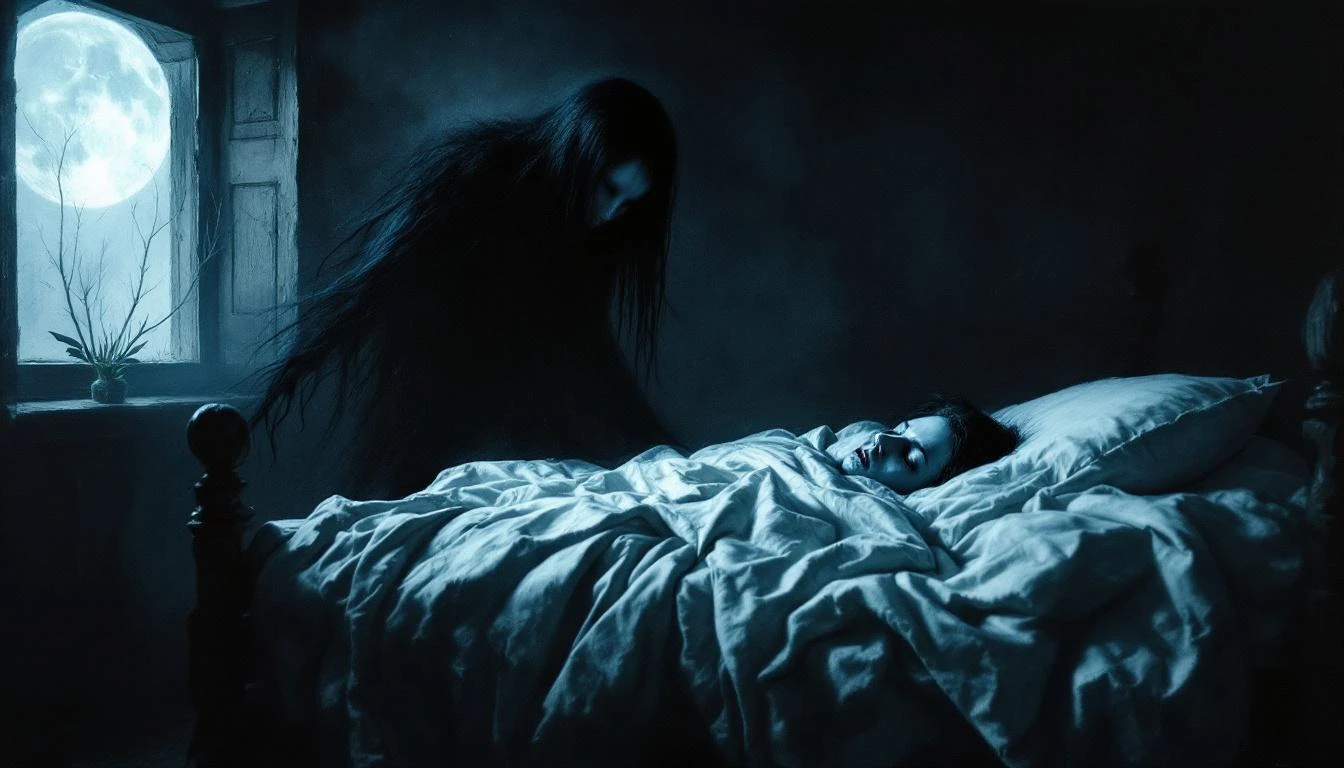
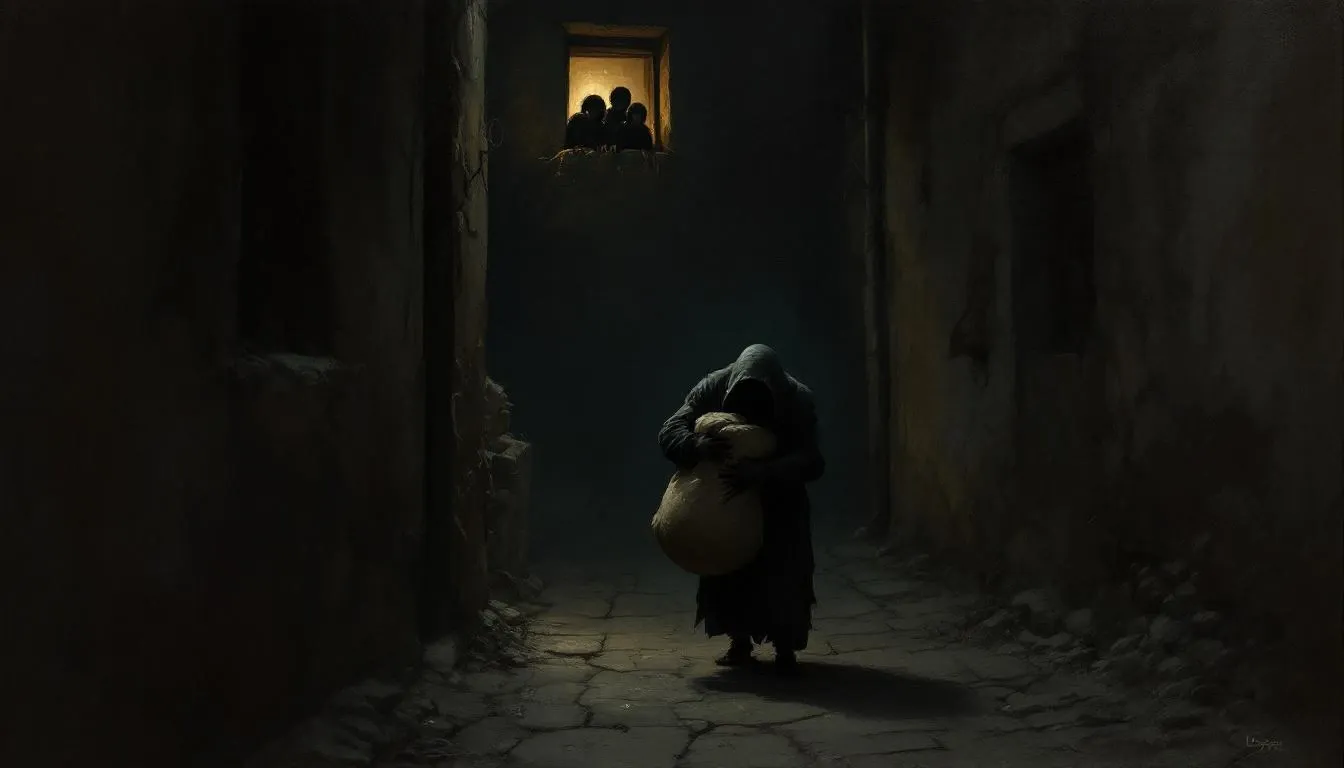
In the dark under your bed, something breathes. It is old and hunched and female, and it has been waiting there since before you were born. It carries a sack — rough burlap, stained with something you do not want to identify. It smells like damp cellars and the underside of floorboards and the particular kind of fear that only children know, the kind that makes you pull your feet up onto the mattress and refuse to let them dangle over the edge.
Its name is Babaroga. And across Serbia, Croatia, Bosnia, and Herzegovina, every child who grew up before television replaced the oral tradition knew exactly what she looked like, where she hid, and what she did to children who would not behave.
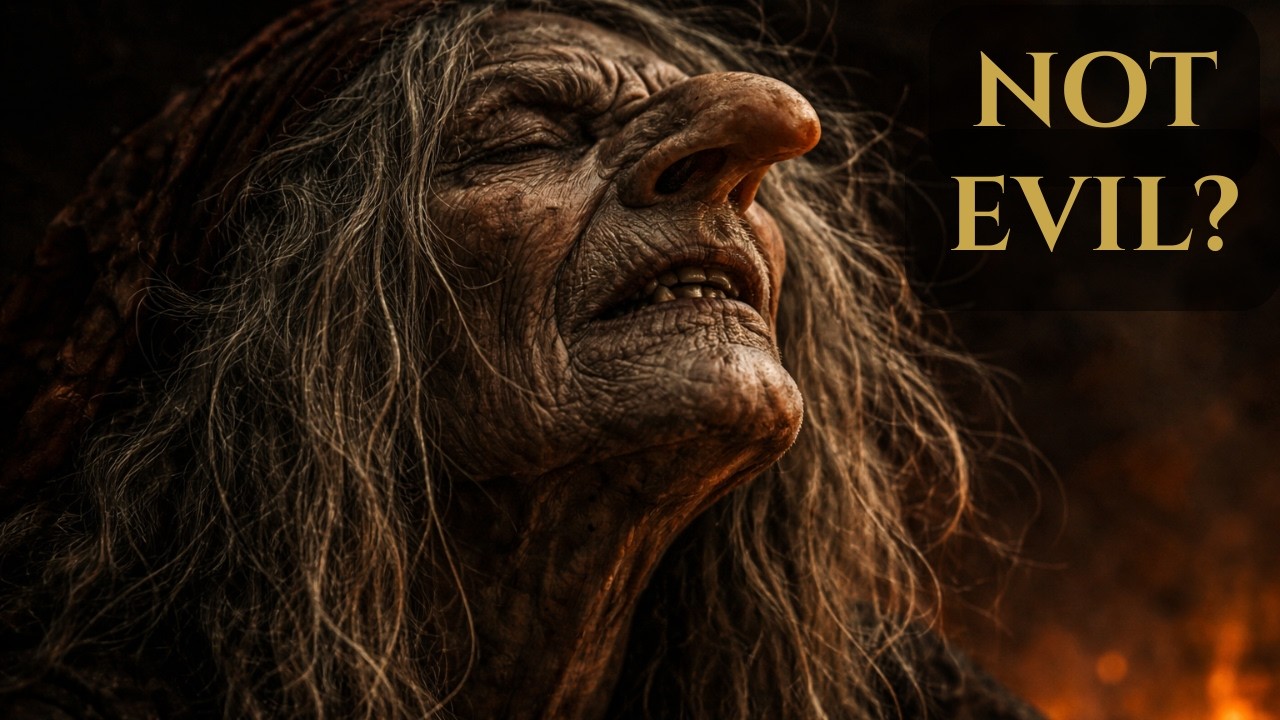
The Slavic world's bogeyman is not a man at all. She is a woman. An old woman with a horn growing from her knee.
The Name: Grandmother Horn
The name Babaroga splits cleanly into two components. Baba is the Slavic word for "old woman" or "grandmother" — the same root that opens Baba Yaga's name and carries the same freight of age, authority, and danger. Roga comes from rog — "horn." Babaroga is, literally, "Grandmother Horn" or "the Old Woman with the Horn."
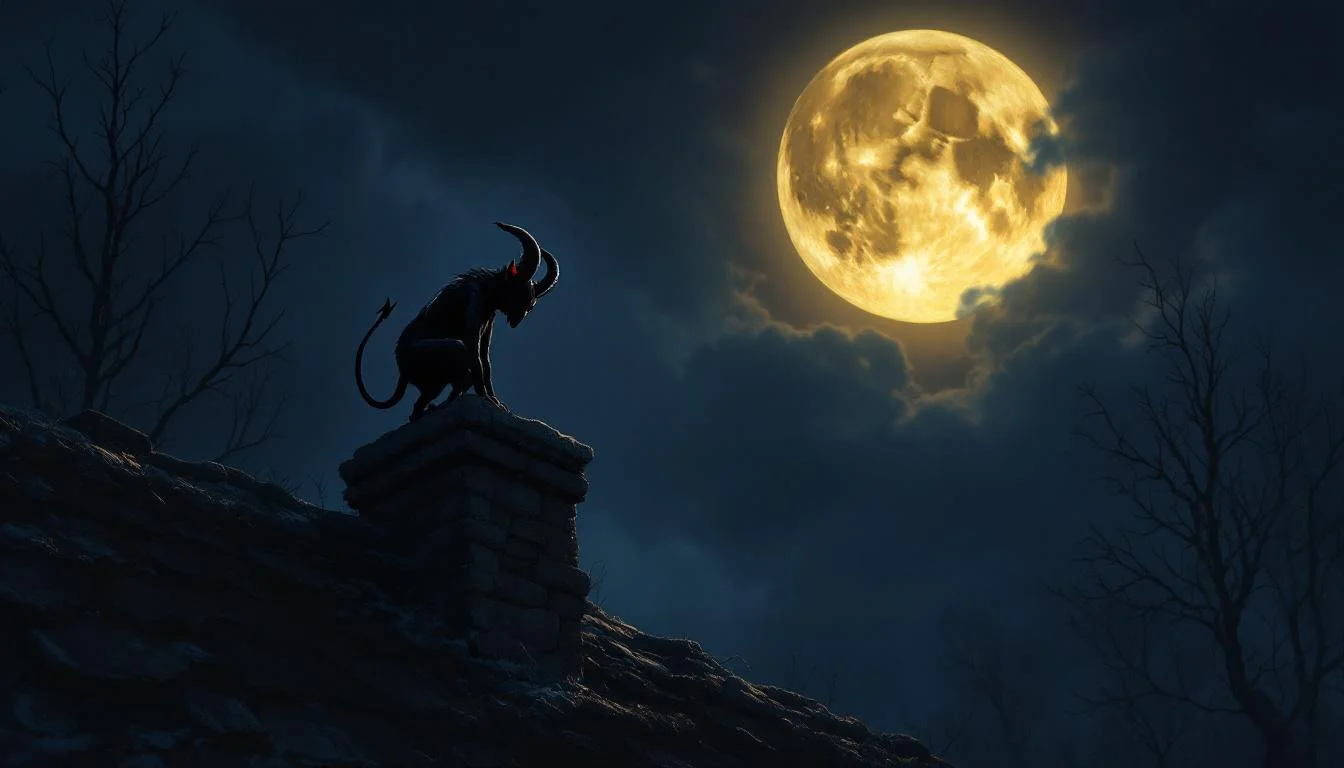
The horn is the detail that makes her unique among European bogeymen. Other cultures have their figures of parental threat — the Italian Babau, the German Butzemann, the Spanish Coco — but none of them have this specific anatomical feature. The horn grows from her knee. Not her head, not her hands — her knee. This peculiar placement is consistent across the South Slavic tradition, from the Vojvodina flatlands to the Dalmatian coast, and it serves a specific narrative function: the Babaroga hides under beds and in closets, and the horn on her knee is what she uses to poke children who dangle their limbs over the edge. The body part that sticks out when you crouch under a bed frame is the knee. The horn is there because the hiding place demands it.
Some regional variants give her additional horns — on her elbows, on her shoulders, sprouting from her spine. In parts of Herzegovina, she is described as having a single horn protruding from her forehead, which aligns her more closely with general European witch iconography. But the knee-horn remains the canonical version, the one that mothers described to children across the Balkans for centuries, the anatomical detail too specific to be accidental and too consistent to be the invention of any single village.
What She Does
The Babaroga's function is simple, and its simplicity is what made it effective for centuries. She is a punishment figure. She arrives when children misbehave — when they refuse to sleep, when they cry at night, when they disobey their parents, when they wander where they should not go. She comes from outside — sometimes from the forest, sometimes from a cave in the mountains, sometimes from a hole in the ground — and she takes the child away.
The mechanism of taking is the sack. The Babaroga stuffs the disobedient child into her burlap bag and carries them off. Where she carries them depends on the region. In Serbian tradition, she takes them to her cave. In Croatian variants, she takes them to a dark forest. In Bosnian tellings, she simply takes them away, destination unstated, which is arguably the most frightening version — the child disappears not into a specific place but into the abstract concept of gone.
What happens to the child after capture is almost never described in detail. This is a consistent feature of the Babaroga tradition and a key difference between her and Baba Yaga. Baba Yaga has a narrative — she tests heroes, she sets tasks, she guards the boundary between life and death, she is the subject of complex stories with arcs and resolutions. The Babaroga has no story. She has only a function. She takes bad children. That is the beginning, the middle, and the end. There is no quest to rescue the child from her cave. There is no clever trick to outwit her. There is only the warning and the threat.
This absence of narrative complexity is not a weakness. It is the Babaroga's greatest strength as a cultural tool. A fully developed story can be analyzed, challenged, deconstructed. A child can ask questions about Baba Yaga — why does she live in a hut on chicken legs? Can the hero escape? What happens if you answer her riddles correctly? But the Babaroga permits no such inquiry. She is a closed system. She comes, she takes, the end. The only variable the child controls is their own behavior.
Babaroga vs. Baba Yaga: The Crucial Difference
The names are similar enough that casual observers sometimes assume Babaroga is merely a South Slavic pronunciation of Baba Yaga. This is wrong, and the differences between the two figures reveal fundamentally different approaches to the supernatural across the Slavic world.
Baba Yaga is an ambiguous figure. She is dangerous, yes — she lives in a house surrounded by a fence of human bones, she threatens to eat visitors, she flies through the sky in a mortar. But she is also a helper. She feeds the hero. She gives them magical objects. She reveals the location of Koschei's hidden death. Baba Yaga operates on a transactional model: approach her correctly, answer her questions with respect, complete her tasks with courage, and she will reward you. She is a gatekeeper, not a monster. Her bone fence is a threshold, not a wall.
The Babaroga offers no transactions. She does not test. She does not reward. She does not have a house worth visiting or wisdom worth seeking. She is pure threat — the distilled essence of parental authority externalized into a supernatural form. Where Baba Yaga asks "Are you brave enough?" the Babaroga asks only "Have you been good?"
This distinction maps onto the broader difference between East Slavic fairy tale tradition (where Baba Yaga lives) and South Slavic folk belief (where the Babaroga dwells). East Slavic folklore is rich in the skazka — the wonder tale, the long narrative of adventure and transformation. South Slavic folklore, while it has its epic poetry and its hero cycles, also preserves a thick layer of domestic superstition — household spirits, protective rituals, threat-figures whose function is social control rather than narrative entertainment. The Babaroga belongs to this layer. She is not a character in a story. She is a tool in a system.
"Babaroga — a bugbear with which they frighten children."
Vuk Karadžić, the great Serbian linguist and folklorist who standardized the Serbian language, gave the Babaroga exactly one line in his dictionary. Not because she was unimportant, but because her importance was understood — so deeply embedded in South Slavic childhood that a full explanation was unnecessary. Everyone already knew.
The Pedagogical Function
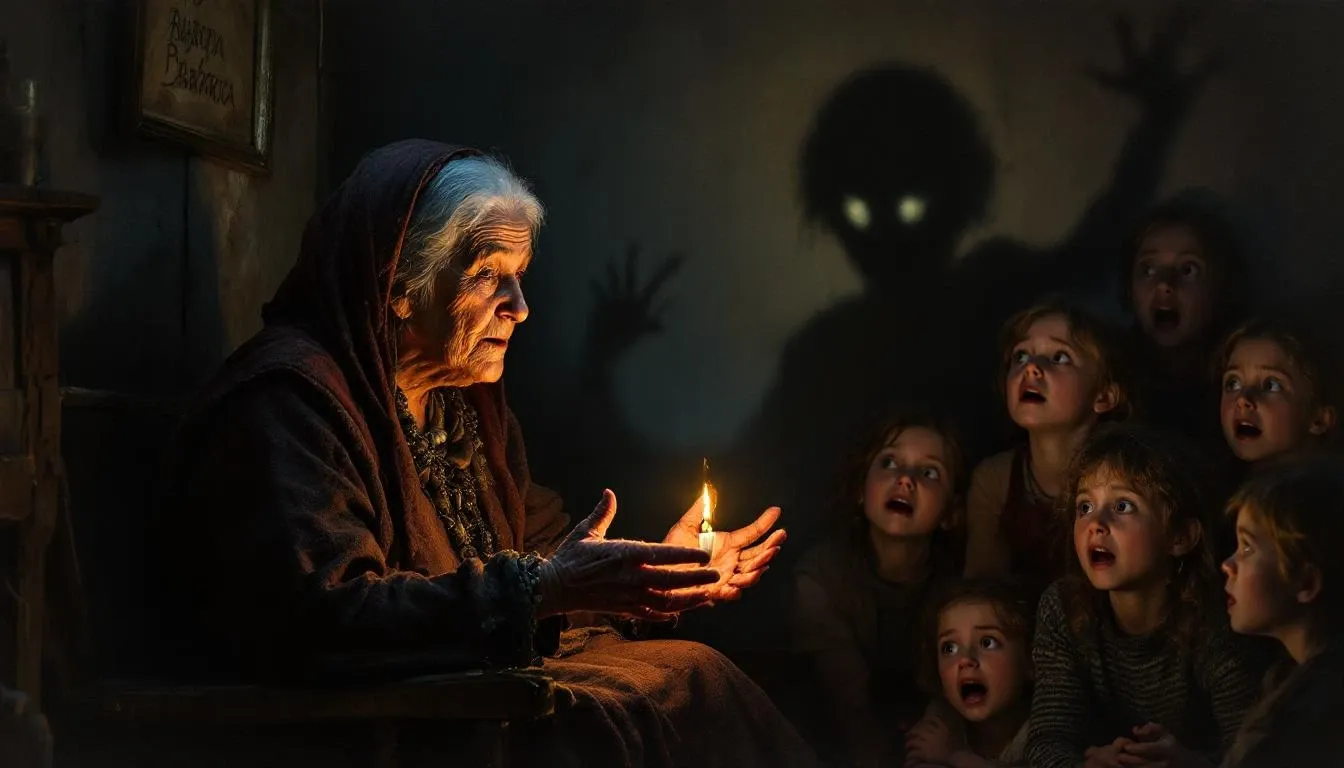
The Babaroga is a disciplinary technology. This is not a dismissive description — it is a precise one. Across cultures and centuries, human societies have invented supernatural figures whose primary purpose is to regulate children's behavior, and the Babaroga is one of the most efficient examples of the type.
The logic is straightforward. Young children do not respond well to abstract consequences. "You must sleep because your body needs rest" is a reasonable argument that no four-year-old has ever found persuasive. "Close your eyes or the Babaroga will come" is not reasonable at all, but it works. The threat operates on fear, which operates on the limbic system, which does not require logical justification. The child does not need to understand why the Babaroga comes. They only need to believe that she does.
This system has obvious ethical problems that modern parenting theory has cataloged at length — teaching children to obey through terror rather than understanding, creating anxiety disorders, replacing internal motivation with external threat. These criticisms are valid. They are also anachronistic when applied to a peasant society where a disobedient child wandering into a forest at night was in genuine danger from wolves, exposure, and the very real possibility of never being found.
The Babaroga was calibrated to the risks of her environment. Don't go near the well at night — the Babaroga hides near water. Don't wander into the forest — the Babaroga lives in caves among the trees. Don't leave the house after dark — the Babaroga comes when the sun goes down. Each warning targeted a specific, real danger and attached a supernatural enforcement mechanism to it. The Nocnitsa, the night hag of East Slavic tradition, performed a similar function — she came for children who would not sleep — but the Babaroga's jurisdiction was broader. She covered everything. She was the universal parental override.
Regional Variants Across the Balkans
The Babaroga is not monolithic. Like all folk figures that persist across a wide geographic area, she adapts to local conditions while maintaining her core identity.
Serbia: The Babaroga is most firmly established in Serbian tradition, where she is a standard part of the folk vocabulary. She hides in dark places — under beds, in closets, behind doors, in the shadows of staircases. The horn on her knee is the canonical detail. She carries a sack. In some Serbian variants, she has a companion — a male figure, sometimes called Babarog (without the feminine suffix), who assists in the collection of misbehaving children.
Croatia: Croatian tradition preserves the Babaroga with essentially the same features as the Serbian version, reflecting the shared cultural substrate of the South Slavic region. In parts of Dalmatia and the Croatian littoral, the Babaroga picks up additional maritime associations — she sometimes comes from the sea rather than the forest, hiding in the fog that rolls in off the Adriatic on winter nights.
Bosnia and Herzegovina: The Bosnian Babaroga is particularly associated with the long, dark winters of the mountainous interior. She lives in caves — a detail that makes geographic sense in a landscape defined by karst geology, where caves are everywhere and the darkness inside them is absolute. Bosnian variants sometimes give her a more explicitly demonic character, influenced by the region's complex religious history and the blending of pre-Slavic, Christian, and Islamic supernatural traditions.
Montenegro and North Macedonia: The figure appears in both regions under the same name, with minor local variations. In some Montenegrin mountain communities, the Babaroga was associated with specific caves or ravines that were considered dangerous — a localization strategy that made the threat tangible. The Babaroga did not live in some abstract "dark place." She lived there, in that specific cave mouth visible from the village, and everyone could point to it.
The Horn: Symbol and Speculation
Why a horn? And why on the knee?
The question has no definitive answer, but the scholarly speculation is illuminating. Horns in Slavic folk belief are associated with the demonic — the Chort, the South Slavic Psoglav, various woodland and water spirits are described with horns as markers of their supernatural status. The horn signals that its bearer is not human, not safe, not of this world. Applied to the Babaroga, the horn on the knee marks her as a creature from the other side — something that looks like an old woman but is fundamentally inhuman.
The knee placement has attracted less scholarly attention but may be the more interesting detail. Knees are joints — points of articulation, of bending, of transition. In some folk magical traditions, joints are considered vulnerable points where spirits can enter or exit the body. The knee is also, as noted, the body part that protrudes when someone crouches in a confined space. The Babaroga crouches under beds. Her horn is where you would feel it first — pressing against the mattress slats, poking through the gap where the bedframe meets the floor, touching your dangling foot with something hard and sharp and wrong.
The genius of the image is its specificity. A child lying in bed in the dark does not think about abstract horned demons. A child lying in bed in the dark thinks about what is directly below them. The Babaroga's horn on her knee transforms the space under every bed in every house into a potential hiding place for something that can reach up and touch you.
Survival in Modern Balkan Culture
The Babaroga has not disappeared. She has adapted.
In contemporary Serbia, Croatia, and Bosnia, the name Babaroga remains in common usage — not as a figure of genuine belief, but as a cultural reference point so deeply embedded that it has become idiomatic. "Don't be a babaroga" means "don't be scary" or "don't be ugly." Parents still use the Babaroga threat, usually with a self-aware smile that acknowledges both its absurdity and its effectiveness. The word appears in children's television programs, in illustrated books, in school plays where the Babaroga is given a softer, comedic treatment that would have been unrecognizable to the grandmothers who first invoked her name in darkened bedrooms.
The animated series Babaroga (2019) reimagined the figure as a somewhat sympathetic creature — still old, still horned, still living in dark places, but given motivations and vulnerabilities that the folk tradition never provided. This domestication of the threatening into the entertaining follows a universal pattern. The Big Bad Wolf becomes the wolf in Shrek. The Chort becomes a comic devil. The Babaroga becomes a cartoon character who teaches children not to be afraid of the dark.
But the original Babaroga — the one without a backstory, without sympathetic motivation, without anything except the sack and the horn and the darkness under the bed — survives in the memories of every Balkan adult who spent at least one childhood night with their feet pulled up and their blanket tucked tight, breathing shallowly, listening for the sound of something moving in the space between the floor and the bottom of the mattress.
That version does not need a television show. She lives where she has always lived — in the dark, where the stories are.
Why She Matters
The Babaroga matters because she is honest about what she is. She does not pretend to be a complex mythological figure with deep symbolic significance. She does not aspire to the metaphysical weight of Baba Yaga or the tragic dignity of the Rusalka or the cosmological grandeur of Perun. She is a scare tactic. She is the creature that parents invented because children would not go to sleep, and she has been performing that function with ruthless efficiency for as long as anyone in the Balkans can remember.
There is something almost admirable about that single-mindedness. In a mythology full of beings who embody cosmic principles and guard metaphysical boundaries, the Babaroga embodies nothing except the fact that the dark is frightening and adults need their children to stay in bed. She is folklore at its most practical — not a myth, not a legend, not an epic, but a tool. Sharpened by use. Perfected by repetition. And still, in some corner of every Balkan childhood, effective.