You wake up and you cannot move.
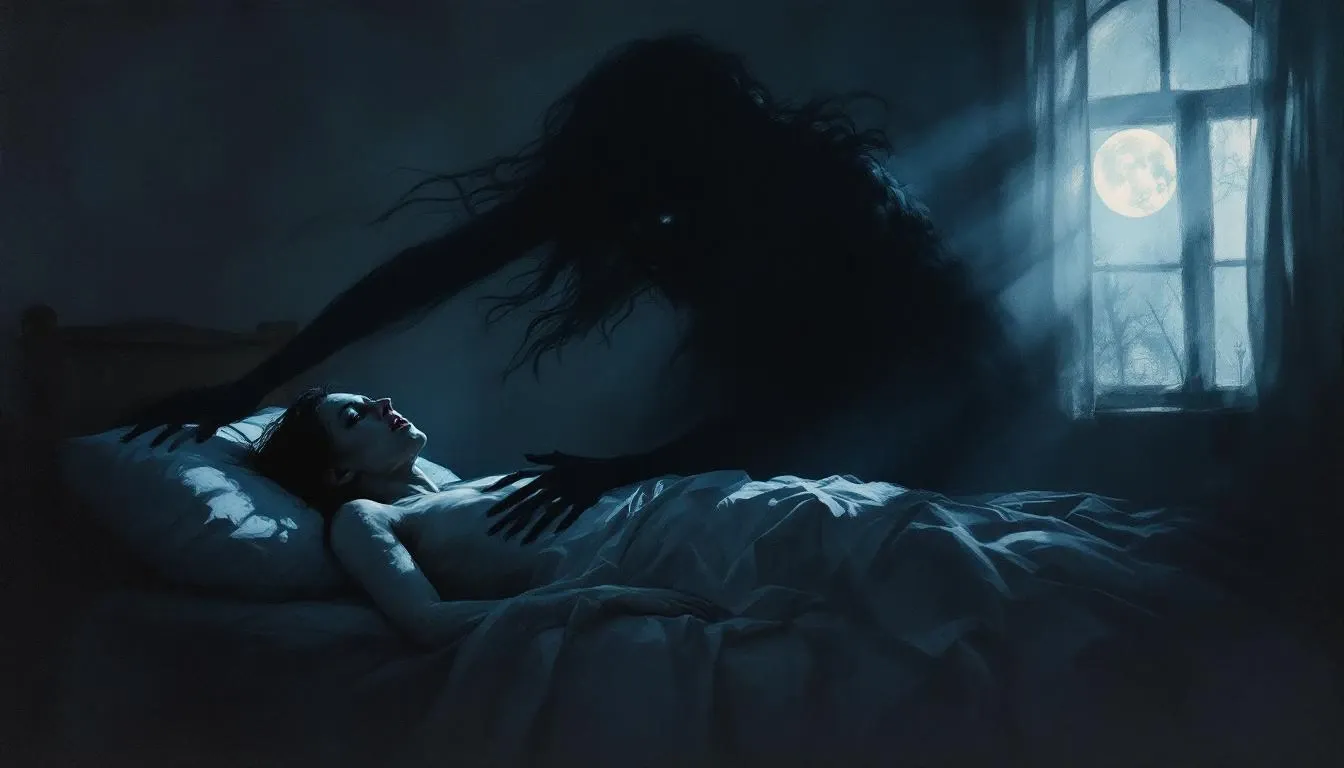
Your eyes are open. The room is dark. You can see the outline of the window, the faint glow of a streetlight through the curtain. You are awake — completely, horribly awake — but your body does not answer. Your arms are pinned. Your legs will not lift. Your chest feels as though something heavy has been placed on it, pressing down with a slow, deliberate force that grows tighter with each breath you try to take.
And then you see her.
A shape at the edge of the bed. A figure made of darkness slightly denser than the darkness of the room. She has no face, or she has too much face — a pale smear where features should be, eyes like holes burned into cloth. She smells of damp earth, of moss, of the cold soil underneath a forest where no sunlight reaches. She does not speak. She does not need to. She is already on your chest, and she has been there for a very long time.
In the villages of Russia, Belarus, Ukraine, Poland, Slovakia, and Serbia, people did not need a sleep researcher to explain what was happening. They had a name for the thing on your chest. They called her Nocnitsa — the Night Hag. And they knew exactly what to do about her.
A Name Born from Darkness
The word Nocnitsa comes from the Slavic root noch — night. She is, in the most literal sense, the night woman, the creature that belongs to the hours between dusk and dawn and cannot exist outside them. Sunlight does not merely weaken her. It erases her. She is a being made entirely of nighttime, and when the morning comes, she dissolves back into the shadows from which she emerged.
Her names multiply across the Slavic world like echoes in a dark hallway. In Belarusian she is nachnitsa. In Ukrainian, nichnytsia. In Polish, nocnica or płaczka — the weeping woman. In Serbian, noćnica. In Bulgarian she takes a different name entirely — gorska majka, the forest mother — which hints at an older, wilder identity. In Croatian she is mrake or vidine. In Slovene, nočnine or mračnine, a word that literally means "darknesses."
But her most revealing alternative names come from the Russian folk tradition. In some regions she was called kriksy — the screamers — or plaksy — the criers. These were not names for a single entity but for a phenomenon: the sounds children made when the Nocnitsa visited them. A baby that shrieked through the night, inconsolable, rigid with terror, its tiny face twisted in a rictus of fear — this was not colic. This was not a bad dream. This was the Nocnitsa feeding.
What She Looks Like (When She Lets You See)
Describing the Nocnitsa is like describing the shape of smoke. She is not a creature with fixed physical form in the way that Baba Yaga has her iron teeth or the Leshy has his towering green body. The Nocnitsa is defined by absence — by the things you almost see and the details that refuse to resolve.
The most common descriptions across East Slavic folklore present her as a shadow with intent. She is made of darkness — not metaphorical darkness, but the actual substance of a lightless room given will and hunger. When she appears, she does not enter through a door or a window. She assembles herself from the gloom that already exists in the corners of your bedroom, condensing like fog into something that has weight and purpose.
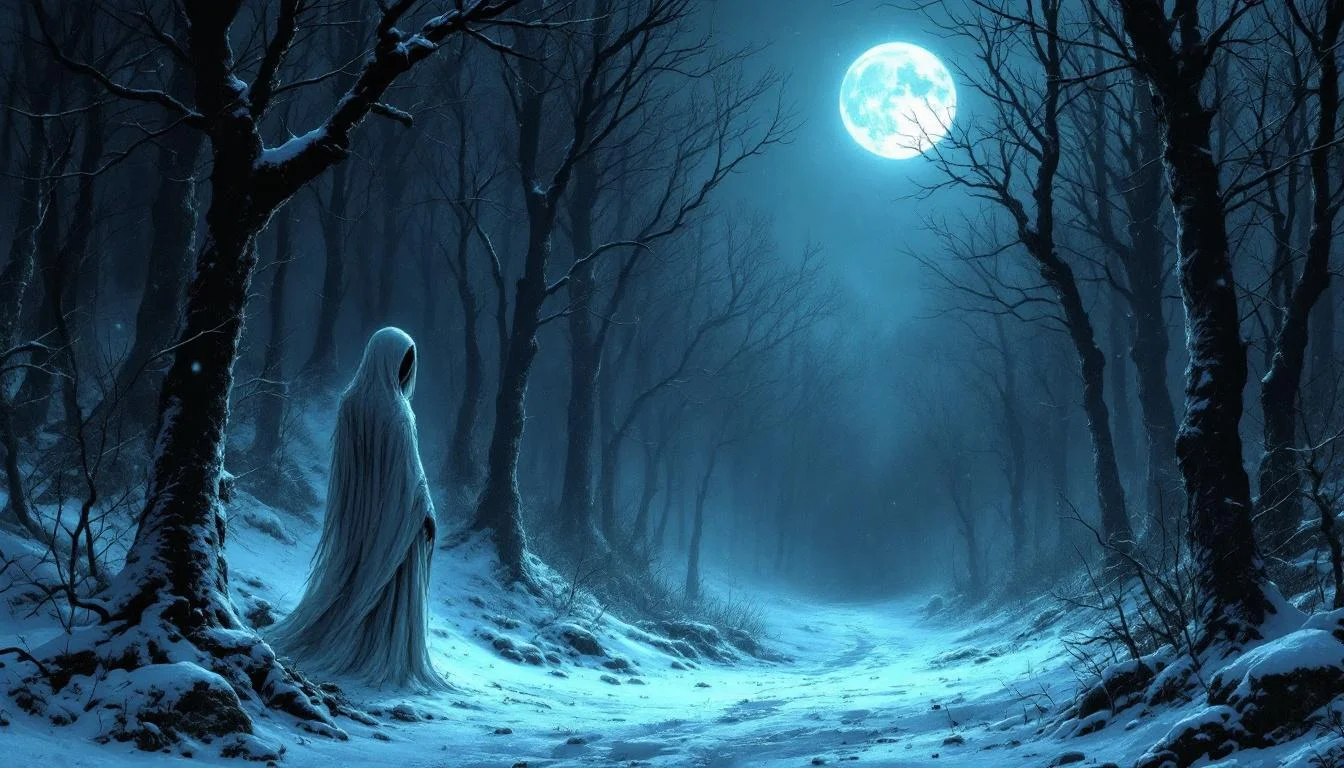
When folk accounts attempt physical description, the picture is consistent and deeply unsettling. She is an old woman — impossibly old, with the wasted body of someone who died long ago and forgot to stop moving. Her skin is grey or translucent. Her hair is long, tangled, matted with what smells like moss and forest dirt. Her eyes glow a faint, sickly red, the color of embers that refuse to die. Her fingers are long and thin — skeletal — and they reach for your throat, your chest, the soft places where breath enters the body.
Some accounts describe a horrible screeching voice, though she rarely speaks. Others insist she is perfectly silent, and that the silence itself is the worst part — the sense that something alive is in the room with you, breathing, watching, pressing, and making no sound at all.
How She Kills You (Slowly)
The Nocnitsa does not attack in the way a Striga attacks — with teeth and sudden violence. Her method is patience. She comes back. Night after night, she returns to the same sleeper, and each visit takes something that does not regenerate.
She sits on the chest of the sleeping person — always the chest — and presses down. The sleeper cannot move, cannot scream, cannot turn their head. They can only lie there and feel the weight increasing, the air thinning, the darkness thickening around them like water filling a well. She feeds on something — the folklore is vague about what, exactly, but the metaphors all point in the same direction. Life force. Vital energy. The substance that makes a person want to wake up in the morning.
Because of this, many folk sources classify the Nocnitsa as a type of vampire — not a blood-drinker, but an energy vampire, a psychic parasite that drains its host without leaving a visible wound. The damage is cumulative. A person visited by the Nocnitsa does not die the first night, or the second, or the tenth. They simply begin to fade. The color drains from their face. They lose appetite. They become irritable, then listless, then hollow. They stop sleeping entirely — not because they cannot, but because they are terrified of what waits for them when they close their eyes.
Children were considered particularly vulnerable. The Nocnitsa was drawn to infants and small children the way certain predators are drawn to the weakest member of the herd. A baby tormented by the Nocnitsa would cry without ceasing through the night — not the ordinary fussing of a hungry or uncomfortable infant, but a sustained, high-pitched shrieking that nothing could soothe. The child would arch its back, go rigid, claw at the air. In the morning, it would be pale and exhausted, with dark circles under its eyes. If the visits continued, the child would sicken and eventually die.
The Nocnitsa, the Mora, and the Goddess of Death
The Nocnitsa does not exist in isolation. She belongs to a family of Slavic nightmare spirits that share overlapping territories, overlapping methods, and — critically — overlapping names.
The closest relative is the Mora — or more precisely, the zmora in Polish, mora in Serbian and Croatian, mura in Burgenland Croatian. The Mora is a proto-Slavic nightmare figure whose name gives us the modern English word "nightmare" (through the Old English mære, which shares the same Indo-European root). She, too, sits on the chest of sleepers. She, too, suffocates. She, too, feeds on something invisible and essential.
The distinction between Nocnitsa and Mora varied by region and often collapsed entirely. In some areas, nocnitsa was simply a euphemism for mora — communities avoided saying "Mora" aloud, fearing it would summon her attention, and used the gentler "night woman" instead. In other regions, the two spirits developed separate identities. The Mora targeted adults, particularly young men whom she visited with a predatory sexual energy. The Nocnitsa targeted children. The Mora could be a living woman whose soul left her body at night to torment others. The Nocnitsa was never human — she was something else entirely, something that had always existed in the dark.
Both figures connect to Morana — the Slavic goddess of winter, death, and nightmares. The etymological chain is suggestive: Morana — Mora — Mara — mare — nightmare. The goddess who brings the killing frost, who presides over the dying season, who must be drowned and burned every spring so that life can return — she may be the mother of all the night-pressing spirits. Some scholars interpret the Nocnitsa and Mora as fragments of Morana's power, distributed across the folklore as the unified pagan goddess was broken apart by Christian theology into smaller, more manageable demons.
The Kikimora Connection
The Nocnitsa also shares territory with the Kikimora — the malevolent female house spirit who lives behind the stove. The Kikimora's nighttime activities sometimes overlap with the Nocnitsa's: she sits on the chests of sleepers, tangles their hair, causes nightmares, and produces the same sensation of paralysis and suffocation.
But the Kikimora is fundamentally a domestic spirit — she is bound to a specific house, created from the souls of unbaptized children or planted by sorcerers through cursed objects hidden in the walls. The Nocnitsa has no such attachment. She roams. She is not the spirit of a dead child but a force of the night itself, unanchored to any building, any family, any human origin. The Kikimora punishes a disordered household. The Nocnitsa does not care whether your house is clean. She comes because you are asleep and because she is hungry.
Iron, Stone, and the Circle That Saves
Slavic folk tradition developed an arsenal of defenses against the Nocnitsa, and the consistency of these remedies across vast geographic distances suggests they are very old — older than Christianity, older perhaps than the Slavic migrations themselves.
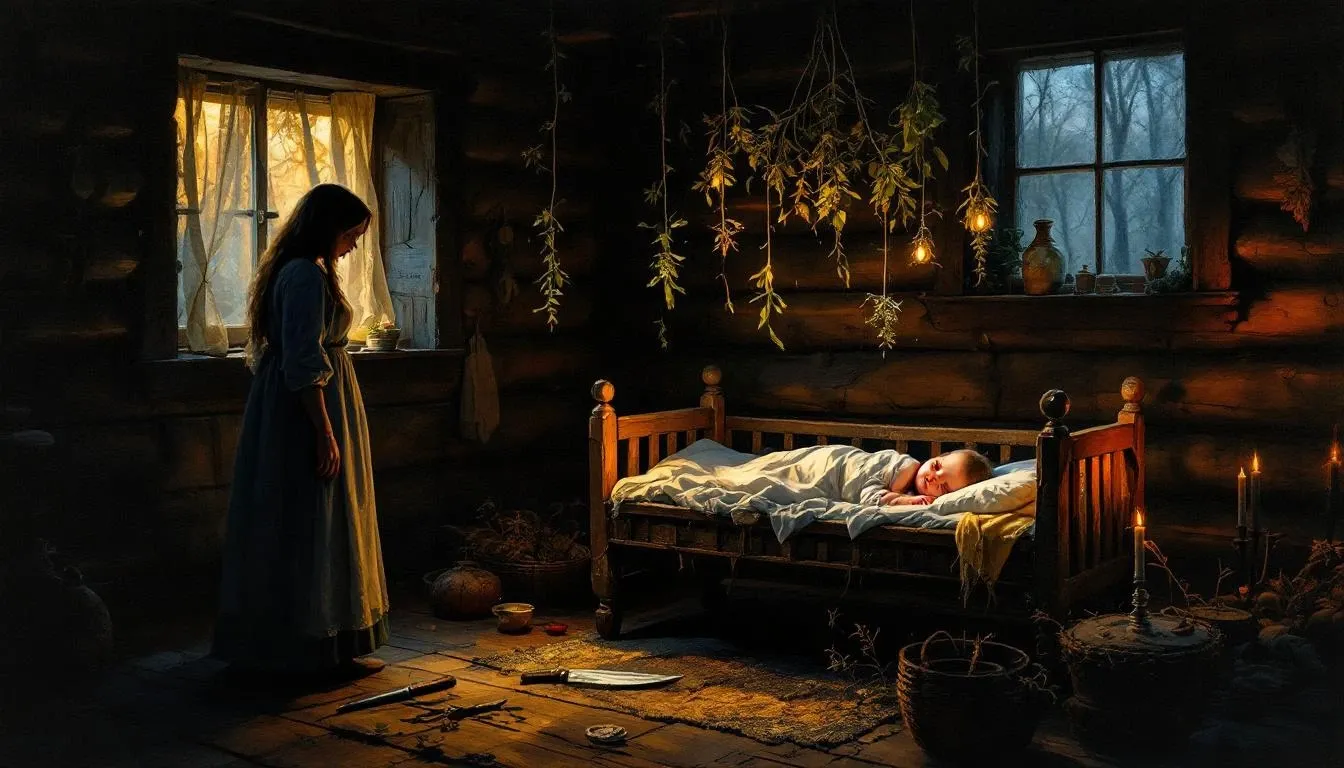
The iron knife. The most widespread protection was iron in any form, but especially a knife. Mothers placed an iron knife in the cradle of an infant threatened by the Nocnitsa. Some drew a circle around the cradle with the blade — an unbroken ring of iron's protective influence that the night spirit could not cross. The belief that supernatural creatures cannot touch iron is one of the deepest and most universal folk convictions in European tradition, and the Nocnitsa was no exception. Iron is earthly, forged, real — everything she is not.
The hag stone. A stone with a naturally occurring hole in its center — called a kurinyi bog (chicken god) in Russian folk terminology, or a hag stone in English tradition — was placed near the child's bed or hung above the cradle. The hole was the key. Spirits, in Slavic belief, could not pass through a natural opening in stone. The hag stone acted as a filter, a spiritual sieve that allowed air and light to pass but trapped the Nocnitsa on the wrong side of the barrier.
In Russian and Slovak folk belief, the nocnitsa are known to torment children at night, causing unceasing crying and restless sleep. A stone with a hole in the center, placed near the child, was believed to ward against the spirit. Mothers would also draw a circle around the cradle with an iron knife, creating a boundary the night visitor could not cross.
The sleeping position. Across the South Slavic lands, a simple behavioral remedy persisted for centuries: do not sleep on your back. The Nocnitsa, like the Mora, required her victim to lie supine — face up, chest exposed, hands folded in what folk tradition called "sleeping with the dead." Sleeping on your side denied her the surface she needed. The Austrian ethnographer Friedrich Krauss noted in 1908 that South Slavic peasants who slept on their backs reported far more night-pressing attacks than those who slept on their sides — an observation that modern sleep research has confirmed with clinical precision.
Other protections included wearing a leather belt from one's wedding while sleeping, placing a scythe beside the bed, laying a crossed axe and broom on the threshold, and nailing a bird of prey to the door of the house. Each remedy combined practical symbolism — sharp objects, binding objects, predator totems — with the deeper Slavic conviction that the boundary between the safe interior and the hostile night could be reinforced through ritual action.
What Science Says About the Thing on Your Chest
Modern sleep medicine has a clinical name for the Nocnitsa's visit. It is called sleep paralysis — a parasomnia that occurs during the transition between wakefulness and REM sleep, when the brain's mechanism for suppressing voluntary muscle movement during dreams fails to disengage upon waking. The result is exactly what the folklore describes: you are conscious, your eyes are open, but your body is immobilized. You cannot move your limbs, cannot turn your head, cannot call for help.
The prevalence is significant. Approximately 7.6 percent of the general population will experience at least one episode of sleep paralysis in their lifetime. Among students and psychiatric patients, the rate is substantially higher. The episodes are brief — typically lasting seconds to a few minutes — but they are accompanied by phenomena that would have terrified a medieval peasant and, frankly, terrify most modern people who experience them.
The hallucinations fall into three categories that researchers have identified with clinical detachment: intruder hallucinations (the perception of a dangerous presence in the room), incubus hallucinations (the feeling of pressure on the chest, difficulty breathing, a sense that something is sitting on you), and vestibular-motor hallucinations (sensations of floating, falling, or leaving the body). The first two categories map precisely onto the Nocnitsa experience — a malevolent figure in the room, weight on the chest, the inability to breathe or move.
The chest pressure has a physiological explanation. During REM sleep, respiratory muscles are partially inhibited, reducing tidal volume and alveolar ventilation. When a person becomes conscious before this inhibition lifts, they experience real breathing difficulty — not imagined, not symbolic, but genuine respiratory compromise that the panicking brain interprets as external compression. Something is on your chest because your chest is, in a measurable physiological sense, not working properly.
Every culture that has experienced sleep paralysis has generated its own version of the Nocnitsa. In Newfoundland, it is the Old Hag. In Japan, kanashibari — being bound with metal. In Turkey, karabasan — the dark presser. In Egypt, the jinn. In Thailand, phi am — the ghost that sits on you. The consistency of the experience across unrelated cultures is one of the strongest arguments that sleep paralysis is a universal human neurological event, and that the Nocnitsa is not a creature of Slavic imagination but a Slavic interpretation of something the human brain has been doing to its owner for as long as humans have slept.
She Is Still Here
The Nocnitsa has not gone anywhere. She has simply changed her costume.
In online forums dedicated to sleep paralysis, the descriptions posted by people who have never heard of Slavic folklore read like entries from a nineteenth-century Russian ethnographic collection. Something was sitting on my chest. I could not move. I could not scream. There was a dark figure at the edge of my bed. It smelled wrong — like earth, like something rotting. I was awake the entire time. The language is modern. The experience is ancient.
What the Slavic peasant understood — and what the sleep researcher sometimes forgets — is that the name matters. Calling the thing on your chest a parasomnia associated with REM atonia does not make it less terrifying at 3 AM. Calling it the Nocnitsa does something else: it gives the fear a shape, and shapes can be fought. You can place an iron knife in the cradle. You can hang a stone with a hole above the bed. You can draw a circle and say: you cannot cross this line.
The Nocnitsa was never really about a specific demon. She was about the universal human experience of waking into helplessness — of being conscious and imprisoned in a body that will not obey, while something terrible leans close in the dark. The Slavic villagers who named her were not creating a myth. They were documenting a medical condition with the tools available to them: story, ritual, and the iron knife under the pillow that let you close your eyes and believe, for one more night, that you were safe.
She will be back tomorrow. She always comes back. But now you know her name, and in the old Slavic tradition, knowing the name of the thing that hunts you is the first step toward surviving the night.