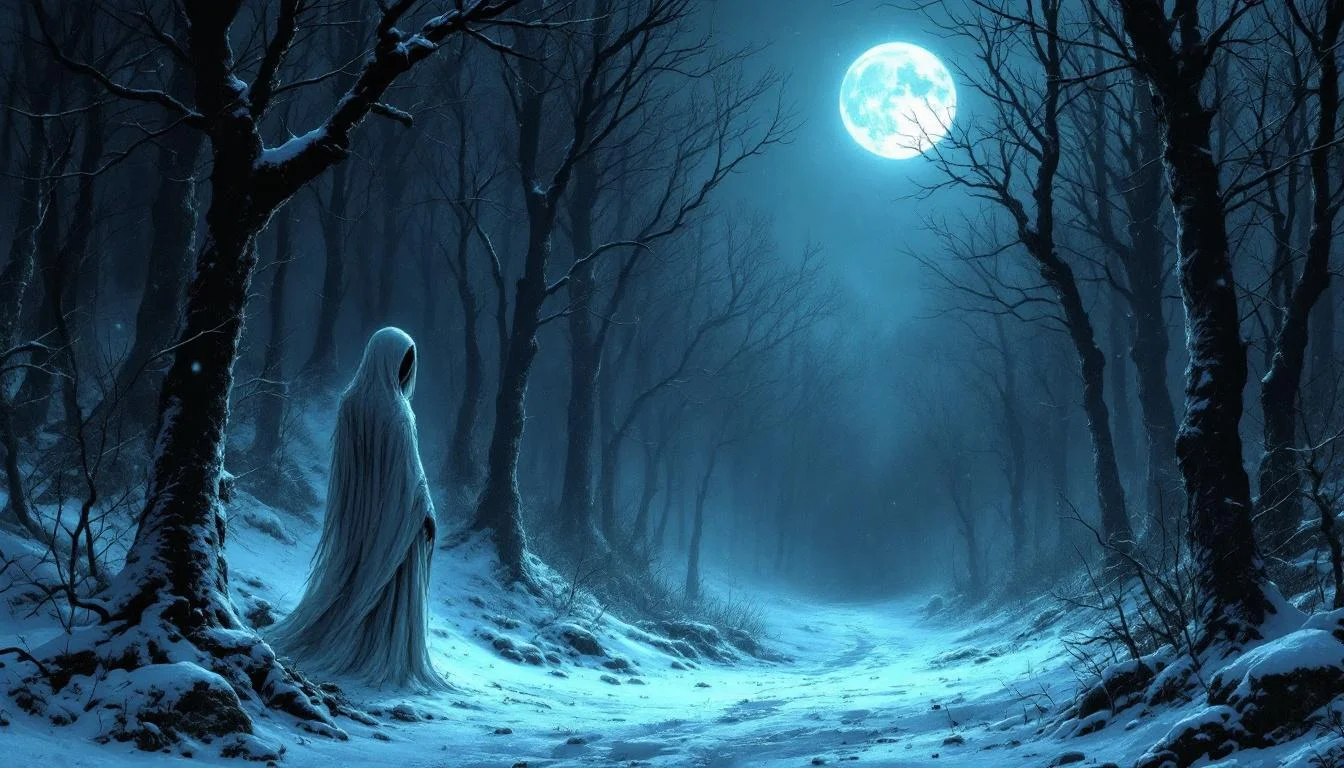
In the forests of the old West Slavic world — the dense oak and pine country that once covered Bohemia, Moravia, Silesia, and the Polish lowlands — hunters did not simply walk into the trees and hope for the best. They asked permission first. They whispered a name before drawing a bow, and left a portion of their kill at crude stone altars set in forest clearings. The name they whispered belonged to a goddess who was neither gentle nor generous by nature. She was wild, proud, and famously difficult to please. She protected the animals of the forest with the same ferocity she granted to those hunters who honored her rules. Those who hunted for sport, who killed without need, who took more than the forest could afford to lose — those men she punished without mercy.
Her name was Devana. The Poles called her Dziewanna. The Czechs knew her through the old glossaries that equated her with the Roman Diana. She was the virgin huntress, the mistress of wolves and wild places, a goddess whose very existence was an act of refusal — refusal to submit, to marry, to abandon the forest for the hearthfire. In a pantheon dominated by the thunder and agricultural concerns of male deities like Perun and Svarog, Devana occupied a space that was entirely her own: the deep woods, the moonlit clearings, the border where human settlement ended and the untamed world began.
The Name and Its Roots
The etymology of Devana is both straightforward and layered with meaning. The most commonly accepted derivation traces her name to the Proto-Slavic root *deva, meaning maiden or virgin. The same root survives in modern Slavic languages — the Russian deva, the Czech divka, the Polish dziewczyna — all meaning girl or young woman. The Polish name Dziewanna carries this meaning on its surface: she is the Maiden, the one who has not submitted to marriage, who remains unbound.
But there is a second, deeper stratum. Some scholars connect her name to the Proto-Indo-European root *deiwos, meaning celestial or divine — the same root that produced Latin deus (god), Sanskrit deva (divine being), and Lithuanian dievas (god). Under this reading, Devana is not merely "the maiden" but "the divine one," a title that positions her among the highest order of beings. The convergence of "maiden" and "divine" in a single name is not accidental. It reflects a theological understanding in which her virginity was not a limitation but a source of sacred power — an unbroken, unconquered sovereignty that set her apart from the domestic goddesses of hearth and harvest.
The Polish word dziewanna also denotes the mullein plant (Verbascum), a tall yellow wildflower that grows in disturbed soil and open meadows. Mullein was used across medieval Europe as a torch — the dried stalk, dipped in tallow, burned slowly and steadily. The association between the goddess and this plant suggests rituals involving torchlit processions through the forest, though no direct textual evidence for such ceremonies has survived. What we have instead is the stubborn persistence of the name itself, binding goddess and plant together across centuries in the Polish language.
"Since the Lechitic state was founded in an area with vast forests believed to be inhabited by Diana, both Diana — called Dziewanna in their language — and Cerera, called Marzanna, enjoyed special cult and devotion among the people."
What the Sources Tell Us
The historical record for Devana is frustratingly thin — thinner than for almost any other major figure in the Slavic pantheon. Unlike Perun, who appears in the Primary Chronicle and in Byzantine accounts of Slavic treaty oaths, or Veles, whose name survives in dozens of place names and folk curses, Devana left only a handful of textual traces. Understanding what those traces mean requires understanding where they came from and how much trust they deserve.
The earliest and most frequently cited source is the Mater Verborum, a Latin encyclopedic dictionary compiled around 1240 in a Benedictine scriptorium in Bohemia. Among its Czech-language glosses, one entry identifies "Devana" as a daughter of Perun and equates her with the Roman Diana. This would be remarkable evidence — a thirteenth-century Czech manuscript confirming a pre-Christian goddess within the Slavic tradition — except for one problem. The Mater Verborum was brought to scholarly attention in the nineteenth century by Vaclav Hanka, a Czech patriot who was later proved to have forged other documents purporting to preserve ancient Czech literary heritage. The Hanka forgeries remain one of the great scandals of nineteenth-century Slavic studies, and while not every gloss in the Mater Verborum is necessarily fabricated, the shadow of doubt falls heavily on precisely those entries that mention Slavic deities. Scholars remain divided. Some accept the Devana reference as genuine medieval testimony; others dismiss it as romantic nationalism dressed in Latin.
The richest and most reliable source is the fifteenth-century Polish chronicler Jan Dlugosz, whose monumental Annales seu cronici incliti regni Poloniae — twelve volumes covering Polish history from antiquity to 1480 — includes a systematic account of pre-Christian Slavic religion. Dlugosz, writing as a Catholic clergyman, used the interpretatio Romana method: he identified Slavic gods with their closest Roman equivalents. He explicitly equated Dziewanna with Diana, the Roman goddess of the hunt and the moon, noting that the vast forests of the Lechitic lands made her cult particularly strong among the Western Slavs.
Beyond these texts, the goddess is confirmed through toponymy — the names of places. Devin, the dramatic cliff fortress overlooking the confluence of the Danube and Morava rivers near Bratislava, carries a name that ninth-century Frankish annals explained as derived from the Slavic deva, meaning girl. The Annales Fuldenses recorded the name as "Dowina, id est puella" — Dowina, that is, maiden. Whether this specifically referenced the goddess or simply described a fortress associated with young women is debated, but the cluster of Devin-related place names across the Czech, Slovak, and South Slavic territories suggests a widespread cult presence that left its mark on the landscape long after the temples were dismantled.
The Myth of Rebellion
The most complete narrative involving Devana — though it must be noted that this story comes from later folklore compilations and reconstructions rather than medieval primary sources — tells of her rebellion against the cosmic order and the punishment that followed. The story reads less like a pastoral myth and more like a family catastrophe, full of pride, transformation, and forced submission.
The goddess, daughter of the thunder god Perun and the earth goddess Mokosh, grew up wild. She chose the forests over her father's celestial hall, preferring the company of wolves and foxes to that of the other gods. She was skilled beyond measure with the bow and moved through the woods with a silence that even Leshy, the forest spirit, could not match. Her beauty was of the unsettled, dangerous kind — not the gentle loveliness of Lada, goddess of love and harmony, but a fierce attractiveness that warned as much as it invited.
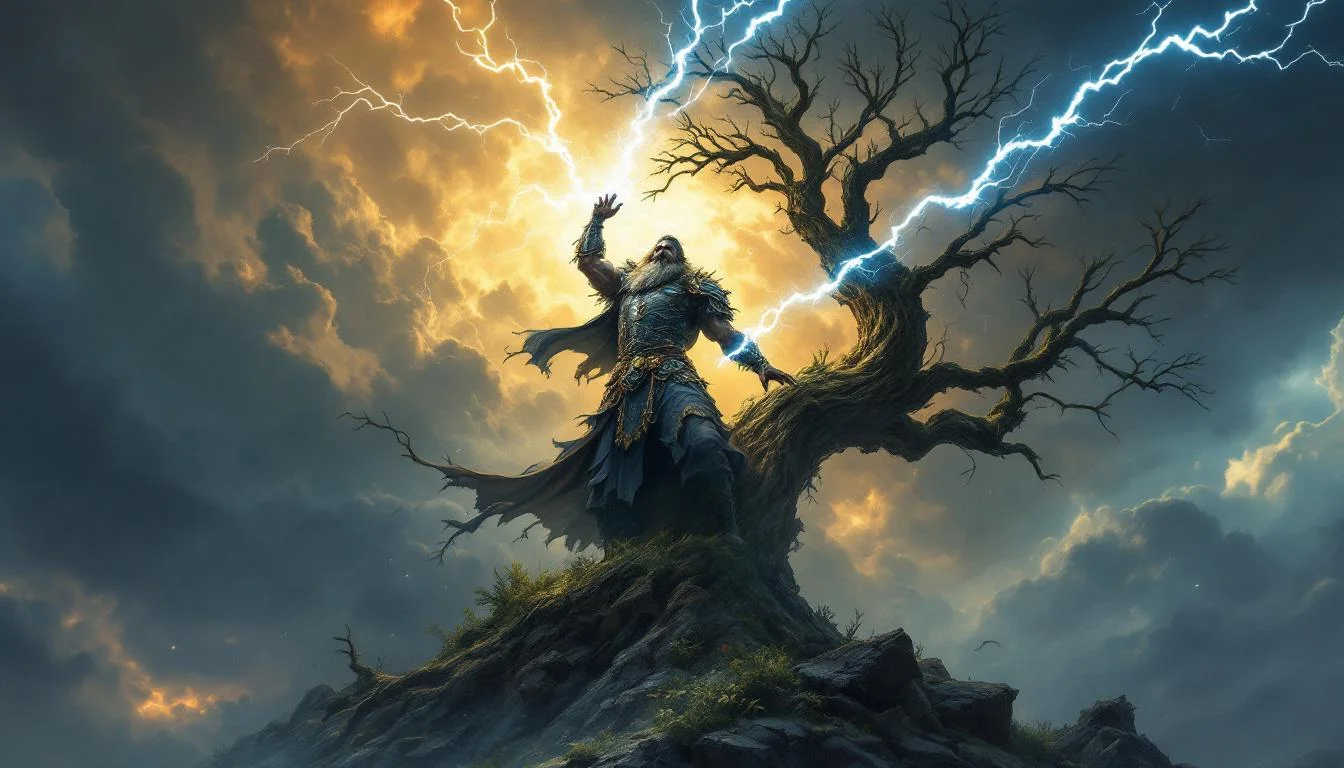
The trouble began when her pride outgrew the forest. She decided that the three worlds of Slavic cosmology — the heavens of Prav, the earthly realm of Yav, and the underworld of Nav — should answer to her. She declared her intention to overthrow Svarog, the celestial smith-god who held sovereignty over the divine order. When news of this reached Perun, the thunder god descended from his mountain to confront his daughter in the woods.
What followed was a chase of shape-shifting. She transformed into a bird and fled skyward — Perun became an eagle and caught her. She dove into the water and became a fish — Perun pursued her as a great pike. At every transformation, the father matched the daughter, mirroring her power until she had nowhere left to run. The myth carries the logic of a fairy tale but the emotional weight of something darker: a father breaking the spirit of a child who has grown too strong for him to tolerate.
As punishment, Perun decreed that his wild, unmarriageable daughter would be given to Veles — lord of the underworld, god of cattle, sorcery, and the lowlands. This was not merely a marriage. It was exile. Perun and Veles stood at opposite ends of the Slavic cosmos, locked in an eternal conflict that structured the mythology from top to bottom. To send the huntress to Veles was to banish her from the sky and the sunlit forest, consigning her to the damp, dark realm beneath the world tree.
The Huntress and Her Laws
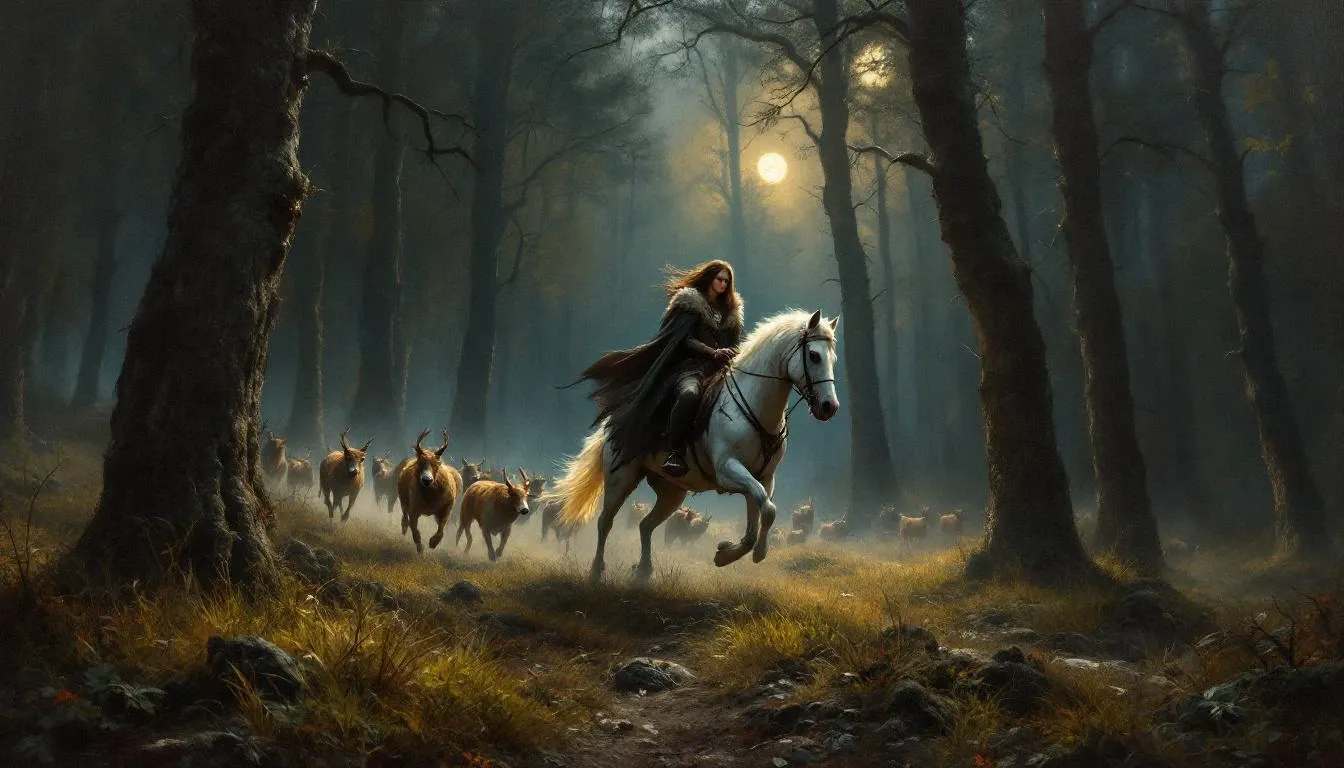
Whatever the later mythological elaborations say about cosmic rebellion and forced marriage, the core of the cult was simpler and more practical: she was the goddess you prayed to before a hunt. In the heavily forested regions of medieval Poland, Bohemia, and the broader West Slavic territory, hunting was not a sport. It was survival. The forests contained wolves, bears, aurochs, and wild boar — animals that could kill a man as easily as a man could kill them. A hunter entering those woods was entering a realm that did not belong to human beings. It belonged to Devana.
The ancient Slavs imagined her dressed in rich furs — a cloak of marten or sable, trimmed with squirrel, with a bearskin thrown over her shoulders and the beast's skull worn as a cap. She carried a hunting bow and a quiver of arrows, and at her feet rested a heavy rogatina — the thrusting spear used specifically for bear hunts, one of the most dangerous encounters a human being could have in the northern European forest. A wolf or fox walked at her side, not as a pet but as an equal, a fellow predator sharing the same territory.
The rules she imposed on hunters reflected a conservation ethic that modern ecologists would recognize. Killing for sustenance was permitted and even blessed. Killing for amusement — hunting as recreation, as display of status rather than need — enraged her. Hunters who violated this principle were said to be punished with venomous snakes sent by the goddess, whose slow-acting poison ensured that the offender had time to understand why he was dying. She protected the animals of the forest the way a lord protects vassals: not out of tenderness, but out of ownership. They were hers. You could borrow them, with proper respect, or you could face consequences.
This dual role — patron of hunters and protector of prey — seems contradictory only if you misunderstand the function. The huntress did not oppose hunting. She governed it. She was the mediator between human need and animal life, the authority who determined when killing was justified and when it was transgression. Her presence in the forest ensured that the relationship between hunter and hunted remained one of reciprocity rather than domination.
The Goddess, the Effigy, and the Ritual Year
One of the stranger puzzles of West Slavic religion is the relationship between the huntress goddess and Morana — the goddess of winter and death known in Poland as Marzanna. Dlugosz mentioned both in the same breath, writing that the Western Slavs gave special devotion to Dziewanna (equated with Diana) and Marzanna (equated with Ceres, though later scholars have argued the Hecate comparison is more apt). The two goddesses appear to have occupied complementary positions in the ritual calendar: Devana associated with the living forest, with growth, youth, and the active season of the hunt; Morana associated with winter, death, and the dormant earth.
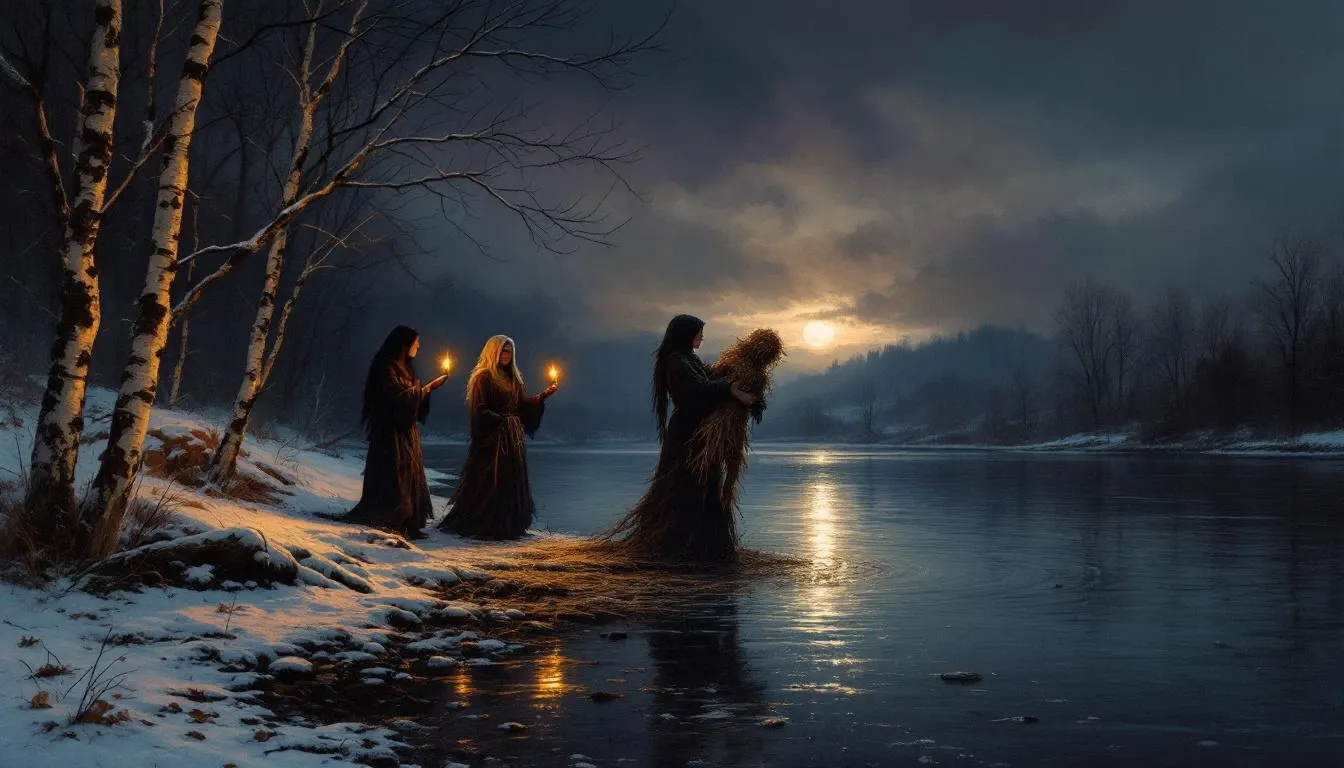
The spring ritual documented from the medieval period onwards tells of effigies being carried from villages and cast into water — a custom that scholars have attributed primarily to Marzanna but which some early sources conflate with Dziewanna. After the baptism of Poland in 966, when Mieszko I ordered the destruction of pagan idols, chroniclers recorded that images of both Dziewanna and Marzanna were mounted on long hazel-wood stakes and thrown into swamps or rivers. Whether these were two separate effigies representing two distinct goddesses, or two names for aspects of a single seasonal figure, remains one of the open questions of Slavic religious studies.
The most plausible reading is that Devana and Morana represented two faces of the same natural cycle. The huntress was the forest alive — green, dangerous, full of prey and predators, governed by the moon and the hunt. Morana was the forest dead — frozen, silent, a landscape of bare branches and buried roots. The destruction of their effigies each spring was a single ritual act aimed at clearing the way for new growth, with the maiden huntress and the winter crone both surrendered to the waters so the agricultural year could begin again.
Why Devana Matters
The Slavic pantheon is full of powerful gods — thunder-wielders, underworld lords, celestial smiths who forged the dome of the sky. Among them, Devana occupies a position that no one else fills. She is the goddess of what lies beyond the fence. Every human settlement in the medieval Slavic world had a boundary, whether a wooden palisade, a ditch, or simply the last plowed furrow before the trees began. On one side was the ordered world of agriculture, law, and family. On the other side was her domain: the forest, the hunt, the animal world that operated by its own rules and answered to its own authority.
Her refusal to marry — or more precisely, her forced marriage to Veles, which she accepted without love — mirrors the tension every forest-dwelling community felt between the need to tame the wild and the knowledge that the wild could never truly be tamed. You could send your hunters into her trees. You could cut timber and clear fields. But the forest always pushed back. The wolves always returned. The bears always came down from the mountains in spring. The huntress goddess was the name the Western Slavs gave to that irreducible wildness — the force that resisted domestication, that punished arrogance, that reminded human beings they were guests in a world far older than their villages.
In 2018, the International Astronomical Union named asteroid 471143 Dziewanna after the Polish form of the goddess. It is a small, cold body orbiting in the darkness beyond Neptune — a trans-Neptunian object in the scattered disc, wild and distant and alone. The astronomers who chose the name understood something about it. She belongs to the places that are hard to reach, that resist human mapping, that exist on their own terms whether anyone is watching or not. She was never a goddess of temples and prayers. She was a goddess of the spaces between, where the firelight ends and the forest begins and something ancient watches from the dark.