There are twelve nights in the dead of winter when the world is not safe. They fall between Christmas and Epiphany — December 25 to January 6 by the old calendar, though in the Orthodox world the dates shift two weeks forward. The Slavs called these the pogani dni — the unclean days, the dirty days, the days when the barrier between the human world and the other place grows so thin that things come through. Not metaphorically. Not symbolically. Things with weight and fur and breath that stinks of horse sweat and something worse — things that drop onto your back from above, wrap their legs around your chest, and ride you through the freezing dark until dawn or death, whichever arrives first.
The thing has a name. In Bulgaria it is karakondzhul. In Serbia, karakondžula. In North Macedonia, karakondjul. The word does not come from any Slavic root — it arrived from Turkish, from karakoncolos, which itself may derive from kara (black, dark) and a root connected to koncolos (werewolf, bugbear). The name is a loan, but the creature is not. It belongs to the oldest layer of South Slavic belief, the stratum that sits beneath Christianity and beneath even the organized paganism of Perun and Veles, in the deep substrate where winter means danger and the dark is full of things that do not have the decency to be imaginary.
The Twelve Uncleansed Days
To understand the karakondzhul, you must first understand the days that birth it.
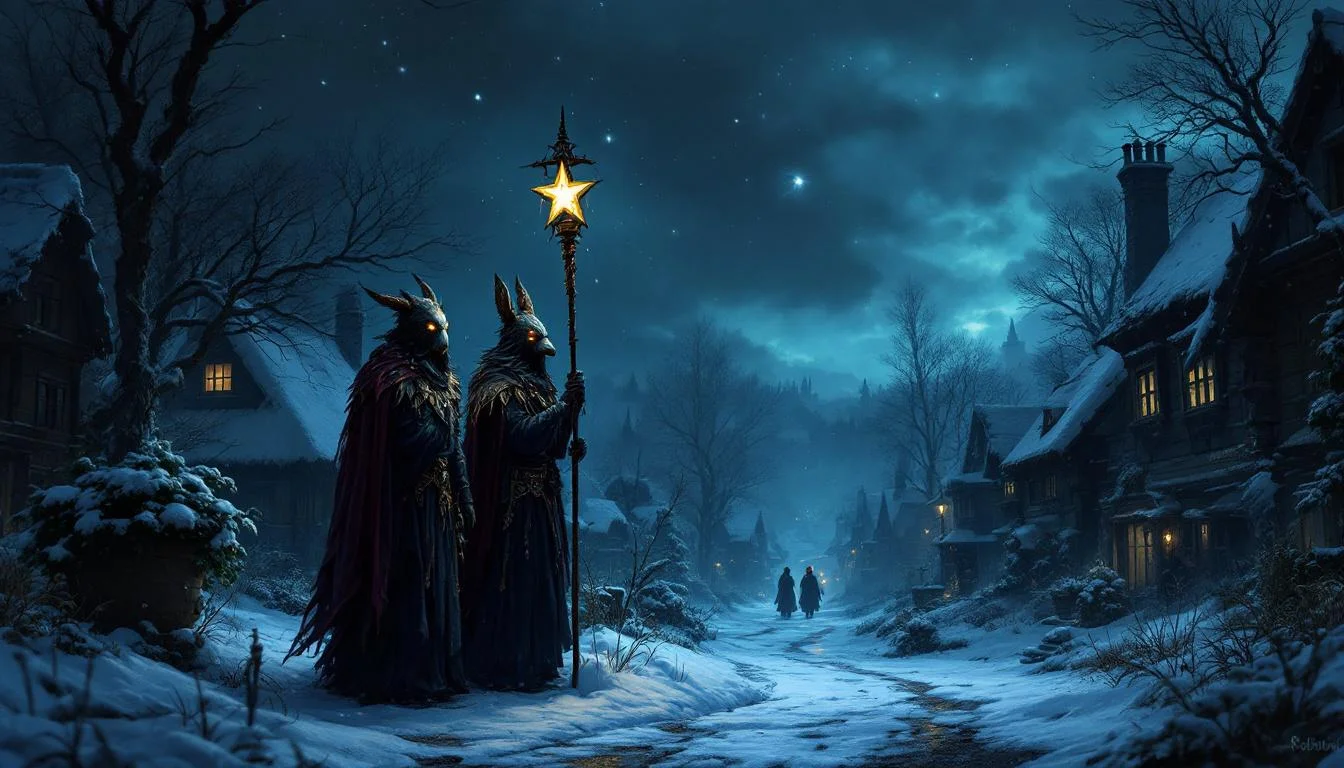
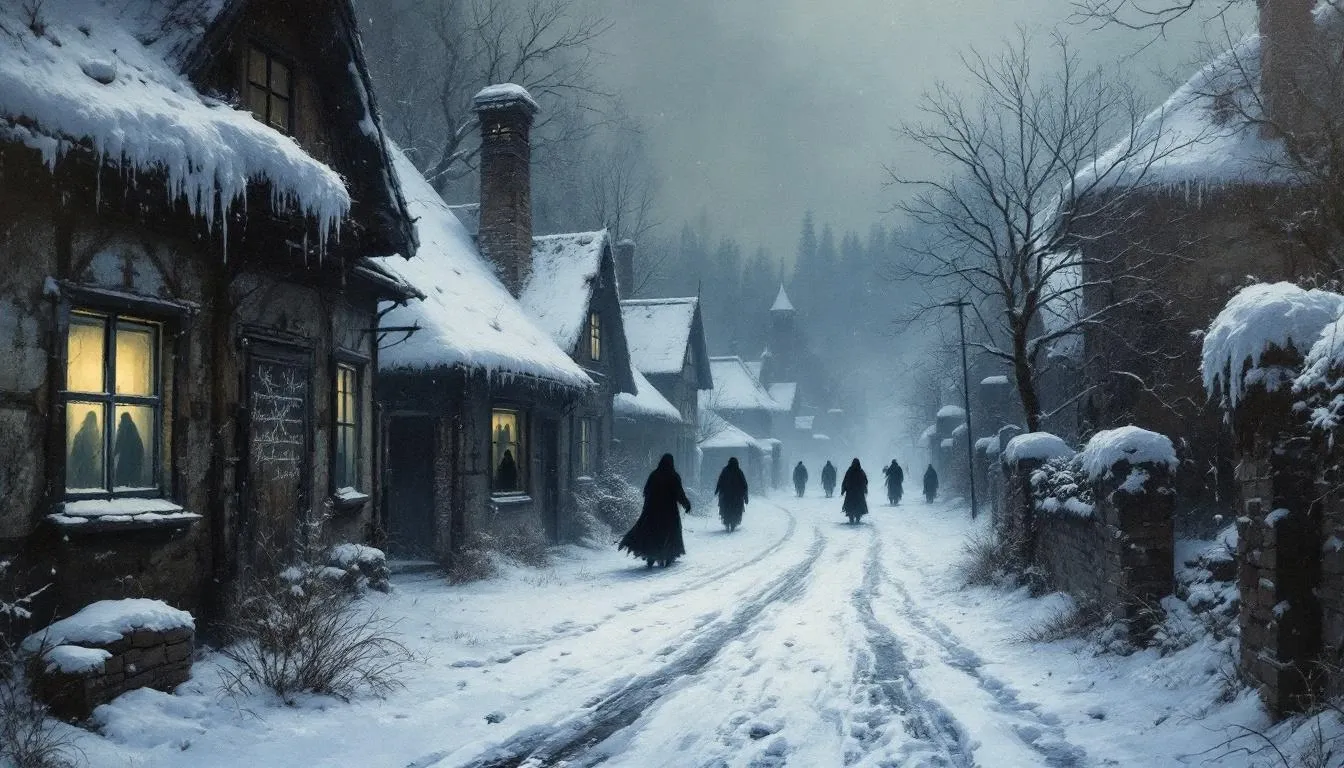
The period between Christmas and Epiphany — the Twelve Days of Christmas in Western tradition, the Svyatki in Russian, the mrŭsni dni (dirty days) in Bulgarian — was universally regarded across the Slavic and Balkan world as a time of spiritual danger. The logic was theological but older than any theology. Christ had been born but not yet baptized. The waters of the world remained unconsecrated. The boundary between the sacred and the profane, normally maintained by the rhythm of church bells, priestly blessings, and the regulated calendar of saints' days, went slack. The dead walked. The spirits rose. The unclean things that spent the rest of the year confined to their marshes, their crossroads, their underworld hiding places came up into the villages and made themselves at home.
In Bulgarian tradition, these days were explicitly marked as a time when spinning, weaving, and certain types of domestic work were forbidden. The reasoning was precise: the karakondzhuli emerged from rivers, wells, and springs during this period, and the sound of a spinning wheel attracted them the way a lantern attracts moths. A woman spinning after dark during the dirty days was not merely breaking a custom. She was ringing a dinner bell.
The prohibition against work was not laziness dressed in superstition. It was a survival protocol embedded in folk memory. The twelve days were liminal — suspended between one state and another, belonging fully to neither the old year nor the new, neither the unbaptized world nor the consecrated one. In that suspension, the rules changed. What was safe in February was lethal in January. The karakondzhul was the embodiment of that lethality: a creature that existed only in the gap, only in the dirty days, only when the world's defenses were down.
The Shape of the Rider
The karakondzhul does not hold a single form. Like most creatures born in oral tradition, it shifts from village to village, from grandmother to grandmother, from one night's telling to the next. But the core features persist with enough consistency to draw a portrait.
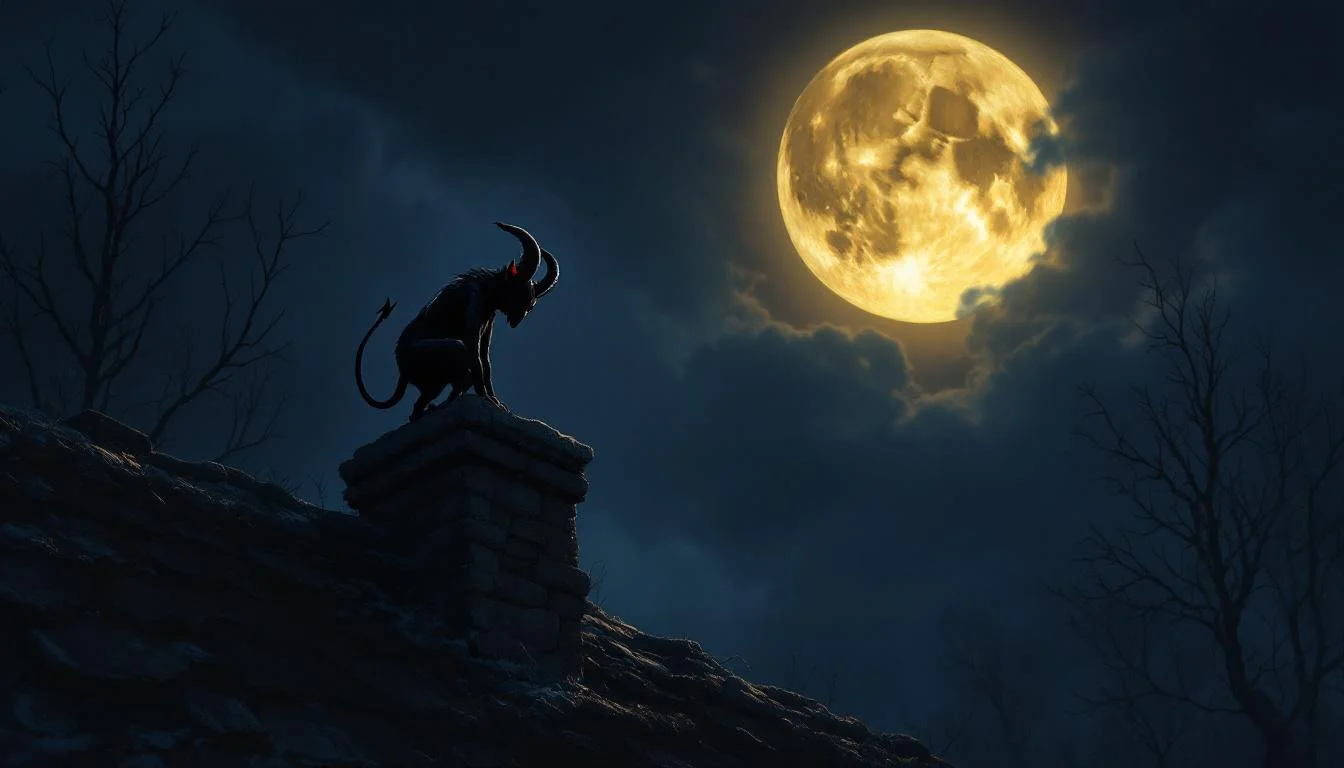
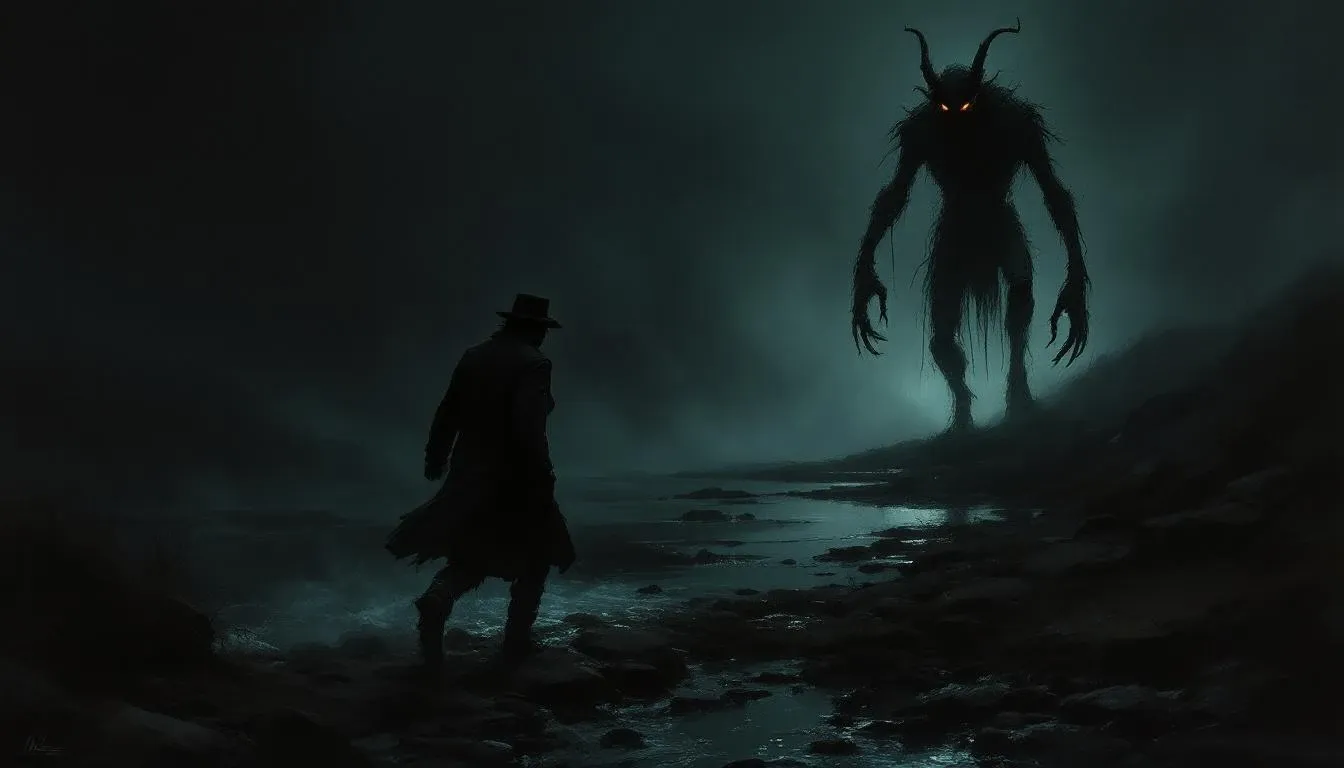
It is dark — not merely in coloring but in essence, as if the creature were made of compressed night. The body is roughly humanoid but wrong in the way that all demonic bodies are wrong in Slavic folklore: too hairy, too tall, joints bending at angles that human joints refuse. The fur is coarse and black, matted like the coat of a goat that has lived wild through three winters. The eyes glow — red in some accounts, yellow in others, always the color of something burning. The legs are the legs of a horse or a donkey, ending in hooves that strike sparks from stone. In certain Bulgarian villages, the creature is described as headless — a torso of fur and muscle that gropes blindly toward its victim, guided by smell or sound or some sense that has no name.
The hands are the critical feature. They are long-fingered, powerful, and designed for a single purpose: gripping. The karakondzhul does not bite. It does not claw. It does not poison or curse or cast spells. It climbs onto your back and holds on. That is its entire method of attack, and it is more terrible than any amount of tooth and venom.
The Back-Riding Terror
The riding is the center of the karakondzhul's mythology. It is not incidental to the creature — it is the creature. Remove the riding and there is nothing left, no identity, no story, no reason for the name to have survived four centuries of telling.
The attack follows a pattern. A person walks alone at night during the dirty days. They are returning from a neighbor's house, or from the tavern, or from some errand that could not wait until morning. The road is dark. The village is behind them. Ahead, something waits at a crossroads, or beside a bridge, or near a well — always a liminal space, always a boundary between one territory and another.
The creature drops onto the victim's back without warning. The weight is enormous — far more than any physical body of that size should produce, as if the thing carried the gravitational pull of the underworld with it. The fingers lock around the shoulders. The legs grip the torso. And then the victim begins to move — not voluntarily, not by their own will, but driven by the creature on their back, steered like a horse through the worst terrain available. Through thorn bushes. Through frozen creeks. Through fields of sharp stubble and ditches full of ice water. The rider does not care about the mount's suffering. The suffering is the point.
The ride ends at dawn. When the first rooster crows — the sound that traditionally banishes all unclean spirits in Slavic belief — the karakondzhul releases its grip and vanishes. The victim collapses wherever they stand, bruised, torn, hypothermic, sometimes half-drowned in whatever body of water the creature steered them through. Some recover. Some do not. The elderly and the frail rarely survived a full night's riding through January weather in the Balkans.
The symbolic reading is plain enough. The karakondzhul is the winter itself — the dark, the cold, the crushing weight of the season pressing down on people who had no central heating, no electric light, no weatherproof clothing beyond sheepskin and wool. To be ridden by the karakondzhul was to be ridden by winter, driven through the worst of it without rest, and either you were strong enough to survive until dawn or you were not.
But the people who told these stories did not experience them as symbols. They experienced them as warnings. Do not walk alone. Do not go out after dark. Do not leave the house during the dirty days unless you absolutely must. The karakondzhul was pedagogical terror — a story shaped by centuries of harsh winters into a survival instruction disguised as a monster.
Kallikantzaroi: The Greek Cousins
The karakondzhul does not exist in isolation. Across the border in Greece, an almost identical creature haunts the same twelve days under the name kallikantzaroi — and the parallels are so precise that they cannot be coincidental.
The Greek kallikantzaroi are small, dark, hairy goblins who emerge during the period between Christmas and Epiphany. They cause havoc — breaking into houses, spoiling food, extinguishing hearth fires, riding on people's backs. They are repelled by the same methods: fire, holy water, the blessing of the waters at Epiphany. They vanish at the same moment: when the priest sanctifies the rivers and springs on January 6, consecrating the water that has been unconsecrated since Christ's birth.
The Greek tradition adds a detail the Slavic versions lack. The kallikantzaroi, according to one widespread belief, spend the rest of the year underground, sawing at the World Tree — the cosmic pillar that holds up the earth. They saw all year, and by December they have nearly cut through. But during the twelve days, they abandon their work to come above ground and torment humans. While they are away, the World Tree heals itself. They return underground in January to find their progress erased, and begin sawing again. The cycle is eternal.
The kallikantzaroi were believed to be black, hairy, and bestial, with blazing red eyes, goats' or asses' ears, and sometimes horses' legs. They descended chimneys during the Twelve Days to seize those who ventured out after dark, leaping upon their backs and riding them through thorns and streams until the crowing of the first cock released the victim.
The connection between the South Slavic karakondzhul and the Greek kallikantzaroi is not merely one of parallel development. The two traditions grew up in the same soil. The Balkans — that tangle of mountains, river valleys, and cultural crossroads where Slavic, Greek, Turkish, and Romani traditions have mixed for a millennium — produced a shared demonology that crosses linguistic and ethnic boundaries. The creature is one being with multiple names, shaped by the same winters, the same long nights, the same fear of the dark that settles over mountain villages when the sun goes down at four in the afternoon and does not return for sixteen hours.
The Turkish connection runs through the name itself. Karakoncolos in Turkish folklore is a winter demon who haunts crossroads and asks passersby riddles or questions. Answer correctly and you pass safely. Answer wrong — or worse, answer with a word containing the sound "kara" (black) — and the creature drags you to your death. The Slavic and Greek versions dropped the riddle but kept the crossroads, the winter timing, and the physical violence. The creature mutated as it moved between cultures, shedding some features and acquiring others, but the skeleton remained: a hairy, dark, winter-born thing that catches you in the open and will not let go.
Defenses: Fire, Ash, and Holy Water
The protections against the karakondzhul form a coherent system, drawing on both pre-Christian magic and Christian ritual in the way that characterizes all Balkan folk practice.
Fire was the first defense. During the dirty days, fires were kept burning through the night — not for warmth alone, but as a barrier. The karakondzhul feared flame. A bonfire at a crossroads could block its path. A torch carried on a nighttime journey could keep it at a distance. The yule log — the badnjak in Serbian tradition, a ritual log burned on Christmas Eve — served a double function: it celebrated the birth of Christ and it created a wall of fire between the household and the creatures that owned the night.
Fireplace ash was a specific and widespread remedy. Bulgarian villagers scattered ash from the hearth across the threshold of the house and around the perimeter of the yard. The logic was both practical and magical. Ash preserves heat — a reminder of the fire that produced it. Ash also records footprints. A line of ash across the doorway would show, in the morning, whether anything had tried to enter during the night. If hoofprints appeared in the ash, the household knew what had visited and could take further precautions: additional blessings, the burning of specific herbs, or the summoning of a priest.
Water crossings offered safety for those caught in the open. The karakondzhul, like most unclean spirits in Slavic tradition, could not cross running water. A person being ridden who managed to stagger to a stream or a river and cross it would feel the creature release its grip at the water's edge. The vodyanoy ruled the rivers; the karakondzhul ruled the land. The jurisdictions did not overlap.
The final and definitive defense was the Blessing of the Waters at Epiphany — Vodokreshchi in South Slavic tradition. On January 6, the priest processed to the nearest body of water, said the prayers, and plunged a cross into the current. At that moment, the water was consecrated, the dirty days ended, and every karakondzhul in existence was driven back below the surface of the earth or the water from which it had emerged twelve nights before. The creature was bound to the liturgical calendar as surely as a prisoner is bound to a cell. The priest's blessing was the lock, and it held for 353 days until the next Christmas cracked it open again.
The Vampiric Connection
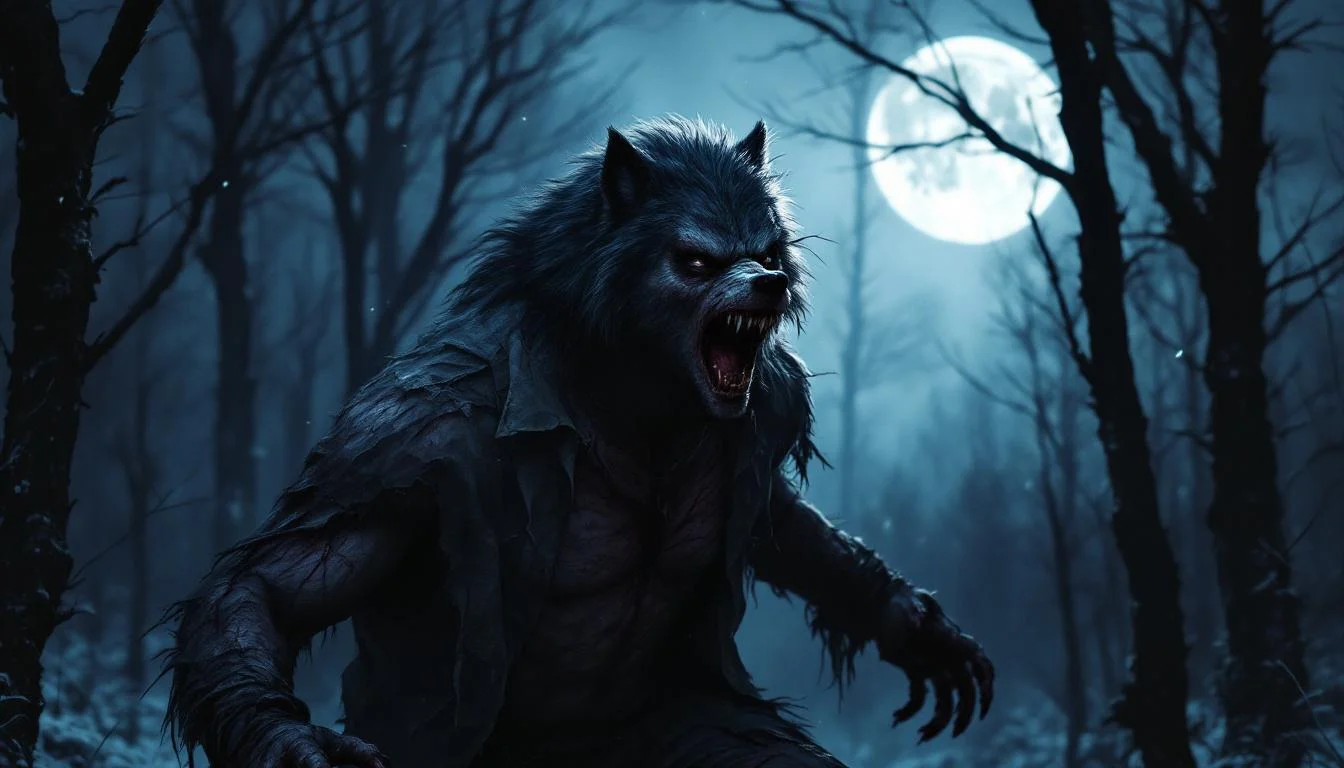
In some South Slavic traditions, the karakondzhul is not a separate species but a form taken by the vukodlak — the Slavic vampire-werewolf — during the dirty days. The logic runs as follows: a person who dies unbaptized, or who was born during the twelve unclean days, or who committed certain sins in life, rises after death as a vukodlak. For most of the year, the vukodlak haunts its grave, its village, the places it knew in life. But during the dirty days, when the boundaries dissolve, the creature gains new powers and new appetites. It transforms into the karakondzhul — darker, hairier, more bestial than its usual vampiric form — and takes to the crossroads to ride the living.
This connection illuminates something about the deeper structure of South Slavic demonology. The categories are not fixed. A creature is not one thing or another — it is a node in a network, connected to other beings by transformation, kinship, and seasonal variation. The chort becomes the karakondzhul becomes the vukodlak becomes the mora, each form appropriate to a different season, a different hour, a different quality of darkness. The folk mind did not classify demons the way a zoologist classifies animals, into neat species with clear boundaries. It understood them as phases — states of being that the dark could enter and exit depending on the time of year, the phase of the moon, and the spiritual condition of the world.
The seasonal restriction is the key. The karakondzhul exists only in the gap. It is a creature of the threshold — born when one year dies and another has not yet been properly begun, active only in the suspension between Christmas and Epiphany, banished the instant the world is re-consecrated. It is not a permanent resident of the Slavic spirit world in the way that the leshy or the domovoy are permanent residents. It is a visitor, a seasonal infestation, a thing that the calendar itself creates and the calendar itself destroys.
Children of the Dirty Days
One of the most persistent and troubling beliefs connected to the karakondzhul concerns children born during the twelve unclean days.
Across the South Slavic world, a child born between Christmas and Epiphany was considered marked — tainted by the same spiritual disorder that allowed the karakondzhul to exist. Such children, the tradition held, risked becoming karakondzhuli themselves after death. Some versions specified that the transformation was not merely a risk but a certainty, avoidable only through specific ritual interventions performed immediately after birth.
The interventions varied by region. In some Bulgarian villages, the newborn's fingernails were singed with a candle flame — a symbolic burning that was meant to prevent the child from developing the claws of the creature it might become. In others, the child was bound tightly in garlic-infused swaddling and kept near the hearth fire for the duration of the dirty days, surrounded by the same protections used against the adult karakondzhul. The message was clear: the child born in the gap belonged, at least partially, to the gap. The rituals were an attempt to pull it back to the human side, to claim it for the world of the living before the world of the unclean could file its competing claim.
This belief connects directly to the broader Slavic and Balkan tradition regarding liminal births. Children born on certain days — during eclipses, during storms, during the transition between Saturday and Sunday — were similarly marked across the region. The underlying principle was consistent: a person who enters the world at a moment of spiritual instability inherits that instability. They are thinner, more permeable, more vulnerable to the forces that operate in the margins. The dirty days were the most dangerous margin of all, and a child born within them carried the danger inside their body for life.
The Weight on Your Back
The karakondzhul is not a complicated creature. It does not spin riddles like a sphinx or offer bargains like a chort. It does not guard treasure or teach forbidden knowledge or grant wishes with poisoned strings attached. It has one function: it gets on your back and it does not get off.
There is something primal in this image that transcends the specific cultural context. The weight on your back that you cannot remove. The thing that rides you through the worst terrain, through thorns and ice water, through the longest nights of the year. The pressure that does not relent until dawn — if dawn comes, if you last that long, if your legs do not give out in the frozen dark.
The Balkan peasant who told this story to their children by the fire on a January night was not discussing abstract theology. They were describing a feeling that every human being recognizes: the sensation of being burdened, driven, ridden by something you cannot see and cannot fight. The karakondzhul is depression in a fur coat. It is grief with hooves. It is the winter itself climbing onto your shoulders and daring you to keep walking.
The cure is always the same. Survive until dawn. Keep the fire burning. Do not go out alone. Wait for the waters to be blessed, for the calendar to turn, for the dirty days to end and the ordinary world to reassert itself. The creature is temporary. The night is long but finite. The rooster will crow.
That is the karakondzhul's deepest lesson, delivered in the language of terror: the dark rides you, but it does not ride forever. The twelve days end. The priest blesses the water. The ice breaks. Spring is coming — not yet, not soon, but coming. And the thing on your back, heavy as a world, dissolves into nothing at the sound of a bird's voice announcing the return of light.