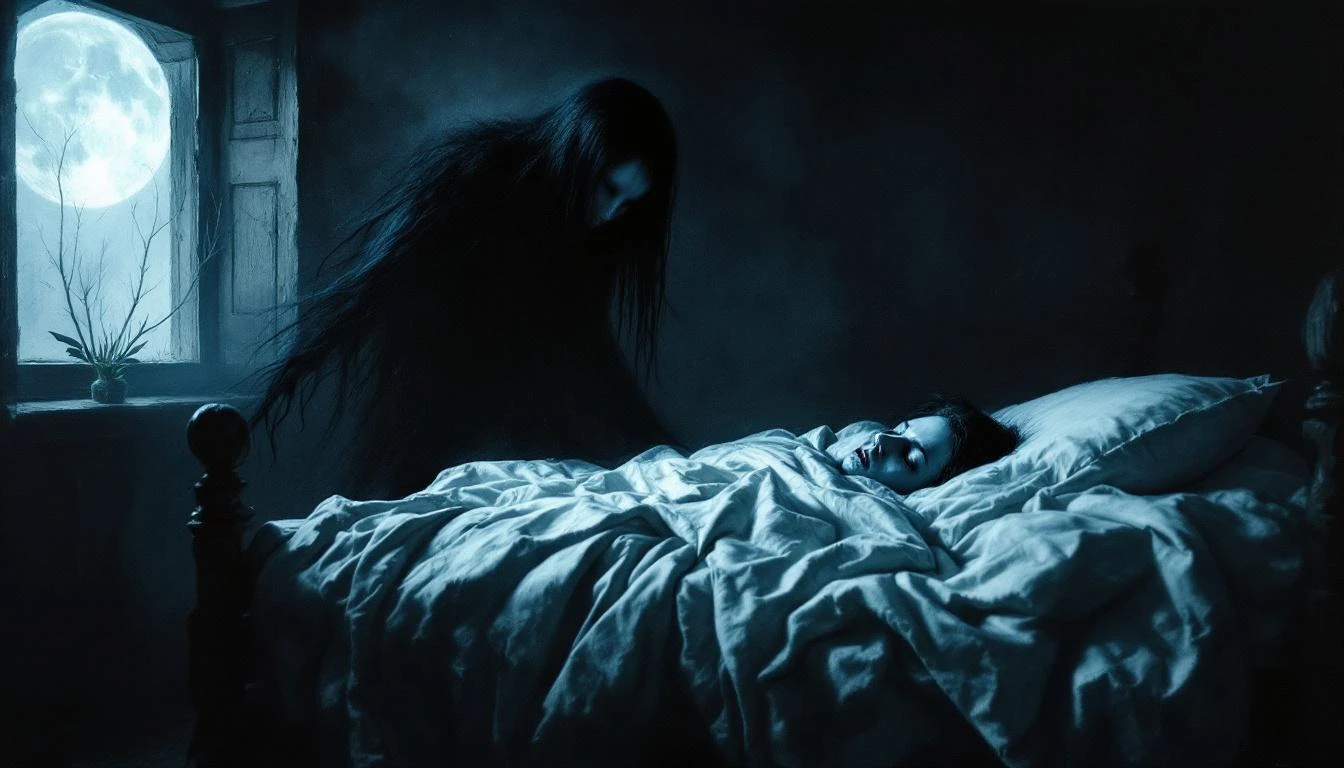
You feel the weight before you understand it. Something has settled onto your ribcage — not suddenly, not with the impact of a falling object, but with the slow, deliberate pressure of a hand pressing a pillow over a face. Your lungs refuse to expand. Your arms are dead things lying at your sides. The room is dark and your eyes are open and somewhere above you, between your face and the ceiling, there is a shape. It has no edges you can trace. It has no features you can name. But it is there, and it is heavy, and it is breathing your air — pulling the oxygen from your mouth with the patient hunger of something that has done this a thousand times before and has never once been stopped.
In modern medicine, they call this sleep paralysis. In the Slavic world — from the frozen marshlands of northern Poland to the limestone karst of Slovenia to the windswept plains of Ukraine — they called it mora. And unlike the clinical diagnosis, the folk explanation came with a face, a history, and instructions for making it stop.
The Mora Is Not the Nocnitsa
This distinction matters, and most English-language sources get it wrong. The Nocnitsa — the Night Hag — is a creature of East Slavic folklore, concentrated in Russia, Belarus, and Ukraine. She is a spirit of pure darkness, a shadowy presence that targets infants and children, feeding on their vitality over successive nights until they sicken and die. She is impersonal. She is hunger given form. She represents the night itself as a predatory force.
The Mora is something different. She is a West and South Slavic phenomenon — dominant in Poland, the Czech lands, Slovakia, Slovenia, Serbia, and Croatia. Unlike the Nocnitsa, the Mora has a human origin. She was, or is, a living person — typically a woman — whose spirit detaches from her body during sleep and travels to the homes of others to sit on their chests and steal their breath. The body of the Mora remains in her own bed, apparently asleep, while her detached soul or astral double roams the village, entering homes through cracks in walls, through keyholes, through any opening smaller than a closed fist.
This is the critical difference. The Nocnitsa is a demon. The Mora is your neighbor. She may not even know what she does. In many folk traditions, the Mora was believed to be unaware of her nocturnal activities — a woman cursed at birth, or marked by some prenatal sin of her mother, whose spirit simply leaves her body each night against her will. She wakes in the morning with no memory of having crushed the breath from the man three houses down. She goes about her day. She bakes bread, draws water, speaks to you at the market. And that night, she comes again.
The Hair Through the Keyhole
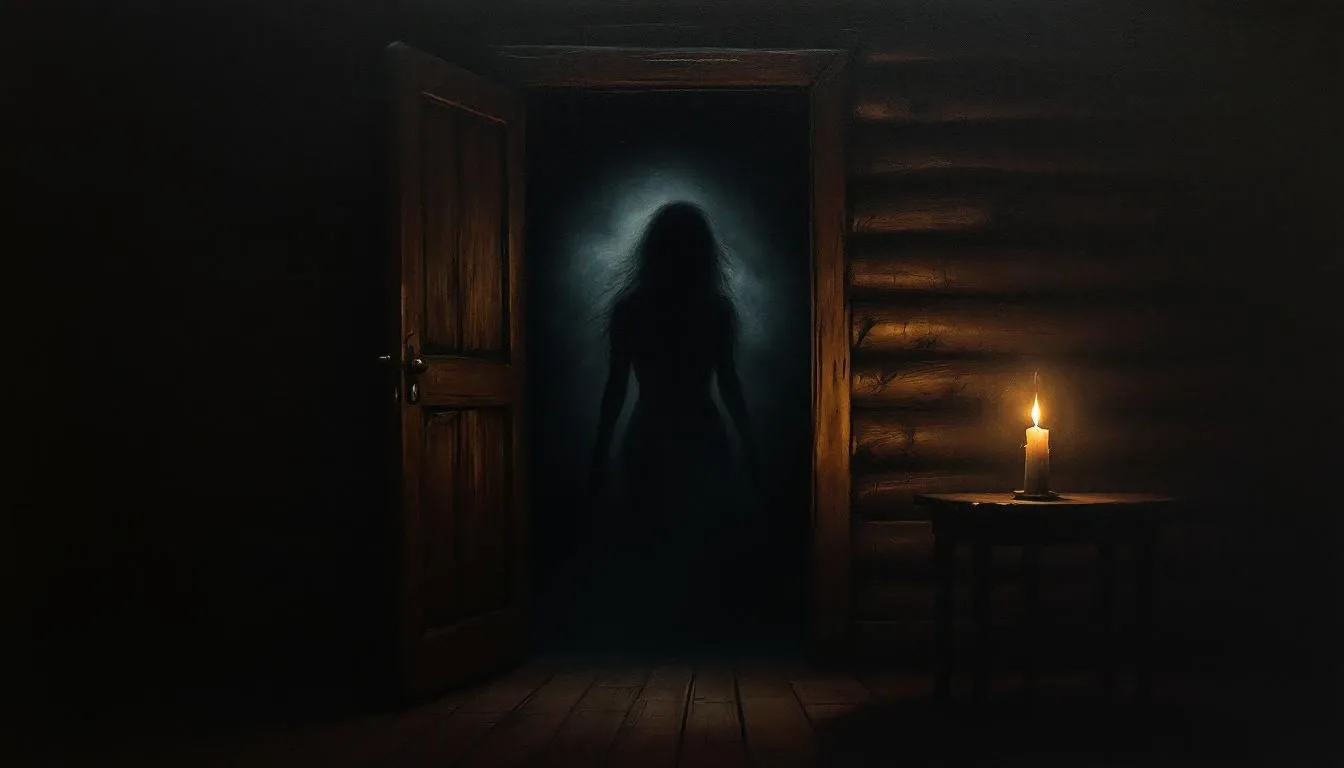
The most distinctive element of Mora folklore — the detail that separates her from every other night-spirit in the Slavic world — is the manner of her entry. The Mora does not walk through walls like a ghost. She does not materialize from shadows like the Nocnitsa. She enters the house physically, through the smallest available opening, by transforming herself into something thin enough to pass through it.
In Polish tradition, the zmora was said to enter through keyholes in the form of a strand of hair, a wisp of straw, or a thread of smoke. She would slide through the narrow aperture, reform on the other side into her full spectral shape, and make her way to the bed of her victim. In Czech and Slovak traditions, the můra entered through cracks between the door and the frame, flattening herself like paper or flowing like water through spaces that should admit nothing larger than a draft of cold air. In Slovenian accounts, the mora came through the window crack, through the gap beneath the door, through the space between two poorly fitted stones in the wall.
This obsession with entry points tells us something about the psychological architecture of the belief. The Mora was not a wilderness spirit like the Leshy or a water-spirit like the Vodyanoy. She was a domestic predator — a creature of houses, bedrooms, intimate spaces. The terror she represented was the terror of violation within the supposedly safe space of the home. Doors and walls and locks — the things that protect you from the outside world — were useless against her. She found the gaps in your security that you did not know existed, and she came through them with the ease of smoke filling a room.
The keyhole tradition spawned its own counter-magic. Across Poland, Czech lands, and Slovakia, people blocked their keyholes at night — stuffing them with wax, cloth, or blessed herbs. Doors were sealed with garlic or lined with iron nails. Windows were marked with crosses. The underlying logic was simple: if the Mora needed a physical entry point, then blocking all physical entry points would stop her. But the logic always broke down, because there was always a gap somewhere — a crack in the plaster, a loose floorboard, a chimney that could not be sealed without suffocating the occupants. The house was never perfectly closed, and the Mora was infinitely patient in finding the opening you forgot.
Polish Zmora, Czech Můra, and the Word That Became Nightmare
The linguistic fingerprints of the Mora are scattered across a dozen European languages, embedded so deeply in everyday vocabulary that most speakers have no idea they are invoking a Slavic demon every time they describe a bad dream.
In Polish, she is zmora — the prefix z- indicating completion or intensification, making her the full mora, the perfected version of the pressing spirit. In Czech and Slovak, she is můra — the word also used colloquially for a nightmare or an oppressive, suffocating situation. In Slovenian, mora or morica. In Croatian, mora or morina. In Serbian, mora or noćna mora — the night-mora, which Serbian speakers still use as the everyday word for nightmare without any consciousness of its supernatural origin.
But the deepest linguistic trail leads into Germanic territory. The Old Norse mara, the Old English mære, the German Mahr or Nachtmahr — all these words for the chest-pressing night-spirit derive from the same Proto-Indo-European root as the Slavic mora. The English word nightmare literally means night-mora — the mare suffix is not the female horse, but the ancient word for the suffocating spirit that visits during sleep. When an English speaker says I had a nightmare, they are — without knowing it — saying a mora came to me in the night.
This is not a coincidence or a false etymology. The philological consensus, established by scholars from Jacob Grimm onward, holds that the mora/mare figure belongs to the oldest layer of Indo-European mythology — predating the separation of Germanic, Slavic, and Celtic peoples. She is older than the Vikings, older than the Slavic migrations, older than any recorded folklore. She belongs to the deepest substrate of European belief about sleep, breath, and the vulnerability of the unconscious body.
::source-quote{source=Kazimierz Moszyński, Kultura ludowa Słowian, 1934} The mora is not a dream and not a demon. She is a living woman whose soul, through curse or accident of birth, separates from the body each night and seeks out sleeping persons to press upon their chests. She steals their breath slowly, sip by sip, as one drinks water from a cupped palm. ::
What the Mora Does to You
The attack follows a pattern so consistent across regions and centuries that it reads less like folklore and more like a clinical report. The victim lies in bed, somewhere between waking and sleep. The room grows heavy — the air thickens, the darkness seems to press inward from the walls. Then the weight appears. It begins on the legs, sometimes on the stomach, but always migrates to the chest. The victim cannot move. Cannot call out. Cannot turn their head. They are conscious — fully, horribly conscious — but the body has become a prison.
The Mora sits on the chest and feeds. What she feeds on varies by tradition. In some Polish accounts, she sucks blood from the breast or from the area over the heart — a detail that links her to the vampire traditions of Eastern Europe. In others, she drinks breath itself, placing her mouth over the victim's nose and inhaling their exhalations, each stolen breath weakening the sleeper further. In Czech tradition, the můra was said to suck milk from the breasts of sleeping women and blood from the chests of sleeping men — a gendered distinction in her feeding habits that folklore never bothered to explain.
The physical aftermath was documented with the precision of village medicine. Victims of repeated Mora visits woke exhausted, with dark circles under their eyes, pain in the chest, and a lingering sense of suffocation that faded slowly through the morning. Over time — if the Mora returned night after night to the same person — the victim grew pale, thin, listless. They lost appetite. They feared sleep. Their hair thinned. In the most extreme accounts, sustained Mora predation ended in death — the victim simply failing to wake one morning, found cold in their bed with an expression of frozen terror on their face.
The Mora was also believed to attack animals. Horses were a particular target. A horse found in the morning drenched in sweat, with its mane tangled into small knots — the so-called elf-locks or mora braids — had been ridden by a Mora through the night. She mounted them as a rider mounts a horse, galloping them through the darkness until the animal was foam-lathered and trembling. In some regions, finding a horse dead in its stall with no visible cause was attributed to Mora predation — she had simply ridden it to death.
Folk Protections: Sleeping Face-Down and the Broom by the Door
The countermeasures against the Mora were as varied as the regions that feared her, but certain patterns repeat with a frequency that suggests genuine folk consensus about what worked.
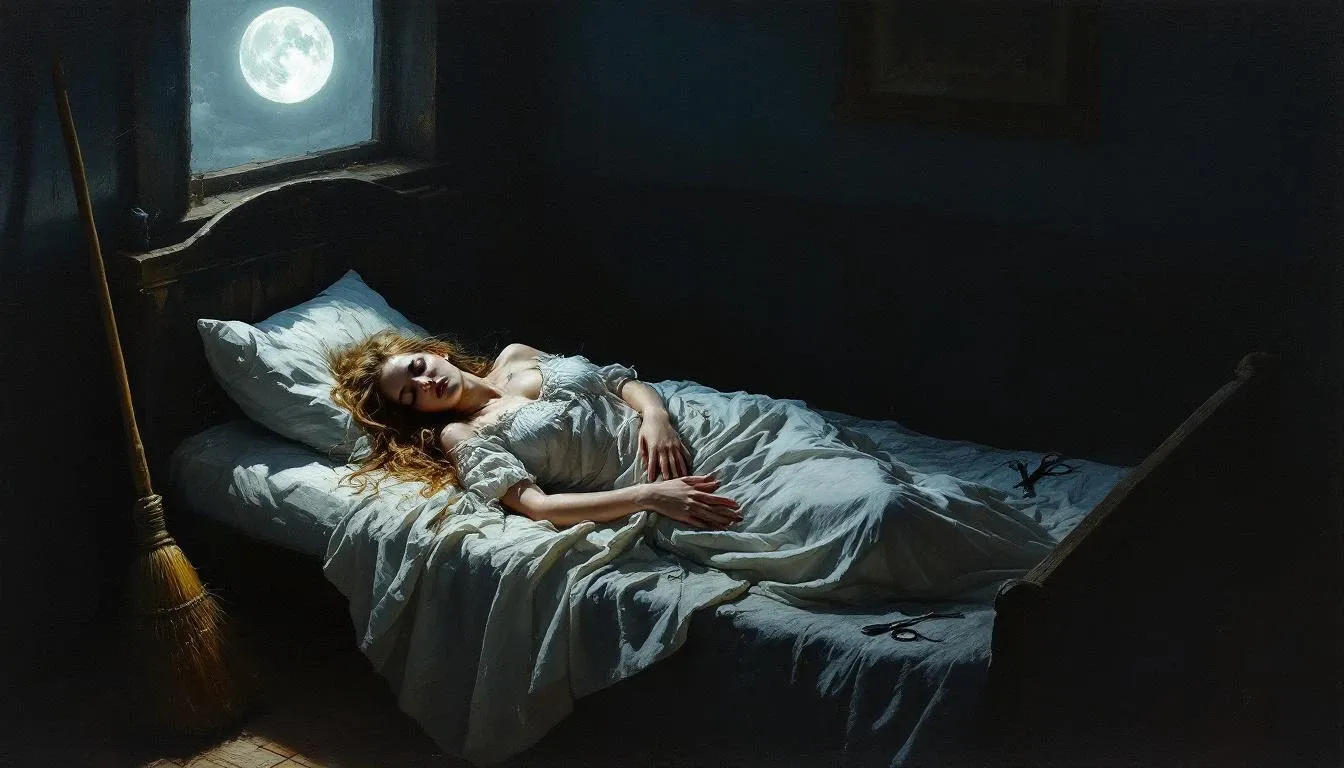
Sleeping face-down was perhaps the most widespread defense. The logic was straightforward: the Mora sits on the chest, so deny her the chest. A person sleeping on their stomach presented no surface for the Mora to occupy, and she would — according to multiple traditions — simply leave in frustration and seek an easier target. This advice persisted well into the 20th century in rural Poland and the Czech Republic, long after literal belief in the Mora had faded.
A broom placed bristles-up beside the door was a specifically Polish defense against the zmora. The reasoning drew on sympathetic magic: before the Mora could reach the bed, she was compelled to count every bristle on the broom. Since a traditional birch broom contained hundreds of fine twigs, the counting would occupy her until dawn, at which point she was forced to flee before sunlight dissolved her spectral form. The same logic applied to placing a sieve or a net near the window — the Mora had to count every hole or every knot before proceeding, and the task was endless.
Bread and salt on the chest appeared in Serbian and Croatian traditions. The victim placed a small piece of bread and a pinch of salt on their breastbone before sleeping. The bread represented life, sustenance, the domestic realm over which the Mora had no legitimate power. The salt represented purification and the repulsion of evil. Together, they formed a barrier the Mora could not cross — or, in some accounts, a substitute offering that satisfied her hunger without requiring her to feed on the sleeper's breath.
Iron objects — a knife beneath the pillow, a horseshoe above the bed, iron nails driven into the door frame — drew on the pan-European belief that supernatural entities cannot abide iron. The Mora, despite her human origin, was still a spirit in her traveling form, and iron burned her the way it burned any fairy or demon. A knife placed blade-up on the chest was considered especially effective — if the Mora attempted to sit, she would impale herself on the blade and be forced to flee.
Calling the Mora by name was the most dangerous and most effective defense. If you knew which woman in the village was the Mora — if you had identified her through the methods described in the next section — then speaking her true name aloud while she pressed upon you would break her power instantly. She would flee screaming, and she could never return to you again. But naming required certainty. Accusing the wrong woman of being a Mora was a devastating social act in a small community, and the consequences of a false accusation could be as destructive as the Mora herself.
Identifying the Mora Among the Living
Because the Mora was a living woman — not a demon, not a ghost, not a creature spawned from darkness — the question of identification was always present. She walked among you. She existed in daylight as an ordinary person. Finding her required attention to details that most people would overlook.
The signs were subtle and contradictory, as folk diagnostic criteria often are. A woman suspected of being a Mora might be unnaturally pale, suggesting that her nightly excursions drained her own vitality as well as her victims'. She might be known for sleeping heavily and being difficult to wake in the morning — because her spirit was still traveling, still pressing upon some distant chest. She might have thick eyebrows that met above the nose, a folk marker of supernatural identity that appeared in Mora lore, werewolf lore, and vampire lore alike. In some traditions, she was born with a caul — the membrane sometimes covering a newborn's face — which marked her as a person with one foot already in the spirit world.
In Polish tradition, there was a method for trapping a zmora in the act. If a person woke during a Mora attack and managed — through supreme effort of will — to grab whatever physical form the Mora had taken near the bed (a strand of hair, a scrap of cloth, a small animal), they could hold it until dawn. When morning came and the Mora could no longer return to her body in spirit form, she would be forced to appear physically — and the victim would see who she truly was. The revelation was considered both a victory and a tragedy. You had saved yourself, but you had also discovered that your tormentor was someone you knew — a neighbor, a cousin, the quiet woman who sold eggs at the Wednesday market.
The Morana Connection: Death Goddess and Night Terror
The Mora does not exist in isolation within Slavic mythology. She connects — through etymology, through function, through the deepest layers of mythological thought — to Morana, the goddess of winter and death whose effigy is burned and drowned each spring across Poland, Czech lands, and Slovakia.
The connection is philological. Both mora and Morana derive from the Proto-Indo-European root *mor- — death. The Mora kills by stealing breath. Morana kills by bringing winter, plague, and the cessation of all living things. They are, in a sense, the same force operating at different scales: the Mora is death in the bedroom, Morana is death across the landscape. The Mora takes one person at a time, breath by breath. Morana takes everything at once, burying the world in cold and silence.
Some scholars — particularly those working in the comparative mythology tradition of Vyacheslav Ivanov and Vladimir Toporov — have argued that the Mora was originally an aspect or emanation of Morana. In this reading, the goddess of death dispersed herself into countless night-spirits during the long winter months, sending fragments of her power into the homes of the sleeping to feed on their warmth and vitality. When spring came and Morana's effigy was destroyed, the Moras weakened too — the pressing spirits of winter retreating with the goddess they served.
This theory is elegant but difficult to prove with the fragmentary sources available. What is certain is that Slavic folk consciousness made the connection intuitively. The same cultures that feared the Mora also celebrated the destruction of Morana/Marzanna each spring. The same villages that stuffed keyholes with wax in winter burned straw goddesses at the river in March. The night-terror and the death-goddess occupied the same psychological territory: the dread of being trapped, crushed, suffocated by a force that comes in darkness and will not release you until the light returns.
She Persists
The Mora should have died with modernization. Electric lights banish the darkness she needs. Locked apartments have no keyhole gaps. Sleep science explains the paralysis in terms of REM atonia and hypnagogic hallucination, reducing her to a neurological misfiring, a glitch in the transition between sleeping and waking states.
And yet. In rural Poland, grandmothers still tell children to sleep face-down when they complain of bad dreams. In Serbia, the word mora is spoken with a half-seriousness that is not quite belief and not quite jest — the way you might say knock on wood while actually knocking. In Croatia, sleep paralysis support forums feature users who describe their experiences using the language of Mora visitation, not because they believe in demons, but because the folk vocabulary describes the subjective experience more accurately than any clinical term.
The Mora persists because sleep paralysis persists. Approximately eight percent of the general population will experience at least one episode in their lifetime — waking immobilized, sensing a presence, feeling weight on the chest, struggling to breathe. The neurological explanation is correct, but it is not complete. It tells you what is happening in the brain. It does not tell you what the experience feels like from inside — the absolute certainty that something is there, that it has intent, that it means you harm. The folk tradition gave that feeling a shape and a name, and the name was Mora, and no amount of science has made the feeling go away.
She enters through the gaps you cannot close. She presses with a weight you cannot lift. She drinks your breath with a patience that outlasts your ability to stay awake. And in the morning, she is gone — back to her body, back to her daylight life, back to being the woman you pass in the street without a second glance. She does not remember what she did to you. She will do it again tonight.
The keyhole is never fully sealed. There is always a gap somewhere. And the Mora is very, very thin.