There is a problem with Kupala. Everyone knows the night — the bonfires, the wreaths, the river bathing, the search for a flower that does not bloom. Kupala Night is the most famous ritual in the Slavic calendar, the one festival that survived Christianity, survived Soviet atheism, survived the conversion of folk tradition into weekend tourism. But behind the night stands a figure that most modern accounts prefer to avoid. Before Kupala was a festival, Kupala was a god.
Or a goddess. Or a twin. Or a spirit of fire merged with water, of purification married to fertility, of midsummer heat tangled with midnight drowning. The sources disagree — violently, across centuries, in ways that reveal more about the deity than any single consistent account could. The confusion is the theology. A god whose fundamental nature is the collision of opposites should not be easy to pin down, and Kupala is not.
What can be said with certainty is this: the name existed before the festival was Christianized. The figure the name described was understood as divine. And the mythology surrounding that figure — involving incest, transformation, fire-water duality, and the catastrophic meeting of a brother and sister who did not know each other — is one of the darkest and most structurally complex in all of Slavic religion.
The Name Before the Saint
The etymology of Kupala leads directly to water. The name derives from the Proto-Slavic root *kǫpati, meaning "to bathe." This is the same root that gives modern Russian купать (to bathe), Ukrainian купатися (to bathe oneself), and Polish kąpać (to bathe). At the most literal level, Kupala is the one who bathes — the bather, the purifier, the spirit of ritual immersion.
When Orthodox missionaries needed a Christian anchor for the midsummer bonfire festival they could not suppress, they attached the Nativity of John the Baptist — June 24 in the Julian calendar — and created the hybrid name Ivan Kupala. Ivan for John, whose baptismal waters provided a convenient theological alibi. Kupala for the bathing ritual that predated baptism by centuries, possibly millennia. The graft was transparent, and the folk memory did not forget it. In the villages, people continued to say "Kupala Night," not "the Nativity of St. John." The saint's name was the guest. Kupala was the host.
But kǫpati does not only mean to bathe in the casual sense. In the oldest Slavic ritual vocabulary, bathing was a sacred act — a crossing between states, a destruction of impurity, a passage from the polluted to the clean. The root carries an implication of transformation. To bathe at the solstice was not hygiene. It was theology. And the figure who presided over that transformation was not merely a patron of water sports. Kupala was the agent of purification through the two elements that the solstice brought together: fire from above, water from below.
Fire-Water: The Duality at the Core
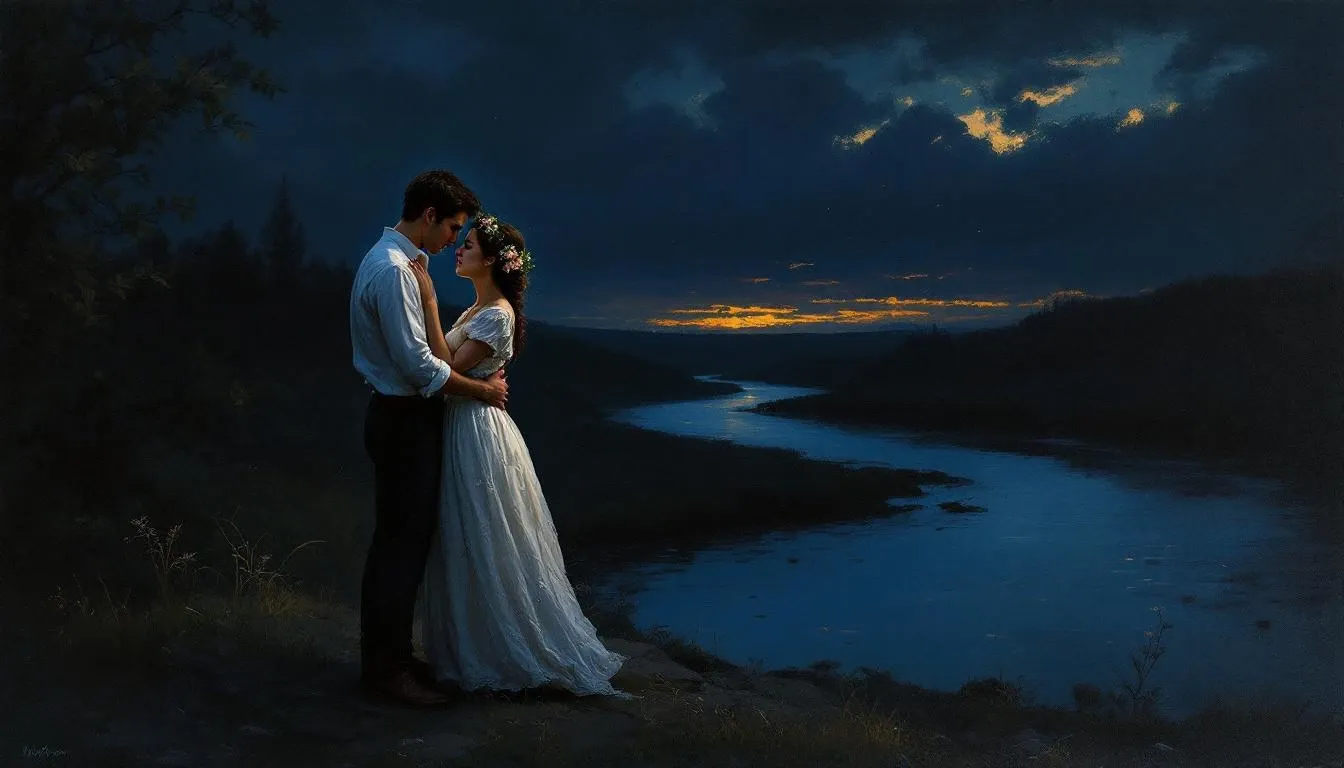
The most distinctive feature of Kupala — the thing that separates this figure from other Slavic water spirits and fire deities — is the insistence on both elements simultaneously. Kupala Night is the only major Slavic ritual that centers equally on fire and water. Bonfires blaze on the riverbank. Participants leap through flames and then wade into the current. Wreaths of flowers are set alight and floated downstream. The entire night is organized around the meeting point of the two elements, the moment when fire touches water and neither destroys the other.
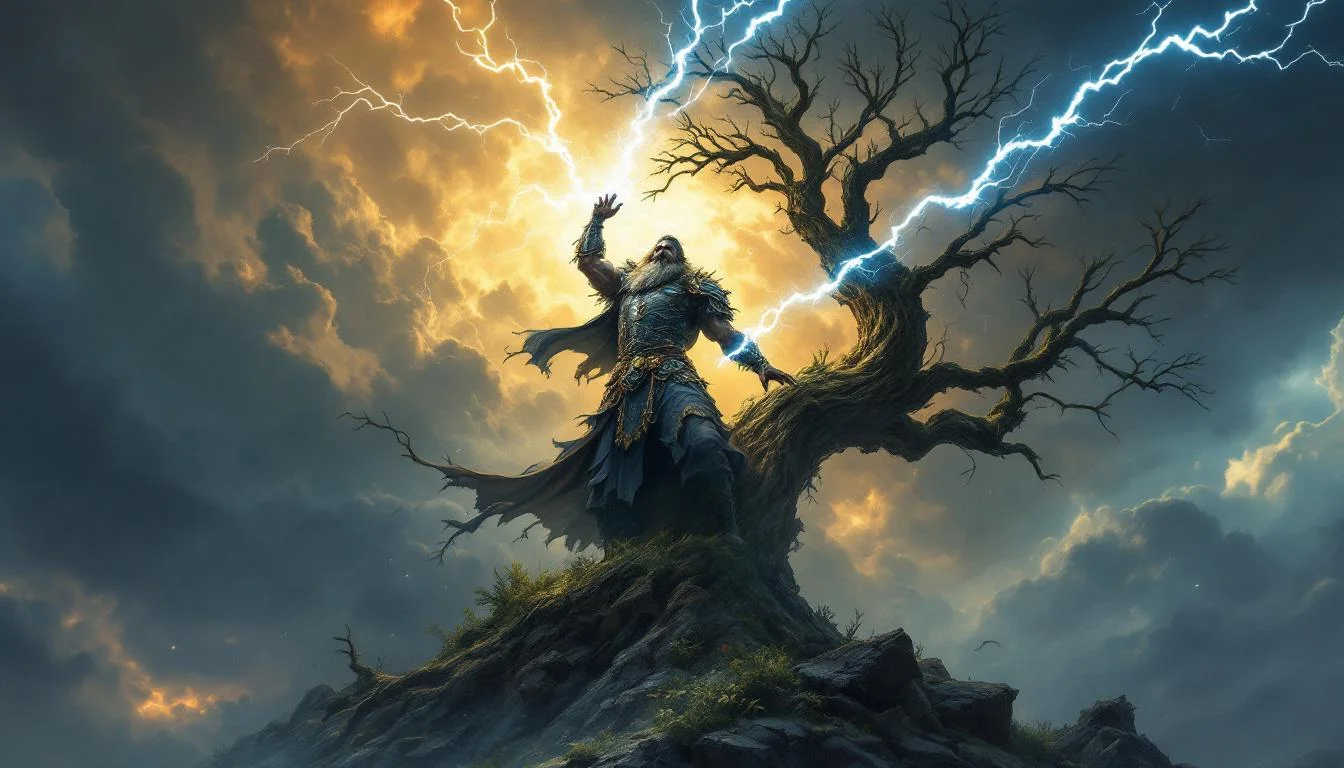
This duality is not accidental. It reflects a theology in which Kupala embodies the solstice itself — the hinge of the year, the point where the sun's fire is at maximum strength and yet, from this night forward, begins to decline into the wet darkness of autumn and winter. Kupala stands at the fulcrum. One hand holds the bonfire. The other trails in the river. The god is the balance point between the two great forces that drive the Slavic cosmos: the fire of Perun in the sky above and the waters of Veles in the earth below.
Boris Rybakov, the Soviet archaeologist and mythologist, argued in his Paganism of the Ancient Slavs (1981) that Kupala represented a distinct theological concept — the sacred union of fire and water at the solstice, understood as a moment of cosmic fertility. The two elements that normally destroy each other were, on this one night, brought into productive contact. The fire did not boil the water away. The water did not extinguish the fire. Instead, they produced something neither could produce alone: the conditions for maximum growth, maximum healing, maximum transformation.
This is why the herbs gathered on Kupala Night were believed to be at peak potency. The conjunction of fire and water — the two purifying forces — charged everything that grew from the earth with unusual power. Mugwort, St. John's wort, fern fronds, wormwood — all of them gathered before dawn on the morning after the solstice bonfire, when the dew itself was considered sacred, saturated with the mingled essence of flame and flood.
The Incest Myth: Kupala and Kostroma
The darkest strand of Kupala mythology — and the one that most clearly marks the figure as a deity rather than a mere festival personification — is the story of the brother and sister.
The tale, preserved in East Slavic folk songs and ritual laments, exists in several variants but follows a consistent structural pattern. A family has twins — a boy and a girl. In some versions the boy is named Kupala and the girl Kostroma. In others the genders are reversed: the girl is Kupala, the boy is Kostroma. The reversal is itself significant, reinforcing the theme of boundaries dissolved and categories confused that runs through all Kupala theology.
The twins are separated in childhood. The most common mechanism involves a bird — a crow or a magpie — that snatches one of the children and carries it away. The stolen twin grows up in a distant land, not knowing that it has a sibling. Years pass. The twins become adults. They meet by accident — at a market, on a road, by a river. They do not recognize each other. They fall in love. They marry.
Then comes the revelation. Through a sign, a song, a birthmark, an old woman's memory, the truth emerges: husband and wife are brother and sister. The marriage has been an abomination. The world's order has been violated.
What follows varies. In many versions, the sister — whichever twin bears the female role — drowns herself in the river. She becomes a rusalka, a water spirit, one of the restless dead who haunt the waterways of the Slavic world. The brother throws himself into a bonfire. Or the sister becomes a flower — the kupala flower, the ivan-da-marya (Melampyrum nemorosum), whose yellow petals and purple bracts represent the brother and sister locked together in a single bloom, forever touching, forever separated by color.
The folk memory preserved the story in the name of a flower. Ivan-da-Marya — the yellow flame and the blue water, the brother and the sister, joined in a single stem. The peasants picked it on Kupala Night and placed it in the corners of their houses, believing that the fire-half of the flower protected against thieves and the water-half against evil spirits. The tragedy of the twins was domesticated into a household charm.
The structural logic of this myth is not merely tragic. It is cosmological. Kupala and Kostroma are fire and water given human form. Their meeting is the solstice — the moment when the two cosmic forces come together. Their marriage is the conjunction of opposites. And their destruction is the price of that conjunction: fire drowns, water burns, and the natural order reasserts itself through catastrophe.
This is why Kupala is a deity and not merely a festival. The night enacts a theological drama. The bonfires and the river bathing are not decorations — they are the retelling of a myth in which the fundamental forces of the universe meet, merge, produce a moment of extraordinary power, and then tear themselves apart.
The Effigy: Death of the God
If the incest myth reveals Kupala's nature, the effigy ritual reveals the deity's fate. Across the East Slavic world — from Belarus through Ukraine to southern Russia — the midsummer celebration included the making, parading, and destruction of a Kupala figure.
The effigy was constructed from straw and branches, dressed in human clothing, and decorated with flowers and ribbons. In some villages it was called Kupala. In others, Marena or Kostroma — the female twin, the death-bride, the counterpart who would be destroyed to mark the turning of the year. The figure was carried through the village in a procession that mixed celebration with lamentation, the participants singing songs that were simultaneously joyful and funerary.
Then the effigy was destroyed. It was set on fire, or drowned in the river, or both — burned on the bonfire and then its charred remains thrown into the water. The method of destruction mirrored the deity's double nature. Fire alone was insufficient. Water alone was insufficient. Both elements had to consume the figure, because the figure embodied both.
This ritual killing has exact parallels in other Slavic seasonal customs. Morana's straw body is drowned and burned at the end of winter. Yarilo's explicitly phallic effigy is buried at the summer solstice. The pattern is consistent: a deity whose power is tied to a season must die when that season turns. Kupala's midsummer fire was at its peak on the solstice night, and from the following morning the days grew shorter, the sun retreated, the fire weakened. The god had to be killed so the cycle could continue.
The destruction was not punishment. It was sacrament. The community was not angry at Kupala. They were participating in the same cosmic drama that the incest myth described: the meeting of fire and water, the brief moment of union, and the inevitable separation that follows. By building the effigy, processing it through the village, and then burning and drowning it, the participants became actors in a myth that predated them by centuries.
The Fern Flower Connection
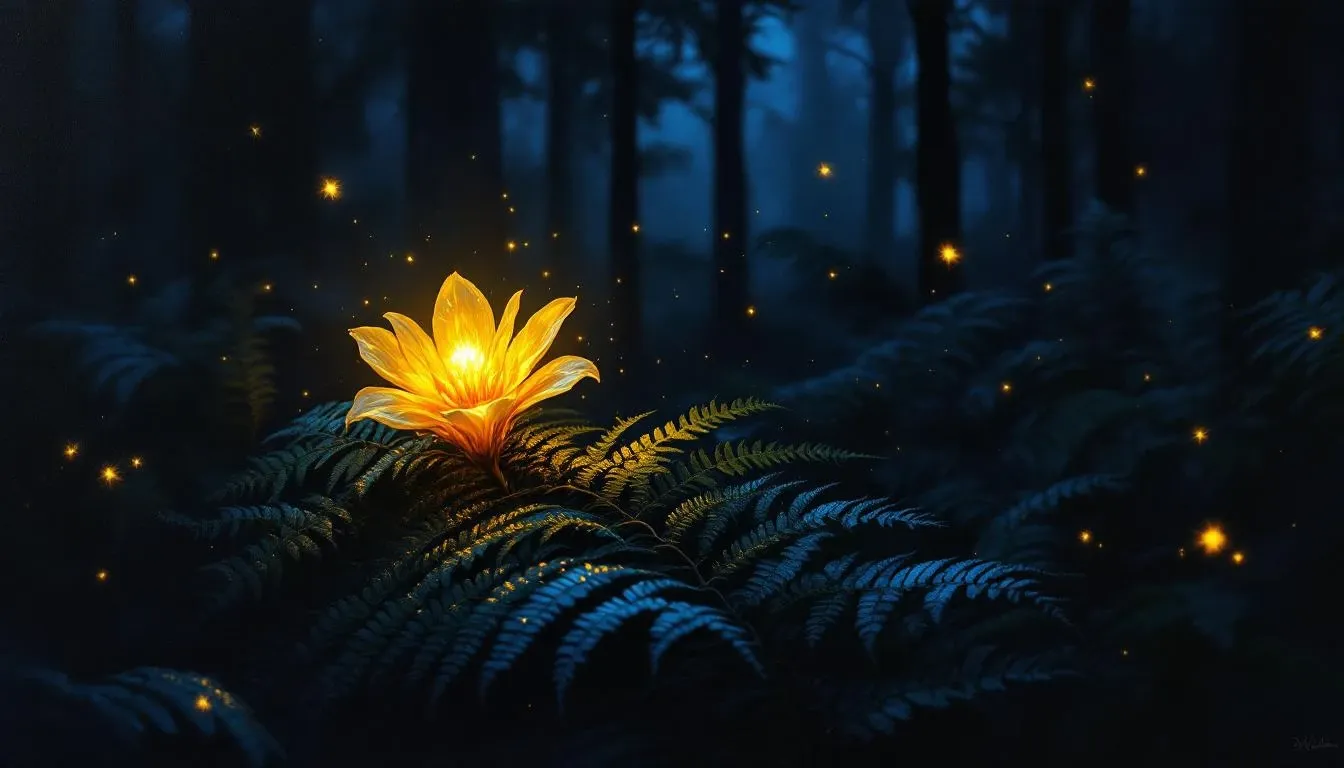
No element of Kupala's mythology is more famous than the fern flower — the tsvit paporoti — the bloom that appears once a year, at midnight on the solstice, in the deepest forest, guarded by spirits, visible only to those brave or foolish enough to search for it. The flower grants its finder the ability to see buried treasure, understand the speech of animals, and command spirits.
The fern flower belongs to the deity, not merely to the festival. It is the botanical expression of Kupala's fire-water theology. Ferns grow in the wettest, darkest places — forest floors, river margins, the undersides of rocks where water drips. They are plants of shadow and moisture, of Veles's domain. And yet the mythical bloom of the fern is described as a flame — red, or golden, or white-hot, burning with its own light in the midnight darkness. The flower is fire emerging from water. It is the solstice's duality condensed into a single impossible object.
That it is botanically impossible — ferns reproduce by spores, not flowers, and have never bloomed in the 360-million-year history of their lineage — is the theological point. The fern flower exists in the gap between what is and what should be. It is the moment of conjunction that cannot last, the fire that blooms in the wettest place and vanishes before it can be held. It is Kupala's own nature made visible: the marriage of opposites that produces a flash of extraordinary power and then is gone.
The Christian Overlay: John the Baptist
The attachment of St. John the Baptist to the midsummer festival was not random. John baptized with water. Christ, John promised, would baptize with fire and the Holy Spirit. The Baptist was himself a figure of fire-water duality — a man who stood in a river while speaking of flames. The missionaries who fused Ivan (John) with Kupala were performing a theological operation more sophisticated than simple suppression. They were mapping an existing Slavic fire-water deity onto a Christian figure who already carried fire-water symbolism.
The Hustyn Chronicle, compiled in the seventeenth century, records the result with evident frustration. The author describes how the people "go mad" on Ivan Kupala Night, performing "all manner of devilry" — leaping over fires, bathing in rivers, singing pagan songs, and searching for herbs with supposed magical properties. The chronicle identifies these practices as survivals of idol worship and condemns them in language that reveals how completely the Church had failed to Christianize the festival's content despite Christianizing its name.
The people kept the fires. They kept the water. They kept the wreaths and the herbs and the fern flower and the songs about Kupala and Kostroma. They added "Ivan" to the front of the name and continued as before. The saint was absorbed into the god, not the other way around.
Kupala and the Solar Year
Kupala's position in the Slavic calendar places the deity at the structural center of the solar myth cycle. Kolyada marks the winter solstice — the rebirth of the sun from its lowest point. Yarilo rides in at the spring equinox, carrying the sun's growing power through the fields. Kupala stands at the summer solstice, the moment of maximum light and the beginning of decline. And Morana rules the autumn-to-winter descent, the death of the year.
These four stations are not merely calendar markers. They describe a single divine drama in four acts: birth, growth, peak, and death. Kupala is the third act — the climax, the moment of greatest power, and therefore the moment when the reversal begins. The longest day contains within it the guarantee of shorter days. The tallest bonfire will burn down to ash. The river that purifies tonight will freeze in December.
This is why Kupala's mythology is simultaneously ecstatic and tragic. The incest myth, the effigy's destruction, the fern flower that cannot be held — all of these express the same truth: the peak is the turning point. The moment of maximum conjunction between fire and water is also the moment they begin to separate. The god who embodies that conjunction must therefore die at the moment of his greatest power.
It is, in its way, the most honest theology in the Slavic system. Perun endures. Veles endures. But Kupala — the god of the moment when everything meets — exists only at the pivot. One night of fire and water, one impossible flower, one marriage of opposites that cannot survive its own consummation. And then the days grow shorter, and the river grows cold, and the bonfire becomes a circle of ash on the riverbank, and the world begins its long slide toward December.
The Slavs lit their fires anyway. They always lit their fires.