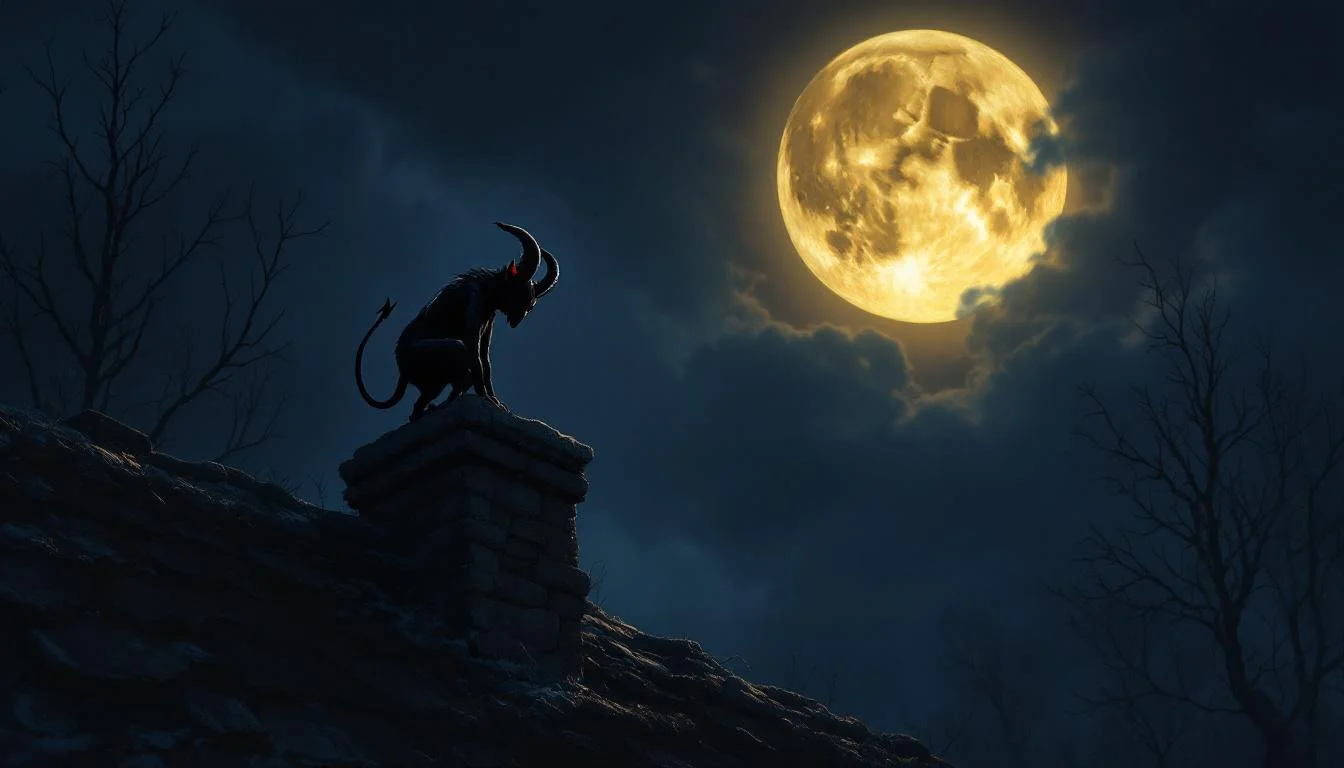
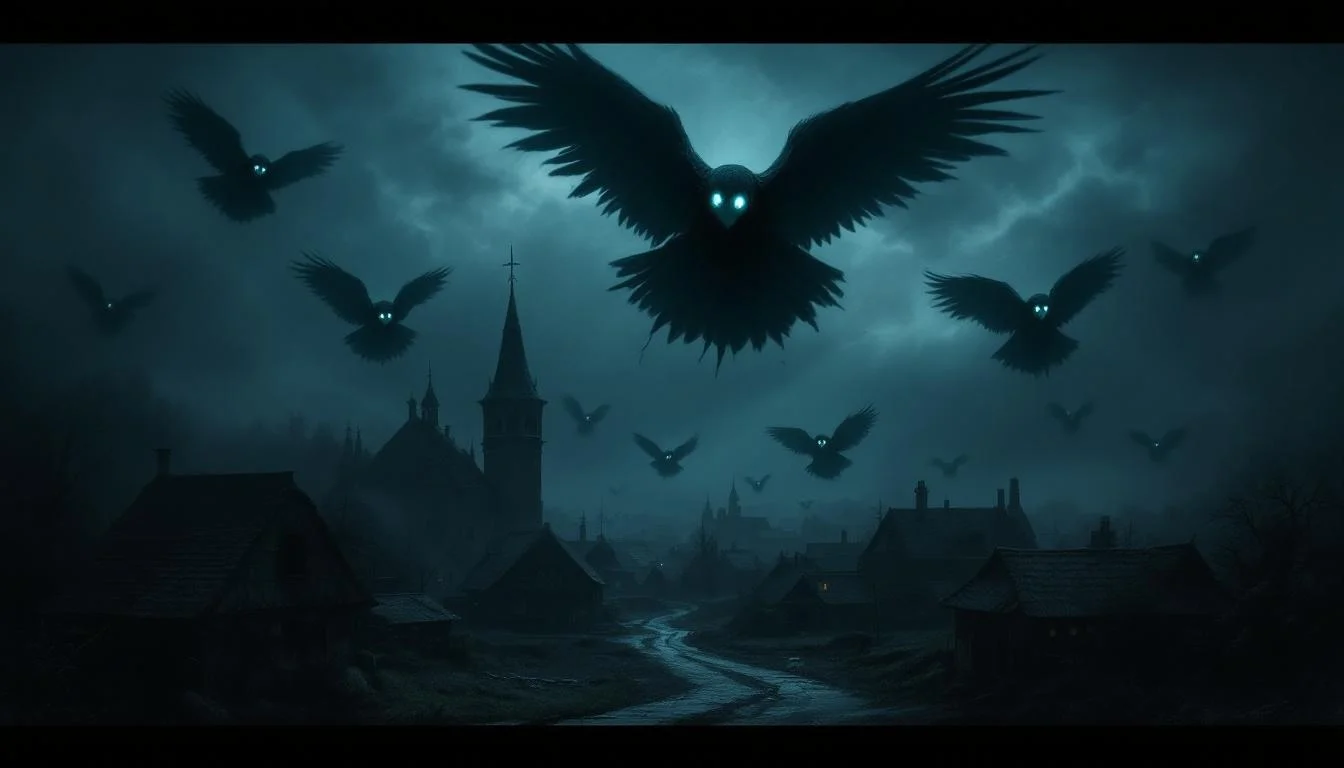
There is a Russian proverb that every Slavic child learns before they can spell their own name: "Ne budi likho, poka ono tikho" — Do not wake Likho while it is quiet. In Ukrainian the words are almost identical: "Ne budy lykho, poky vono tykhe." The message is the same in both languages, and it is not a metaphor. It is a survival instruction. Because in the old Slavic world, Likho was not a concept. It was a creature. It had a body — tall, gaunt, impossibly thin, draped in black rags. It had a face, though not a face you would want to see. And it had one eye. Always one eye. That single, unblinking eye staring out of a skull that looked like it had been starved for centuries is the oldest image in this mythology, and it is the one detail that every source — every tale, every region, every century — agrees on.
Likho is the personification of evil fate. Not evil in the grand, theological sense. Not Satan, not a fallen angel warring against heaven. Evil in the most intimate, human sense: the kind of misfortune that finds you personally, attaches itself to your life like a parasite, and will not let go no matter what you do. Your house burns. Your crops fail. Your children fall sick one after another. Your neighbor prospers while you starve. That is Likho's work. And the worst part — the part the old stories emphasize again and again — is that you probably went looking for it.
A Word That Became a Monster
The etymology of likho opens a trapdoor into the oldest layers of Slavic thought. The word is not a proper name. It is a common noun meaning misfortune, bad luck, evil — and before that, in Old Russian, it carried a different set of meanings: excessive, too much, remaining, odd. The root connects to the concept of the odd number, the thing left over, the one that does not pair. In the old Russian counting game chetno i likho — even and odd — likho was the odd number, the unlucky remainder, the thing that should not exist but does.
From there the semantic drift is short and terrible. The odd number becomes the unlucky number. The unlucky number becomes bad luck itself. Bad luck becomes a creature — because in the Slavic folk imagination, abstract forces do not stay abstract for long. If misfortune exists, it must have a shape. If it has a shape, it can be met on a road. If it can be met on a road, someone will go looking for it. And if someone goes looking for it, there must be a story about what happened when they found it.
The related word likhoradka — literally "Likho's joy" — means fever in Russian. Fever was understood as Likho's gift, a fragment of its malice that entered the body and burned from within. The Nav spirits, those restless dead who haunted the living, were sometimes described as Likho's companions — fellow travelers on the road of misfortune, drawn to suffering the way flies are drawn to wounds.
The Body of Evil Fate
What does Likho look like? The sources do not fully agree, and that disagreement is itself revealing.
The dominant tradition — the one found in most East Slavic fairy tales — describes Likho as a woman. Not merely an old woman, but a giantess: enormously tall, emaciated to the point where her bones show through her skin, dressed in black or in rags so filthy they have turned black. Her hair is wild, tangled, matted. Her fingernails are long and yellowed. She is hunched despite her height, as though her own body is a burden she can barely carry. And she has one eye — a single large eye set in the center of her face, or sometimes where the left or right eye should be, with the other socket empty and dark.
But there is a second tradition, more fragmentary, in which Likho appears as a male creature: a forest goblin, small and twisted, with a single glowing eye. This version overlaps with descriptions of the Leshy and the various forest demons that populate the wilder corners of Slavic mythology. The gender instability is typical of spirits that predate the Christian era — creatures that were understood as forces before they were understood as characters, and whose physical form was secondary to their function.
What matters in every version is the single eye. Likho is odnoglazoe — one-eyed. This is not a random detail. In the symbolic language of Slavic folklore, paired things are whole and fortunate. Two eyes, two hands, two sides of the body in balance. The odd number — the single eye, the missing half — signals that something has gone fundamentally wrong. Likho's body is a visual argument: it is incompleteness made flesh, the universe out of balance, the odd remainder that the counting game could not resolve.
The Blacksmith and the Tailor: Afanasyev's Tale
The most famous Likho story was recorded by Alexander Afanasyev in his monumental Narodnye russkie skazki (Russian Fairy Tales), the same collection that preserved dozens of the tales that define the Slavic canon — Baba Yaga, Koschei the Deathless, the Firebird, and a hundred others. The tale is called simply Likho Odnoglazoe — One-Eyed Likho — and its structure is so clean and savage that it reads like a parable carved into bone.
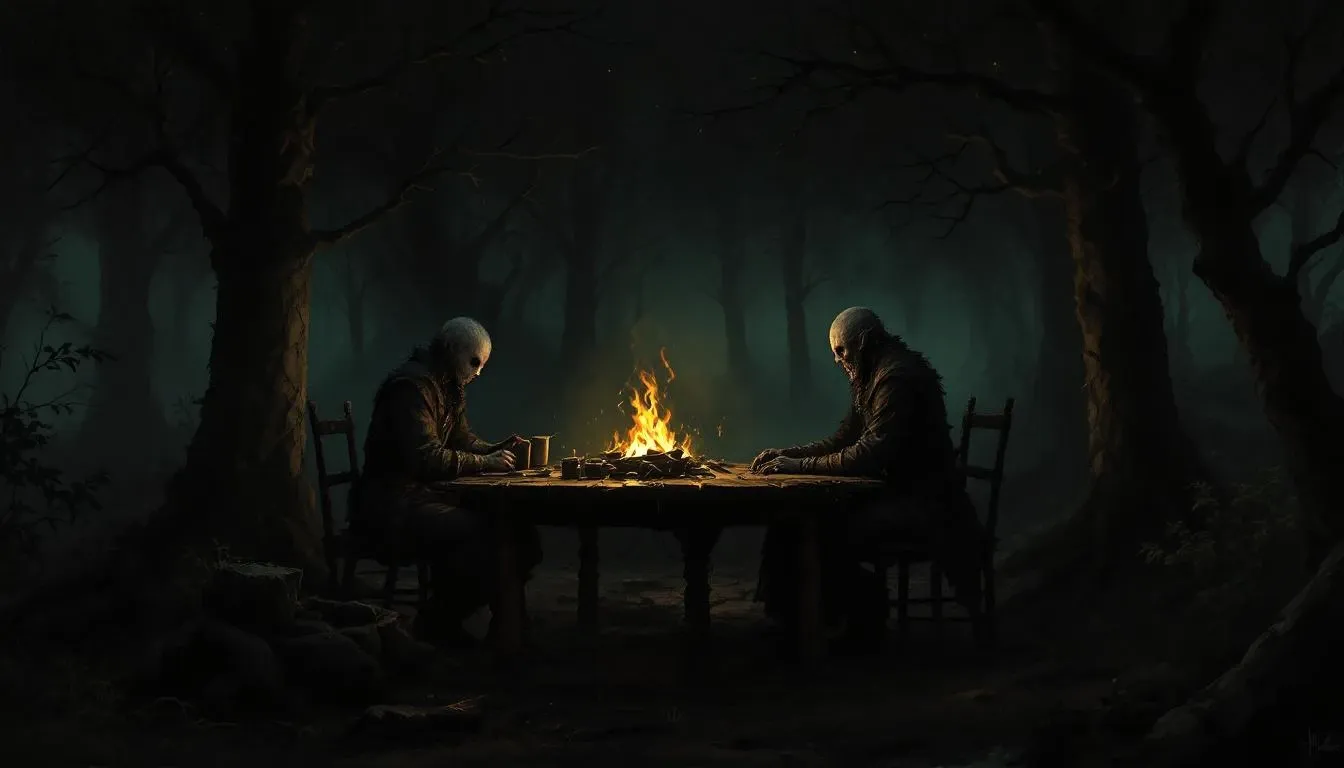
Two men — a tailor and a blacksmith — set out on a journey together. They are good men. They have lived quiet, comfortable lives. And precisely because they have never known real suffering, they grow curious about it. They want to find likho — evil, misfortune — just to see what it looks like. They are warned not to go. They go anyway.
After days of traveling through increasingly empty countryside, they come to a hut in the woods. Inside lives a one-eyed old woman of enormous size. She welcomes them. She feeds them. And then, when they have eaten and relaxed, she reveals what she is. She is Likho.
The tailor dies first. Likho kills him, cooks him in her stove, and eats him — picking his bones clean. The blacksmith watches this happen and understands that he is next.
But the blacksmith is clever, and his cleverness takes a specific, professional form. He tells Likho that he is a smith by trade and offers to forge her a new eye. A second eye — imagine how much better she could see, how much more efficiently she could hunt. Likho agrees. The blacksmith asks only that she allow herself to be tied down, because the procedure of hammering in a new eye will be painful and she must not flinch.
She consents. He ties her to the chair. And then, instead of forging an eye, he takes a burning hot iron rod and drives it into her single eye, blinding her completely.
The blacksmith heated the iron red-hot and drove it straight into Likho's eye. She howled so terribly that the forest shook. She tore free of her bonds and threw herself at the door, blocking it with her body, feeling the air with her long arms: "You shall not leave! You shall not leave!"
Now begins the second act, and this is where the story reveals its deep kinship with a tale told three thousand years ago on the other side of Europe.
Odysseus in a Sheepskin Coat
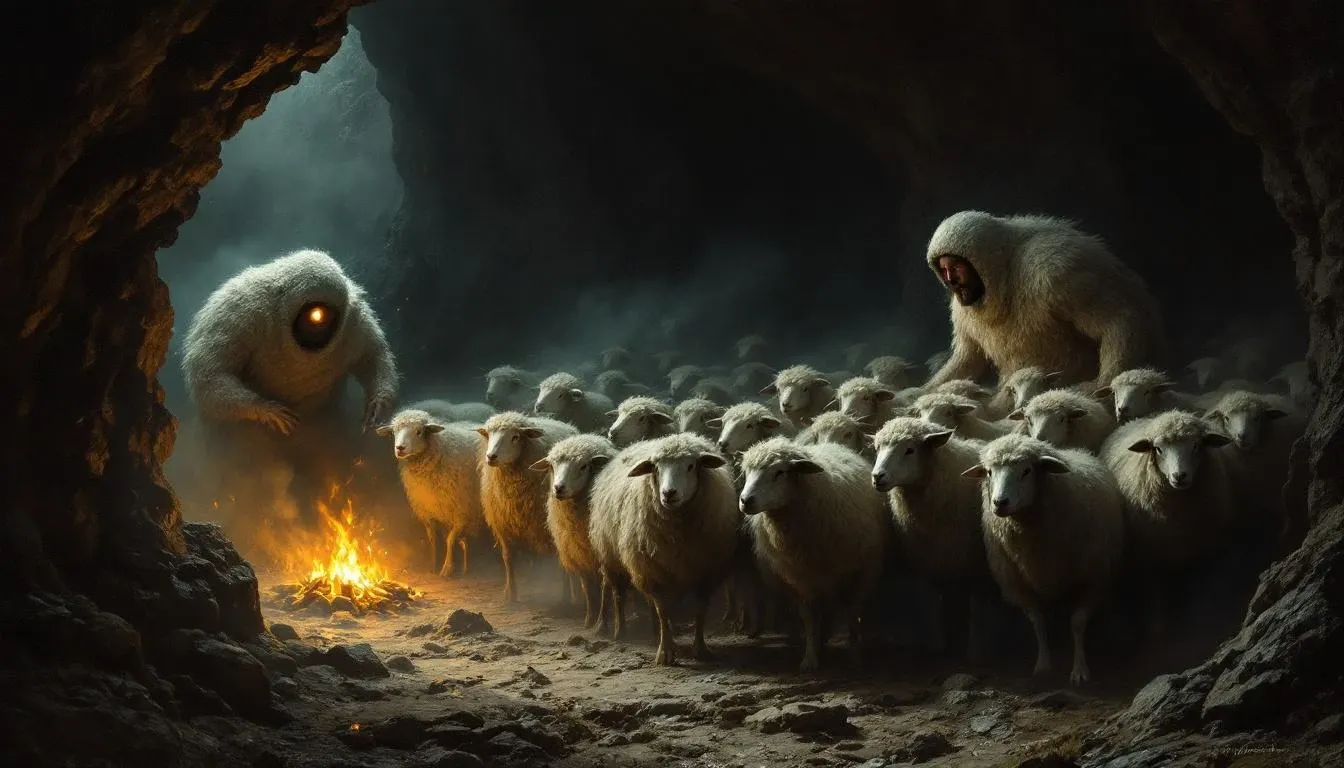
Blinded, Likho blocks the door. The blacksmith is trapped. She cannot see him, but she can feel every inch of the hut, and her arms are long. Night passes. In the morning, Likho opens the door — not to free the smith, but to let her sheep out to pasture. She stands in the doorway and runs her hands over the back of every animal as it passes, checking that the blacksmith has not climbed onto one.
The blacksmith is wearing a sheepskin coat. He turns it inside out — fur side exposed — drops to all fours, and crawls through the doorway on his hands and knees. Likho's fingers pass over his back. She feels wool. She lets him through.
The parallel to Homer's Odyssey is unmistakable. Odysseus blinds the Cyclops Polyphemus with a burning stake, then escapes by clinging to the underside of Polyphemus's rams as the blinded giant feels the back of each animal at the cave entrance. The structure is identical: a clever mortal blinds a one-eyed giant, then escapes by disguising himself among livestock while the giant guards the exit by touch.
Scholars have debated whether this represents direct borrowing — whether the tale traveled from Greece to the Slavic lands along trade routes — or whether it is an example of independent convergence, two cultures arriving at the same narrative solution to the same mythological problem. The folklorist Stith Thompson classified both under the same motif number (K603: "Escape by disguise from ogre's home"). Similar stories appear in Basque, Turkish, Berber, and Finnish traditions. The one-eyed giant who is blinded by a clever prisoner who then escapes among the flock may be one of the oldest story structures in the world.
But Afanasyev's version adds something Homer's does not: a coda about the impossibility of truly escaping evil.
The Servant of Death
Before the fairy tales softened Likho into a villain who could be outwitted, there was something older and darker. In the pre-Christian Slavic world, Likho was understood not as a monster in the woods but as a servant of Death itself — a functionary of the cosmic order, an agent of the force that ended all things.
Villages held rituals during epidemics in which they constructed a one-eyed feminine idol — a rough figure, carved or bundled from straw, with a single eye marked on its face — and set it ablaze. The burning was not entertainment. It was sympathetic magic of the most desperate kind: by destroying the image of Likho, the community hoped to destroy the misfortune that was killing them. Plague, cattle disease, famine — these were Likho's work, and if Likho could be burned in effigy, perhaps the dying would stop.
This ritual places Likho in the same category as Mara/Morana, the Slavic goddess of death and winter, whose straw effigy is burned every spring in ceremonies that survive across Eastern Europe to this day. The connection is not accidental. Likho, Mara, and the Chort all belong to the dark half of the Slavic cosmos — the underworld, the realm of Veles, the domain of death and cold and the things that end. They are not evil in the modern sense. They are necessary. The old Slavs understood that a world without death is a world without meaning, and the creatures that carried death were feared but not hated — the way a farmer fears winter but does not pretend it should not exist.
Christianity collapsed this nuance. Death's servants became demons. The ritual burning of Likho's effigy, once a negotiation with fate, became mere superstition. And Likho herself migrated from the ritual space into the fairy tale, where she was reduced from an agent of cosmic necessity to a monster who eats tailors and gets poked in the eye.
But the proverb survived. Ne budi likho, poka ono tikho. Do not wake Likho while it is quiet. The proverb does not say "Likho does not exist." It says Likho is sleeping. Right now. Nearby. And if you are wise, you will not make noise.
Likho in The Witcher and Modern Games
Andrzej Sapkowski, the Polish author who created the Witcher universe, built his world on the bedrock of Slavic mythology — and Likho was too potent a figure to ignore. In the Witcher bestiary, creatures drawn from Slavic tradition are classified as "relicts" — ancient beings that predate the current age, survivors of a world that has moved on without them. The Likho fits this category perfectly: a being that embodies an older, pre-rational understanding of misfortune as something with teeth and claws and a single staring eye.
In The Witcher 3: Wild Hunt, the game that brought Sapkowski's mythology to a global audience, players encounter creatures throughout the world that draw directly from the same folk traditions as Likho. The bestiary of Witcher creatures includes dozens of Slavic beings — from the vodyanoy to the striga to the leshy — each reimagined as a concrete threat that Geralt must face with silver sword and preparation. The game's DLC expansions pushed even deeper into Slavic folklore, with Hearts of Stone exploring themes of cursed fate, demonic bargains, and the impossibility of escaping the evil you have invited into your life — the same moral that sits at the heart of the Afanasyev tale.
The indie game One-Eyed Likho, developed by the Russian studio Morteshka (the team behind Black Book and The Mooseman), takes the creature as its central figure. Released in 2025, the game drops players into a first-person horror experience set in a greyscale world inspired by 19th-century Russian folk art. The player must navigate Likho's domain armed with nothing but a matchbox — a deliberate echo of the blacksmith's burning iron rod — solving puzzles and surviving encounters with the one-eyed giantess herself. The game understands something essential about the original folklore: Likho is not a creature you defeat. It is a creature you survive, if you are clever enough, and even then you do not survive whole.
Likho and the Greek Cyclops: The Oldest Story in the World?
The structural parallels between Likho and Polyphemus raise a question that has occupied comparative mythologists for over a century: is this the same story?
The core elements align with unsettling precision. Both creatures are one-eyed giants. Both trap human visitors in an enclosed space. Both are blinded by a heated weapon wielded by a clever captive. Both guard the exit by touch, feeling the backs of their livestock. Both are foiled by a hero who disguises himself as — or among — the animals. The correspondence is too exact and too specific to be dismissed as coincidence.
But the differences matter too. Polyphemus is a son of Poseidon, a shepherd living in solitude, hostile but not inherently supernatural beyond his parentage. Likho is misfortune itself — not a creature who causes bad luck but bad luck given a body. Odysseus blinds Polyphemus and sails away, his cunning validated by the gods. The blacksmith blinds Likho and escapes — but leaves his hand behind, cursed to the golden axe. The Greek hero wins. The Slavic hero merely survives, diminished.
This difference reflects something fundamental about the two cultures' relationship to fate. Greek heroes can outsmart fate, at least temporarily. Slavic heroes can endure fate, can outwit its agents, can crawl through the doorway in a sheepskin coat — but they cannot walk away unmarked. The golden axe is waiting. The hand will be lost. There is always a cost. The Slavic and Greek mythologies share narrative bones, but the flesh they put on those bones tells very different stories about what it means to be human in a world that is not on your side.
Why Likho Still Matters
Every culture has a word for bad luck. Few cultures have given bad luck a face.
The genius of Likho — the reason this particular creature has survived a thousand years of retellings — is that it answers a question no philosophy or theology has ever answered satisfactorily: why me? Why does the storm destroy my house and spare my neighbor's? Why does the disease take my child and leave yours? Why does misfortune follow some people like a shadow they cannot outrun?
The Slavic answer is Likho. Not a random process. Not divine punishment. Not karma. A creature. One-eyed, gaunt, impossibly old, dressed in rags, waiting in a hut at the end of a road that you should never have walked down. Likho does not punish you for your sins. Likho does not test your faith. Likho simply is — the way winter is, the way death is, the way the odd number is left over when the counting is done. It cannot be reasoned with. It cannot be appeased. It can only be survived, and the survival will cost you something, and the proverb will still be true tomorrow morning: do not wake Likho while it is quiet.
Because Likho is always quiet. Until it is not.