The island of Rügen sits in the Baltic Sea off the northeast coast of Germany, separated from the mainland by a narrow strait that a strong man could almost swim across. Today it is a holiday destination — chalk cliffs, beech forests, seaside resorts with wicker beach chairs facing the grey water. A thousand years ago, it was the last stronghold of Slavic paganism on the Baltic coast, and its temples held more gods per square mile than any other place in the Slavic world.
Svetovit was the most famous — four heads, a white horse, the great temple at Arkona on the island's northern cape. But Svetovit was not alone. The Rani, the Slavic tribe who held Rügen, maintained multiple temples to multiple gods across the island. And in the settlement of Karentia — modern Garz, on the island's southern end — there stood a temple dedicated to a god who made even Svetovit look restrained.
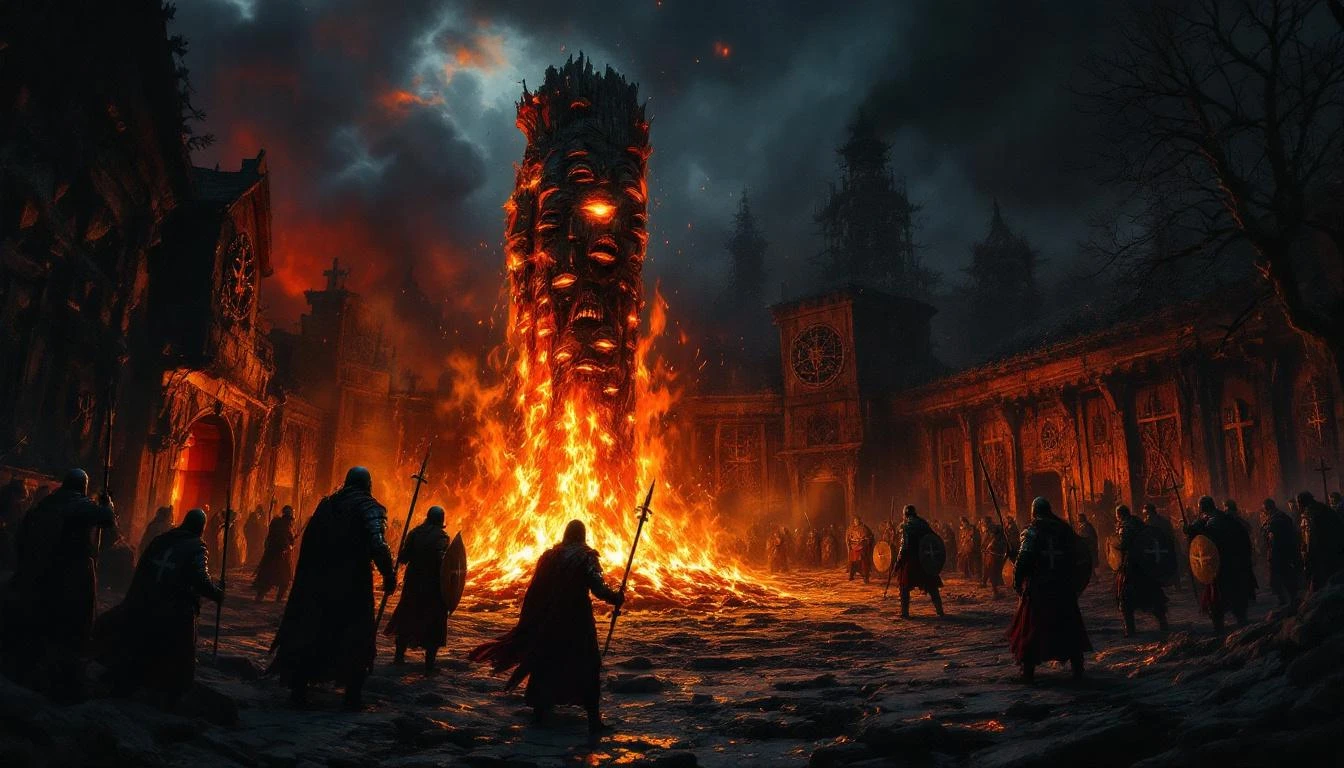
He had seven heads. He wore seven swords on his belt. He held an eighth sword, drawn, in his right hand. And swallows nested in the cavities of his wooden mouths.
His name was Rugevit. He was the war god of Rügen. And almost everything we know about him comes from a single Danish source that recorded his destruction.
The Source: Knytlinga Saga
The primary account of Rugevit appears in the Knytlinga Saga — a thirteenth-century Icelandic saga that chronicles the deeds of the Danish royal dynasty. The saga includes a detailed description of the Danish conquest of Rügen in 1168, when King Valdemar I and Bishop Absalon of Lund destroyed the Slavic temples and forcibly converted the Rani to Christianity.
Saxo Grammaticus, the Danish clerk who wrote the Gesta Danorum around 1200, provides the most famous account of the fall of Arkona and the destruction of Svetovit. But Saxo focused primarily on Arkona, the main temple. The Knytlinga Saga broadens the picture, describing the secondary temples at Karentia and the gods that inhabited them. It is from this saga that we learn about Rugevit, and about his companions Porevit and Porenut — the other multi-headed gods of Rügen who stood in temples near his own.
In Karentia there were three temples of notable workmanship. In the largest of these stood the idol Rugevit, carved from oak wood, which differed from all the other images in its repulsive multiplicity of heads. Seven faces appeared joined on one neck, and seven swords hung from the belt at its side, while an eighth it held drawn in its right hand, fixed by an iron nail to its grip so firmly that it could not be severed from the arm except by cutting.
The description is precise enough to be architectural. An oak idol — oak being the sacred wood of the Slavs, the tree of Perun and of thunder. Seven heads on a single neck, not seven necks but seven faces crowded onto one structure, a cluster of eyes and mouths looking outward in every direction. Seven swords at the belt — sheathed, decorative or ceremonial, representing either seven victories or seven armies or seven aspects of war. And one sword drawn, held in the right hand, nailed permanently to the grip with an iron fastening so that it could never be removed without destroying the arm that held it.
The drawn sword is the critical detail. This is not a god at rest. This is a god already fighting. The other swords are reserves, sheathed potential, wars not yet begun. The eighth sword is the current war — the one being fought right now, the perpetual battle. Rugevit is frozen mid-strike. He never sheathes the blade he holds.

Seven Heads: The Meaning
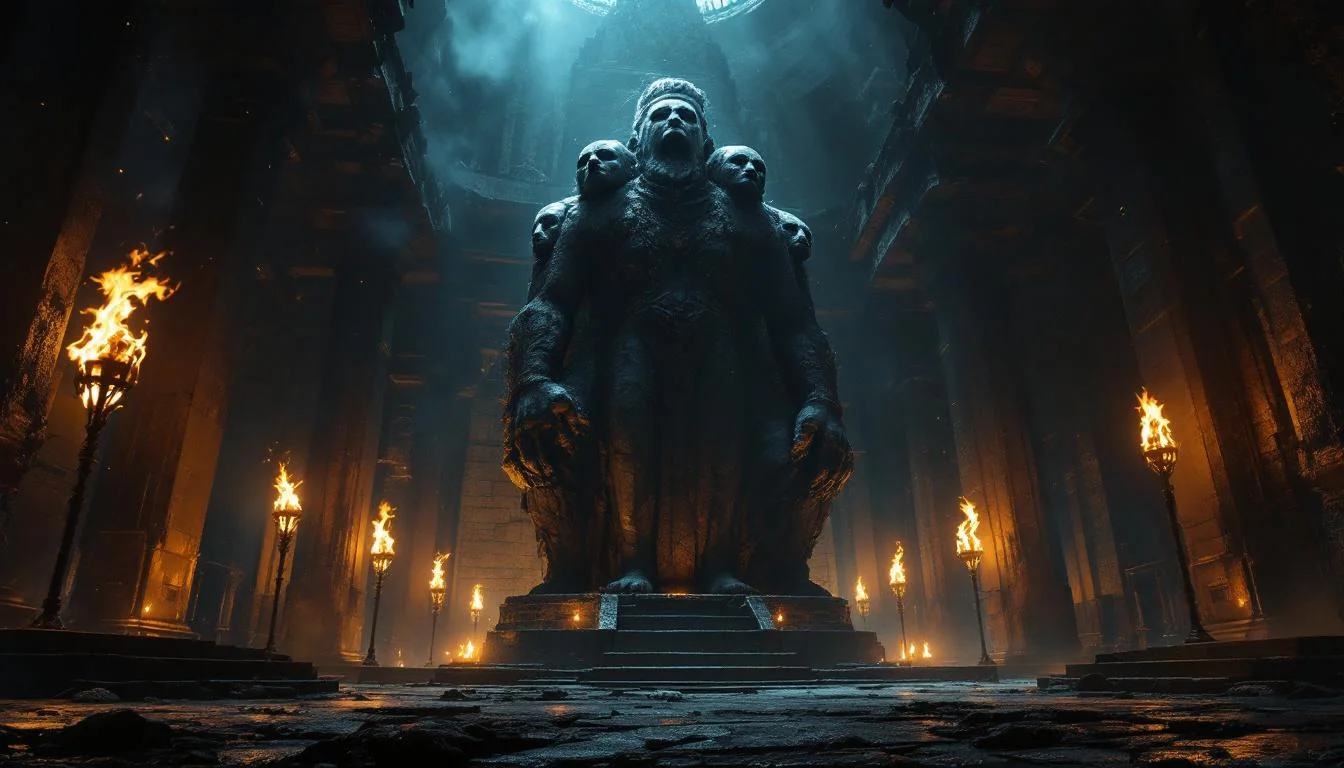
The multi-headed gods of Rügen form a distinct theological tradition unlike anything found among the East Slavs. Svetovit had four heads. Triglav, in Pomeranian Szczecin, had three. Rugevit had seven. His companion Porevit had five. Porenut had four (or five, depending on the source), with a fifth face on its chest.
This multiplication of heads demands interpretation. The most common scholarly approach — following the logic applied to Svetovit and Triglav — is cosmological. Four heads for four cardinal directions. Three heads for three cosmic realms (sky, earth, underworld). Seven heads for... what?
Seven is a number saturated with Indo-European sacred significance. Seven planets were visible to the ancient world. Seven days compose the week. Seven was a number of completeness in systems from Vedic India to Norse mythology. If Svetovit's four heads watched the four horizontal directions and Triglav's three heads watched the three vertical layers, Rugevit's seven heads may represent total cosmic awareness — the four directions plus the three realms, horizontal completeness plus vertical completeness, a god who sees not merely everywhere but everything.
An alternative interpretation focuses on the martial context. Seven swords, seven heads — each head directing one army, one campaign, one front of a simultaneous multi-directional war. A god with seven heads does not need to choose which direction to face. He is already facing every direction from which an enemy could approach. For a people whose island was surrounded by hostile forces on all sides — Danes to the west, Saxons to the south, Poles to the southeast — a god who watched seven directions at once was not an abstraction. He was a tactical necessity.
There is also a more prosaic possibility. The Rani may have been engaged in a kind of theological arms race with their neighbors. If the Pomeranians had a three-headed god and the Rani had a four-headed god, the response is obvious: build a bigger one. Seven heads beats four. The drawn sword beats the drinking horn. The escalation produces a god of raw intimidation, a war idol designed not for cosmological elegance but for psychological impact — the thing that makes visiting diplomats and enemy scouts understand exactly how seriously these people take their capacity for violence.
Karentia: The Three Temples
Karentia — identified with the modern town of Garz, on a hill in southern Rügen — hosted not one but three temples. Each contained a major idol. Together, they formed a religious complex that complemented Arkona, the principal sanctuary on the island's northern tip.
The arrangement suggests a deliberate division of divine labor. Arkona held Svetovit, the supreme god, the oracle, the god of prophecy and governance. Karentia held the war gods — the specialists in violence, the deities you consulted not about whether to go to war (that was Svetovit's domain) but about how to fight it once it began.
The Knytlinga Saga describes three idols at Karentia: Rugevit, Porevit, and Porenut. The names are significant. Rugevit likely derives from the name of the island itself — Rugia or Rügen — plus the suffix -vit, meaning "lord" or "ruler" (the same suffix as in Sveto-vit). Rugevit was "Lord of Rügen" — the patron deity of the island, the specific protector of the Rani homeland.
Porevit had five heads but no weapons — a god of five aspects but not a warrior, perhaps representing the productive or judicial side of governance. Porenut had four heads and a fifth face on its chest, touching its forehead with one hand — a gesture scholars have interpreted as contemplation, prophecy, or the concentration of power inward.
Together, the three formed a system: Rugevit for war, Porevit for governance, Porenut for counsel or divination. Three temples, three gods, three functions — a Slavic counterpart to the tripartite Indo-European structure that Georges Dumezil identified across cultures: sovereignty, war, and production. The Rani had organized their divine hierarchy with the clarity of a military command structure.
The Swallows
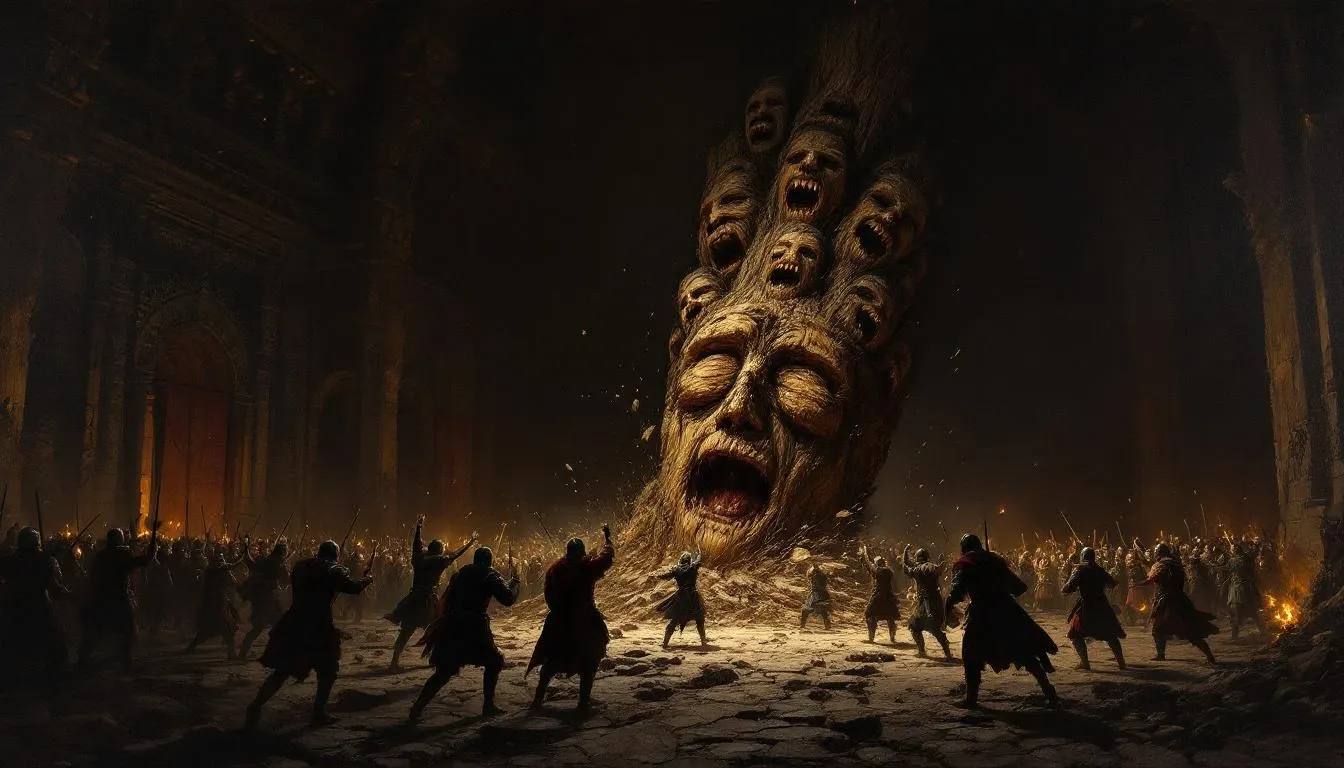
Among the most haunting details in the Knytlinga Saga's description of Rugevit is a small, almost incidental observation: swallows had built their nests inside the idol's open mouths and beneath his chins. The accumulated bird droppings covered the figure's faces and chest.
The saga presents this as evidence of neglect — proof that the pagans' god was so impotent he could not even keep birds from soiling his own face. It is the kind of detail a Christian chronicler includes to diminish and ridicule. Look at your great war god, covered in bird dung. Some protector.
But the detail may carry a meaning the chronicler did not intend. Swallows, in Slavic folk tradition, were not ordinary birds. They were associated with the souls of the dead, with spring's return, with the boundary between the domestic world and the wild. A swallow nesting in a house was a blessing — the bird chose that home, and its presence meant the household was favored. Swallows in Rugevit's mouths may have been seen not as degradation but as sanctification: the birds of the returning dead making their home in the war god's wooden body, filling his open mouths with life in the season of his silence.
Or perhaps the nesting was simply what happens to any large wooden structure left standing in a Baltic island temple for decades or centuries. Birds nest in convenient cavities. The wood of an idol is no different from the wood of a barn. The sacred and the practical overlap, and the war god of seven heads endured the swallows because that is what standing still for a hundred years in a wooden building means.
The chronicler meant the swallows as mockery. They may have been worship. They may have been nothing at all. The ambiguity is the point — we do not have the Rani's interpretation, only the Dane's sneer.
1168: The Fall of Rügen
The destruction of Rügen's temples was a single campaign executed across a few weeks in the summer of 1168. King Valdemar I and Bishop Absalon arrived with a Danish fleet. Arkona fell first — the fortress on the northern cape, undermined and stormed, its garrison of three hundred overwhelmed. Svetovit's idol was chopped apart and burned. The white horse was taken. The treasure was confiscated.
With Arkona's fall, the rest of the island capitulated. The Rani princes submitted, accepted baptism, and agreed to Danish overlordship. The secondary temples — including the three at Karentia — were destroyed without significant resistance. The military backbone of Rani paganism had been broken at Arkona. Karentia fell not in battle but in the demoralized aftermath.
The Knytlinga Saga describes the destruction of Rugevit's idol with a practical detail that captures the scale of the thing. The oak figure was so large that the Danes could not simply topple it. They had to cut it down like a tree — axes applied to the base, the massive wooden body felled in sections. The seven heads were separated from the neck. The eight swords were confiscated. The oak was split and burned.
The fire that consumed Rugevit also consumed Porevit and Porenut. Three temples, three idols, a single afternoon of systematic destruction. By the end of the day, Karentia's religious complex — which had stood for generations, possibly centuries — was ash and charcoal.
Rugevit in the Wider Context
The multi-headed gods of the West Baltic Slavs represent a distinct theological tradition that has no parallel in East Slavic religion. Perun in Kyiv had one head. Mokosh had one head. Veles had one head. Even Svarog, the cosmic smith, was singular. But among the Polabian and Baltic Slavs — from Rügen to Szczecin to Wolin — the gods multiplied their faces with an enthusiasm that suggests a different understanding of what divinity looked like.
What the multi-headed tradition does reveal is a Slavic theology of totality. Each additional head is another direction watched, another realm governed, another dimension of reality brought under divine authority. The one-headed gods of the East Slavs achieved their cosmic scope through specialization — Perun for the sky, Veles for the underworld, Mokosh for the earth. The multi-headed gods of the West achieved it through multiplication — Svetovit sees four ways at once, Triglav watches three worlds simultaneously, Rugevit covers seven aspects of existence in a single wooden body.
The result is the same: gods who miss nothing. But the method is different, and the method tells us something about the people who chose it. The Baltic Slavs, surrounded by enemies on every horizon — Danes, Saxons, Poles, and rival Slavic confederations — needed gods who could watch multiple threats simultaneously. A single-headed god can be flanked. A seven-headed god cannot.
What Remains
Rugevit left no folk memory. No saint absorbed his function. No holiday preserves his rituals. The Rani were Christianized, then Germanized, and their Slavic identity was erased so completely that the island of Rügen — whose very name may echo in Rugevit — is today a thoroughly German place where the Slavic past survives only in village names and archaeological sites.
The chalk cliffs of Cape Arkona still crumble into the Baltic. The earthwork rampart of the fortress is still visible, though it shrinks with every winter storm. Tour buses bring visitors to the site, where a lighthouse and a pair of preserved East German watchtowers stand near the place where Svetovit's temple once dominated the skyline. There is a small museum. There are information boards.
At Garz, where Karentia stood and where Rugevit's three temples occupied their hilltop, there is less. A church, built — as so often — on the same hill where the pagan temple stood, absorbing the sacred geography of the older religion even while destroying its content. The oak idol of Rugevit is ash. The seven swords are lost. The swallows nest in the church eaves now, indifferent to which god shelters them.
Seven heads that watched seven directions. Eight swords, seven sheathed and one forever drawn. A god carved from oak and nailed to his own weapon, incapable of putting it down even if he wanted to. The permanent warrior, the perpetual strike, the blade that never returns to its scabbard.
The Danes took the sword from his hand by cutting the arm off at the shoulder. It was the only way to disarm him. Even in destruction, he would not let go.