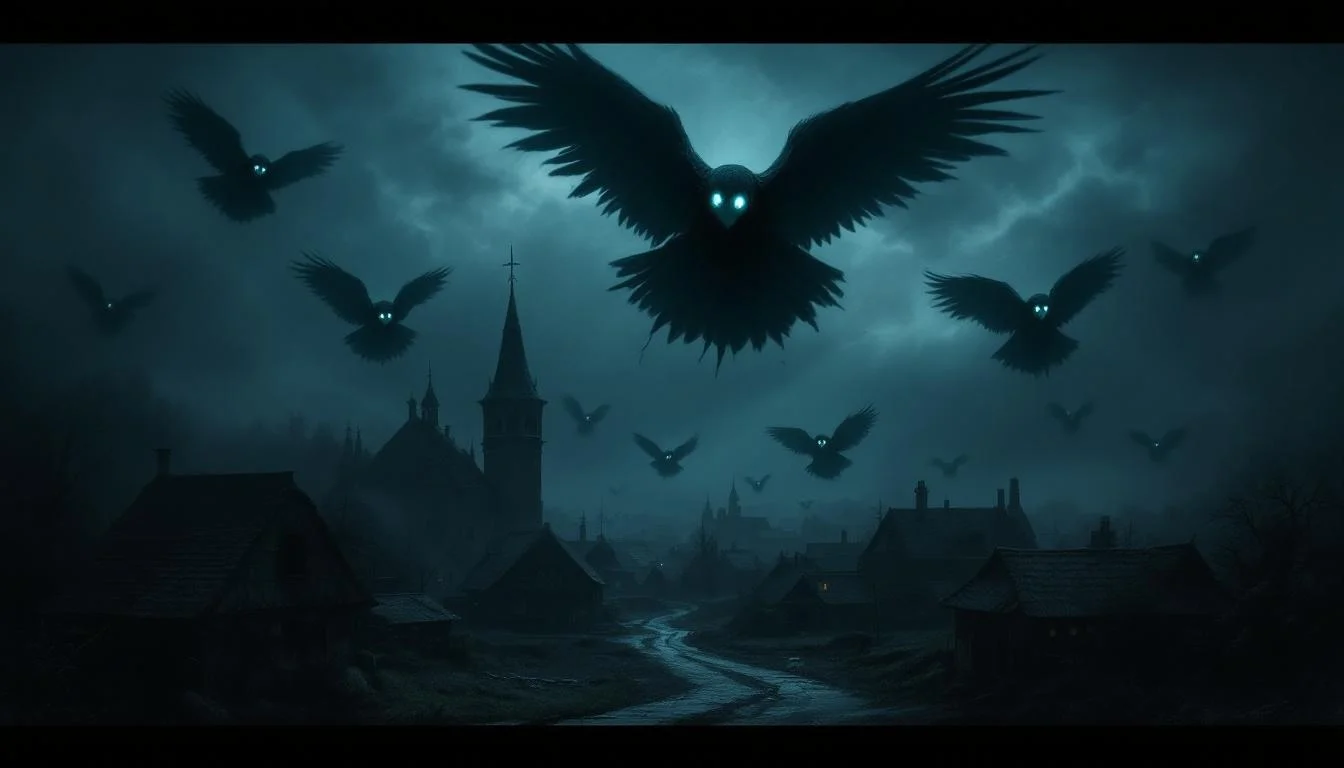
The body was washed by women who did not weep — not yet. The weeping came later, at the appointed hour, in the appointed form, with words that had been passed down so long nobody remembered who first spoke them. But before the laments, before the fire, before the feast that would last through the night, there was the washing. Cool water, linen cloths, and hands that worked quickly because the dead do not wait. The Slavs understood something that most modern people have forgotten: death is not a moment but a process, and the living have obligations at every stage of it. From the instant the breath stopped to the fortieth day after the pyre cooled, the family of the deceased was bound by a sequence of rituals so precise and so consequential that a single misstep could trap the soul between worlds — producing not a peaceful ancestor but a restless spirit that would haunt the household for generations.
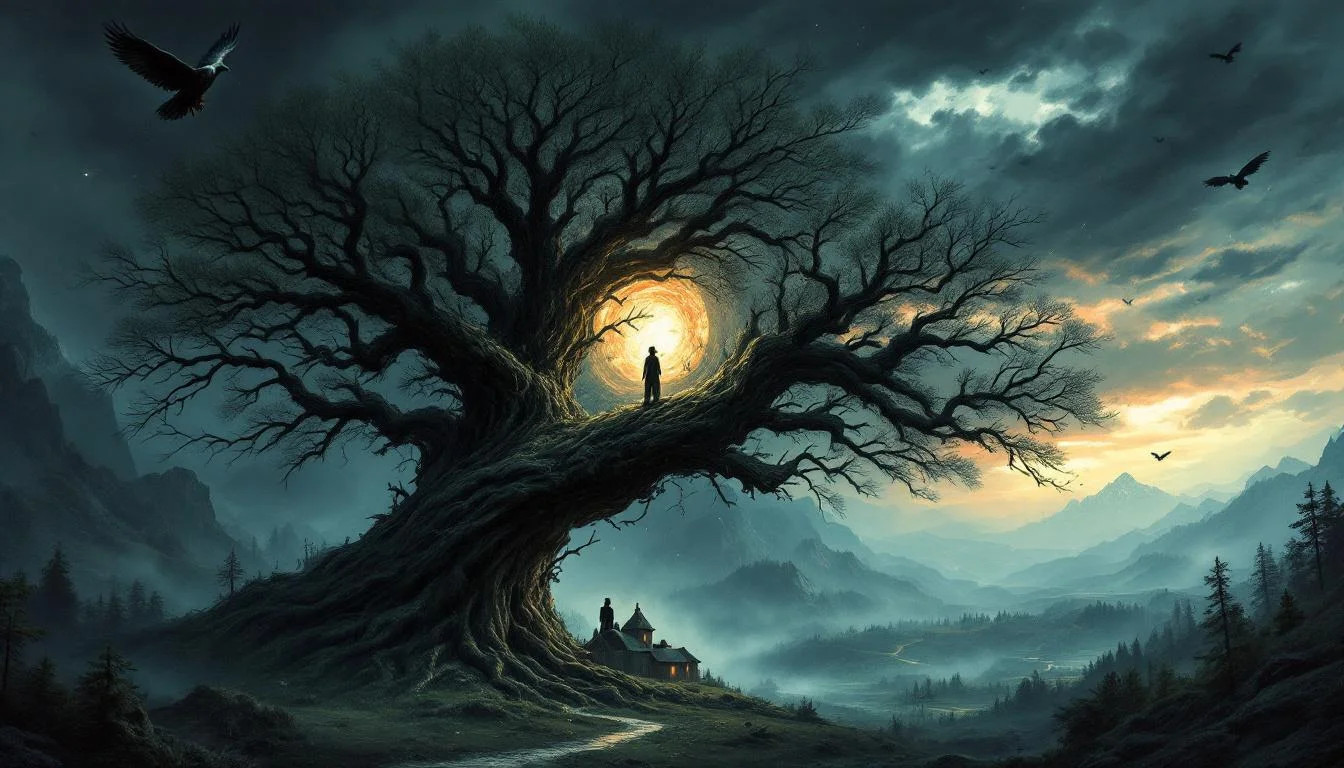
These were not symbolic gestures. The pagan Slavs did not perform funeral rites to express grief or honor memory in some abstract, emotional way. They performed them because they believed, with the certainty of people who had watched it go wrong, that the dead needed help getting where they were going. The Slavic afterlife was a real place — Nav, the dark world beneath the roots of the World Tree — and the road there was long and treacherous. It crossed the stinking river Smorodina and the red-hot Kalinov Bridge, and a soul that arrived without the proper send-off risked wandering forever at the threshold, neither alive nor properly dead.
The Pyre at Sunset: How the Slavs Burned Their Dead
Cremation dominated Slavic burial customs for nearly two thousand years, from the earliest archaeological evidence of proto-Slavic cultures through the gradual Christianization that began in the ninth century and was not complete in some regions until the twelfth. The Czechs and Poles burned their dead until the eleventh century. The Serbs continued until the tenth. In the remote Baltic and northern forests, the old fire-rites persisted even longer, carried out in secret clearings while priests preached inhumation in the villages below.
The burning was never casual. Wood for the funeral pyre was selected with the same care a carpenter would give to building a house, because in a sense that is exactly what it was — a house for the dead, a temporary structure that would carry the soul upward with the smoke. Birch was preferred in many Eastern Slavic communities, being considered a sacred tree associated with purity and the feminine divine. Oak — the tree of Perun, the thunder god — was used for warriors and chieftains, men whose deaths demanded the attention of the sky. The logs were stacked into a rectangular framework called a krada, a word that shares its root with the Slavic term for a ritual bonfire, and the body was placed on top, dressed in the finest clothing the family possessed, surrounded by the objects the dead person would need in Nav.
A warrior was cremated with his weapons — his sword, his shield, sometimes his horse, killed and placed beside the pyre. A craftsman was sent with his tools. Women were buried with spindles, jewelry, combs, and sometimes keys, signifying their authority over the household they were leaving behind. Children received toys and small clay vessels. The grave goods were not symbolic tributes. They were practical provisions for a journey the living fully expected the dead to make.
After the fire burned down — and a proper funeral pyre burned for hours, fed and tended by the family — the ashes and bone fragments were carefully gathered. In some regions they were placed into ceramic urns, simple clay vessels often decorated with geometric patterns that may have represented the sun, water, or the World Tree. In others, the remains were wrapped in cloth or bark and placed directly into the ground. Over this spot the community raised a kurgan — a burial mound whose height corresponded to the status of the deceased. A village elder might receive a mound two meters high. A prince received a hill.
The Domovina: A House for the Dead
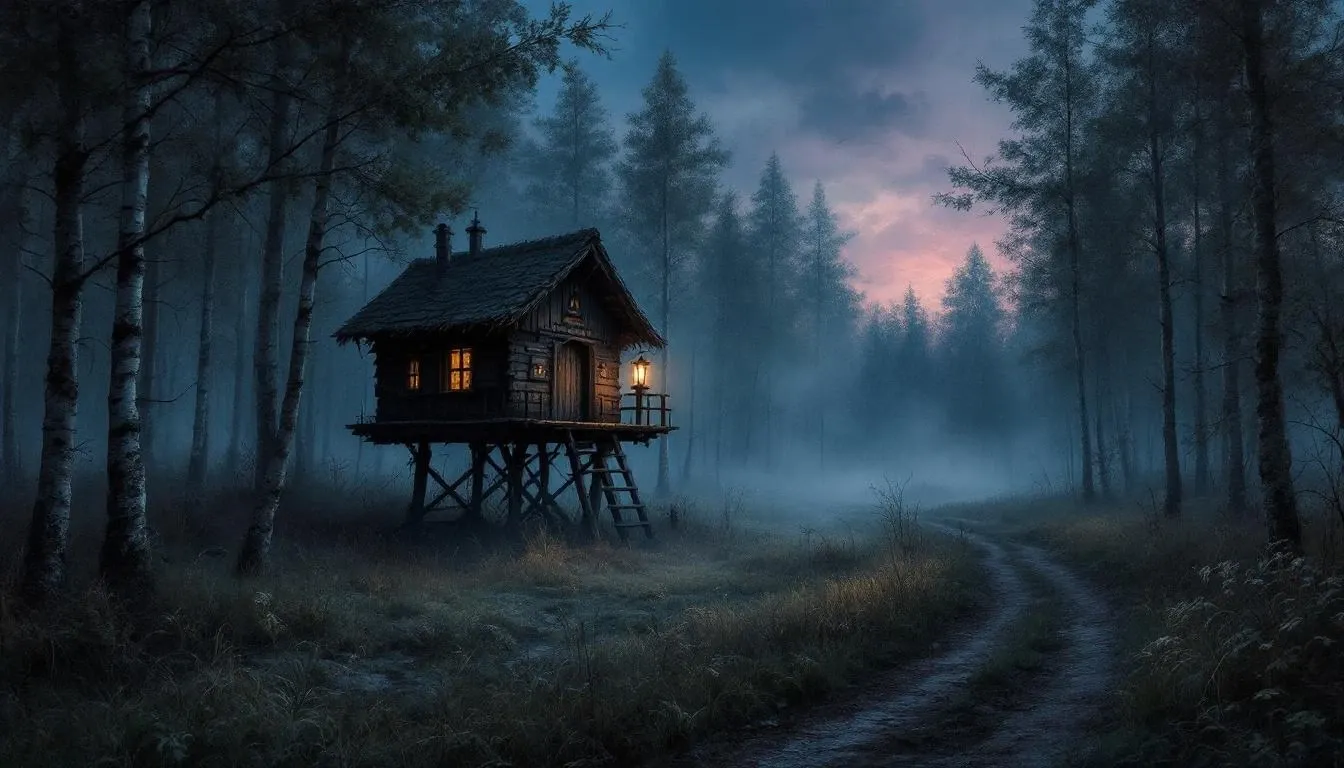
Not all ashes went underground. In certain West and East Slavic traditions, cremation urns were placed inside small wooden structures called domoviny — miniature houses built on thick poles, standing at the edge of the village or along a road leading into the forest. These houses had three walls instead of four, the open side facing the settlement so that offerings could be placed inside: bread, honey, grain, a cup of water or mead. The dead person's soul, during its forty-day wandering, was expected to return to this small house to eat and rest before continuing its journey.
The domovina is likely the historical origin of one of the most famous images in Slavic folklore — the hut on chicken legs. When the fairy tales describe Baba Yaga's house standing in the forest on its bird-like supports, spinning to face whoever approaches, they are remembering something real: a funerary structure that once stood at the boundary between the village and the wild, between the living and the dead, between Yav and the dark country beyond. Baba Yaga herself, in the oldest stratum of her mythology, may be less a witch than a guardian of the threshold — a figure who stands at the gate of Nav and decides who crosses. The fence of bones around her yard, the skull-lanterns on the posts, the oven where she threatens to cook her visitors: all of these are echoes of cremation, of the pyre, of the place where bodies became ash and souls became ancestors.
The domovina tradition survived Christianization in altered form. Across Russia, Ukraine, and Belarus, small roofed crosses and miniature houses appeared in cemeteries well into the modern era — structures that Orthodox clergy tolerated because they looked like shelters for icons but that served the older function of feeding stations for the dead.
The Trizna: Feasting with the Dead
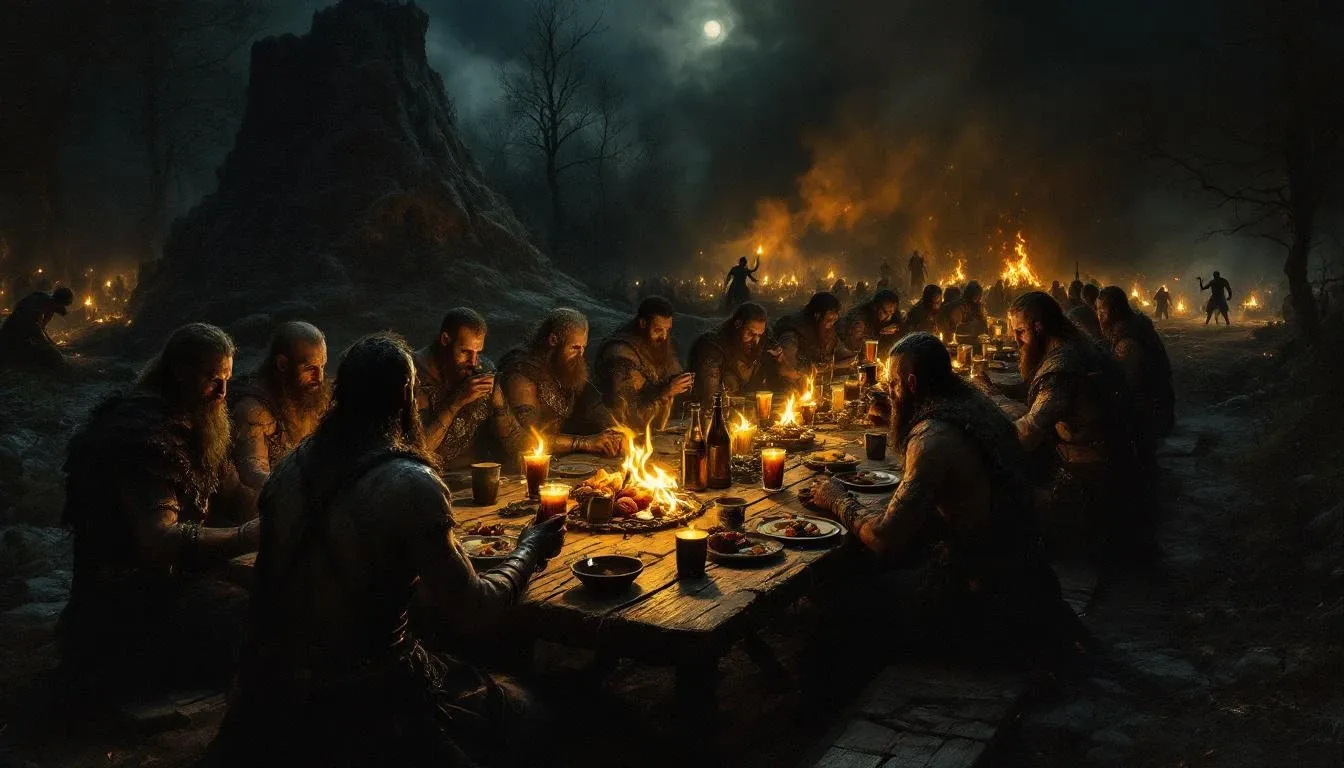
No Slavic funeral was complete without the trizna — the funeral feast that followed the cremation or burial. The word itself is old enough that its exact etymology is disputed. Some scholars connect it to the Slavic root for "three," suggesting it may have originally involved three distinct ritual acts or three types of sacrifice. Others link it to words meaning "contest" or "struggle," which fits the historical descriptions of what actually happened during these feasts: the trizna was not a solemn, quiet meal. It was loud, physical, and deliberately chaotic.
The Primary Chronicle describes the trizna held by Princess Olga at the grave of her husband Prince Igor in 945, where the feast was followed by the slaughter of the Drevlians who had murdered him. While Olga's revenge was exceptional, the martial character of the trizna was not. Funeral feasts regularly included wrestling matches, horse races, mock combat, and tests of strength — all performed beside the cooling pyre or atop the freshly raised kurgan. The logic was not entertainment. The noise, the competition, the laughter served a protective function: evil spirits and Nav spirits were drawn to the newly dead, and the commotion of the living drove them away. You fought death by being aggressively, noisily alive.
Then they pulled the ship up onto the shore and placed four posts of birch and other wood around it. They made a structure like great tents around the ship. They brought a couch and placed it on the ship, covered with Greek brocade. An old woman whom they called the Angel of Death arranged the furnishings. They brought intoxicating drink, fruits, fragrant herbs, bread, meat, and onions. They took a dog, cut it in two, and put it on the ship. They brought his weapons and laid them beside him. They took two horses, drove them until they were dripping with sweat, then cut them to pieces with swords and threw their flesh on the ship. Then a relative of the dead man took a piece of wood, lit it, and walking backward so as not to look at the ship, set the fire.
Ibn Fadlan, an Arab diplomat who witnessed a Rus funeral on the Volga in 922, left the most detailed account of the trizna complex that survives. His description — of the ship raised on shore, the ten days of preparation, the animal sacrifices, the slave girl who volunteered to accompany her master into death, the woman called the Angel of Death who administered the rites — is one of the most frequently cited primary sources in all of early medieval studies. The funeral he witnessed was almost certainly a Scandinavian-influenced Rus ceremony rather than a purely Slavic one, but the core elements — the pyre, the feast, the grave goods, the ritual killing of animals, the communal drinking, the belief that fire carried the soul upward — were shared across the cultures that mingled along the Volga trade routes.
What mattered at the trizna was abundance. The family was expected to provide more food and drink than could reasonably be consumed, because the dead person was eating too. A portion of every dish was set aside for the deceased — placed on the grave, thrown into the fire, or left at the domovina. The dead were not absent from their own funeral. They were the guest of honor, and stinginess at the feast was an insult that could turn a cooperative ancestor into a vengeful one.
Forty Days of Wandering
The funeral pyre was the beginning of the death process, not the end. For forty days after cremation or burial, the Slavs believed the soul remained in Yav — the visible world — drifting through the places it had known in life. It visited its former home. It sat at the table where it used to eat. It stood in the doorway, watching the family carry on. A towel and a cup of water were kept on the windowsill during this period so the wandering soul could wash and rest when it returned. Mirrors were covered or turned to the wall, because a soul that saw its own reflection might become confused and refuse to leave. Doors were left slightly ajar at night. A candle burned continuously near the spot where the person had died.
The third day, the ninth day, and the fortieth day were marked with specific commemorative meals — smaller versions of the trizna, prepared at home and sometimes taken to the gravesite. On the third day the soul was believed to survey the house one final time. On the ninth it began its journey toward Nav in earnest, crossing fields and forests, following rivers, moving always toward the west and the setting sun. On the fortieth day it reached the Smorodina, crossed the Kalinov Bridge, and entered the realm of the dead for good. At this point, the family shook out the towel from the windowsill at the cemetery, releasing whatever trace of the soul still clung to the cloth, and either burned it or cast it into running water. The mourning period was over. The dead person was now an ancestor — a roditel, a member of the family's invisible household, reachable through prayer, offering, and the seasonal festivals that brought the dead back to eat with the living.
If the forty-day process was interrupted — if the body was not properly cremated, if the funeral feast was neglected, if the family failed to leave food and water for the wandering soul — the dead person could not complete the crossing. It became trapped in Yav, transformed from a potential ancestor into a potential threat. These were the navki, the unquiet dead, the spirits that haunted crossroads and riverbanks and abandoned houses. The rusalki, the upyri, the entire dark taxonomy of Slavic revenants grew from this single failure: a funeral done wrong, a crossing never made, a soul stuck between the three worlds with nowhere to go and no one to feed it.
The Unburied and the Damned
The worst fate in Slavic death culture was not a painful death or a violent end. It was no funeral at all. A body left unburied — whether from war, murder, drowning, or abandonment — could not begin the forty-day journey. Its soul was condemned to wander indefinitely, growing angrier and more dangerous with each passing season. Communities understood this, and even enemies were sometimes given minimal rites to prevent their ghosts from causing trouble. A handful of earth thrown over the corpse, a few words spoken, a fire lit nearby: these could be enough to start the process, even if the full ceremony was impossible.
People who died by suicide, by drowning, or by lightning strike occupied a special category of dread. Their deaths were considered cosmically wrong — interruptions of the natural order that no amount of ritual could fully repair. In many Slavic communities, such bodies were not buried in the village cemetery at all but placed at crossroads, at the edges of fields, in swamps and bogs, at the boundaries between cultivated land and wilderness. The logic was containment: if the soul could not be sent to Nav, it should at least be kept away from the places where the living slept and ate and raised their children. Crossroads were favored because the intersection of paths confused wandering spirits, trapping them in an endless loop of indecision about which way to go.
This fear of the improperly buried dead is the engine that drives much of Slavic supernatural folklore. The vampire traditions of the Balkans, the rusalka legends of the rivers, the stories of the striga howling outside village windows at night — all of these trace back to the same root anxiety. The funeral rite was not merely custom. It was infrastructure. It was the mechanism by which the community managed the boundary between the living and the dead, and when that mechanism failed, the boundary failed with it.
Why Slavic Funeral Rites Matter
The death practices of the pagan Slavs tell us something that no list of their gods or catalog of their myths quite captures: these people took the relationship between the living and the dead seriously enough to build an entire ritual architecture around it. The pyre at sunset, the domovina at the forest edge, the feast on the kurgan, the forty days of bread and water on the windowsill — each element served a function within a system designed to move the soul from one world to another without incident, and to maintain the connection between the two worlds after the crossing was complete.
That system did not vanish when Christianity arrived. It transformed. The forty-day mourning period became the Orthodox sorokoust — forty days of liturgical prayer for the departed. The commemorative meals on the third, ninth, and fortieth days survived almost unchanged, relocated from the kurgan to the churchyard but retaining the same foods, the same timing, the same underlying conviction that the dead need feeding. The trizna became the pomynky, the funeral banquet still practiced across the Slavic world, where a place is set at the table for the deceased and a shot of vodka is poured that no one drinks. The domovina became the cemetery cross-shelter. The grave goods became the coins placed on the eyes and the bread tucked into the coffin.
The bones of the old rites are still there, visible beneath the Christian surface, if you know where to look. Every time a Slavic grandmother covers a mirror when someone dies, she is performing a ritual older than any church in her country. Every time a family leaves a cup of water on the windowsill and waits, they are keeping faith with a belief that predates written history — that the dead are not gone, that they are only traveling, and that the least the living can do is leave the light on.