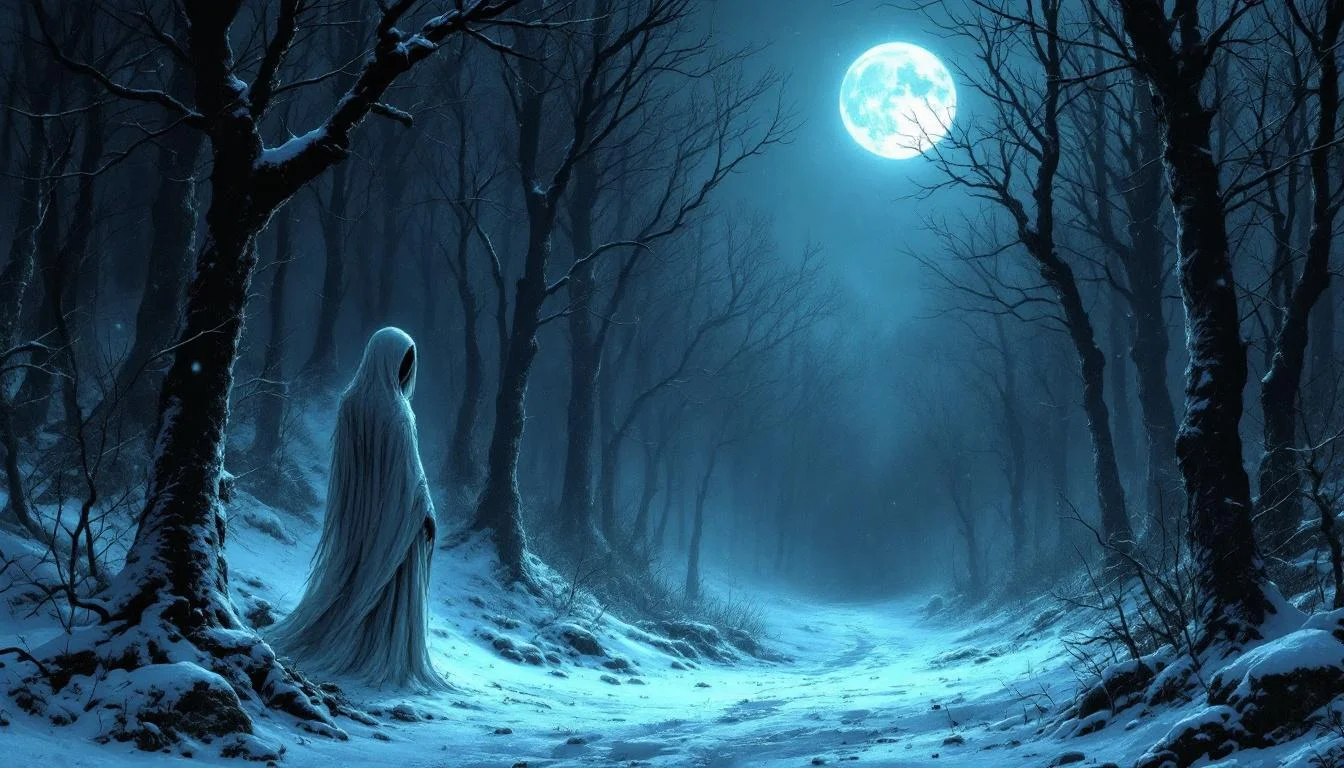
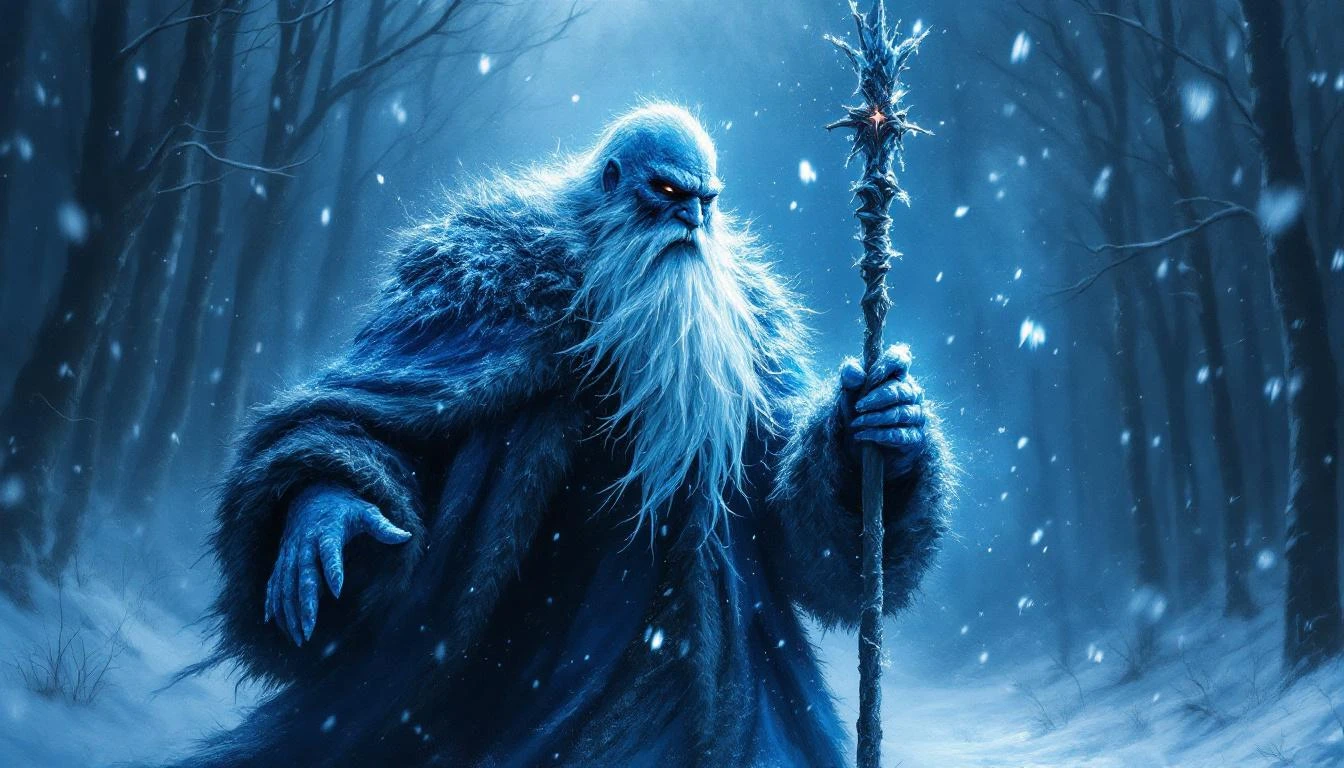
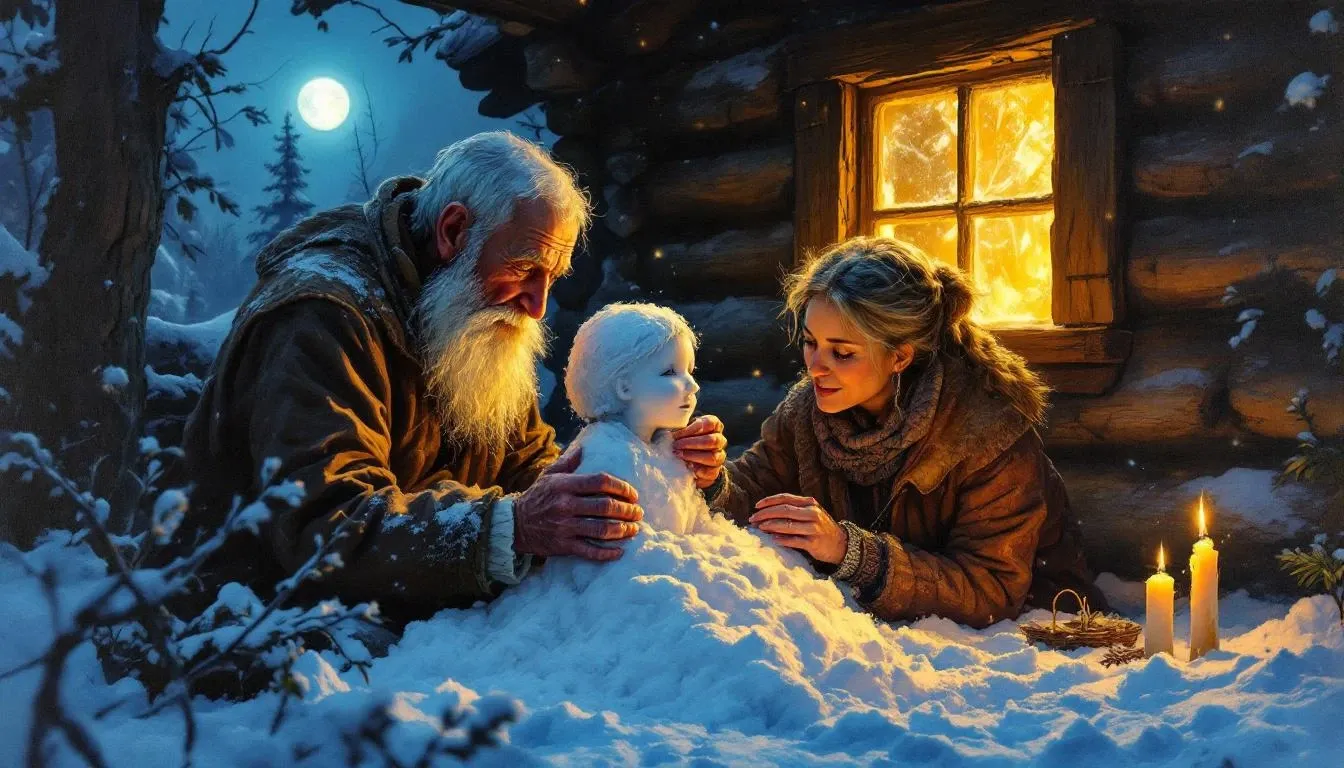
An old man and an old woman have no children. It is winter — the deep, still Russian winter where the birch forests stand white to the horizon and the only sound is the creak of branches under the weight of ice. They watch the village children building snow figures in the yard, rolling heavy balls of wet snow into rough human shapes, pressing pebbles into the faces for eyes.
Something breaks open in them — the particular grief of people who have wanted a child for decades and never had one. The old man goes outside. The old woman follows. Together, wordlessly, they begin to build a girl out of snow. Not a rough figure with stone eyes. A real girl — or as close as snow allows. They shape her carefully: the curve of a cheek, the line of a brow, the small hands, the narrow waist. They work until their own fingers are numb.
When they finish, the snow girl opens her eyes.
She steps off the snowbank, shakes the frost from her white hair, and walks into their house. She is alive. She is their daughter. Her name is Snegurochka — from sneg, the Russian word for snow.
She is the most beautiful girl in the village. She is also the most doomed, because she is made of the one substance that cannot survive the thing all human beings need most. She is made of winter, and winter always ends.
The Folk Tale: Where She Comes From
The original folk version of Snegurochka first appeared in print in 1869, when Alexander Afanasyev included a tale about a snow girl — called Snegurka or Snezhevinochka — in the second volume of his scholarly work The Poetic Outlook on Nature by the Slavs. Afanasyev, who had already published the definitive collection of Russian fairy tales, recognized this story as something different from the usual pattern of magic helpers and questing heroes. This was a creation myth in miniature — and a destruction myth at the same time.
The folk version is short and brutal in its simplicity.
A childless couple makes a snow girl who comes alive. She is a perfect daughter through the long winter — obedient, sweet-natured, pale as birch bark, with eyes the color of frozen rivers. The villagers marvel at her. The old couple weeps with gratitude.
Then spring comes.
Snegurochka grows sad. She avoids the sun. She sits in the shadows of the house, pressing herself into the coolest corners. When the other girls call her to come outside, she refuses. When the warm rain falls, she hides.
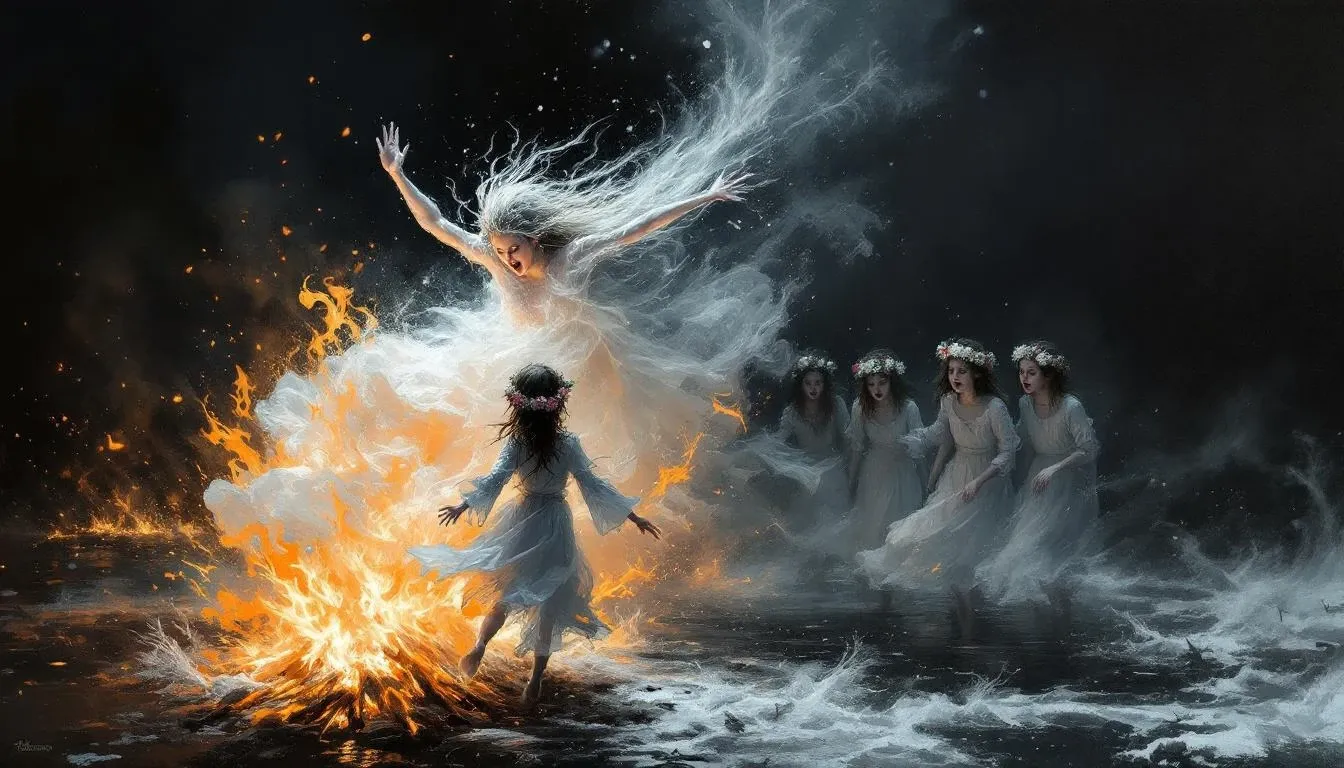
A group of village girls invite her on an outing — in some versions on Kupala Night, the midsummer solstice when Slavic communities built bonfires and young people leaped over flames as an act of ritual purification. The girls gather wood, build a small fire, and take turns jumping over it — an ancient tradition that symbolized cleansing, fertility, and the triumph of light over darkness.
When Snegurochka's turn comes, she runs toward the flames. She leaps. Halfway over the fire, she evaporates — dissolving into a thin white cloud that rises into the summer sky and vanishes.
No body. No grave. Just steam.
"Snegurka leaped over the fire, and was drawn upward in the form of a white cloud. And the cloud rose higher and higher and disappeared from sight. The old man and the old woman were left with nothing."
Afanasyev noted the tale's connection to a German analog — the Schneekind, a snow child who melts — but he understood that the Russian version carried a weight the German one did not. The Schneekind was a moral fable about impermanence. The Russian Snegurochka was something larger: a parable about the fundamental incompatibility between the human world and the world of elemental forces. She does not melt because she is fragile. She melts because she tried to become something she was not.
Ostrovsky's Snow Maiden: The Version That Changed Everything
In 1873, the playwright Alexander Ostrovsky — already the most important dramatist in Russia, the man who had essentially invented realistic Russian theater — took Afanasyev's folk tale and transformed it into something unprecedented. His play Snegurochka (The Snow Maiden: A Spring Fairy Tale) premiered at the Bolshoy Theatre in Moscow on May 11, 1873, with incidental music composed by Pyotr Ilyich Tchaikovsky.
Ostrovsky's version is not a fairy tale. It is a myth on the scale of a Greek tragedy, set in a pre-Christian Slavic kingdom governed by Tsar Berendey, where the old gods are real and the change of seasons is a matter of cosmic negotiation.
In Ostrovsky's telling, Snegurochka is not made by peasants. She is the daughter of two elemental forces: Morozko — Grandfather Frost, the spirit of winter — and Vesna-Krasna, Spring the Beautiful. She is the child of a failed union between opposites — cold and warmth, death and life, stasis and growth. Her very existence is a paradox. She carries winter in her body and the longing for spring in her heart.
The Sun God Yarilo is angry. Because Frost keeps his daughter hidden in the forest, because she is beautiful and cold and refuses to participate in the world of human warmth, Yarilo has withheld full summer from the Berendey kingdom. The crops are uncertain. The seasons are disordered. The cosmic balance demands that Snegurochka either learn to love — which will destroy her — or remain cold forever — which will condemn the kingdom to eternal half-winter.
Snegurochka leaves the forest and enters the human world. She lives among the Berendeyans, who are enchanted by her beauty but unsettled by her coldness. A young shepherd named Lel sings to her, and she is drawn to his music, but she cannot feel what the other girls feel. She watches them blush, weep, tremble with jealousy — and she understands none of it. She is ice watching fire and not comprehending the heat.
A wealthy merchant named Mizgir falls obsessively in love with her, abandoning his betrothed Kupava in the process. Kupava, heartbroken, appeals to Tsar Berendey, who is alarmed — not by the romantic drama, but by the cosmic implications. If Snegurochka cannot love, Yarilo will never return full summer to the kingdom. The tsar decrees that by dawn on Kupala Night, every maiden must have a partner. Love must prevail, or the kingdom perishes.
Snegurochka, desperate, goes to her mother Spring and begs for the ability to love. Spring warns her: love will kill you. Your heart is ice. If it warms, you will cease to exist.
Snegurochka chooses love anyway.
At dawn, as the first ray of Yarilo's sun strikes the hilltop where the Berendeyans have gathered, Snegurochka tells Mizgir she loves him. She is weeping. She is dissolving. Her feet leave wet prints on the grass. Her hands become translucent. She says she is happy — that this moment of love, even though it is killing her, is worth every cold century she might have lived without it.
Then she is gone. A puddle on the hilltop, steaming in the June sun.
Mizgir, unable to bear the loss, throws himself into the lake and drowns. Tsar Berendey addresses his people. He tells them not to grieve — Snegurochka's death has restored the cosmic order. Yarilo is appeased. Full summer will return. The sacrifice was necessary.
The Berendeyans sing a hymn to the sun. The play ends.
Rimsky-Korsakov: The Opera That Made Her Immortal
In 1880, Nikolai Rimsky-Korsakov read Ostrovsky's play and was overwhelmed. He later wrote in his autobiography that the beauty of the work struck him as if for the first time — that previously he had underestimated it, but now every scene, every image burned in his imagination. He composed the opera in the summer of 1881, working with a speed and intensity he described as unprecedented in his career. The libretto was his own, closely adapted from Ostrovsky's text.
The Snow Maiden: A Spring Fairy Tale premiered at the Mariinsky Theatre in Saint Petersburg on February 10, 1882, conducted by Eduard Napravnik. It was Rimsky-Korsakov's third opera, and it remained his personal favorite for the rest of his life — even after he had composed Sadko, The Tale of Tsar Saltan, and The Golden Cockerel.
The opera is structured around a collision between the mythological and the human. The prologue takes place in the realm of the spirits — Frost, Spring, the Wood-Sprite — where the cosmic stakes are established. The four acts move through the Berendey kingdom as Snegurochka descends into the human world and is gradually destroyed by it. The music mirrors this descent: the supernatural scenes are scored with shimmering, crystalline orchestration — celesta, harp, flute harmonics — while the human scenes use folk melodies, choral dances, and the warm textures of strings and woodwinds.
Rimsky-Korsakov wove genuine Russian folk songs — calendar songs, seasonal ritual chants, and khorovodi (ceremonial circle dances) — into the score. The shepherd Lel's songs are modeled on authentic pastoral melodies. The Berendeyans' choruses follow the rhythmic patterns of actual village celebrations. The effect is a world that feels archaeologically real, even though it is populated by frost spirits and sun gods.
The opera's final scene — Snegurochka's melting — is among the most devastating passages in Russian music. The orchestra thins as she dissolves, her vocal line climbing higher and growing softer, until the music itself seems to evaporate. Then the full orchestra erupts in the Berendeyans' hymn to Yarilo — a blast of major-key sunlight that is simultaneously triumphant and heartless. Summer has returned. The cost is one girl's life. The kingdom does not mourn her. It celebrates.
The Meaning of Melting
Every version of Snegurochka's story arrives at the same image: a girl dissolving into water, mist, or steam. The consistency of this ending across folk tale, literary drama, and opera suggests that the melting is not merely a plot device. It is the point.
In the folk tale, Snegurochka melts because she tries to do what the other village girls do — jump over the Kupala bonfire. She attempts to participate in a human ritual, and the ritual destroys her. The message is straightforward: she is not human, and the human world will kill her if she pretends otherwise.
In Ostrovsky's play and Rimsky-Korsakov's opera, the melting is more complex. Snegurochka does not die from external heat. She dies from internal warmth — from the love that her mother's gift awakened in her frozen heart. The sun merely finishes what emotion started. She was already melting from the inside.
This is the tragic engine of the story: Snegurochka cannot remain what she is and have what she wants. She can be immortal and cold, or mortal and warm. She cannot be both. The choice between safety and feeling, between an endless frozen existence and a single moment of devastating love, is presented as the fundamental human dilemma — even though Snegurochka is not, technically, human at all.
The Slavic seasonal logic underneath the tragedy makes it even more pitiless. Snegurochka is winter. Winter must die so that summer can live. The melting is not an accident or a punishment — it is a cosmic requirement. Morana, the goddess of winter and death, is ritually drowned and burned every spring across the Slavic world. Snegurochka's dissolution follows the same pattern. She is the effigy of winter that must be destroyed at the solstice. The only difference is that this effigy can feel, can speak, can fall in love, and can tell us it is afraid.
From Tragic Maiden to New Year's Granddaughter
The modern Snegurochka that most Russians know — the smiling young woman in a silver-blue coat and a fur-trimmed kokoshnik headdress who accompanies Ded Moroz to New Year's celebrations — bears almost no resemblance to the figure in the folk tale or the Ostrovsky play.
The transformation began in the late nineteenth century, when the emerging figure of Ded Moroz (Grandfather Frost) — himself a sanitized descendant of the terrifying Morozko — needed a companion for his New Year's rounds. Snegurochka was drafted for the role. The logic was superficial but functional: she was associated with snow, she was young and pretty, and her name was already familiar from the folk tale and the opera.
The Soviet government formalized the pairing. When Ded Moroz was rehabilitated in 1935 after a seven-year ban on New Year celebrations, Snegurochka was installed beside him as his granddaughter and assistant. Her backstory was scrubbed clean. No melting. No doomed love. No Kupala bonfire. She became a cheerful hostess at children's New Year parties — the yolka celebrations held around decorated fir trees in schools, community centers, and the Kremlin Palace of Congresses.
By the 1950s, the pairing was canonical. Every Soviet New Year card, every holiday film, every department store display featured Ded Moroz with Snegurochka at his side. She wore blue or white. She smiled. She handed out presents. She led children in songs. She was, in every way that mattered, the opposite of the character whose name she carried — warm, sociable, human in everything but origin.
The distance between the two Snegurochkas — the girl who melts because she dares to love and the girl who leads a chorus of kindergarteners in a New Year's song — is the distance between myth and merchandise. It is the same distance that separates Morozko the death-testing frost spirit from Ded Moroz the gift-giving grandfather. The Slavic world has a pattern of domesticating its most terrifying figures, filing down the teeth until what remains is safe enough for a greeting card.
But the teeth were there once. And the story remembers.
A Girl Who Cannot Win
What makes Snegurochka the most tragic figure in Slavic folklore — more tragic than Morana, who dies every spring but is reborn every winter; more tragic than the rusalki, who at least have each other — is the absolute impossibility of her situation.
She has two options. She can remain cold, loveless, and eternal — existing forever as a beautiful object that cannot participate in life. Or she can feel, love, and die — gaining the one thing that makes existence meaningful at the exact price of existence itself.
There is no third path. No clever solution. No fairy-tale trick that lets her keep both her life and her heart. The Firebird can be caught. Koschei's death can be found. Baba Yaga's tasks can be completed. But Snegurochka's dilemma has no solution because it is not a problem — it is a condition. She is ice. Love is heat. The physics cannot be negotiated.
Ostrovsky understood this. His Snegurochka does not rail against her fate. She does not search for a magical cure. When her mother tells her that love will kill her, she accepts it with the calm of someone who has always known that this was the price. Her final speech is not a lament. It is a statement of accounts: I loved. I melted. I would do it again.
This is what separates her from the Western tradition of tragic heroines. Juliet dies because of bad timing. Ophelia dies because of madness brought on by cruelty. The Little Mermaid dies because of a bargain gone wrong. Snegurochka dies because of what she is. Her tragedy is not circumstantial. It is constitutional. She is built from the material that love destroys, and no other outcome was ever possible.
The Russian language has a word for this kind of sorrow — toska. It does not translate cleanly into English. It is not sadness, not melancholy, not grief. It is the ache of wanting something that the structure of the world will not allow you to have. Nabokov called it "a sensation of great spiritual anguish, often without any specific cause." Snegurochka's entire existence is an embodiment of toska: the longing of cold for warmth, of winter for spring, of the inhuman for the human — knowing that the longing itself is the instrument of destruction.
She Is Still Melting
Every spring, when the snow retreats from the Russian countryside and the rivers crack their ice and the first mud appears beneath the birches, something of Snegurochka happens in the real world. The snow becomes water. The white becomes clear. The solid becomes liquid and then vapor and then nothing. Every snowman that collapses in a March thaw, every icicle that drips from an eave, every frost pattern that vanishes from a window when the morning sun arrives — these are small, wordless reenactments of her story.
The folk tale knew this. That is why it ends not with a moral but with an image: a white cloud rising from a bonfire on the shortest night of the year, climbing higher and higher until it disappears against the sky.
The old man and the old woman were left with nothing.
That is the price. The Slavs understood it. You can shape snow into the likeness of what you love most in the world. You can breathe life into it. You can call it your daughter and watch it grow. But you cannot keep it. Spring always comes. And whatever winter made, spring will unmake.
Snegurochka chose to feel warmth rather than live forever in the cold. Whether that was wisdom or folly is the question the story has been asking for two hundred years. It does not answer. It only shows you the cloud rising — and the empty place where a girl stood a moment before.