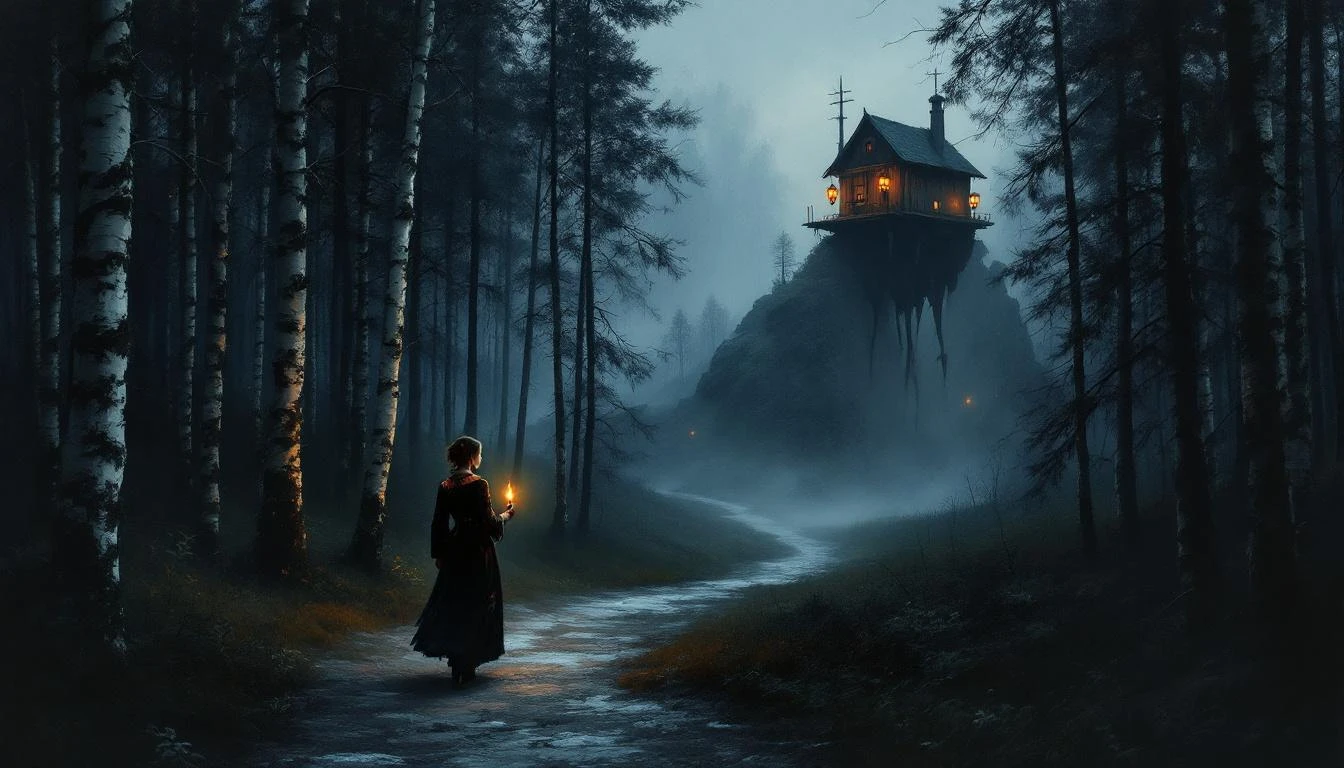
A man drives his daughter into the forest in a sled. It is the dead of winter. The snow is knee-deep between the birch trees. He leaves her at the base of a fir tree, alone, in the dark, and drives away without looking back.
He does this because his wife told him to. The girl is not the wife's daughter — she is his, from a previous marriage, and the stepmother wants her dead. Exposure is the chosen method. Let the cold do the work.
The girl sits under the tree and waits. The frost deepens. Her breath crystallizes. Her fingers stop hurting, which is not a good sign.
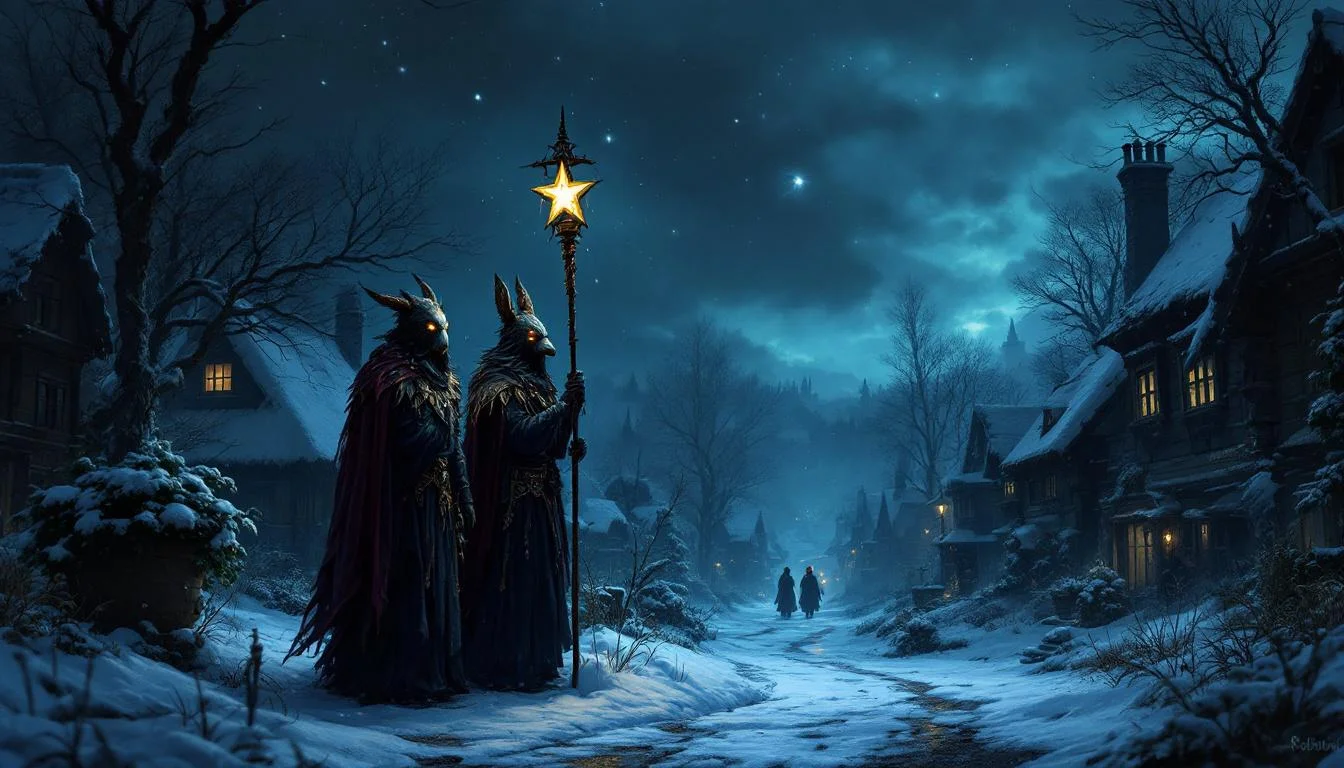
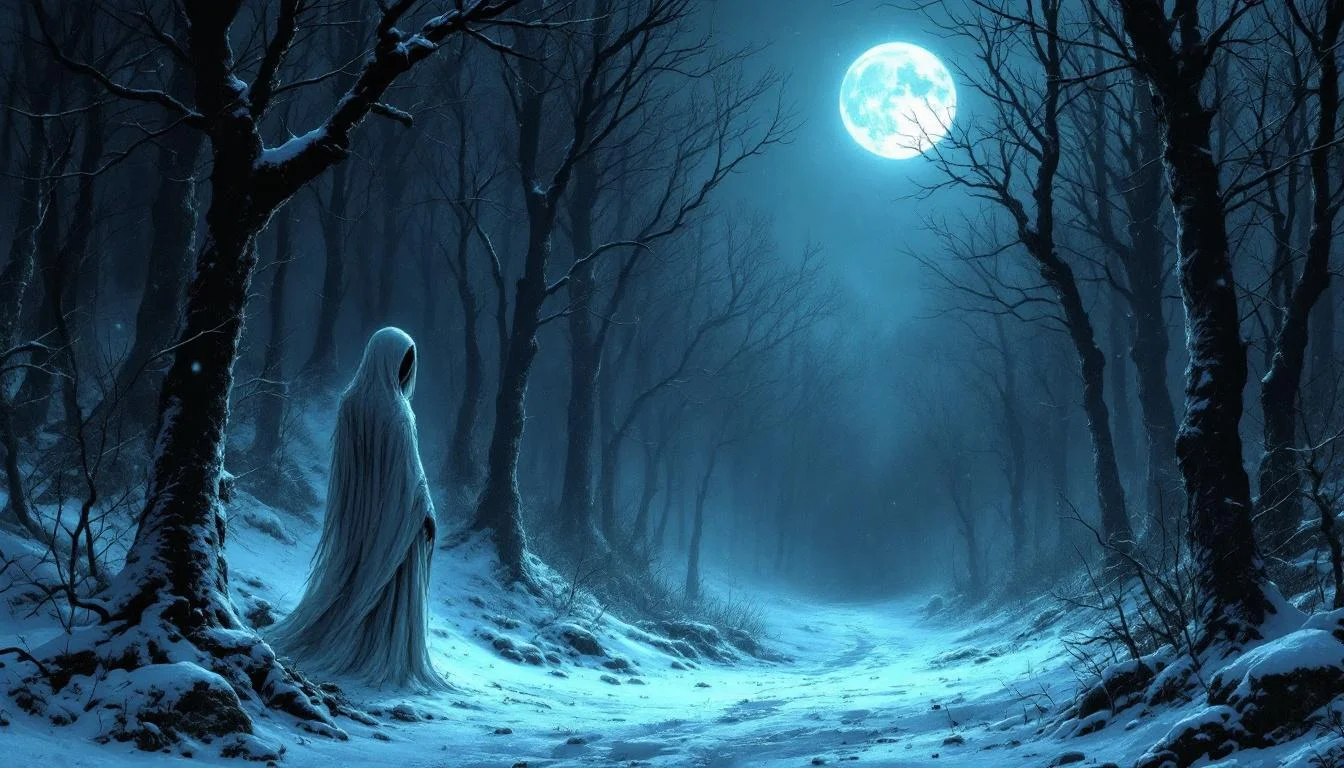
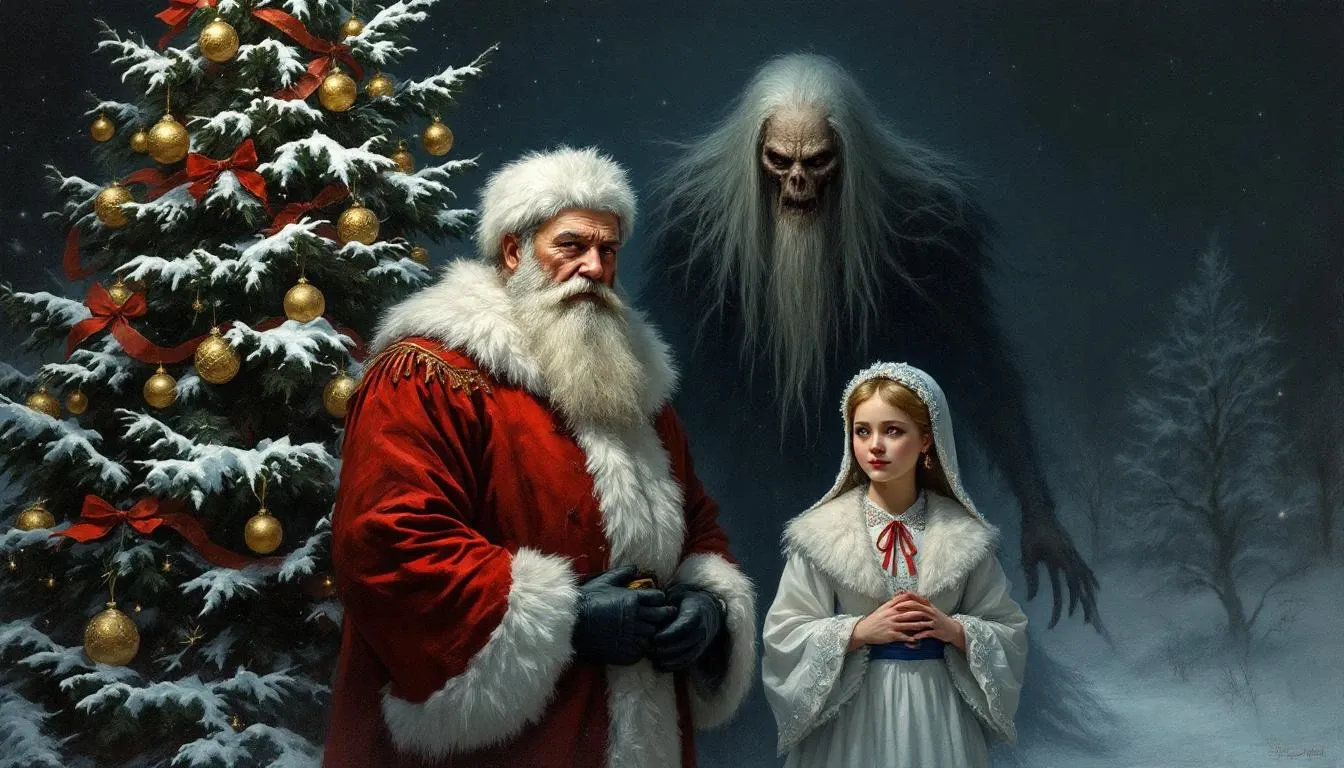
Then she hears it — a cracking in the branches overhead. Something is moving through the canopy, leaping from fir to fir, snapping twigs, making the trunks groan. It descends toward her. It is not human. It is not animal. It is the cold itself, given a body and a voice.
"Are you warm, maiden?" it asks. "Are you warm, pretty one?"
She is freezing to death. Her answer will determine whether she survives.
This is Morozko. And unlike every modern version of Father Frost that has come after him, he is not here to give presents. He is here to judge.
A Spirit Before He Was a Grandfather
The name is straightforward. Moroz is the Russian word for frost — bitter, killing frost, the kind that splits tree bark and turns rivers to stone. The diminutive suffix -ko does not soften this. It is the same construction used for other East Slavic spirits: Domovoy, Leshiy, Vodyanoy. The suffix marks him as a being — an intelligence that inhabits a natural force — not merely a weather event.
Before he appeared in any fairy tale, before any writer put him on a page, Morozko existed in the pre-Christian Slavic understanding of winter as a living entity. The East Slavs personified frost as a spirit who walked the land during the cold months, tapping on the walls of houses, chaining rivers with ice, cracking the earth open. He was also called Treskun (the one who makes things crack), Studenets (the cold one), and in Belarus, Zyuzya — a white-bearded old man who carried an iron mace and wandered barefoot through the snow.
The most ominous of his names was Karachun — a word that also meant sudden death, the winter solstice, and the shortest day of the year. When someone died unexpectedly in the cold, people said Karachun had taken them. The word survives in modern Russian as a colloquial term for a sudden, violent end: ему пришёл карачун — his Karachun has come.
This is the Morozko that existed before literature got hold of him — not a character in a story, but a force that needed managing. The peasant relationship with frost was transactional. You could not defeat it. You could not ignore it. You could offer it kissel and hope for the best.
The Fairy Tale: Afanasyev's Version
The story most people know was recorded by Alexander Afanasyev in Narodnye russkie skazki (Russian Folk Tales), published between 1855 and 1863. Afanasyev collected two versions — one from Novgorod province, one from Kursk — but the structure is identical. It is classified as Aarne-Thompson type 480: The Kind and the Unkind Girls.
The plot is simple and brutal.
A widower remarries. His new wife despises his daughter from the first marriage — the girl is too pretty, too obedient, too hardworking. Everything the stepdaughter does is wrong. Everything the woman's own daughter does is perfect, despite the biological daughter being lazy and mean-spirited.
The stepmother decides the stepdaughter must die. She orders her husband to take the girl into the forest and leave her in the snow. The man — and this detail is critical — obeys. He loads his daughter onto a sled, drives her to a clearing beneath a great fir tree, dumps her there, and rides home.
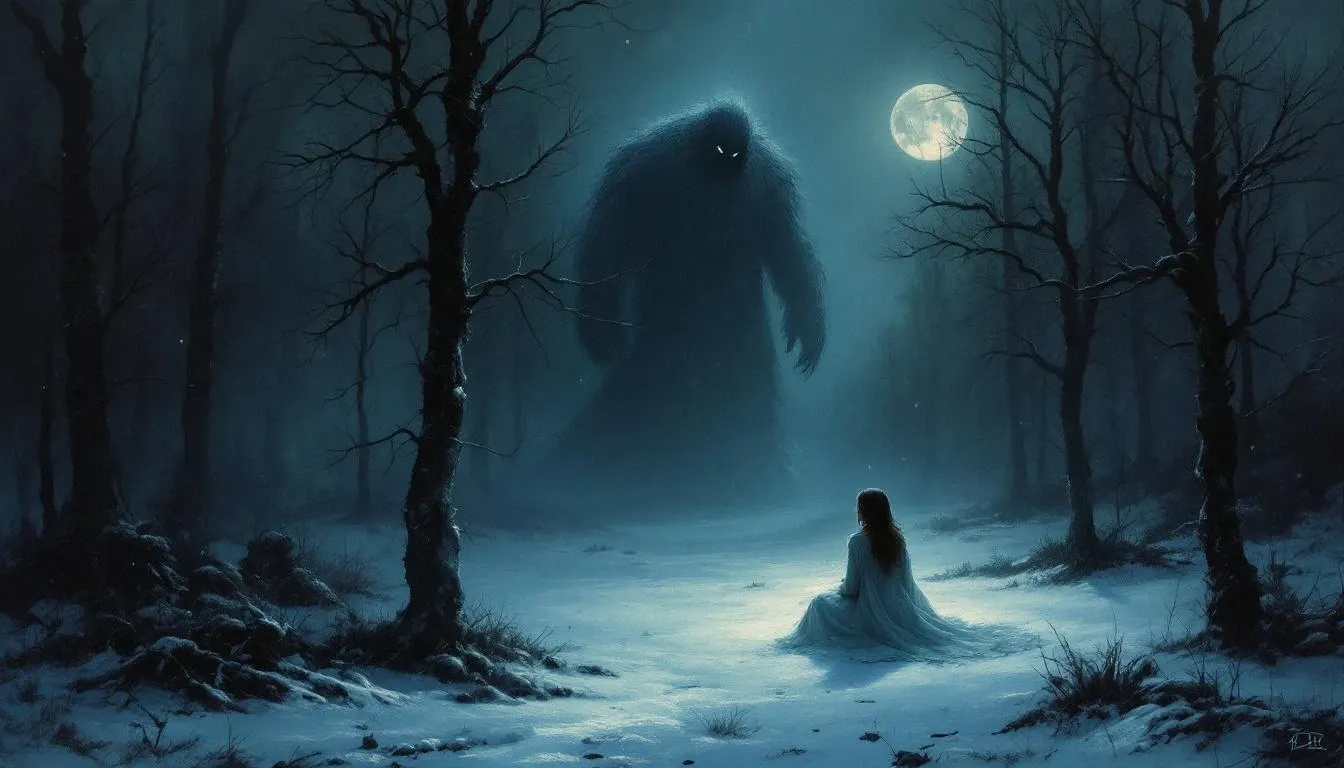
The girl sits in the snow. The temperature drops. Morozko arrives.
He comes through the treetops, cracking branches, filling the air with sharp cold. He descends to where the girl sits and asks his question — the question that has become the most famous line in Russian folklore:
"Are you warm, maiden? Are you warm, pretty one? Are you warm, my darling?"
She is not warm. She is dying. But she answers politely: "Warm, warm, dear Father Morozko."
He asks again, sending the cold deeper. She answers the same way. He asks a third time — and this time the frost is so severe she can barely speak — but still she replies with courtesy and endurance.
Morozko is satisfied. He wraps her in furs, covers her with warm blankets, and gives her a chest filled with gold and silver. When the old man returns to the forest the next morning — sent by his wife to collect the body — he finds his daughter alive, robed in furs, sitting on a treasure chest.
The stepmother sees the riches and immediately sends her own daughter to the same clearing. This girl is not polite. When Morozko descends and asks "Are you warm, maiden?", she snaps at him: "Of course I'm not warm, you old fool! Can't you see I'm freezing? Stop blowing on me!"
Morozko freezes her to death.
The old man drives out the next morning and brings back a corpse.
What the Test Actually Tests
The fairy tale is often reduced to a moral lesson about politeness: be nice to strangers, and good things happen. But this misses the deeper logic of the story, which has nothing to do with manners and everything to do with the Slavic understanding of how humans should relate to forces beyond their control.
Morozko's question is not a social nicety. It is a test of acceptance. The stepdaughter does not lie when she says she is warm — she performs an act of spiritual submission. She acknowledges that the cold is sovereign in its own domain. She does not curse it, fight it, or demand that it change. She endures, and in enduring, she demonstrates that she understands her place in the order of things.
The stepsister fails not because she is rude but because she is entitled. She treats the frost as an inconvenience — something that should accommodate her comfort. She demands warmth from the spirit of cold. This is not merely bad manners. In the pagan worldview that underlies the tale, it is a category error. You do not demand that winter stop being winter. You do not tell the forest to be warmer. You accept the terms of the world you have entered.
This pattern — a supernatural being testing whether a human can accept suffering without complaint — runs through Slavic folklore like a root system. Baba Yaga tests Vasilisa the same way: not with riddles but with impossible tasks performed under threat of death. The successful heroines of these stories do not outsmart the supernatural. They submit to it correctly.
The fairy tale, stripped of its surface, is a survival manual for living in a world governed by forces that do not care about you. The frost does not hate the girl. It has no feelings about her at all. It simply is. Her only choice is how she responds to a reality she cannot change.
Moroz Ivanovich: The Literary Softening
In 1840 — fifteen years before Afanasyev published his folk version — the writer Vladimir Odoevsky published Moroz Ivanovich in his collection Town in a Snuffbox. This version transformed the story in ways that would prove permanent.
Odoevsky's Moroz Ivanovich is no longer a wild spirit in the treetops. He is a kindly old man who lives in an ice palace accessible through a magical well. The two girls — Hardworking Girl and Lazy Girl — fall down the well and must perform household chores for him. The hardworking girl cooks, cleans, and shakes out his featherbed (releasing snow onto the world above). She receives a chest of silver. The lazy girl burns the porridge, tears the sheets, and complains constantly. She receives what appears to be silver but turns out to be icicles that melt in the sun.
Nobody dies. The stakes have been lowered from death to embarrassment.
This is the version that made Morozko safe for children's literature. And it is the version that opened the door for his eventual transformation into something unrecognizable.
From Morozko to Ded Moroz: The Great Forgetting
The distance between Morozko and Ded Moroz (Grandfather Frost) is the distance between a wild animal and a zoo exhibit. They share a species, but not a life.
Ded Moroz emerged in the late nineteenth century as Russian culture searched for a native equivalent to the Western European Christmas gift-bringer. The old frost spirit was the obvious candidate. He was already associated with winter, already had a white beard, already visited people during the Kolyada season. All that was needed was to strip away everything dangerous and replace it with presents.
By the 1880s, Ded Moroz appeared on Christmas cards as a bearded grandfather in a blue or red robe, carrying a sack of gifts and a magical staff. He acquired a granddaughter — Snegurochka, the Snow Maiden — as a companion. He was given a home address: Veliky Ustyug, a town in Vologda Oblast that now operates a year-round Ded Moroz tourist complex.
The Soviet government initially banned Ded Moroz in 1928 as part of its campaign against religious holidays. Christmas was abolished. The New Year's tree was forbidden. For seven years, the old frost spirit was officially dead.
Then, in 1935, Stalin reversed course. Not out of nostalgia — out of pragmatism. The regime needed a secular winter holiday that would replace Christmas without acknowledging it. Ded Moroz was resurrected, stripped of any remaining religious associations, and installed as the mascot of Soviet New Year celebrations. The Christianization that had already softened him was now completed by atheist ideology. He became a jolly old man who gave presents to good Soviet children.
The test was gone. The frost was gone. The death was gone. What remained was a man in a blue coat with a sack.
The 1964 Film: Morozko on Screen
In 1964, director Alexander Rou made a film that gave Morozko his most enduring visual form. Morozko — released internationally as Jack Frost — was produced by Gorky Film Studio and starred Alexander Khvylya as the frost spirit, Natalya Sedykh as the stepdaughter Nastenka, and Eduard Izotov as Ivan, a conceited young hunter whose subplot was added to the fairy tale.
The film won the Grand Prize at the Venice International Film Festival in 1965 and became a fixture of Soviet New Year television broadcasts. It is still shown on Russian channels every winter.
Rou's Morozko is neither the wild spirit of folk belief nor the department-store grandfather of Soviet New Year cards. He occupies an intermediate space — magical, imposing, genuinely powerful, but ultimately benevolent. His forest is enchanted. His cold is real. But his purpose is to reward virtue, not to kill. The film preserves the structure of the test — Nastenka's courtesy versus the stepsister's rudeness — but wraps it in a fairy-tale warmth that the original story pointedly lacks.
The film's most famous scene is the test itself: Morozko descends through the frozen forest, his breath crystallizing the air around him, and asks Nastenka if she is warm. The actress was actually freezing during filming — Rou insisted on shooting in genuine winter conditions — and her visible discomfort gives the scene an authenticity that studio work could not have achieved.
For most Russians alive today, this is Morozko. Not the Afanasyev text. Not the pagan spirit. The 1964 film — a Soviet fairy tale shot in real snow.
The Winternight Trilogy: Morozko Returns
In 2017, American author Katherine Arden published The Bear and the Nightingale, the first volume of the Winternight Trilogy. The novel — set in medieval Russia — returned Morozko to something closer to his mythological origins.
Arden's Morozko is called the "winter-king" and the "frost-demon." He is ancient, beautiful, dangerous, and ambiguously motivated. He takes an interest in the novel's heroine, Vasilisa Petrovna, a young woman who can see the household spirits — the domovoy, the bannik, the vazila — that her increasingly Christianized village is forgetting.
The trilogy's central conflict is between the old Slavic spirits and the advancing Christian order that is killing them through disbelief. Morozko stands at the center of this conflict as both a love interest and a genuine threat. He is not safe. He is not kind, exactly. He is a force of nature that has learned to wear a human face — but the face does not always fit.
Arden drew directly on Afanasyev's tales and on the folklore of the three worlds — Prav, Yav, and Nav — to build her version of the frost spirit. Her Morozko has a twin brother, Medved (the Bear), who represents chaos and destruction. The two of them are opposite faces of the same coin: winter that preserves versus winter that destroys.
The trilogy was a bestseller and introduced Morozko to an English-speaking audience that had never heard of him. For many Western readers, the Winternight books are their first encounter with Slavic mythology beyond a Wikipedia summary.
Morozko and Morana: The Winter Pair
It is impossible to discuss Morozko without mentioning Morana — the goddess of winter, death, and nightmares. If Morozko is winter's body — the physical cold, the cracking ice, the frozen breath — then Morana is winter's soul: the death that cold brings, the darkness that settles over the world, the slow starvation of late February.
Some scholars have proposed that Morozko was originally a servant or subordinate aspect of Morana, personifying her weapon (frost) rather than her domain (death). Others treat them as a married pair — the Lord and Lady of winter, ruling together over the dead months. The folk record does not clearly resolve this. What is clear is that they belong to the same mythological territory: the Slavic magical worldview in which natural forces were not metaphors for spiritual beings but were spiritual beings, experienced directly in the cracking of ice and the death of cattle.
The ritual destruction of Morana's effigy each spring — the drowning of Marzanna in Poland, the burning of the Maslenitsa figure in Russia — has no equivalent for Morozko. He was not ritually killed. He simply withdrew. The frost stopped, and he was gone — retreated to wherever frost spirits go when the rivers thaw.
This asymmetry is telling. Morana had to be destroyed because she represented death itself, and death required active intervention to overcome. Morozko represented cold — dangerous, yes, but temporary by nature. He left on his own. He did not need to be drowned. He just needed to be survived.
The Moral Architecture of Frost
What makes Morozko unusual among Slavic spirits is his moral clarity. Most supernatural beings in East Slavic folklore are morally ambiguous — the Leshiy may help or hinder, the Rusalka may drown you or let you pass, Baba Yaga may eat you or arm you for your quest. Their behavior depends on circumstance, mood, and the phase of the moon.
Morozko is different. His judgment is consistent and transparent. He tests, and the test has a right answer. Courtesy and endurance are rewarded. Entitlement and complaint are punished. There is no trickery, no hidden agenda, no sudden reversal. He is, in a pantheon of chaos, a figure of order.
This is perhaps why he survived the transition from paganism to literature to Soviet propaganda to modern pop culture more successfully than almost any other Slavic spirit. His moral simplicity made him adaptable. He could be a pagan frost-demon testing travelers, a literary grandfather rewarding industrious children, a Soviet New Year mascot distributing presents to the collective, or a dark romantic hero in a fantasy novel. The surface changed. The underlying structure — the test — remained.
The frost does not care who you are. It cares how you respond to it. This is the oldest lesson Morozko teaches, and it is the one that every version of the story, from Afanasyev's brutal folk tale to Arden's romantic trilogy, preserves intact.
He is still out there in the birch forest, cracking the branches overhead. He is still descending toward the clearing where someone sits in the snow. He is still asking his question.
Are you warm, maiden?
Your answer matters.