In the twelfth century, a German priest named Helmold sat down in the parish of Bosau, near the shores of Lake Plön in what is now Schleswig-Holstein, and wrote a chronicle of the Slavic peoples whose territories bordered his own. He was not sympathetic to them. He was a Christian missionary documenting pagans — their wars, their customs, their gods — with the clinical interest of a man recording what he believed would soon disappear. Among the deities he listed was a goddess whose name he rendered in Latin as Siwa. She was, he wrote, the goddess of the Polabians — one of the three principal divinities of the Obodrite confederation, standing alongside Prove, god of the Wagrians, and Radigast, god of the Obodrites proper.
That single mention, buried in a chapter of the Chronica Slavorum, is nearly everything we have. Siwa — Živa, Zhiva, Żywia, depending on which Slavic language carries her forward — left no temples that archaeologists have confirmed, no statues that survived the conversion campaigns, no mythology preserved in the detail we have for Perun or Veles. She is a goddess known primarily from one paragraph written by a man who wanted her worship to end. And yet her name — built from the most fundamental word in any Slavic language, the word for life itself — proved harder to kill than any idol.
The Name That Contains Everything
The etymology of Zhiva is not a matter of scholarly debate. It is transparent, almost embarrassingly so. Her name derives from the Proto-Slavic adjective *živa, the feminine form of *živъ, meaning "alive" or "living." The root is among the oldest and most productive in the Slavic lexical family. From it descend the Russian zhizn (life), zhivot (belly, but originally "life" — as in the Church Slavonic phrase "lay down one's zhivot" meaning to sacrifice one's life), zhivotnoye (animal, literally "a living thing"), and zhivitsa (tree resin, the "living sap" that flows from wounded pines). Polish gives us życie (life), Czech život (life), Serbian živeti (to live). Every Slavic language carries her name inside its most essential vocabulary, embedded so deeply that no amount of Christianization could dig it out.
The question scholars have asked is whether "Zhiva" was ever a proper name at all, or whether it was an epithet — a title meaning "the Living One" — applied to a goddess whose original name has been lost. Vyacheslav Ivanov and Vladimir Toporov, two of the most rigorous figures in comparative Slavic mythology, proposed that Zhiva was an epithet of Mokosh, the great mother goddess whose worship demonstrably survived into the modern era. Their logic was structural: if Mokosh was the principal female deity of the Eastern Slavs, and if the Polabians — isolated in the far west, surrounded by Germanic peoples, cut off from the main body of Slavdom — preserved the same deity under a different name, then "Zhiva" might not be a separate goddess but Mokosh wearing a regional mask. The "Living One" would then be a description of the life-giving function that Mokosh performed everywhere else.
This is plausible. It is also unprovable, and other scholars have rejected it, arguing that the Polabian Slavs maintained a distinct enough religious culture that their goddess need not be reduced to an Eastern Slavic equivalent. What is certain is that the name functioned as both a divine title and a linguistic fossil — a reminder that for the Slavs, the concept of divinity and the concept of being alive were, at some deep grammatical level, the same thing.
Nam preter lucos et penates, quibus agri et opida redundabant, primi et precipui erant Prove deus Aldenburgensis terrae, Siwa dea Pelaborum, Radigast deus terrae Obotritorum.
Helmold's Witness and the Problem of a Single Source
The passage quoted above is the foundation — and, in many respects, the entirety — of what we know about Zhiva from a primary historical source. Helmold wrote his Chronica Slavorum between approximately 1167 and 1172, continuing the work of Adam of Bremen. He was describing the religious landscape of the Obodrite confederation during the reign of Prince Niklot, the last major pagan ruler of the Polabian Slavs, who died fighting the Saxons in 1160. By the time Helmold was writing, the temples were already falling. The sacred groves were being felled. The conversion — often accomplished at sword-point — was well underway.
The manuscript tradition complicates matters further. Helmold's chronicle survives in several copies, and the goddess's name is not consistent across them. The Copenhagen manuscript reads Siwa. The Lubeck copy has Siwe. The Vienna transcript — widely regarded as the most corrupted — renders it Silue. The Szczecin version offers Synna. Scholars have settled on Siwa as the most likely original reading, mapping it to Slavic Živa through standard phonological correspondence. But the textual instability is a warning: we are dealing with a name that was already becoming garbled within a century of being written down.
What Helmold tells us, beyond the name, is minimal but significant. He identifies Zhiva as one of three "first and foremost" (primi et precipui) deities, alongside Prove and Radigast. This is not a minor position. He is not listing a local spirit or a household guardian. He is naming the chief goddess of an entire tribal group — the Polabians — within a confederation that controlled a significant stretch of the southern Baltic coast. One manuscript variant calls her the "Goddess of Ratzeburg" (Raceburgensium Dea), tying her worship to a specific fortified settlement, though whether Ratzeburg was her cult center or merely the political capital of the Polabians who worshipped her remains unclear.
Helmold also describes, in the same chapter, the general character of Polabian worship: sacred groves dense with ancient oaks, priestly castes who determined the timing of ceremonies through augury, annual offerings of cattle and sheep, and feasts in which a sacrificial skull was passed from hand to hand while participants invoked both benevolent and malevolent gods. He does not specify which of these practices belonged to Zhiva's cult specifically, but the context is important. She was worshipped within a living, functioning temple culture — not as a folk memory or a poetic abstraction, but as a deity who received blood offerings and priestly service.

The Polish Thread: Długosz and Żywia
Three centuries after Helmold, another chronicler picked up the name — or something very close to it. Jan Długosz, the fifteenth-century Polish historian whose Annales seu Cronicae Incliti Regni Poloniae (1455) attempted to systematize the pre-Christian religion of the Poles, listed a deity he called Żywie among the gods worshipped by the ancient Poles. His method was interpretatio romana — the medieval practice of mapping foreign gods onto the Roman pantheon to make them comprehensible to a Latin-educated audience. Długosz associated Żywie with life, vitality, and the regenerative force of nature, presenting her as a goddess concerned with the annual rebirth of the green world.
The connection to Helmold's Siwa seems obvious, and many scholars have treated Żywia and Zhiva as the same deity recorded independently by a German priest in the north and a Polish chronicler in the south. If correct, this would significantly expand Zhiva's geographic range, placing her worship not only among the Polabian Slavs but among the Poles — and suggesting that she was not a local tribal goddess but a figure with pan-West-Slavic distribution. The Lada problem haunts this identification, however. Długosz was working centuries after the conversion, relying on fragmentary traditions, folk customs, and his own educated guesswork. His pantheon has been shown to contain errors and inventions. That he lists Żywie does not prove she was worshipped in the form he describes — it proves only that the name, or something like it, was still circulating in Polish cultural memory four hundred years after Christianization.
Zhiva and Morana: The Axis of the Year
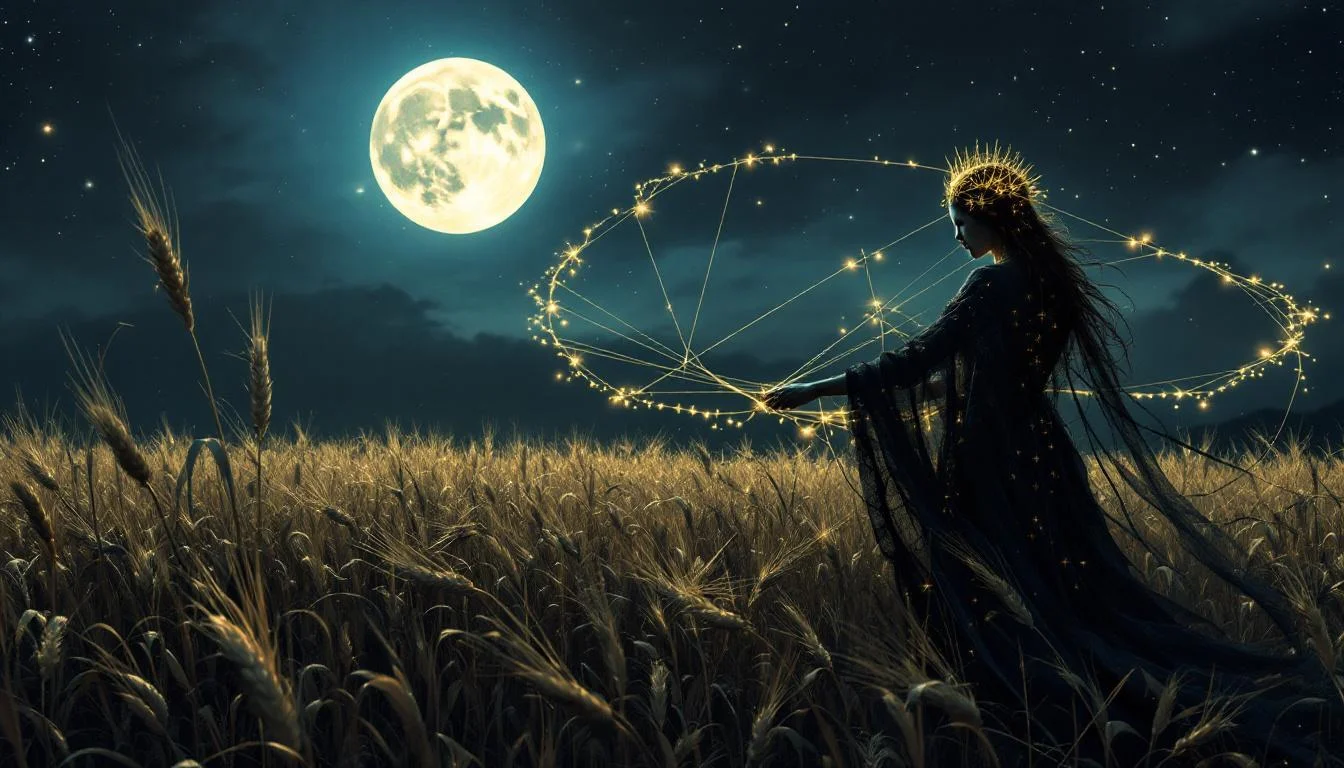
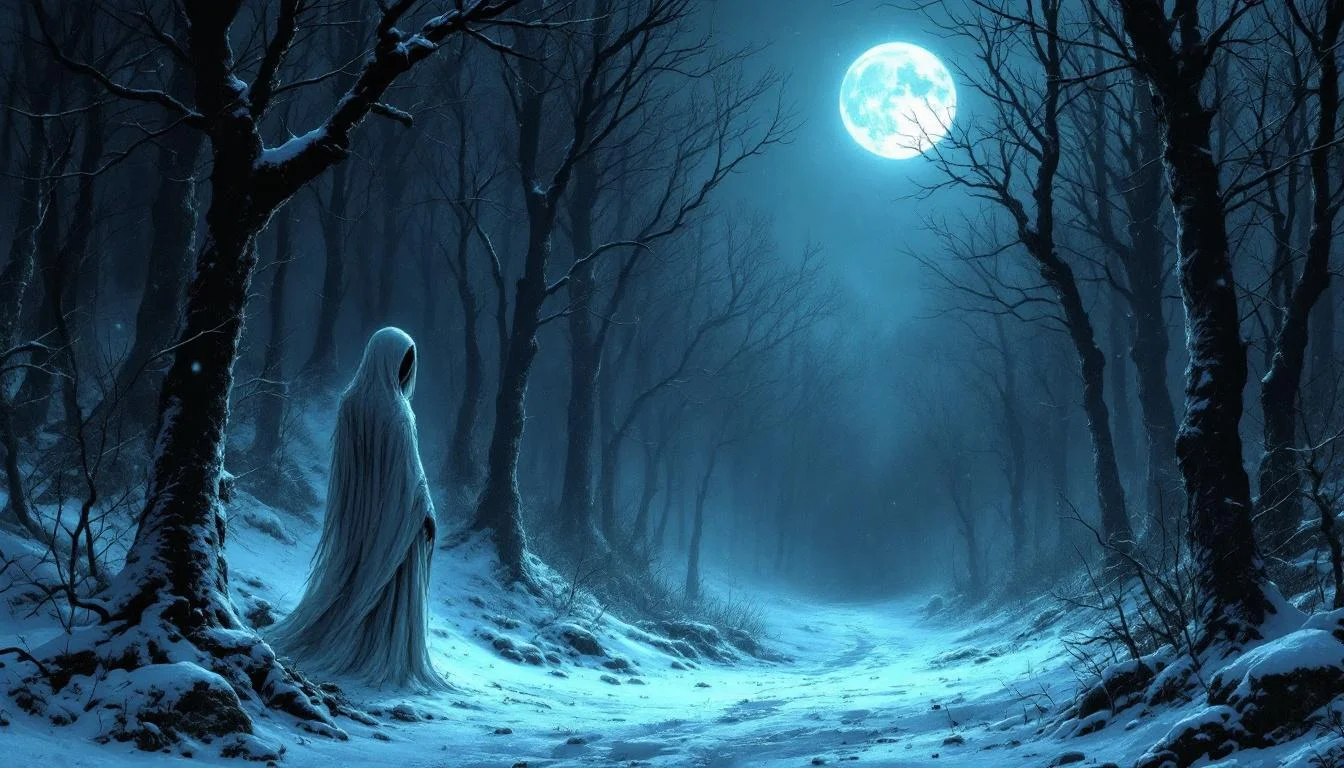
If there is a single mythological relationship that defines Zhiva's place in the Slavic cosmos, it is her opposition to Morana — the goddess of winter, death, and the long dark. The two form a structural pair so fundamental that understanding one without the other is like trying to grasp the meaning of daylight without acknowledging night. Morana governs the dying half of the year: the withering of crops, the freezing of rivers, the retreat of all living things into dormancy or death. Zhiva governs the return. She is the force that pushes green shoots through frozen soil, that fills rivers with snowmelt, that brings the migratory birds back to nesting grounds abandoned since autumn.
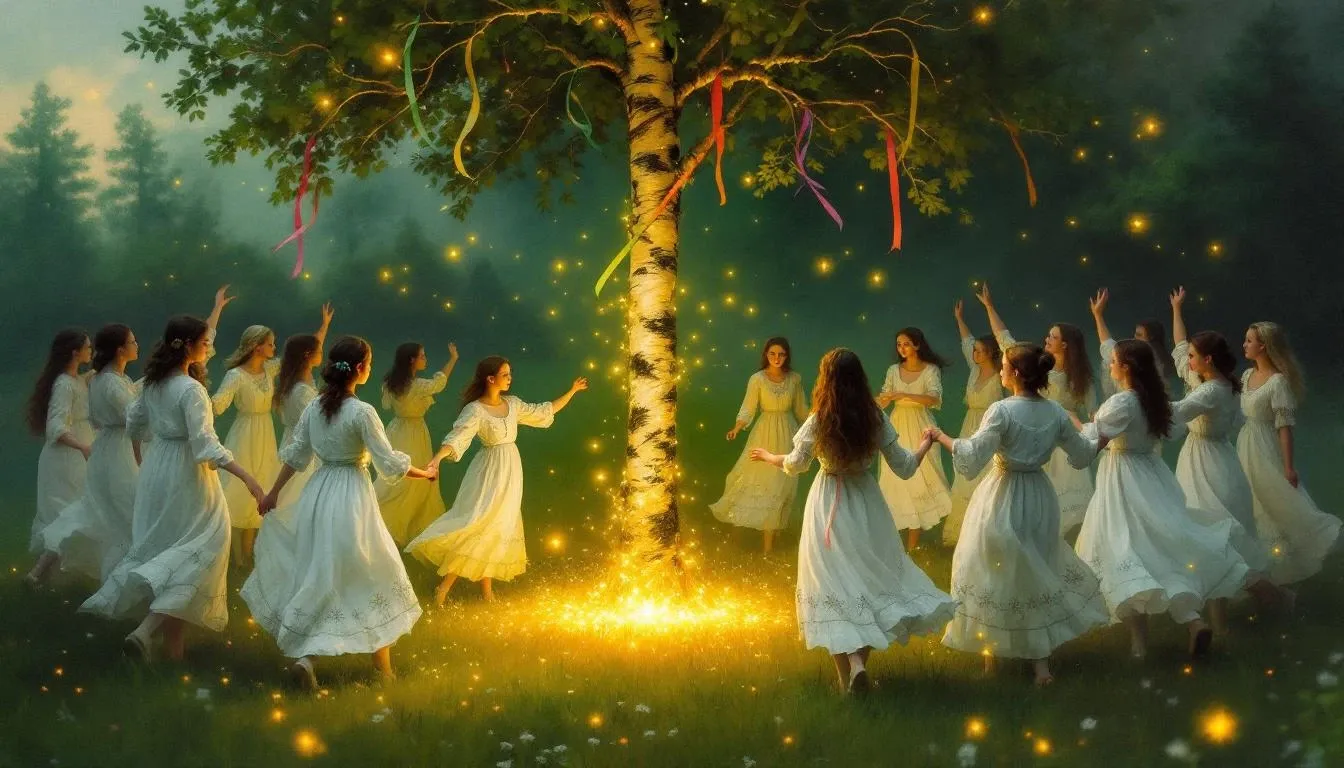
The ritual evidence for this opposition is powerful, even if it does not always name Zhiva explicitly. Across Poland, Czech lands, Slovakia, and parts of Germany and the Balkans, the spring equinox was marked by the ceremonial destruction of Morana's effigy — the straw figure dressed in rags and ribbons, carried through the village to absorb the winter's accumulated death, then burned and drowned in the nearest river. This ritual, documented since at least the fifteenth century and still practiced today, is one half of a transaction. Morana goes out. But something must come back. In Polish tradition, the returning symbol was the gaik — a green branch decorated with ribbons and spring flowers, carried into the village after Marzanna had been thrown into the water. The gaik represented the return of life. It represented, in structural terms, what Zhiva embodied in theological ones.
Whether the Polabians themselves framed the seasonal cycle as a contest between Zhiva and Morana is something we cannot confirm from Helmold's text. He does not describe such a myth. But the logic is hard to escape. A goddess whose name means "the Living One," worshipped by a people whose entire agricultural survival depended on the reliable return of spring — she would have needed an antagonist. The Slavic mind organized the cosmos in oppositions: Belobog and Chernobog, the white god and the black god, the upper world and the lower. Zhiva and Morana fit this pattern with an elegance that feels less like scholarly reconstruction and more like inevitability.
Symbols, Birds, and Living Water
The folk memory that accumulated around Zhiva — drawn from later sources, comparative mythology, and the practices of Slavic neopaganism — paints a goddess rich in symbolic associations, even if the historical provenance of each detail is difficult to pin down. The most persistent symbol is the cuckoo bird, whose connection to Zhiva appears in folk traditions across the Slavic world. The cuckoo was a liminal creature: it arrived in spring and vanished in autumn, tracking the exact boundary between Zhiva's season and Morana's. Its habit of laying eggs in other birds' nests gave it a reputation for uncanniness — it was a creature that did not follow the normal rules of motherhood, and this transgressive quality made it an appropriate vessel for a goddess who crossed the boundary between the living world and the otherworld called Iria.
The concept of living water (zhivaya voda) — water that heals wounds, restores youth, and resurrects the dead — is another thread that leads back to Zhiva, or at least to the root she shares with it. In Russian fairy tales, living water is the counterpart to dead water (myortvaya voda): the hero must apply dead water first to close the wounds of a fallen comrade, then living water to restore breath and consciousness. The pair echoes the Zhiva-Morana duality — death must come first, in proper sequence, before life can do its work. Whether the folk concept of living water was ever explicitly linked to the worship of Zhiva as a deity is unknown. What is clear is that the Slavic imagination built an entire cosmology around the root živ-, and that cosmology extends far beyond any single goddess.
Later iconographic traditions — some drawn from nineteenth-century Romantic reconstructions, others from modern Slavic neopagan practice — depict Zhiva as a young woman with flowing hair, dressed in green, holding sheaves of grain or bundles of wildflowers. She is sometimes shown with fruits and grapes, sometimes wreathed in a rainbow, sometimes riding a chariot drawn by doves and swans. Her sacred color is green — the color of new growth, of the forest canopy in June, of the world as it looks when death has been pushed back for another year. Her sacred stone is the emerald. These details come from traditions that postdate the historical worship of Zhiva by many centuries, and treating them as authentic Polabian theology would be a mistake. But they reflect a genuine continuity of association — the persistent Slavic intuition that life, greenness, fertility, and feminine divine power belong together.
Why Zhiva Matters
The question that Zhiva's fragmentary record forces us to confront is not whether she was real — Helmold's testimony, however brief, establishes that she was worshipped — but how much of any Slavic goddess we can recover from the wreckage of conversion. The Polabian Slavs were among the last Slavic peoples to be Christianized, and their conversion was among the most violent. The Wendish Crusade of 1147, the campaigns of Henry the Lion, the systematic destruction of sacred sites at Arkona, Rethra, and Ratzeburg — these did not merely replace one religion with another. They erased the infrastructure of memory. Temples were burned. Priests were killed or scattered. Oral traditions were interrupted at the point of a sword.
What survived did so in fragments: a name in a hostile chronicle, a folk custom whose participants no longer remembered its origin, a word embedded so deeply in the language that it could not be cut out without destroying the language itself. Zhiva survived in all three forms. She is the name Helmold recorded. She is the life-force that the gaik represented when it was carried back into the village after Morana's drowning. And she is the root inside zhizn, život, życie — the word that every Slavic speaker uses, every day, to mean the thing that Zhiva was goddess of.
This is not a small legacy. Mokosh survived by disguising herself as Saint Paraskeva. Perun survived by merging with the prophet Elijah. Zhiva's survival was more radical and more invisible. She did not hide inside a saint or a folk hero. She hid inside the language. Every time a Slavic speaker says the word for "life," they are — without knowing it, without intending it — speaking the name of a goddess who was worshipped on the Baltic coast a thousand years ago, in groves of ancient oaks, by people who believed that the world's continued existence depended on her annual return.
The oaks are gone. The groves are farmland. The Polabians themselves were absorbed into the German population centuries ago, their language extinct, their tribal identity dissolved. But the syllable persists. Živ-. Alive. Living. The irreducible fact that resists every attempt at erasure — theological, political, linguistic. The goddess whose name means life did what her name promised. She lived.