There is a rule in the villages of old Russia, Belarus, and Ukraine that every child learns before they learn to count: do not say the name. Not the name of the chort, who is dangerous enough, but the name of something smaller, quicker, and far less predictable. The name belongs to a creature the size of a child's forearm, bald as a peeled egg, horned like a goat, and missing its heels — because a wolf bit them off in the first age of the world, or because the creature was never fully formed to begin with, or because nothing truly evil can stand on solid ground. The creature is the anchutka, and the reason you do not say the name is simple: it comes when called. Not eventually. Not after some ritual or invocation. Immediately. The old sources are explicit on this point. Speak the word aloud and the thing appears beside you, grinning with a face that is part pig, part child, part something that should not exist at all. Peasant wisdom across the East Slavic world was unanimous — better keep quiet about them entirely.
This is the paradox at the heart of anchutka lore. The creature is one of the oldest named demons in Slavic mythology, with roots that stretch back before Christianity arrived in the lands of the Rus. Yet the very act of discussing it was considered an invitation to disaster. The result is a being that exists in fragments — half-remembered warnings, cryptic folk sayings, scattered references in ethnographic collections from the nineteenth century. To reconstruct the full picture is to piece together a portrait that the people who knew it best deliberately tried to erase from conversation.
The Shape of the Heelless One
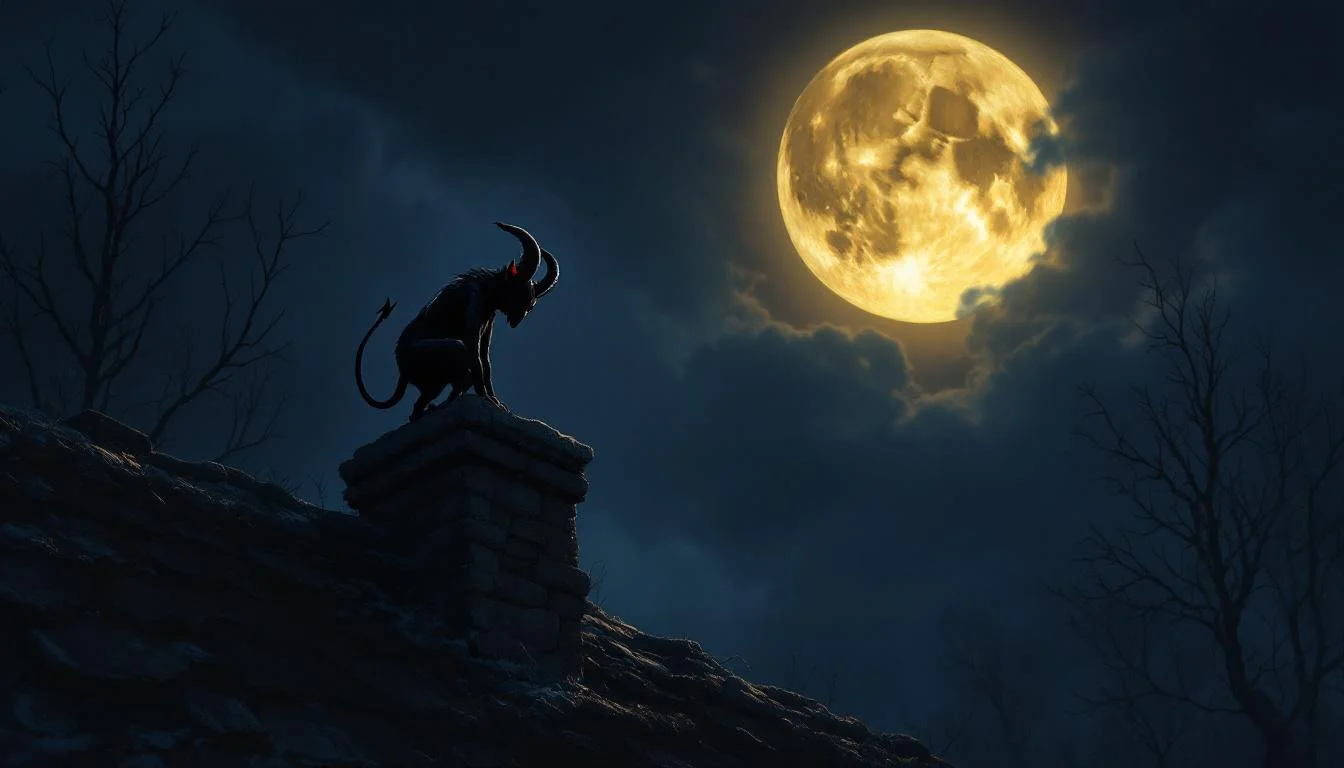
The physical appearance of the anchutka is distinctive enough to separate it from the broader category of Slavic demons, though it shares bloodlines with many of them. East Slavic sources describe a small imp — rarely taller than a forearm's length — with a bald head shaved like a Tatar boy, a pair of small horns, and a snout that resembles a pig's. The body is sometimes hairy, sometimes naked and smooth as river clay. But the defining feature, the one that gave the creature its most common folk epithet, is the feet. The imp is bespyatyi — without heels. Some accounts describe duck-like feet, flat and webbed, splayed at wrong angles. Others describe hedgehog legs, stubby and bristled. The folk explanation for this deformity is vivid and precise: a wolf chased the creature through the primordial forest, caught it by the ankle, and bit the heel clean off. The wound never healed because creatures born of unclean power do not regenerate in the way that living things do. They persist in their brokenness, and the brokenness defines them.
This physical incompleteness connects the heelless imp to the broader Slavic understanding of what demons are. They are not fallen angels in the Christian sense, not creatures who chose evil. They are unfinished things — beings that God began to create and abandoned, or that slipped through the cracks between the sacred and the profane. The missing heel is a mark of that incompleteness, a visible sign that the creature belongs to the world of nav — the realm of the dead, the unclean, the not-quite-real. The creature's ability to fly despite having no wings reinforces this interpretation. It does not obey the rules of the physical world because it was never fully admitted into it.
Three Breeds of Trouble
Not all anchutkas are the same, and the differences matter enormously if you are unlucky enough to encounter one. East Slavic folklore recognizes three distinct subtypes, each bound to a specific habitat and each with its own temperament, ranging from merely unsettling to genuinely lethal.
Field anchutkas are the least dangerous, though calling anything associated with demonic forces safe would be a serious miscalculation. These are tiny creatures — sometimes described as miniature men and women no bigger than a hand — who inhabit agricultural crops. The specificity of the folk taxonomy is remarkable. There are potato-dwelling spirits called kartofelniki, flax-dwellers called lenniki, hemp spirits known as konopelniki, oat imps called ovsyaniki, and rye-dwellers named rozhniki. Each lives inside the stalks and roots of its particular crop, and during harvest season the creatures retreat into the last uncut sheaves, growing more concentrated and more agitated as their habitat shrinks. Peasants knew to leave the final stalks standing in the field — not out of laziness or superstition in the pejorative sense, but as a calculated bargain. You gave the spirit somewhere to live through the winter, and in return it did not follow you home.
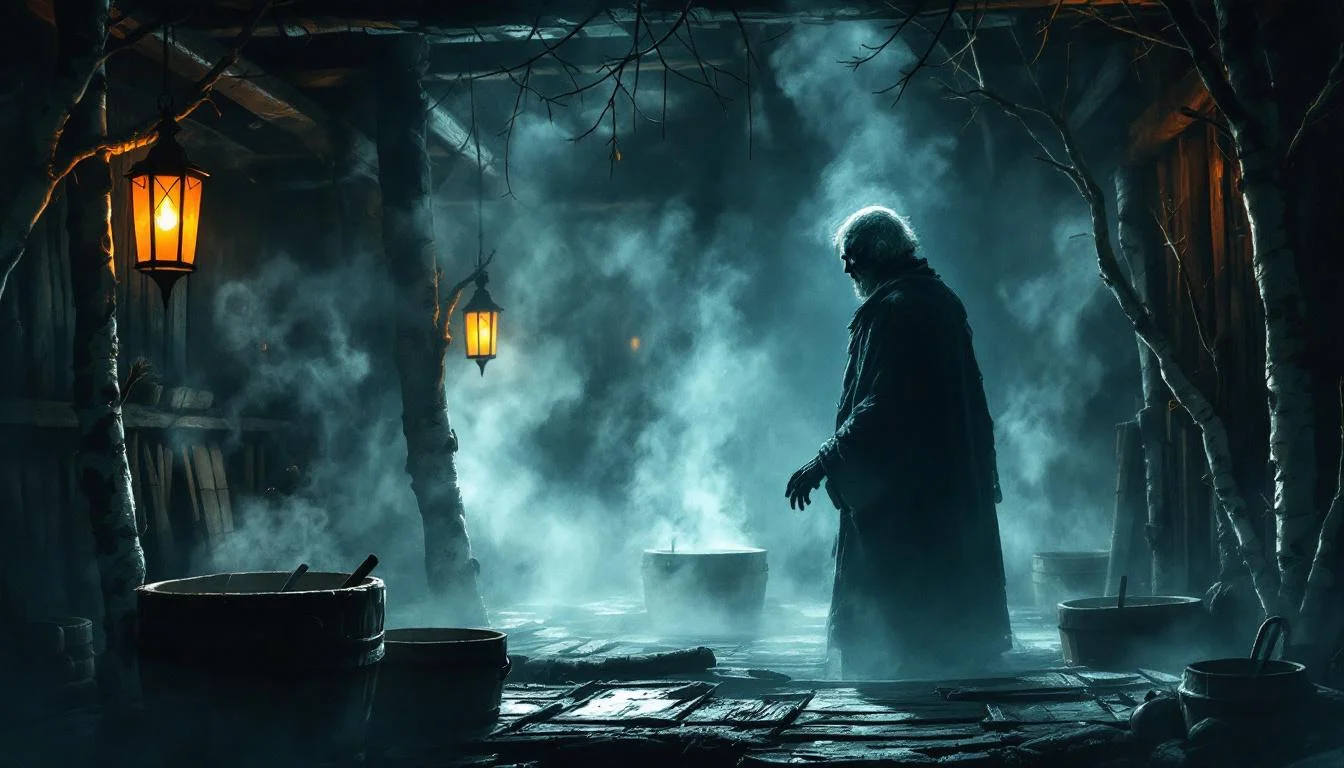
Bathhouse anchutkas are considerably worse. These creatures are the offspring of the bannik — the terrifying spirit who rules the bathhouse — and they inherit their parent's volatile temperament along with a talent for driving humans insane. They hide in the steam, behind the stove, under the benches, and they wait for their moment. Their preferred targets are young women bathing alone, and their preferred method of attack is psychological. The victim hears groaning from the walls. Shadows move where no shadow should fall. Then the madness comes — a sudden, overwhelming compulsion to run shrieking from the bathhouse, naked and raving, singing obscene songs, tearing at their own hair. Villages that experienced repeated incidents of this kind knew the diagnosis: the bathhouse harbored these heelless demons. The prescribed remedy was extreme. You demolished the entire structure, timber by timber, and rebuilt it from fresh wood on a new foundation. There was no exorcism, no prayer, no priest who could drive them out. The wood itself was contaminated, and the only cure was fire and replacement.
Bathhouse anchutkas cloud the minds of those who bathe. They harass women with groans and apparitions until the victims flee naked and screaming. If a household experiences annual deaths, the bathhouse must be torn down and rebuilt — the spirits have nested in the wood itself.
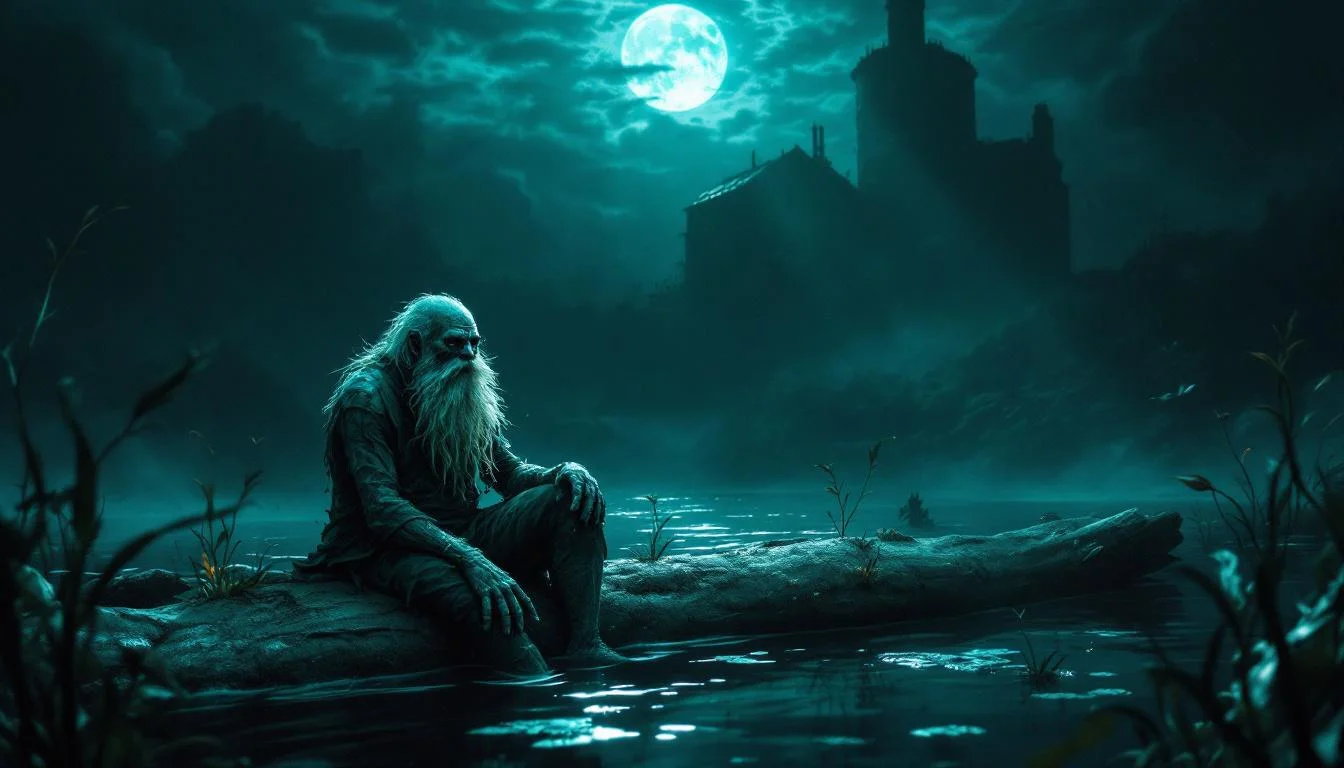
Water and swamp anchutkas are the most dangerous of all. These serve as attendants and foot soldiers to the vodyanoy — the drowned god of Slavic rivers and lakes — and to his swamp-dwelling cousin the bolotnik. They are described in folk sources as extraordinarily fierce and repulsive, and their primary method of killing is elegant in its simplicity. A swimmer enters the water. The imp, invisible beneath the surface, grabs the swimmer's leg and induces a violent cramp. The leg locks. The swimmer panics, swallows water, goes under. The vodyanoy adds another soul to his collection at the bottom of the river. Every unexplained drowning in a river or swamp — and in the vast waterways of historical Russia, there were many — could be attributed to the work of these small, vicious servants.
A Name That Predates Christ
The etymology of the word anchutka is a scholarly battleground, and the competing theories reveal something important about how pre-Christian and Christian belief systems collided and merged in the East Slavic world. There are three major hypotheses, and none of them has achieved consensus.
The first and most widely cited theory connects the name to the word Antichrist. In the phonetic chaos of Russian folk speech, Antichrist becomes anchikhrist, which erodes into the diminutive forms anchipka, anchutka, and antipka — all of which function as euphemisms for the devil. This transformation was not accidental. Among the Old Believers — the Russian Orthodox dissenters who rejected the church reforms of the seventeenth century and believed they were living under the rule of the actual Antichrist — the word became taboo. You did not say Antichrist aloud for the same reason you did not say the imp's name: the word itself had summoning power. So the faithful developed cover-words, phonetic masks that disguised the dangerous name behind a veil of diminutive suffixes and consonant shifts. Under this reading, the creature is literally a pocket-sized Antichrist — the eschatological terror of the End Times shrunk down to the size of a bathhouse gremlin.
The second theory looks not to Greek theology but to Baltic linguistics. The Lithuanian word anciute is a diminutive of antis, meaning duck. The creature's webbed, duck-like feet suddenly make etymological sense: the being is, at its linguistic root, a little duck-demon, a thing of the marshes and the shallows, born where water meets land and neither element fully claims the territory. The related Lithuanian compound anciabalis — literally duck-swamp — maps precisely onto the preferred habitat. This Baltic connection is ancient, predating Christianity entirely, and it suggests that the anchutka was not originally a demon at all but a nature spirit of the wetlands, something amphibious and liminal, belonging to the same conceptual family as the vodyanoy and the rusalka.
The third theory, advanced by the philologist Boris Uspensky, derives the name from the personal name Onisifor — Greek Onesiphoros — which in Russian folk pronunciation became Antsifer and then the familiar diminutive. This theory has fewer adherents, but it points to a broader pattern in Slavic demonology: the tendency to use personal names as euphemisms for supernatural beings, as if giving a demon a human name somehow domesticated it, made it manageable, reduced it from a cosmic threat to a neighborhood nuisance you could address by name and negotiate with.
Iron, Milk, and the Art of Survival
The folk remedies against attacks by these heelless spirits are practical, specific, and entirely consistent with the broader logic of East Slavic protective magic. The underlying principle is simple: unclean spirits fear iron. This belief is pan-Slavic, pan-European, and possibly pan-human — the association of forged metal with protection against supernatural evil appears in cultures from Ireland to Japan. For the anchutka, the application was direct. Swimmers entering rivers or lakes were advised to carry a small pin — not a knife, not a sword, but a humble sewing pin, tucked somewhere against the skin. The iron disrupted the imp's ability to grip the leg and induce the killing cramp. A pin cost nothing. A pin weighed nothing. A pin could save your life, and the grandmothers who pressed them into the hands of children heading to the river on summer afternoons were practicing a form of preventive medicine that had been refined over centuries of hard experience.
For those already afflicted — pulled from the water twitching and convulsing, or stumbling from the bathhouse wild-eyed and raving — the treatment was warm milk mixed with honey, administered daily for one week. This remedy sits at the intersection of folk medicine and folk magic, where the line between treating the body and treating the soul does not exist. Milk and honey are substances of purity, of nurturing, of the domestic world that stands in opposition to the wild and unclean spaces where these imps thrive. The treatment was not about curing muscle cramps or calming hysteria in any modern clinical sense. It was about restoring the victim's connection to the human world, pulling them back from the boundary between the three worlds that the spirit had dragged them across.
For households plagued by bathhouse-dwelling specimens, the remedies escalated dramatically. If a family experienced unexplained deaths year after year, and if the deaths could be traced to encounters in or near the bathhouse, the prescription was demolition. The bathhouse was torn down completely — not renovated, not blessed, not cleansed with holy water, but physically destroyed. New timber was cut, a new foundation was laid, and the structure was rebuilt from nothing. The old wood was considered irredeemably tainted, soaked through with the presence of the heelless demons who had nested in it. You could no more purify that wood than you could wash the blackness out of swamp mud.
The Anchutka in the Slavic Demon Hierarchy
Understanding this creature requires understanding where it sits in the vast and sprawling taxonomy of Slavic supernatural beings. It is not a major demon. It is not a god diminished by Christianity, like Veles or Chernobog. It is not even a chort — the generic Slavic devil who occupies the center of folk demonology across all Slavic cultures. The anchutka is something smaller, more specific, and in many ways more revealing of how ordinary people actually experienced the supernatural in their daily lives.
The creature belongs to the class of beings that Russian folklorists call nechistaya sila — unclean force. These are not the grand adversaries of cosmic mythology but the petty tormentors of everyday existence: the thing that sours the milk, the presence that makes the bathhouse feel wrong on the third heating, the invisible hand that grabs your calf muscle in the river and will not let go. The imp's role is to inhabit the margins — the spaces between the cultivated field and the wild forest, between the heated bathhouse and the freezing night outside, between the river's surface and its black, unknowable bottom. It lives in thresholds and transitions, in the places where the human world grows thin and the other world bleeds through.
Its relationship to other spirits is familial and functional. The bathhouse variety is the child of the bannik, inheriting dominion over steam and scalding water. The water variant serves the vodyanoy as a kind of junior operative, doing the dirty work of drowning while its master watches from the riverbed. The field type coexists with the leshy — the forest lord — occupying the cultivated ground that the leshy disdains. And the anchutka marries the kikimora, the malevolent female house spirit, creating a demonic household that mirrors and mocks the human one. This web of relationships reveals a coherent supernatural ecology, a system in which every spirit has a role, a territory, a set of rules, and a place in the hierarchy.
Why the Anchutka Matters
The anchutka survives in fragmentary form because the people who feared it most refused to speak its name. That silence is itself a kind of testimony — an acknowledgment that some things are too dangerous to describe fully, too close to the bone to be safely committed to narrative. The great demons of Slavic mythology — the chort, the vodyanoy, Baba Yaga — have been thoroughly documented because they were dramatic enough to overcome the taboo against naming them. The heelless imp was not dramatic. It was small, common, and intimate, and those qualities made it more frightening, not less.
What this creature tells us about Slavic folk religion is that the supernatural was not experienced primarily as a system of grand cosmic conflicts between good and evil. It was experienced in the bathhouse at midnight, in the river on a hot afternoon, in the last row of wheat before the harvest. The demons that mattered most were not the ones in the theology books but the ones that grabbed your leg underwater, drove your daughter mad in the steam room, or killed your livestock one animal at a time until you finally tore down the bathhouse and rebuilt it from scratch. The anchutka is the demon of ordinary life — the small, heelless, duck-footed imp that lives in the cracks of the everyday world and reminds you that no corner of existence is entirely safe, entirely human, entirely your own.