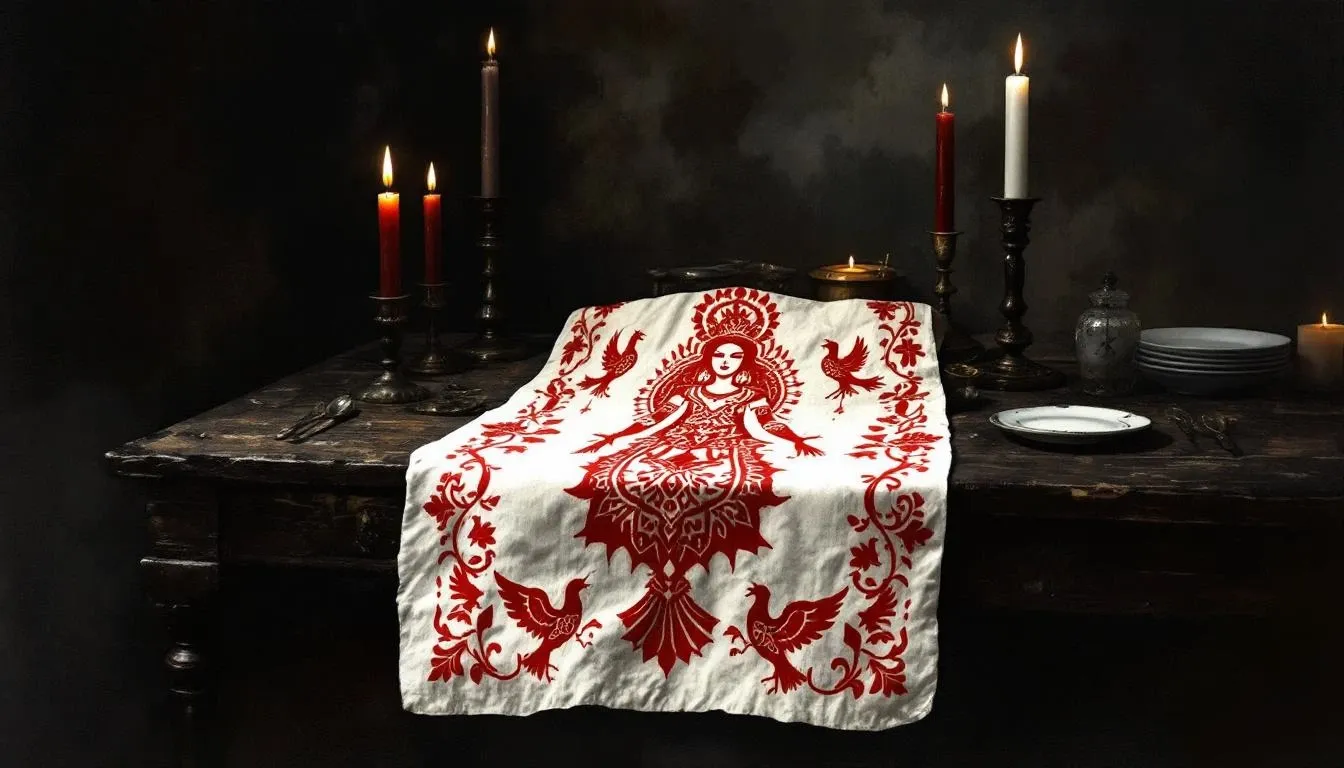
There is a figure stitched into the oldest East Slavic embroidery — a woman with upraised arms, flanked by horses or birds, her body a geometric abstraction of curves and angles repeated on wedding towels, on the hems of ritual shirts, on the cloths draped over icons in village churches. She has no face in these designs. She is shape without portrait, presence without identity. Ask a Ukrainian grandmother what the figure represents, and she might say bereginya — the protector. Ask her what a bereginya is, exactly, and the answer dissolves into uncertainty. A spirit. A guardian. Something old. Something from before.
Before the saints. Before the icons. Before the Church arrived with its hierarchy of angels and its calendar of holy protectors and its insistence that all divine power flowed from a single masculine source. Before all of that, the rivers and fields and homes of the East Slavic world were guarded by female spirits whose name derives from the verb berech' — to protect, to preserve, to keep safe. They were the Bereginyas, and they have been almost entirely forgotten.
A Name That Means Protection
The word bereginya is built on layers of meaning that reinforce each other. The most obvious derivation is from the Old East Slavic berech' (беречь) — to guard, to take care of, to watch over. A bereginya is, at its most literal, a female guardian. She who protects. She who keeps safe the things placed in her care.
But there is a second root tangled into the word: bereg (берег) — the shore, the riverbank. This is not a coincidence. In the earliest sources that mention bereginyas — the medieval sermon texts collectively known as Slovo sviatogo Grigoriia (The Word of Saint Gregory) — these spirits are associated with water, with riverbanks, with the boundary between dry land and the drowning depths. The riverbank is itself a place of protection: it is the edge where you stand safely, looking out over the water that could kill you. The bereginya guards the bereg — she is the spirit of the safe shore, the boundary that holds.
This dual etymology — protection and shore — places the bereginya in a specific ecological niche within Slavic folk belief. She is not a water spirit in the way the Rusalka is a water spirit — she does not live in the depths, does not lure men to drowning, does not embody the destructive power of rivers. She is the opposite. She stands at the water's edge and prevents the water from taking what it should not have. She is the force that keeps children from falling in, that keeps the river within its banks during spring floods, that maintains the boundary between the safe world of the shore and the dangerous world beneath the surface.
Rybakov's Theory: Remnant of the Great Goddess
No discussion of the bereginya can proceed without addressing the work of Boris Alexandrovich Rybakov — the Soviet archaeologist and historian whose 1981 book Paganism of the Ancient Slavs (Yazychestvo drevnikh slavyan) placed the bereginya at the center of a reconstructed Slavic religion that many scholars have since questioned but none have fully dismantled.
Rybakov argued that the bereginya was not merely a minor protective spirit but a survival — a degraded remnant — of a primordial Great Goddess who had once stood at the apex of Slavic religion. In his reconstruction, the pre-Slavic peoples of the Neolithic and Bronze Age worshipped a supreme female deity associated with the earth, fertility, moisture, and the protection of life. As centuries passed and the religious system grew more complex, this single goddess fragmented into multiple figures: Mokosh inherited her earth-and-fate aspects, the Rusalki inherited her water-and-fertility aspects, and the Bereginyas inherited her protective function — reduced from a goddess to a class of minor spirits, but still carrying the residual authority of the original.
Rybakov's evidence was primarily archaeological and art-historical. He pointed to the female figures with upraised arms that appear on Tripolye culture ceramics (5th-3rd millennium BC), on Scythian metalwork, and on East Slavic embroidery spanning from the medieval period to the 19th century. The continuity of the image, he argued, demonstrated the continuity of the concept — a female protector figure worshipped for thousands of years under different names but with the same essential function.
The theory is seductive and has been enormously influential in popular culture — bereginya imagery now appears on Ukrainian nationalist symbols, in neo-pagan movements, and in folk art revival projects across Eastern Europe. But academic assessment has been more cautious. Critics note that Rybakov tended to read backward from later folk material into the archaeological record, assuming continuity where coincidence was equally possible. The upraised-arms figure appears in artistic traditions worldwide and need not represent the same concept across millennia and cultures. The great scholar of Slavic religion Leszek Moszyński pointed out that we have exactly zero pre-Christian Slavic texts that describe a Great Goddess in anything resembling the form Rybakov proposed.
Still, Rybakov was not wrong about everything. The bereginya clearly existed as a concept in early medieval East Slavic paganism — the Church polemics confirm this much. Whether she was a degraded goddess or always a minor spirit, she was real to the people who left her offerings at the river and stitched her image into their wedding cloths.
Bereginyas and Rusalki: The Separation That Never Quite Held
The relationship between bereginyas and rusalki is one of the most debated questions in Slavic folklore studies. The medieval sources mention them together. The folk material sometimes treats them as the same thing. And yet their functions appear to be opposite — one protects, the other destroys; one guards the shore, the other drags you from it.
Several scholars have proposed that bereginyas and rusalki represent two stages of the same being — that the bereginya is what the rusalka was before Christianity reclassified her. In this reading, the original water spirits of Slavic belief were benevolent: they brought moisture to fields, ensured fertility, protected those who honored them. They were guardians — bereginyas. Then the Church arrived, pronounced all non-Christian spirits demonic, and the guardian water-spirits were rewritten as dangerous undead — rusalki, the vengeful drowned.
Vladimir Propp advanced a version of this argument in his analysis of the Rusalka cycle, noting that the earliest rusalka traditions show strong agricultural and fertility functions that make no sense if the rusalka was always a malevolent ghost. She was, Propp argued, originally a spirit of moisture and growth — closer to the bereginya than to the dangerous creature she later became. Christianity created the dangerous rusalka by demonizing the protective bereginya.
This reconstruction remains hypothetical, but it explains why the two figures are so often confused in folk material, why some regions use the terms almost interchangeably, and why the protective embroidery figure called bereginya in some contexts is called rusalka in others — particularly on ritual towels associated with Kupala Night celebrations.
::source-quote{source=Boris Rybakov, Paganism of the Ancient Slavs, 1981} The bereginya is the latest echo of the Neolithic Great Goddess — reduced by time and Christian pressure from a supreme deity to a vague protective force, yet still present in the embroidery, still receiving offerings at the river's edge, still standing guard over the boundary between the world of the living and the world below. ::
The Embroidery Tradition: Bereginya on Cloth
If the bereginya survives anywhere in tangible form, it is in the textile arts of Ukraine, Belarus, and northern Russia. The figure appears on rushnyky (ritual towels), on the sleeves and hems of women's shirts, on the borders of wedding cloths — always in the same basic posture: a female figure with arms raised, often flanked by symmetrical animals (horses, deer, birds) or geometric plant motifs.
The posture is not decorative randomness. The upraised arms are a gesture of invocation or protection — the same gesture found in ancient Mediterranean prayer figures, in Minoan faience goddesses, in Bronze Age Scandinavian rock carvings. Whether all these figures represent the same concept is debatable. That the East Slavic version specifically represents a protective function is supported by the contexts in which it appears: wedding towels (protecting the new marriage), birth cloths (protecting mother and child), and icon covers (mediating between the human and divine).
The bereginya motif in Ukrainian embroidery reached its most elaborate forms in the 18th and 19th centuries, when village women created complex geometric compositions in red thread on white linen. The red-on-white palette was itself symbolic: red represented life, blood, vitality, and the fire of the sun; white represented purity, the spirit world, and the linen cloth that wrapped both the newborn and the dead. The bereginya stood at the intersection of these forces — a guardian figure rendered in the color of life against the color of the spirit realm, protecting the boundary between them.
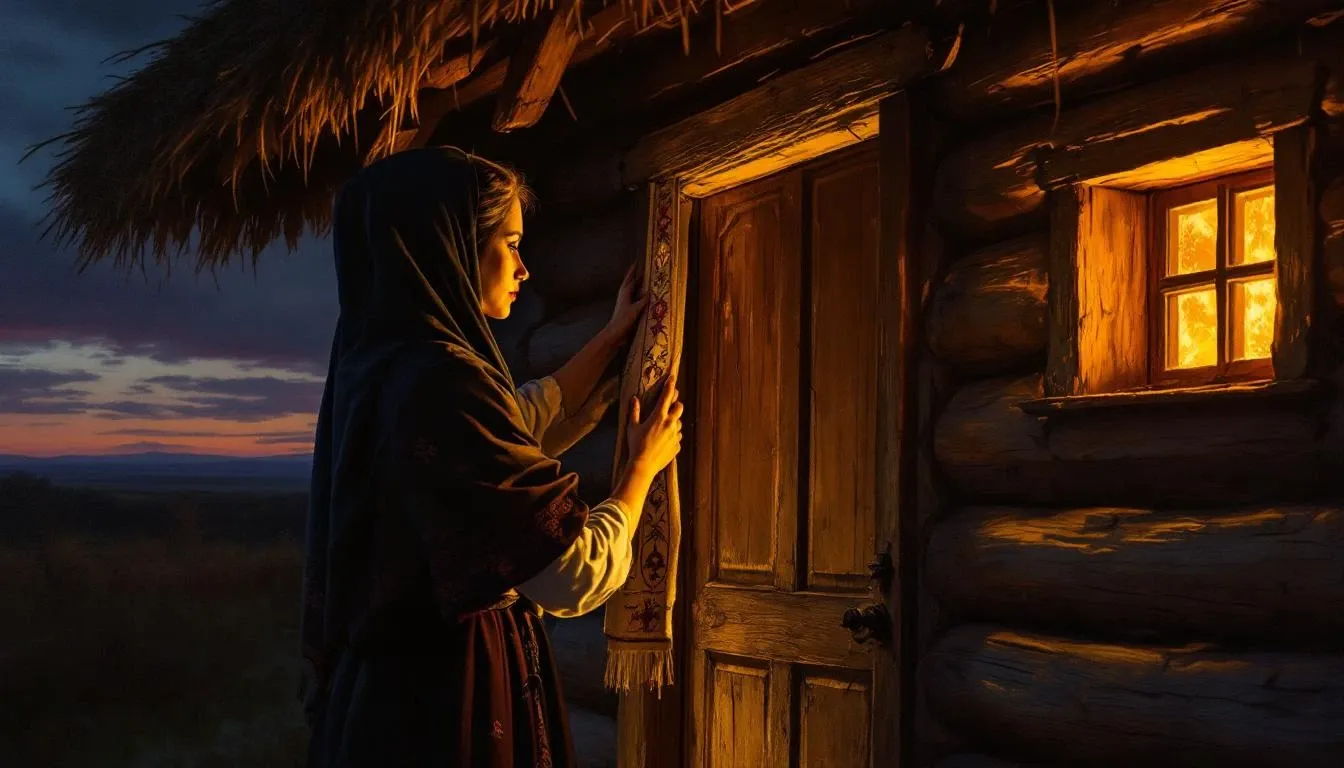
In many regions, the rushnyk bearing the bereginya figure was hung above the doorway or draped over the corner icon shelf — precisely the locations where protective magic was most needed. The doorway was a threshold, a liminal space where unwanted spirits might enter. The icon corner was the sacred center of the home, the point where divine protection concentrated. Placing the bereginya in both locations — the vulnerable boundary and the sacred center — suggests that her protective function operated in two directions: keeping evil out and keeping holiness in.
What They Protected Against
The bereginya's protective function was not abstract. She guarded against specific threats that the Slavic folk worldview identified and categorized with considerable precision.
Against Nav' — the forces of death. The Nav spirits — the restless dead, the unclean deceased, the souls trapped between worlds — were a constant threat in Slavic belief. They emerged from the underworld through water sources, crossroads, and boundary spaces. The bereginya, stationed at the riverbank (the primary boundary between the living world and the underworld accessed through water), served as a first line of defense against the Nav. She prevented the dead from crossing into the living world through the rivers they haunted.
Against disease and misfortune. In the Slovo sviatogo Grigoriia, offerings to bereginyas are listed alongside other prophylactic practices — not as worship of a deity, but as practical protection against illness, crop failure, and household disaster. The bereginya was a spiritual immune system, a constant low-level defense against the entropy that threatened to dissolve every human achievement back into chaos.
Against specific malevolent spirits. Some folk traditions describe bereginyas as actively opposing other supernatural beings: preventing the Domovoy from turning hostile, warding off the Kikimora from the household, keeping the water-spirits of the deep from approaching the shore. In this reading, the bereginya is not merely a passive guardian but an active combatant — fighting a constant spiritual war on behalf of the humans she protects.
Against the forgetting of proper order. Perhaps most subtly, the bereginya protected the rhythm of correct behavior — the seasonal rituals, the proper offerings, the maintenance of relationships between the human community and the spiritual forces surrounding it. When people honored the bereginyas, they were simultaneously honoring the entire system of folk-religious practice that kept the world stable. The offerings were not just for the spirits. They were for the people making them — a regular reminder that protection required attention, that safety was not a passive state but an active practice.
The Modern Bereginya: Symbol and Controversy
In the 20th and 21st centuries, the bereginya has experienced a resurrection that would have bewildered the medieval villagers who left her offerings by the river. She has become a national symbol — particularly in Ukraine, where the bereginya figure from traditional embroidery has been adopted as an image of Ukrainian feminine strength, cultural continuity, and spiritual independence from both Russian and Western cultural imperialism.
The Ukrainian postal service has issued stamps featuring the bereginya motif. The figure appears on bank cards, cultural foundation logos, and political campaign materials. Neo-pagan groups claim her as a central deity in their reconstructed Slavic religion. Feminist scholars reclaim her as evidence of pre-patriarchal goddess worship. Nationalists deploy her as proof of an ancient, continuous Ukrainian spiritual tradition predating Christianity.
None of these modern uses are exactly wrong, but none of them are exactly right either. The historical bereginya was not a goddess of female empowerment or national identity. She was a minor protective spirit — possibly a degraded goddess, possibly always a class of local guardians — whom villagers honored with small offerings in the hope of maintaining the fragile safety of their homes and fields. She did not represent a nation. She represented a riverbank. She did not embody feminine power in the abstract. She guarded specific places, specific families, specific thresholds against specific dangers.
The gap between what the bereginya was and what she has become is a measure of how much has been lost. When a folk spirit becomes a national symbol, it gains visibility but loses specificity. It becomes available to everyone and belongs to no one. The bereginya on a postage stamp is separated from the bereginya on a rushnyk hung above a village doorway by more than centuries — she is separated by the entire distance between lived belief and cultural heritage, between a spirit you feed and a symbol you display.
But perhaps this too is protection of a kind. The bereginya survived Christian persecution by retreating into embroidery. She survived Soviet atheism by being classified as folk art rather than religion. She survives the 21st century by becoming a symbol flexible enough to mean whatever her culture needs her to mean. She adapts. She persists. She guards — not a riverbank anymore, perhaps, but the idea that something older than churches and empires once stood watch over the vulnerable, and that this watching mattered.
The thread is unbroken, even if the meaning has changed. The woman with upraised arms still appears on the cloth. The bereg still holds.