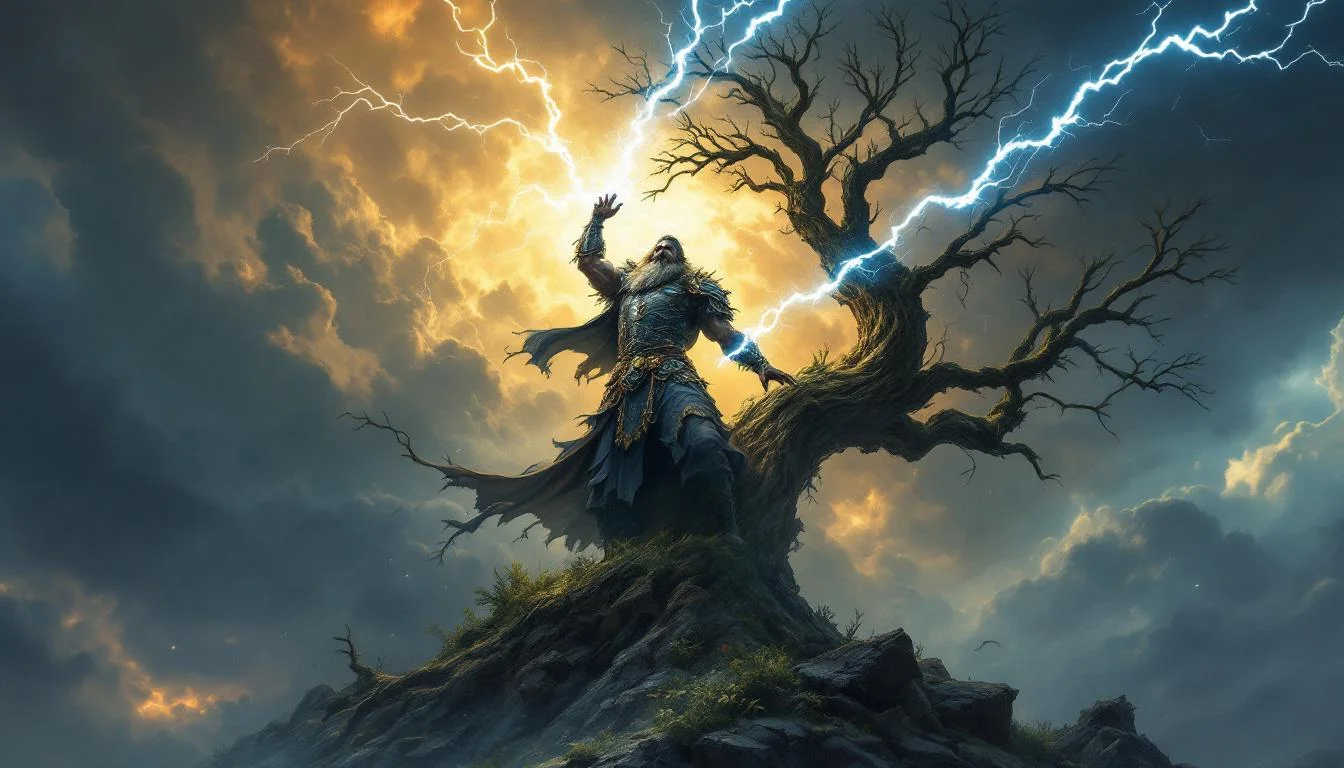
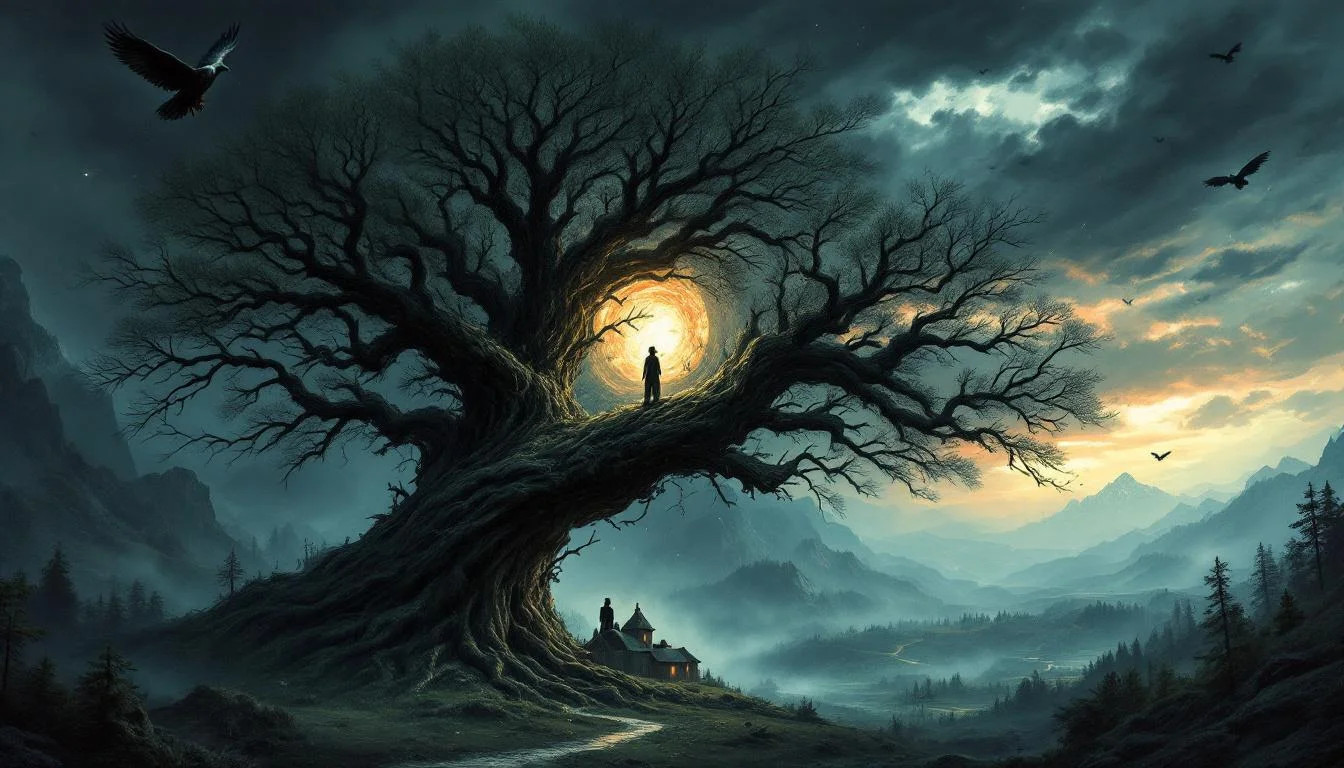
Somewhere around six thousand years ago, a group of semi-nomadic pastoralists spread out from the Pontic-Caspian steppe carrying cattle, bronze tools, wheeled carts, and a set of stories about the sky. They had a thunder god who fought a serpent. They had a great tree that held the worlds together. They had a division between the realm of the living, the realm of the dead, and the realm of cosmic law. They did not write any of it down, because they had no writing. But they carried the stories in their mouths like seeds, and everywhere they settled, the seeds took root.
Some of those people pushed northwest, into Scandinavia, and became the ancestors of the Norse. Others spread across the vast forests and river plains between the Baltic and the Black Sea, and became the Slavs. Thousands of years of separation, different climates, different enemies, different ways of surviving winter — and still, when you lay the two mythologies side by side, the skeleton is the same.
This is not coincidence. This is inheritance. And the fact that most people in the Western world can name Thor but not Perun, can describe Valhalla but not Nav, can picture Yggdrasil but not the Slavic World Tree — that asymmetry is not a measure of quality. It is a measure of who had better publicists.
The Root: Proto-Indo-European Religion
Every meaningful comparison between Slavic and Norse mythology starts with the same fact: they are siblings. Not distant cousins, not vague parallels, but descendants of the same parent tradition — Proto-Indo-European religion, the reconstructed belief system of the people who spoke the ancestor language of Sanskrit, Greek, Latin, Germanic, Baltic, and Slavic tongues.
Linguists and comparative mythologists — beginning with the work of Georges Dumézil in the mid-twentieth century and continued by scholars like Marija Gimbutas, Vyacheslav Ivanov, and Vladimir Toporov — have mapped the shared architecture in precise detail. The Proto-Indo-European cosmos was structured around a set of recurring figures and conflicts: a sky father, a thunder god who fights a chaos serpent, a trickster who crosses boundaries, a world tree connecting vertical layers of reality, and a division of the cosmos into realms of order, life, and death.
The Norse kept this architecture and built a fortress on top of it. The Slavs kept it and let the forest grow through it. The result is two mythologies that look strikingly different on the surface — one dominated by warrior halls and apocalyptic battles, the other woven into birch groves and hearth spirits — but share the same bones underneath.
Thunder Against Thunder: Perun and Thor
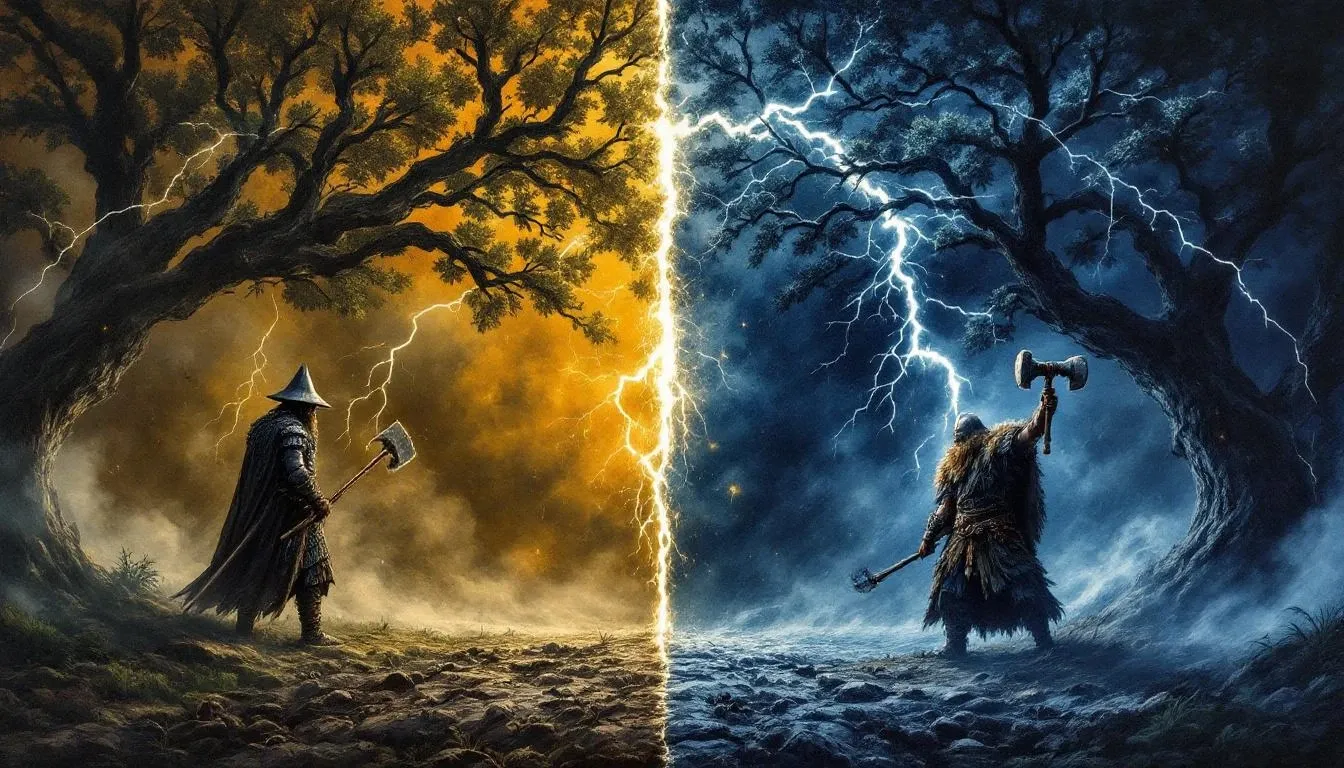
The most obvious parallel is the one that hits hardest: Perun, the Slavic god of thunder, and Thor, the Norse god of thunder, are reflections of the same Proto-Indo-European archetype, a deity reconstructed as *Perkwunos — "the Striker."
The resemblances are not subtle. Both ride chariots across the sky — Thor's pulled by goats, Perun's by horses or goats depending on the regional tradition. Both carry a weapon forged from the substance of storms — hammered into shape, one might imagine, at the celestial forge of Svarog: Thor's hammer Mjolnir, Perun's axe or mace. Both have reddish beards. Both are associated with oak trees — the tree most frequently struck by lightning, which early peoples took as proof that the thunder god favored it. Both are the primary divine defenders of the cosmic order against the forces of chaos, and both fight their battles in the sky where mortals experience them as storms.
But the parallels go deeper than physical description. Both Perun and Thor occupy the same structural position within their respective mythologies: they are the enforcers. Not the wisest gods, not the creators, not the poets — the ones who keep the walls standing. Thor defends Asgard against the giants. Perun defends the order of the upper world against the chaos that rises from below. When either of them raises a weapon, rain follows, because the storm is not random violence. It is the mechanism of cosmic maintenance.
The linguistic chain connecting them is direct. Proto-Indo-European perkwu- means "oak" or "to strike." From this root descend Lithuanian Perkunas, Latvian Perkons, Old Prussian Percunis, and Slavic Perun. The Norse tradition dropped the perk- root — Thor's name comes from thunraz, "thunder" — but the god himself carried every other feature of *Perkwunos across the frozen north.
Where Perun and Thor diverge is in rank. Thor, in Norse mythology, is the son of Odin. He is powerful but subordinate. Perun answered to no one. He stood at the top of the Slavic pantheon — the supreme deity, the first idol erected in Vladimir's hilltop shrine in Kyiv in 980 AD, the god whose statue received a silver head and golden mustache while the others stood plain. This difference matters. In the Norse world, wisdom (Odin) sits above strength (Thor). In the Slavic world, the law of the storm is the highest wisdom.
The Trickster Below: Veles and Loki
If the thunder gods are twins, their antagonists are something stranger — cousins who share a grandparent but took wildly different paths.
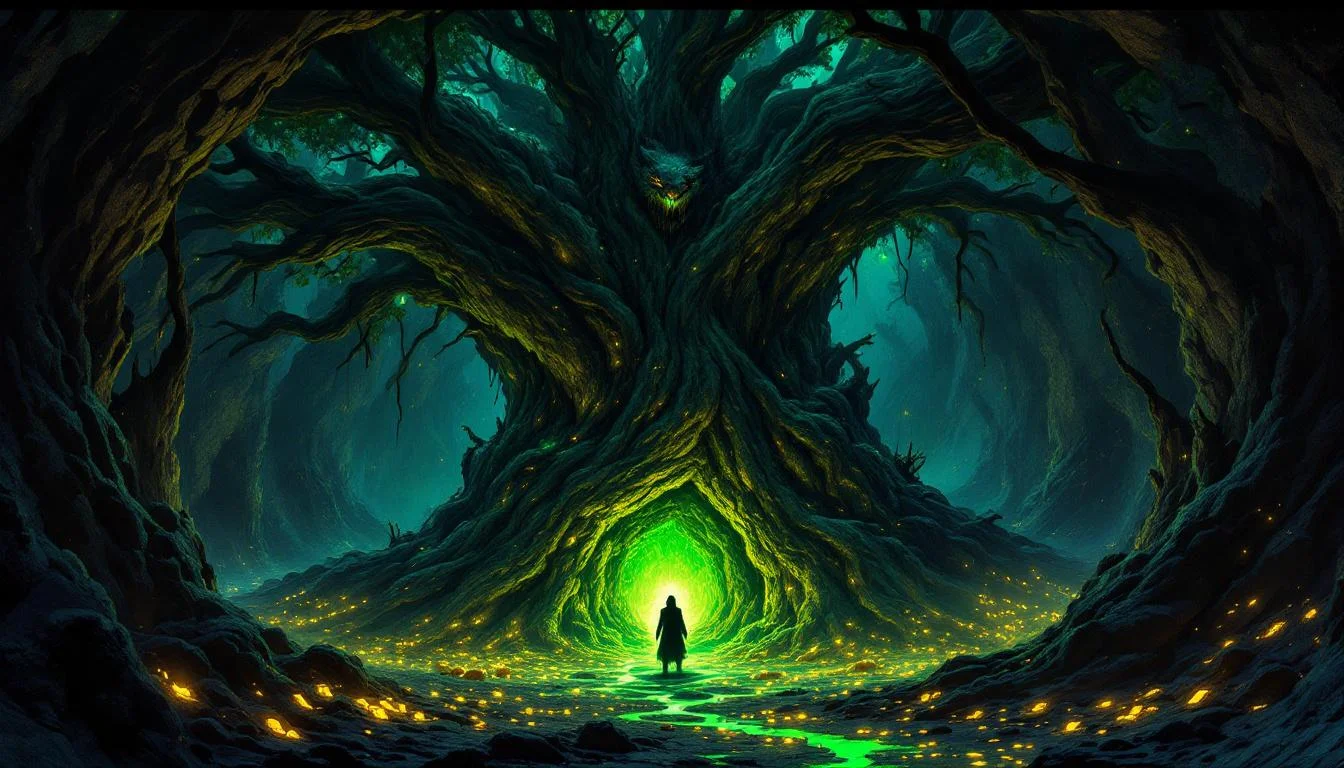
Veles is the Slavic god of the underworld, cattle, water, magic, and the arts. He lives among the roots of the World Tree, in the wet dark kingdom of Nav, and his eternal conflict with Perun — the serpent rising from below to steal from the sky, the thunder god hurling lightning to drive him back — is the central myth of Slavic cosmology.
Loki is the Norse trickster, the shapeshifter, the god who is neither fully with the Aesir nor against them until everything falls apart and he leads the forces of chaos against Asgard at Ragnarok.
The comparison is tempting, and partially valid. Both Veles and Loki are shapeshifters. Both are associated with deception and boundary-crossing. Both stand in opposition to the thunder god. Both represent a force the ordered universe cannot eliminate without destroying itself.
But Veles is far more than a trickster. He is a lord of the dead who receives souls the way a shepherd receives his herd. He is a god of wealth — the Proto-Slavic word for cattle, skotŭ, is the same as the word for riches, and Veles guarded both. He is a god of music, poetry, and prophecy. He has more in common with Odin — the one-eyed wanderer, the god of wisdom and sorcery, the lord of the dead in Valhalla — than with Loki, the agent of entropy. In fact, scholars such as Leszek Moszyński have noted that Veles combines attributes that the Norse split across multiple figures: Odin's wisdom and mastery of the dead, Loki's shapeshifting and opposition to the thunder god, and Freyr's association with fertility and wealth.
The fundamental myth of the Slavic tradition is the combat between the Thunder God and his chthonic adversary. The adversary steals cattle (water, women) from the upper world and conceals them in the lower world. The Thunder God pursues, strikes, and liberates the stolen substance. The adversary hides behind trees, stones, animals, and humans — each of which is split or destroyed by the thunderbolt.
This structural difference reveals something fundamental about the two mythologies. Norse mythology tends to separate its divine functions into distinct characters: wisdom goes to Odin, strength to Thor, chaos to Loki, fertility to Freyr, death to Hel. Slavic mythology prefers integration. Veles is the whole underworld compressed into a single figure — death, wealth, art, magic, deceit, and the deep waters, all tangled together like tree roots, because that is how the world below the surface actually works.
The World Tree: Same Spine, Different Branches
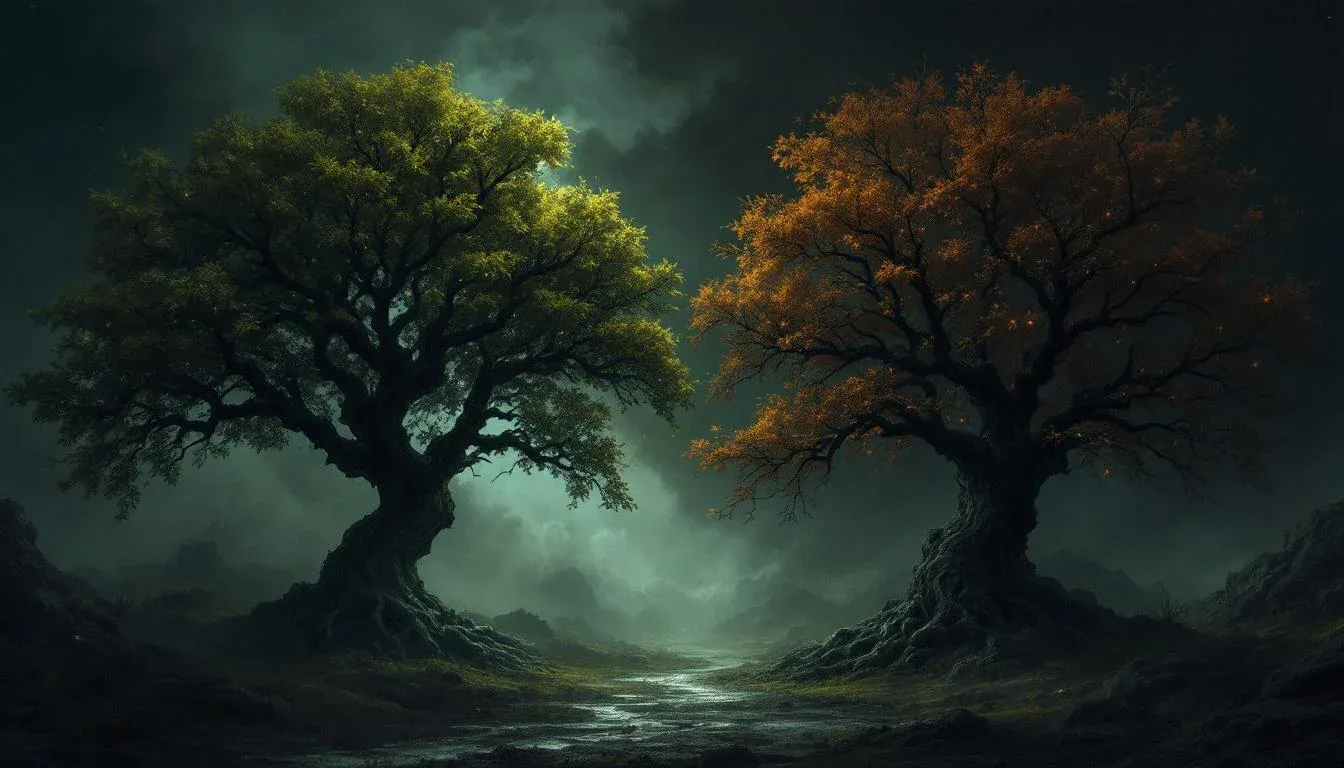
Both mythologies place a great tree at the center of the cosmos. The Norse called it Yggdrasil — usually described as an ash — with its roots reaching into three wells and its branches sheltering the Nine Worlds. The Slavs described it as a mighty oak, its roots drinking from black water where Veles coiled, its trunk passing through the visible world of Yav, its crown reaching into Prav — the realm of cosmic law where Perun kept his watch.
The structural function is identical. Both trees connect vertical layers of reality. Both serve as the axis around which the cosmos organizes itself. Both are contested spaces — their roots are gnawed (by the Norse serpent Nidhogg, by Veles in serpent form), their trunks are the battleground where upper and lower worlds meet, and their crowns are the seat of the highest power.
The difference is in what hangs from the branches.
Yggdrasil shelters Nine Worlds: Asgard and Vanaheim for the gods, Midgard for humans, Jotunheim for the giants, Alfheim, Svartalfheim, Niflheim, Muspelheim, Helheim. It is an architecture of compartments — each realm with clear boundaries, its own inhabitants, its own rules. You can draw a map of Norse cosmology. People have. It looks like a building with nine floors.
The Slavic World Tree holds three worlds — Prav above, Yav at the trunk, Nav below — but the boundaries between them are porous. The dead drift upward as spirits on certain feast days. The gods reach downward through storms and omens. The forest is simultaneously Yav and something else, because the leshy who rules it does not respect the boundary between the living world and whatever lies just outside of it. You cannot draw a clean map of Slavic cosmology. It is less a building and more an ecosystem.
The End of the World (Or Not)
Here the mythologies diverge so sharply that the difference becomes the most interesting thing about the comparison.
Norse mythology has Ragnarok — the Twilight of the Gods, the final battle, the end of everything. The great wolf Fenrir breaks free. The world-serpent Jormungandr rises from the sea. Loki leads the dead against Asgard. The gods fight and die. The sun is swallowed. The world sinks into the sea. It is one of the most powerful apocalyptic narratives in world literature, a vision of destruction so total that even the gods cannot survive it.
Slavic mythology has nothing of the kind.
There is no Slavic Ragnarok. No final battle. No apocalypse. The Slavic cosmos is cyclical, not linear. Perun fights Veles. The storm breaks. The waters are released. The world renews. Then Veles rises again, and the cycle repeats. Seasons turn. Years turn. The World Tree stands. Nothing ends because nothing is supposed to end — the cosmos is not heading toward a destination. It is breathing.
This is not a gap in the tradition, not a myth that was lost. It reflects a fundamentally different understanding of how the universe works. Norse mythology, shaped by the harsh finality of Scandinavian winters and centuries of warrior culture, understood the cosmos as something that could be broken. It had a beginning (the frost giant Ymir was killed and his body became the world) and it would have an end. Slavic mythology, shaped by the agricultural rhythms of the forest-steppe and a culture more concerned with surviving the next harvest than conquering the next coastline, understood the cosmos as something that recycled itself endlessly. Death was not an ending. It was a season. Nav was not destruction — it was composting.
Why One Became Famous and the Other Disappeared
This is the question that cuts deepest, because the answer has nothing to do with which mythology was richer, deeper, or more true. It has everything to do with writing.
The Norse had the Eddas. In the thirteenth century, the Icelandic scholar Snorri Sturluson compiled the Prose Edda — a systematic account of Norse mythology, written in clear prose, organized by topic, designed to be read and preserved. Before him, the anonymous Poetic Edda collected the mythological poems of the Viking Age. Iceland, isolated and literate, converted to Christianity relatively late and relatively gently, and its scholars had the unusual impulse to record the old stories rather than destroy them.
The Slavs had no Snorri. They had no Iceland. The conversion of the Slavic world to Christianity — beginning with Bulgaria in the ninth century, Kievan Rus in 988, and continuing through the Baltic Slavs into the twelfth century — was often violent and thorough. Temples were burned. Idols were drowned. Priests of the old religion were killed or scattered. And critically, the Slavic peoples had no pre-Christian written tradition. Everything was oral. When the oral chain was broken — when the grandmothers who knew the old songs died and their grandchildren sang hymns instead — the myths did not vanish entirely, but they fragmented. They survived as folk customs, harvest charms, fairy tales, superstitions, and the names of rivers and mountains. Reconstructing Slavic mythology from these fragments is like rebuilding a cathedral from the stones that local farmers carted away to build their fences.
Then came the modern amplifiers. Richard Wagner built operas on Norse mythology. J.R.R. Tolkien drew heavily on the Eddas for Middle-earth. Marvel Studios turned Thor into a billion-dollar franchise. Video games from God of War to Assassin's Creed Valhalla made Odin and Ragnarok household vocabulary. Norse mythology rode the Viking brand — explorers, warriors, longships, a culture the English-speaking world has romanticized for two hundred years.
Slavic mythology had no comparable vehicle. No blockbuster franchise. No Tolkien figure who embedded it into the foundations of modern fantasy. The Witcher series — based on Andrzej Sapkowski's novels and rooted in Slavic folklore — has started to change this, but it is one franchise against a century of Norse cultural saturation.
The disparity is not a verdict on the mythologies themselves. Norse mythology is better documented. Slavic mythology is not lesser. It is simply less loud.
The Deep Differences: Nature Spirits vs. Warrior Halls
Beneath the shared architecture, the two mythologies cultivated genuinely different atmospheres, and the differences reveal the cultures that produced them.
Norse mythology is a mythology of halls. Valhalla, Sessrumnir, Hlidskjalf — the divine spaces are built structures, places of walls and roofs and doors, feasting tables and high seats. The afterlife is a hall. The cosmos has architecture. Even the World Tree feels structural, load-bearing, engineered. This is the mythology of a seafaring people who built longhouses against the wind and ships against the sea, who experienced nature as something to be crossed, weathered, and survived.
Slavic mythology is a mythology of forests. The divine spaces are clearings, rivers, crossroads, the space beneath an oak tree. The afterlife is a wet meadow. The most powerful supernatural beings — the leshy, the rusalka, the vodyanoy, the domovoy — are not gods sitting in halls but spirits inhabiting specific places: this stretch of river, that particular birch grove, the threshold of your house. The Slavic supernatural world is distributed, embedded in the landscape like mycorrhizal networks under the forest floor.
Norse mythology asks: who will you fight beside when the world ends? Slavic mythology asks: how will you live with the spirits that share your forest?
Both questions are worth answering. The fact that the modern world has spent more time on the first does not make it the better question.
What Remains
Two branches from the same tree. One was carved into sagas and carried by longships to the edges of the known world. The other grew quietly in the dark soil between the rivers, whispered from grandmother to grandchild, hidden in the patterns stitched into wedding shirts and the words spoken over bread at the threshold of a new house.
Norse mythology gives us Ragnarok — the fire and the flood, the end that makes the story feel complete. Slavic mythology gives us something older and, in its own way, harder to accept: a world that does not end. A cycle that does not break. A storm god and a serpent god locked in a conflict that has no resolution because resolution is not the point. The point is the rain that comes after.
If you have arrived at Perun through Thor, at Veles through Loki, at the Slavic World Tree through Yggdrasil — good. You came through the door that was open. But now that you are here, look around. The room is larger than you thought. The tree has roots you have not seen. And the stories carried by the people who had no saga-writers and no longships and no Marvel contracts are not echoes of the Norse tradition.
They are the other half of the same inheritance. And they have been waiting a long time to be heard.