Every civilization that thinks seriously about death comes to the same conclusion: there must be a border. The dead cannot simply be here and then not here, present and then absent, without something in between — a line, a wall, a gate, a body of water that separates the place where people breathe from the place where they do not. The need for this border is so deep and so universal that it appears independently across cultures that never contacted each other. The Greeks drew the Styx. The Norse dug the river Gjoll beneath Helheim's roots. The Egyptians sailed the deceased across the waters of the Duat. And the Slavs — the people who settled the vast, river-laced plains between the Baltic and the Black Sea, who navigated the Dnieper and the Volga and the Don, who built their entire civilization along watercourses — created the Smorodina.
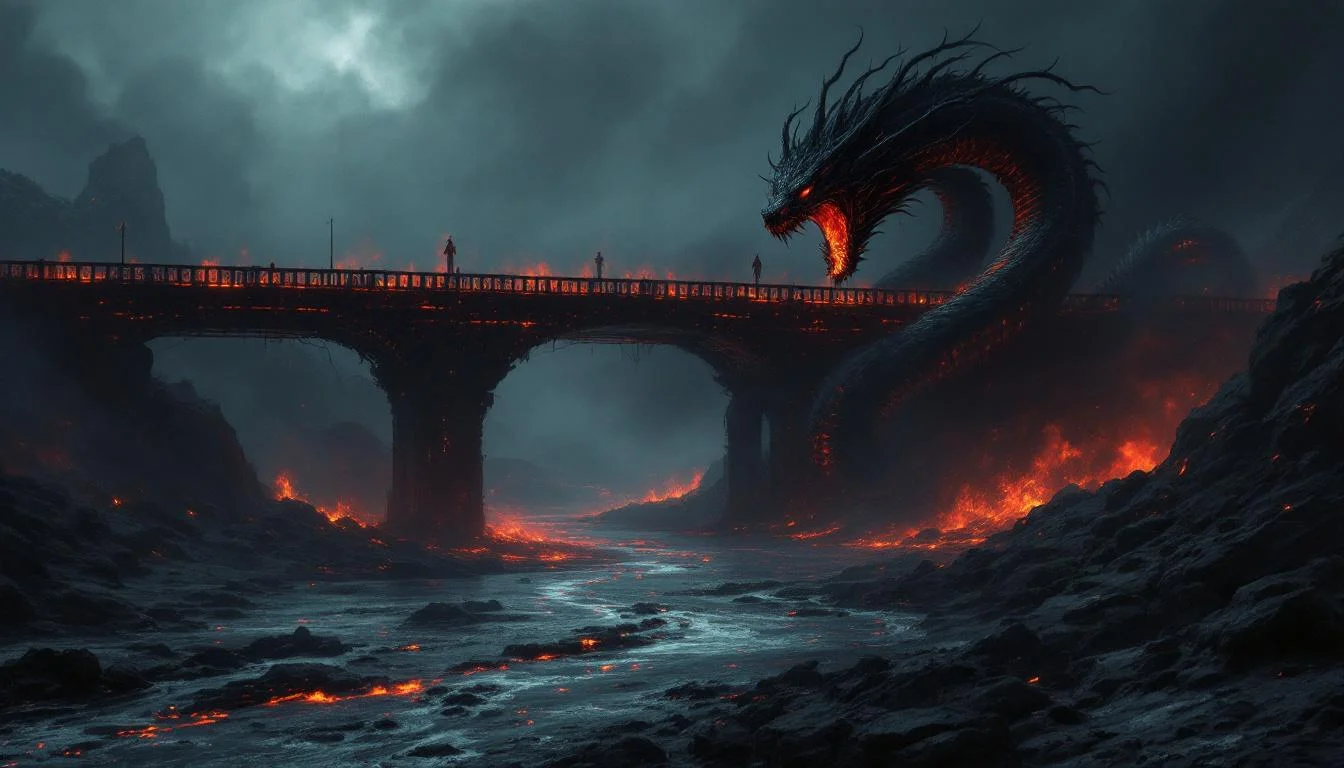
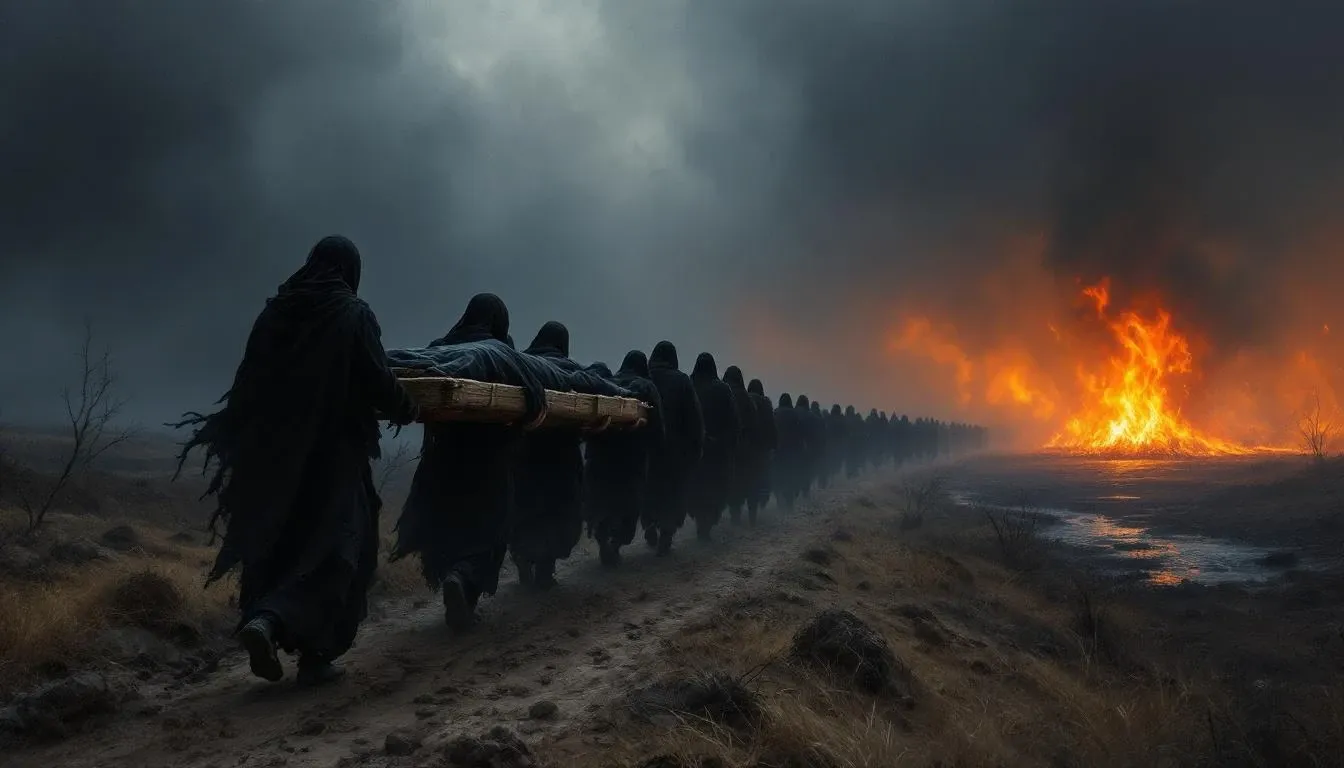
The Smorodina is not like other rivers. It does not flow with water. It burns. The flames rise from its surface in sheets, in walls, in twisting columns of black smoke that carry a stench so foul it gives the river its name. Smrad in Old Russian means stink, reek, the smell of something rotting or burning or both at once. The Smorodina is the Stinking River, and what stinks is the fire — not the clean fire of a hearth or a forge, but the foul fire of cremation, of sulfur, of the boundary between the world that makes sense and the world that does not.
You cannot ford it. You cannot swim it. You cannot go around it, because it has no end — it runs from one edge of the cosmos to the other, separating Yav (the world of the living) from Nav (the world of the dead) as completely as a moat separates a castle from the countryside. There is exactly one way across, and it involves a bridge made from the wood of a tree that bleeds, guarded by a creature with more heads than any creature needs.
This is the geography of death in the Slavic imagination, and it is among the oldest and most persistent motifs in all of East Slavic oral literature.
The Name: Stench and Fire
The etymology of Smorodina is deceptively simple. It comes from smrad or smorod — stench, stink, foul odor. The river is named for its smell, not its appearance, which tells us something about how the Slavic imagination experienced the underworld border: smell first, sight second. The Smorodina announces itself before you see it. You know you are approaching the boundary of the dead because the air turns foul, because the reek of burning reaches you through the trees or across the fields, because your body's oldest warning system — the one that detects rot and fire and tells you to go the other direction — activates long before your eyes confirm what your nose already knows.
This is not accidental. Smell is the most primitive sense, the one most directly connected to the brain's fear centers, the one most resistant to rational overriding. You can look at something terrible and force yourself to keep looking. You can hear something terrible and force yourself to keep listening. But a truly foul smell triggers a revulsion that operates below the level of conscious control. The Slavs built their death-border from smell because smell is the sense that cuts deepest.
There is a second layer to the name. The Russian word smorodina — with a different stress pattern — means "currant," specifically the blackcurrant bush whose leaves have a strong, pungent aroma. Some scholars have suggested that the river's name contains a pun or a double meaning: the river of stench is also the currant river, and the currant bush — a plant of the riverbank, a plant of the boundary between dry land and water — reinforces the liminal character of the entire image. But this reading is secondary. The primary meaning is stink, and the stink is the stink of fire.
The Cosmological Function
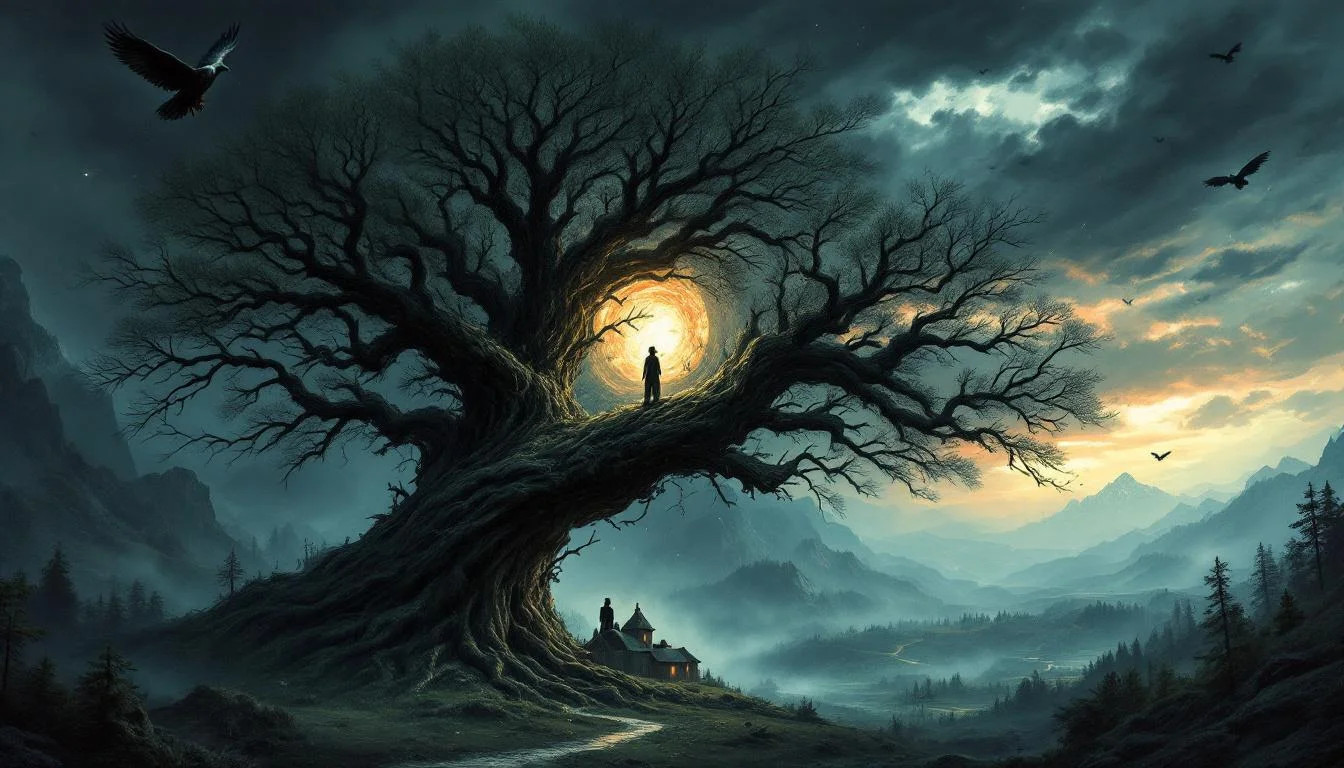
The Smorodina is not merely a feature of the landscape. It is a structural element of the cosmos — as fundamental to Slavic cosmology as the World Tree or the three worlds that the tree connects.
In the standard reconstruction of Slavic cosmology, the universe consists of three levels. Prav (or the heavenly realm) sits at the top, in the canopy of the World Tree, governed by Perun and the sky gods. Yav — the visible world, the world of the living — occupies the middle, at the trunk. Nav — the invisible world, the world of the dead — lies at the roots, governed by Veles, the god of the underworld, of cattle, and of the dead.
The Smorodina is the border between Yav and Nav. It is the line that the living cannot cross while alive and that the dead cannot cross to return. It runs at the base of the World Tree, at the boundary between the trunk and the roots, between the visible and the invisible, between breath and its absence.
This placement is significant because it means the river of fire is not far away. It is not at the edge of the world or on a distant continent. It is right beneath the surface of the living world — separated from the fields and villages and roads of Yav by nothing more than the depth of a tree's roots. The dead are always close. The fire is always burning just below the ground the living walk on. The Smorodina is not a destination you journey to. It is a destination that is always already there, waiting beneath the everyday world like an underground river, invisible until the moment you die and the ground opens and you find yourself standing on its banks.
The Guardian: Serpent, Dragon, Chudo-Yudo
Every border needs a guard. The Smorodina has several, depending on which layer of the tradition you are reading.
In the oldest layer — the pre-Christian, mythological layer — the guardian of the Smorodina is a serpent. Not just any serpent, but a cosmic one: the dragon who lives at the roots of the World Tree, who gnaws at the foundations of the cosmos, who embodies the chthonic forces that oppose the sky god's order. This serpent is connected to Veles in his serpentine aspect — Veles the dragon, Veles the underworld power, the adversary of Perun in the central myth of Slavic cosmology. The serpent at the Smorodina is the guardian of the dead, the keeper of the boundary, the thing that ensures the two worlds do not mix.
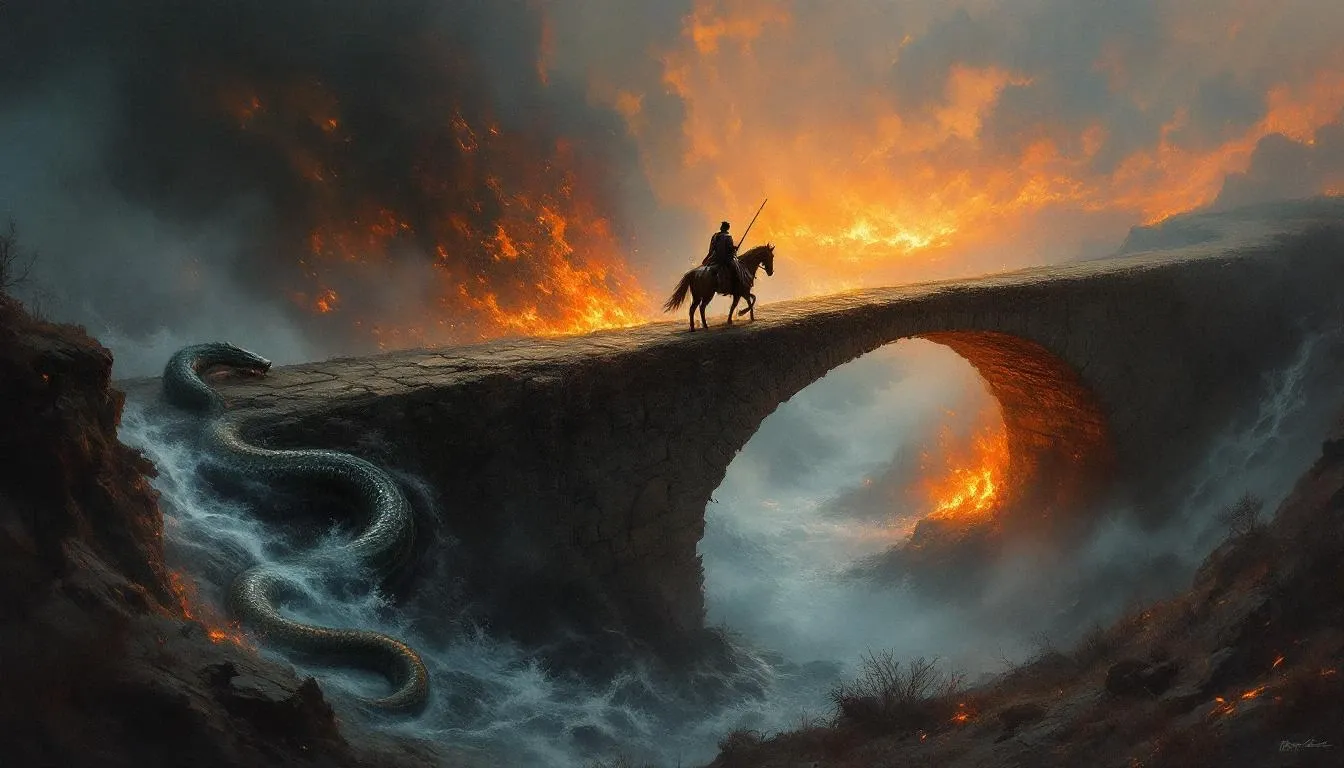
In the fairy tale layer — the later, narrative layer that preserved fragments of the mythology in the form of stories — the guardian is Chudo-Yudo, the many-headed wonder-beast. Chudo-Yudo is a dragon, but a dragon with personality: he rides a horse, he speaks, he fights with sword and fire, he regenerates his severed heads overnight. He lives on the far bank of the Smorodina, at the foot of the Kalinov Bridge, and his function in the stories is the same as the serpent's function in the mythology — to guard the crossing, to prevent unauthorized passage, to test anyone who dares attempt the journey from the living world to the dead.
The most famous encounter with the guardian occurs in the fairy tale cycle of "Ivan and Chudo-Yudo," where the youngest of three brothers fights the dragon across three nights on the Kalinov Bridge. Each night the dragon comes with more heads — six, then nine, then twelve — and each night Ivan must cut them all off while his useless brothers sleep. The battle is the central event of the story, and it takes place on the bridge over the Smorodina, in the literal no-man's-land between the living and the dead. Ivan is fighting for passage. The dragon is fighting for the integrity of the border. The fire burns below them both.
Mother Amelfa said to Dobrynya: 'Do not ride, my child, to the Smorodina River. The first stream burns with fire, the second stream shoots sparks. And no one — neither rider nor foot-traveler — has ever crossed the Smorodina and returned alive.' But Dobrynya did not heed his mother's words.
The Heroes Who Crossed
In the byliny — the Russian heroic epics — the Smorodina is a proving ground. The greatest heroes of the Russian tradition confront it, and their encounters with the burning river define their heroism more precisely than any battle with a mortal enemy.
Dobrynya Nikitich, the second of the three great bogatyrs, rides to the Smorodina against his mother's explicit warning. She tells him what every mother tells her child: do not go there, no one returns. He goes anyway. He reaches the river. He strips off his armor and swims — yes, swims — through the fire, because Dobrynya is the kind of hero who solves problems by going straight through them. On the far bank he encounters a dragon — sometimes identified as the Zmey Gorynych, sometimes simply as the guardian serpent — and fights it in the river itself, waist-deep in burning water, slashing at the creature while the flames lick at his skin.
Ilya Muromets, the greatest of the bogatyrs, encounters the Smorodina in variants of his own cycle. His approach to the river is characteristically direct: he rides his horse straight at it, trusting his steed and his strength to carry him through. Ilya does not swim the Smorodina. He leaps it, or fords it, or simply rides through the fire as if it were a shallow creek, because Ilya Muromets operates at a level of heroic power that makes the river's danger secondary to his own determination.
The pattern in the byliny is consistent: the hero is warned, the hero goes anyway, the hero crosses, the hero fights whatever waits on the other side. The Smorodina functions as a threshold of commitment. Once you have crossed the burning river, you have entered a different order of existence. You have left the world where ordinary rules apply and entered the world where only heroes survive. The crossing is itself the transformation — not the battle on the other side, not the dragon, not the quest's ultimate goal, but the moment of entering the fire and choosing not to turn back.
The Funeral Geography
The Smorodina was not only a feature of epic poetry and fairy tales. It structured actual funeral practice across the East Slavic world.
When a person died in a traditional East Slavic village, their body was carried to the cemetery along a specific route — often a route that crossed a physical body of water. In many regions, crude bridges were built from logs or planks along the funeral path, and the procession crossed these bridges on foot, carrying the coffin. After the burial, the bridges were sometimes dismantled or burned. The logic was practical and mythological at once: the journey from the house to the grave replicated the soul's journey from Yav to Nav, and the water crossing replicated the crossing of the Smorodina. By removing the bridge after the burial, the living ensured that the dead could not find their way back. The path to the underworld was a one-way road, and the bridge was destroyed behind the traveler.
Water was poured at the graveside in some traditions — not on the grave itself but beside it, as if watering the meadows of the underworld, preparing the pastures where Veles would graze the soul like a new addition to his flock. Food was placed on the grave or buried with the body: bread, eggs, honey, grain. The dead needed provisions for the journey across the fire-river, just as the dead of other traditions needed coins for Charon's ferry or supplies for the Egyptian afterlife's trials.
The forty-day mourning period — observed across the Orthodox Slavic world — corresponds to the traditional belief that the soul lingered near the body for forty days before making its final journey to Nav. During this period, the soul was thought to visit the places it had known in life: the house, the field, the bathhouse, the church. On the fortieth day, it departed for good, following the rivers southward (rivers flow toward the sea; the sea leads to the Smorodina; the Smorodina leads to Nav). The commemorative feast held on the fortieth day — the sorokoviny — was both a farewell and a practical measure: the family gathered to ensure the soul had been properly equipped for the crossing and would not return, unprepared and angry, to haunt the living.
Styx, Gjoll, and the Family of Death-Rivers
The Smorodina belongs to a family of mythological rivers that spans the entire Indo-European world, and the family resemblances are unmistakable.
The Greek Styx was the river of the underworld, the border of Hades, the water by which the gods swore their most binding oaths. Like the Smorodina, it could not be crossed by the living except under extraordinary circumstances. Unlike the Smorodina, it was not made of fire — it was dark, cold, still. The crossing was made by boat, with Charon as ferryman, and the fee was an obol placed on the tongue or over the eyes of the dead. The Greek system was transactional: you paid for passage. The Slavic system was combative: you fought for it, or your soul navigated the crossing alone.
The Norse Gjoll (or Gjallarbru) was the bridge over the river that led to Helheim, the realm of the dead. It was guarded by the giantess Modgud, who questioned every traveler and allowed passage only to the genuinely dead. The bridge was roofed with glowing gold and trembled when the living crossed it. The parallel to the Kalinov Bridge is striking: a bridge over a river of death, guarded by a supernatural being, glowing with light that comes from burning rather than illumination.
The Zoroastrian Chinvat Bridge performed yet another variation on the theme: it widened for the righteous and narrowed to a razor's edge for the wicked, with the river of judgment flowing below. The bridge was itself the test — not a thing you merely crossed but a thing that evaluated you in the crossing, that measured your soul's weight against your sins.
The Smorodina combines elements from across this family. Its fire recalls the Norse. Its guardianship recalls the Greek. Its bridge — the Kalinov Bridge — recalls the Zoroastrian judgment-crossing. Whether these traditions influenced each other directly or inherited the same motif from a common Proto-Indo-European source is a question scholars have debated for two centuries without resolution. What is not debated is the pattern: a terrible river, a narrow crossing, a guardian that does not yield easily, and on the far side a land from which no living traveler returns.
Fire and Water: The Double Nature
One of the Smorodina's most distinctive features is its dual nature. In some texts it is a river of fire. In others it is a river of foul black water — stagnant, thick, reeking of decay. These two descriptions are not contradictory. They are complementary, and the folk tradition did not experience them as inconsistent.
Fire and rot are both modes of destruction. Fire transforms the solid into ash and smoke. Rot transforms the solid into muck and soil. Both processes reduce the structured to the formless, the living to the inert, the recognizable to the unrecognizable. The Smorodina embodies both because both are aspects of death itself — the twin processes by which the body returns to the elements, whether through the cremation pyre or the slow chemistry of the grave.
The dual nature may also reflect a historical layering. The fire-river may belong to the period when the Slavs practiced cremation — the era of the funeral pyre, when the dead were burned on wooden platforms and their ashes scattered in rivers. The foul-water river may belong to the later period of inhumation, when the dead were buried in the earth and the body's decay was the primary physical transformation associated with death. The Smorodina absorbed both practices into its description, becoming a river that is simultaneously burning and rotting, a border that reflects every way the Slavs have ever disposed of their dead.
The River That Is Always There
The Smorodina is not a place you can visit. No river on any map burns with fire or stinks of sulfur or is spanned by a bridge of guelder-rose wood guarded by a twelve-headed dragon. The Smorodina exists only in the oral literature, in the byliny and the fairy tales and the funeral songs and the healing charms that invoke the geography of the otherworld as if it were as real as the Dnieper.
But it is real in the way that all great mythological images are real: as a structure of thought, a framework for experiencing the most fundamental of human realities. Death requires a border. The Slavs drew theirs in fire.
The fire-river says something specific about the Slavic understanding of the death-boundary. It is not passive. It is not a gate you walk through or a line you step across. It is an ordeal — an experience that transforms you, that burns away whatever you were in life, that reduces you to something essential enough to exist on the other side. The Smorodina is not merely a barrier. It is a process. You do not merely cross the fire. The fire crosses you.
This is why the bylina heroes must fight at the Smorodina. This is why the fairy tale champions must battle Chudo-Yudo on the Kalinov Bridge. This is why the dead need provisions and why the funeral procession crosses water and why the bridge is burned behind the coffin. The journey to the land of the dead is not a simple relocation. It is a transformation — a burning, a reduction, a crossing through fire that leaves the traveler fundamentally changed. The person who stands on the far bank of the Smorodina is not the person who stood on the near bank. The fire has done its work.
The Smorodina burns between the worlds. It has always burned. It will burn until the last person who knows the stories forgets them, and probably longer than that, because some borders are older than the people who describe them. The dead still need somewhere to go. The living still need to believe that the going involves a crossing, a boundary, a moment of transformation between the known and the unknowable.
The river is waiting. It smells of sulfur. The bridge is narrow. Something with too many heads stands at the far end, patient as geology.
The fire will not go out.