The earth shook the day Volga was born. The sea heaved. Fish dove to the deepest trenches. Birds climbed to the highest air. In the forests, every beast — wolf, bear, fox, hare — scattered and hid. The natural world recognized what had entered it: something that was not entirely natural. Something that wore the shape of a man but carried the blood of a serpent.
That is how the byliny open the story of Volga Svyatoslavich — with a birth that terrifies the biosphere. This is not the way the singers introduce the other bogatyrs. Ilya Muromets is born a cripple. Dobrynya Nikitich is born a nobleman's son. Alyosha Popovich is born in a thunderstorm, yes, but the storm is a literary effect, not a cosmic event. Volga's birth is different in kind. When Volga enters the world, the world flinches.
He is the shapeshifter. The prince who becomes a falcon, a wolf, a pike, an ant, an ermine, a golden-horned bull. He learned to speak the language of beasts before he learned the language of men. He was a sorcerer before he was a warrior, and his bylina does not pretend otherwise. The other bogatyrs fight with strength or cunning or sword-skill. Volga fights with transformation — the ability to become something other than human, to step outside the boundaries of his own species and enter the consciousness of every creature in the world.
This makes him the strangest figure in the Slavic heroic tradition, and possibly the oldest. Because Volga is not, at his core, a warrior. He is a shaman.
The Serpent Father
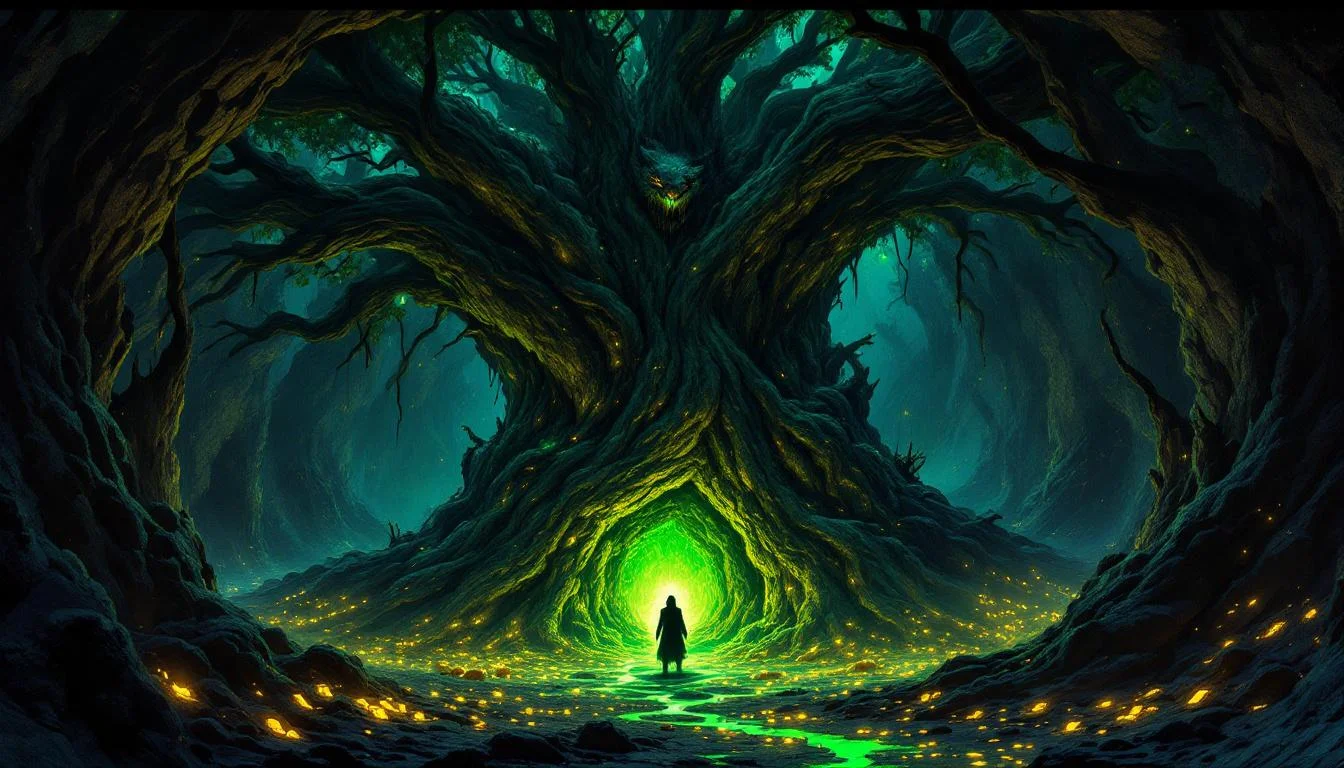
The byliny are coy about Volga's parentage, but the hints are consistent across multiple versions and collectors. His mother is a princess — Marfa Vseslavyevna in most tellings. She walks in a garden and steps on a serpent. The serpent wraps itself around her leg, or around her body, and from this union Volga is conceived.
The father is the serpent. The byliny do not elaborate. They do not explain what kind of serpent, or whether it was a serpent-god, or a transformed man, or a force of pure otherworldly energy wearing a serpent's skin. They simply state the fact — serpent and princess, garden and coiling — and move on, leaving the listener to draw their own conclusions.
In the garden walked the young princess Marfa Vseslavyevna, and she stepped upon a fierce serpent, and the fierce serpent coiled about her leg, about her leg of white... And from that time the princess conceived.
The serpent-father motif places Volga in a mythological category that extends far beyond the byliny. The hero born from a serpent's union with a mortal woman appears across Indo-European mythology: Alexander the Great was said to be the son of Zeus in serpent form. Melusine, the serpent-woman of French legend, founded a royal dynasty. In Celtic tradition, the serpent is a symbol of otherworldly knowledge and transformation. The serpent-born hero is always a bridge figure — part human, part other, able to move between worlds that ordinary mortals cannot cross.
For Volga, the serpent heritage explains everything that follows. His shapeshifting ability, his command over animals, his instinctive understanding of the non-human world — all of it flows from the fact that he is not fully human. He carries the blood of something older, something cold-blooded and close to the earth, something that sheds its skin and becomes new.
The connection to Veles — the Slavic god of the underworld, cattle, magic, and serpents — is difficult to miss. Veles is consistently associated with serpentine imagery in the reconstructed Slavic storm myth. He is the chthonic deity, the god of the lower world, the shape-changer who wears many forms. Volga, born from a serpent, master of transformation, is the heroic echo of Veles — the god's power expressed through a human vessel. Some scholars have suggested that the Volga byliny preserve a fragment of a Veles mythology that was otherwise lost when the pre-Christian priesthood disappeared: the god of transformation reduced to a folk hero, his cosmic powers scaled down to a prince's adventures.
The Education of a Shapeshifter
The byliny describe Volga's childhood as a rapid education in the non-human. He grows fast — supernaturally fast, the way heroes in byliny always do — and before he is of normal fighting age, he has already mastered the three arts that define his character.
First, he learned the language of birds. He could speak to the falcon, the eagle, the raven, the swan. He understood their calls and could command their flights. This gave him mastery of the upper world — the sky, the domain of vision and speed and the reconnaissance that wins battles before they begin.
Second, he learned the language of fish. He could speak to the pike, the salmon, the sturgeon. He understood the currents and the deep places. This gave him mastery of the lower world — the water, the domain of hidden things, the realm beneath the surface where ordinary vision cannot reach.
Third, he learned the language of beasts. Wolf, bear, fox, hare — every creature that ran on the earth answered to his voice. This gave him mastery of the middle world — the forest, the steppe, the living landscape between sky and water.
Sky, water, earth. The three realms of the Slavic world model, mapped onto three categories of animal speech. This is not accidental. The byliny singers who composed and transmitted Volga's story were encoding a cosmological statement in the format of a hero's education. Volga does not merely learn useful skills. He learns to speak the language of each cosmic layer. He becomes a citizen of all three worlds — a feat no ordinary human can accomplish.
This triple mastery is the hallmark of the shaman in comparative religious studies. The Siberian shaman — and the Slavic volkhv, the pre-Christian priest-sorcerer whose name may be etymologically related to Volga — was defined precisely by the ability to travel between worlds. The shaman ascended to the sky-world by becoming a bird. The shaman descended to the water-world by becoming a fish. The shaman traversed the earth-world by becoming a beast. Volga's education is a shaman's initiation, compressed into the narrative language of the bylina.
The Campaign Against the Indian Kingdom
The main adventure in the Volga bylina is his military campaign against the Indeyskoye tsarstvo — the Indian Kingdom, a faraway land ruled by a hostile king named Saltyk Stavrulyevich (the name varies across collectors).
The "Indian Kingdom" in bylina geography is not India. It is a generic term for a distant, powerful, non-Christian realm — the kind of place that serves as the necessary opponent in a heroic narrative. What matters is not where it is but what happens when Volga goes there.
Volga assembles his druzhina — thirty warriors, the standard bylina number — and leads them toward the Indian Kingdom. But unlike other bogatyrs who would simply ride, fight, and conquer, Volga uses his shapeshifting to wage a different kind of war.
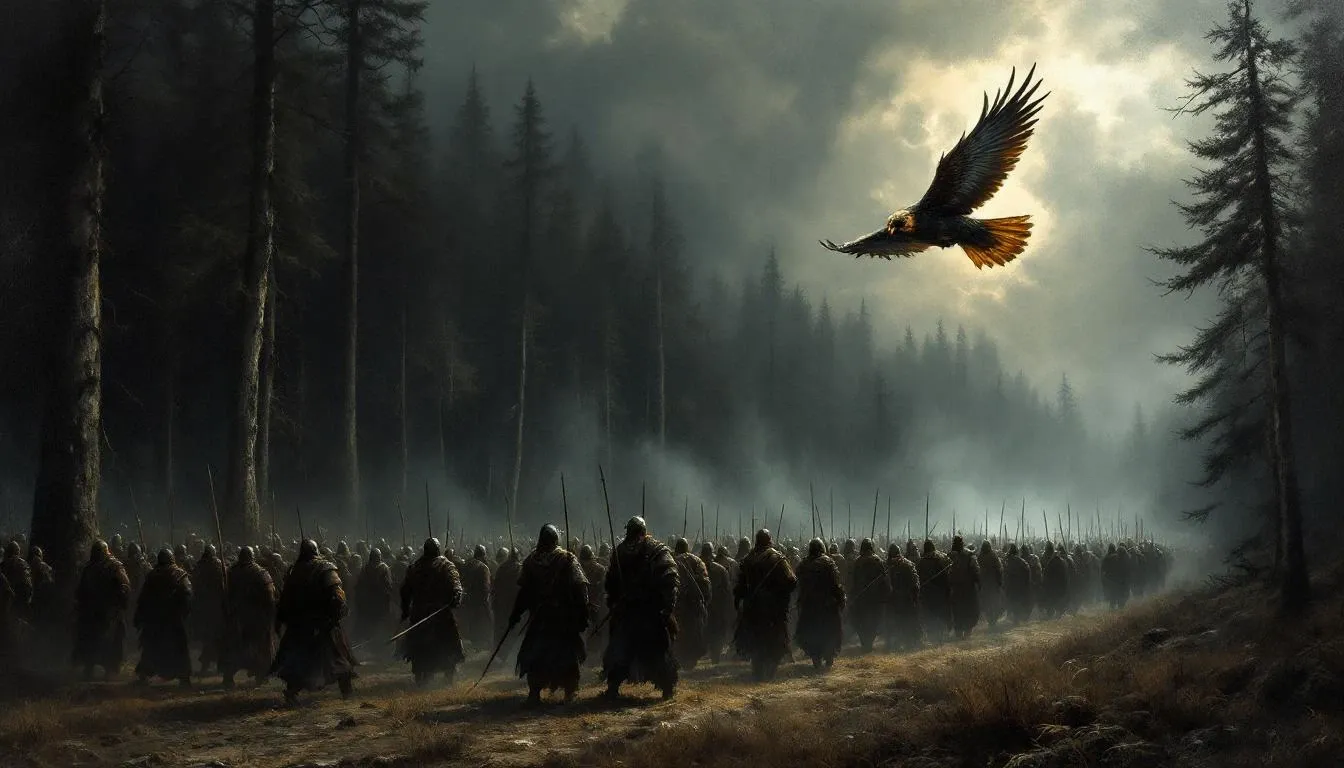
He transforms into a falcon and flies ahead to the Indian king's palace. Perched on a windowsill in bird form, he overhears the king and queen discussing their military plans, their defenses, their strategy for repelling invaders. This is espionage conducted through metamorphosis — the world's first special forces operation, conducted by a man who became a bird.
He transforms into an ermine (or a weasel, in some versions) and infiltrates the Indian kingdom's armory. He chews through the bowstrings. He gnaws the bindings on the weapons. He disables the defensive infrastructure from the inside, in animal form, undetected.
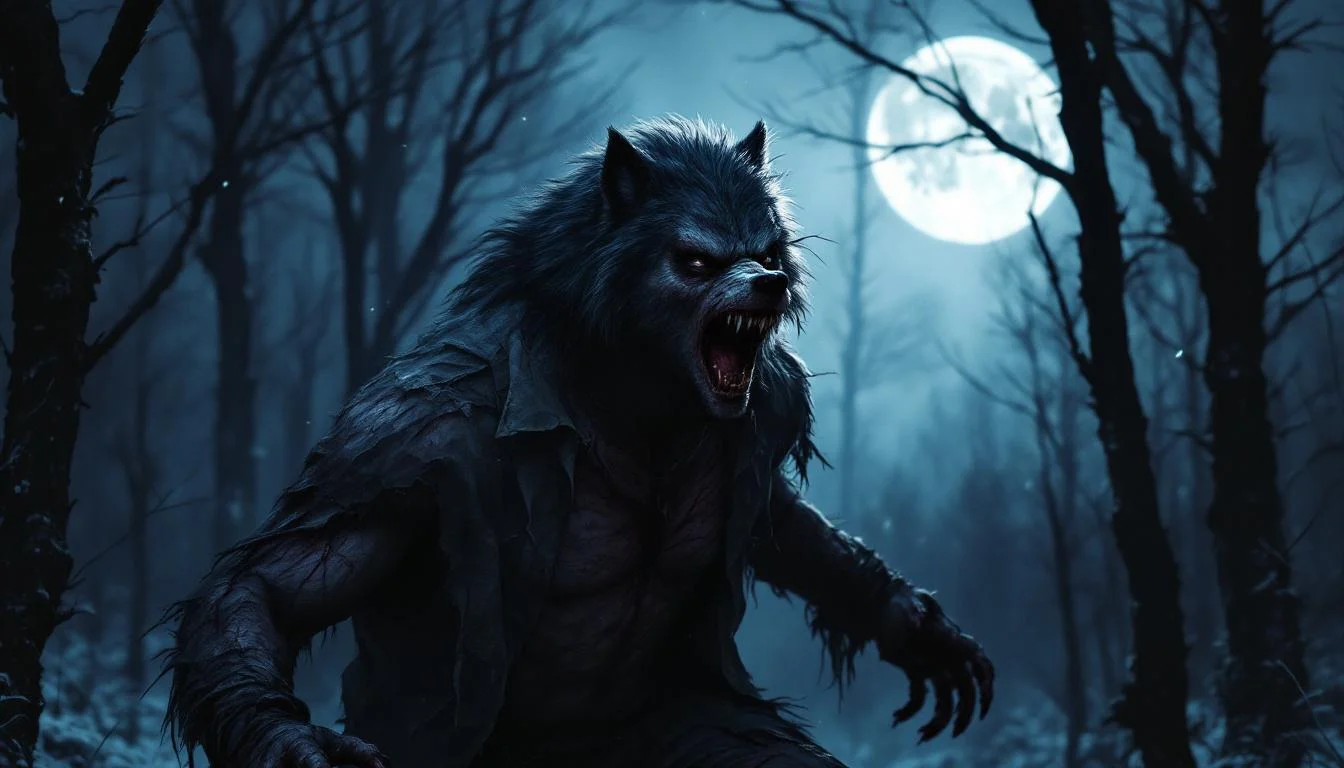
He transforms into a wolf and hunts down the Indian kingdom's horses, stampeding them into the wilderness, leaving the enemy cavalry without mounts.
He transforms his entire druzhina into ants, leading them through a crack in the fortress wall. Once inside, they resume human form and attack. The Indian kingdom falls.
This is not conventional heroism. Dobrynya fights the dragon face to face. Ilya confronts the Nightingale in open combat. Volga cheats. He spies, sabotages, infiltrates, and attacks from impossible angles. His warfare is not about honor or courage. It is about intelligence — literally, in both senses of the word. He gathers intelligence (information) and applies intelligence (cunning) to destroy an enemy he could not defeat in direct confrontation.
Volga Meets Mikula
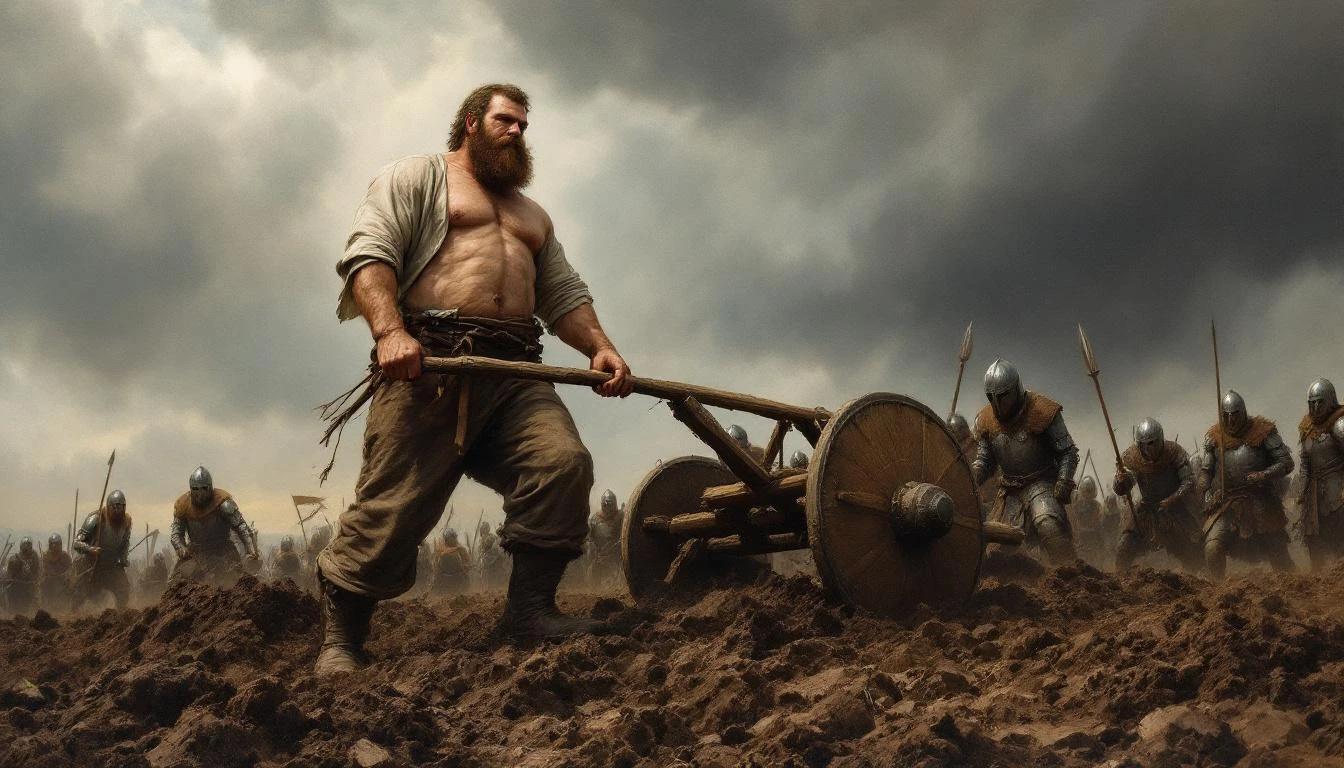
The most famous episode in the Volga tradition is not a battle at all. It is a meeting — the encounter between Volga and Mikula Selyaninovich, the peasant-bogatyr who plows the earth with a damascene plow and whose strength exceeds anything the warrior world can produce.
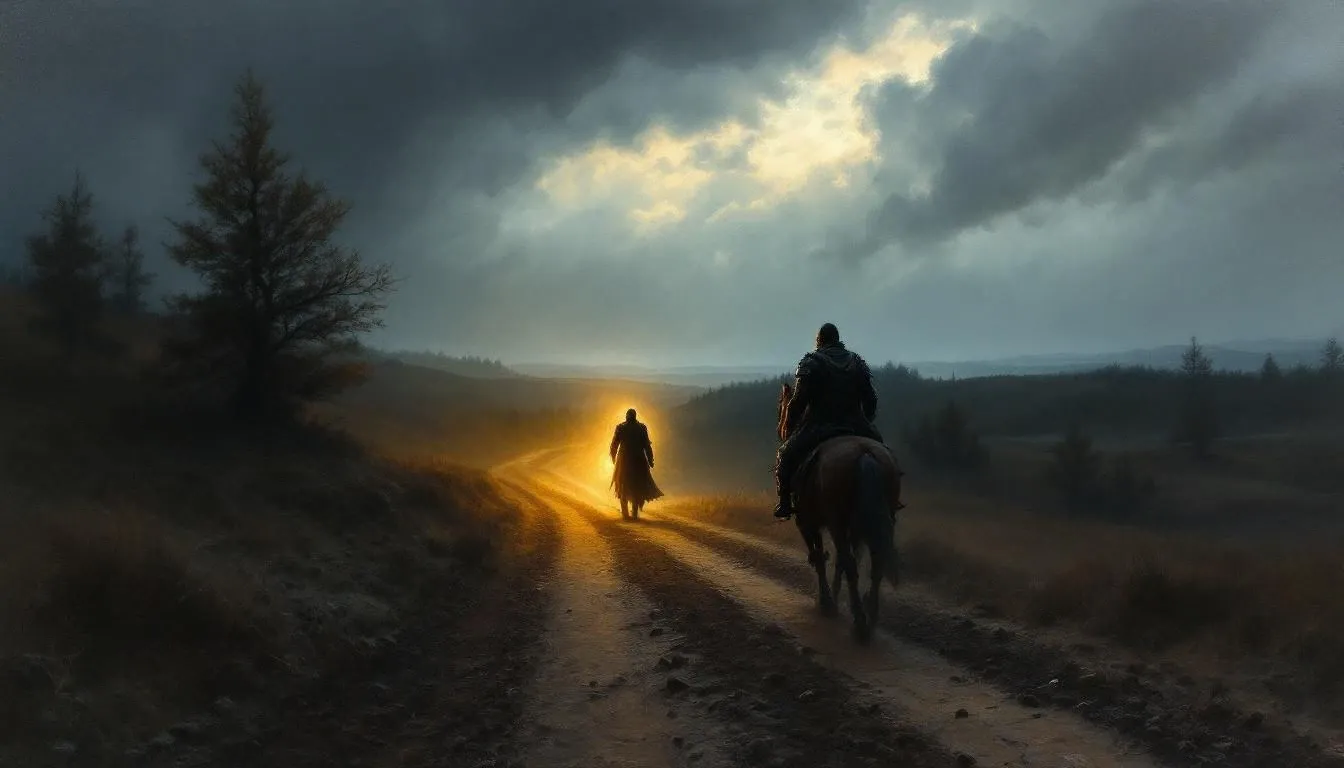
Volga rides with his druzhina across the steppe and hears the sound of plowing — distant, persistent, three days' ride away. When he finally reaches the source, he finds Mikula, a peasant working his field with an effortlessness that makes the warband stare. Volga invites Mikula to join his expedition. Mikula agrees, but first asks Volga's warriors to pull his plow from the furrow and hide it behind a bush.
Thirty warriors cannot lift it. Five cannot lift it. One cannot lift it. Mikula walks over and lifts it with one hand.
The scene is a confrontation between two kinds of power: the shapeshifter's magic and the peasant's earthbound strength. Volga can become a falcon, a wolf, a pike, an ant. He can infiltrate fortresses and overthrow kingdoms through cunning and transformation. But he cannot lift a plow. His thirty warriors cannot lift a plow. All the shape-changing in the world cannot move a piece of metal that the earth is holding down.
And then there is the mare. Mikula's small, shaggy peasant mare outruns every warhorse in Volga's druzhina. The trotting workhorse beats the galloping charger. Volga, humiliated and fascinated in equal measure, asks where such a horse can be purchased. Mikula names an absurd price — five hundred rubles — and adds that the mare is now beyond any price, because you cannot buy what the earth gives freely to those who deserve it.
The meeting between Volga and Mikula is one of the key structural episodes in the bylina tradition because it establishes a hierarchy that the singers clearly regarded as essential. The shapeshifter is powerful. The warrior is dangerous. The sorcerer-prince who can become any creature in the world is a formidable force. But the peasant who works the earth — the man whose power is not magical but relational, drawn not from serpent blood but from the daily labor of feeding the world — is stronger still.
Volga, for all his transformations, cannot become the earth. Mikula does not need to.
The Volkhv Connection
The name Volga has been connected by multiple scholars to the word volkhv — the Old East Slavic term for a pagan priest, sorcerer, or shaman. The volkhvy were the pre-Christian religious specialists of the East Slavic world, the men (and possibly women) who communicated with spirits, performed divinations, conducted rituals, and served as intermediaries between the human community and the supernatural forces that governed it.
The linguistic connection is not universally accepted, but it is suggestive. Volga, volkhv, and possibly Volga (the river) may share a common Proto-Slavic root related to moisture, magic, or the sacred. If the connection holds, then Volga Svyatoslavich is not merely a prince who happens to know magic. He is a volkhv — a shaman-priest — wearing the narrative disguise of a bogatyr.
This would explain why Volga feels different from the other heroes of the bylina cycle. Ilya, Dobrynya, and Alyosha are warriors first. Their adventures involve combat, physical strength, and the defense of the realm through martial means. Volga's adventures involve transformation, espionage, animal communication, and the manipulation of reality through shapeshifting. He does not fight the way warriors fight. He operates the way shamans operate — by crossing the boundary between human and animal, between the visible and the invisible, between the world as it appears and the world as it can be reshaped.
The historical volkhvy were persecuted after the Christianization of the East Slavic lands. The chronicles record uprisings led by volkhvy in the eleventh century — men who resisted the new religion and attempted to maintain the old practices. These uprisings were crushed, and the volkhvy gradually disappeared from the historical record, pushed to the margins and eventually forgotten.
But they did not disappear from the byliny. Volga Svyatoslavich may be the last surviving portrait of the volkhv in Slavic literature — the shapeshifting priest preserved in the amber of oral tradition, his religious function stripped away but his powers intact, singing the language of birds in a poem that Christian audiences could enjoy without realizing they were listening to the echo of a pagan priesthood.
The Historical Oleg
Several scholars have connected Volga Svyatoslavich to the historical Prince Oleg of Novgorod — known as Oleg the Seer (Oleg Veshchiy) — who ruled in the late ninth and early tenth centuries. The Primary Chronicle describes Oleg as a man of supernatural wisdom: he predicted events before they happened, he was called "the seer" by his own people, and his death — by snakebite from a horse's skull — carries unmistakable mythological overtones.
The connection between Volga and Oleg is not a simple identification. The bylina character is not a historical biography set to verse. But the overlap is suggestive: a prince associated with serpents (Oleg dies from a serpent hidden in a horse's skull; Volga is born from a serpent), a man of supernatural knowledge (Oleg the Seer; Volga the shapeshifter), a military leader who conquers distant lands through cunning rather than brute force (Oleg's capture of Kyiv through deception; Volga's infiltration of the Indian Kingdom through transformation).
The most likely explanation is that the bylina character of Volga accumulated traits from multiple sources over centuries of oral transmission: a real prince (Oleg), a mythological archetype (the shapeshifter-shaman), and a religious memory (the volkhv). These layers fused into a single figure who is simultaneously historical, mythological, and religious — a character who cannot be reduced to any one of his components.
The Shapeshifter and the Slavic Soul
Volga Svyatoslavich occupies a unique position in the Slavic heroic tradition. He is not the strongest (that is Ilya or Svyatogor). He is not the most noble (that is Dobrynya). He is not the most cunning (that is Alyosha). He is the most other — the hero who is least human, most connected to the non-human world, most capable of crossing the boundaries that define ordinary experience.
His shapeshifting is not a superpower in the modern comic-book sense. It is a religious faculty — the ability to dissolve the boundary between self and world, between human consciousness and animal consciousness, between the fixed identity of a man and the fluid identity of everything that is not a man. When Volga becomes a falcon, he is not a man wearing a falcon suit. He is a falcon. When he becomes a wolf, he runs with a wolf's hunger and a wolf's instinct. When he becomes an ant, he experiences the world through an ant's trembling antennae.
This is the shaman's gift, and the shaman's burden. The man who can become everything risks becoming nothing — losing the fixed human identity that anchors ordinary life. The byliny do not explore this danger explicitly, but they encode it in the structure of Volga's story. He is the hero who can do the most extraordinary things — fly, swim, crawl through walls — and yet he is humbled by a peasant with a plow. His transformations conquer kingdoms but cannot lift a furrow of earth. His magic is real and powerful and, in the presence of Mikula's earthbound strength, ultimately secondary.
The message is not that magic is worthless. The message is that magic, like military strength, like political authority, exists within a hierarchy that the earth defines. You can become a falcon. You can become a wolf. You can become an ant and crawl through the crack in a fortress wall. But you cannot become the earth. And the man who works the earth — the farmer, the peasant, the one who serves what cannot be transformed — is the one the earth serves back.
Volga Svyatoslavich is the Slavic myth's acknowledgment that there are more ways to be in the world than the human way. The serpent-born prince who speaks the language of birds and beasts and fish is a reminder that the boundary between human and animal, between self and other, between the world we know and the world we can only enter by leaving ourselves behind, is thinner than we think.
He is also a reminder that, however many forms you can take, the strongest form is the one that stays — the farmer in the field, the human in the body, the man who does not need to transform because the earth already knows his name.