The dead are under your feet. Not metaphorically. The Slavic universe was built in layers, and the bottom layer — the dark one, the wet one, the one that pressed up against the underside of the living world like a face against glass — was full of people who used to be alive and had not entirely stopped.
This was Nav. The word comes from the Proto-Slavic navь, which means simply "corpse" or "the dead." It did not mean a place of punishment. It did not mean a place of reward. It meant the place where dead things are. The Slavic underworld was not organized around morality. It was organized around the blunt, physical fact that people die and their bodies go into the ground and something — call it a soul, call it a shade, call it the part of a person that remains after the part that breathes has stopped — continues to exist down there, in the dark, in conditions that resemble life closely enough to be uncanny.
Nav is the most misunderstood element of Slavic cosmology, because every attempt to explain it reaches for comparisons that distort it. It is not the Greek Hades, though both are underworlds. It is not the Norse Hel, though both are cold. It is not the Christian hell, though centuries of Christian overlay have smeared the two together so thoroughly that separating them requires deliberate effort. Nav is its own thing: a realm of the dead that is not a reward, not a punishment, not a way station, and not an ending. It is a continuation. The dead in Nav do not rest. They persist.
The Architecture of the Underworld
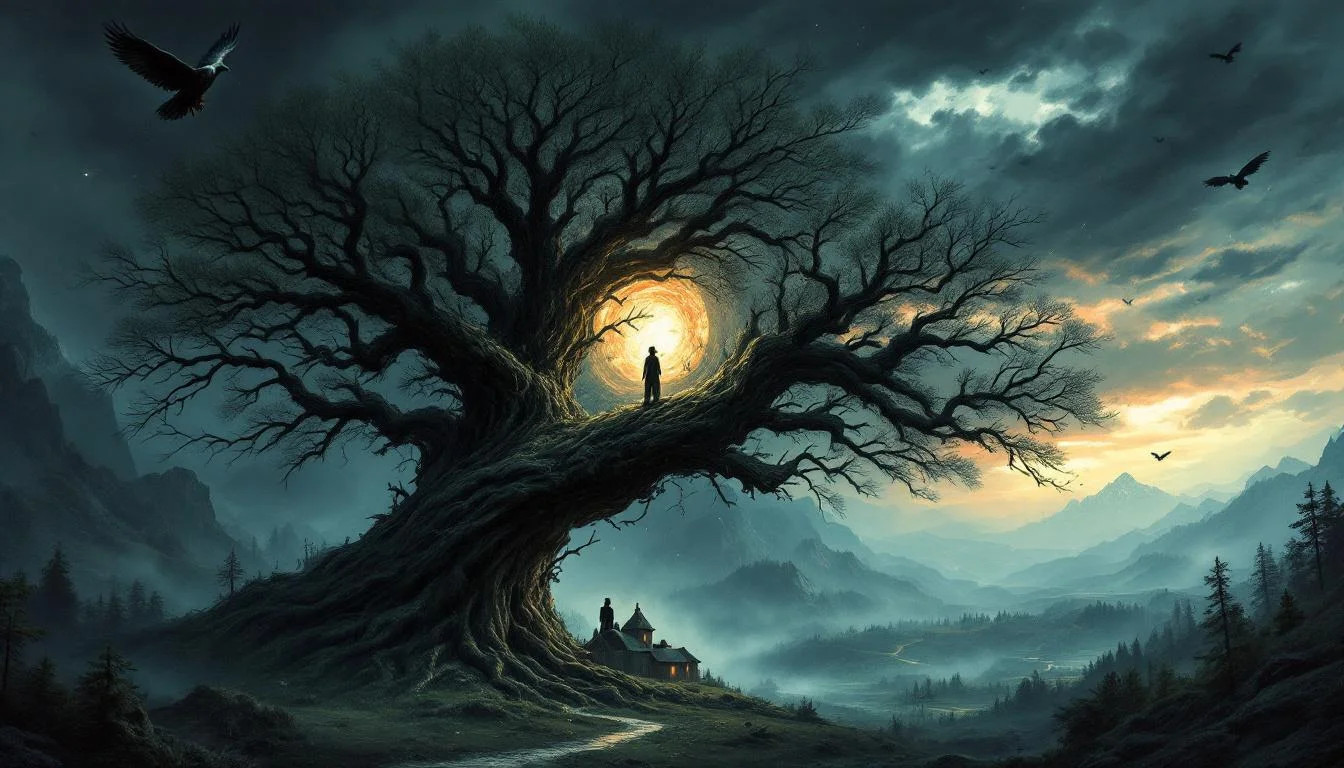
In the three-world cosmology of the ancient Slavs, the universe was a vertical structure — a cosmic tree with three layers. Prav (the principle of divine law) occupied the crown. Yav (the visible, living world) occupied the trunk. Nav occupied the roots.
The imagery was not accidental. Roots grow downward, into the dark, into the wet, into soil that is composed — if you think about it, which the Slavs apparently did — of the decomposed remains of everything that has ever lived and died. The roots drink from this. The tree's life comes, in part, from the dead matter below. The metaphor encoded a genuine ecological insight: the living world is nourished by the dead world. Nav feeds Yav. The underworld is not a punishment for the living but a condition for the living — the foundation without which the tree cannot stand.
The World Tree itself — the cosmic oak or ash that connected the three worlds — had its roots soaking in black water. This water was sometimes described as a river, sometimes as a swamp, sometimes as a vast underground sea with no visible shore. The water was always dark. It was always cold. And it was always associated with Veles, the god who ruled Nav from somewhere down among the roots.
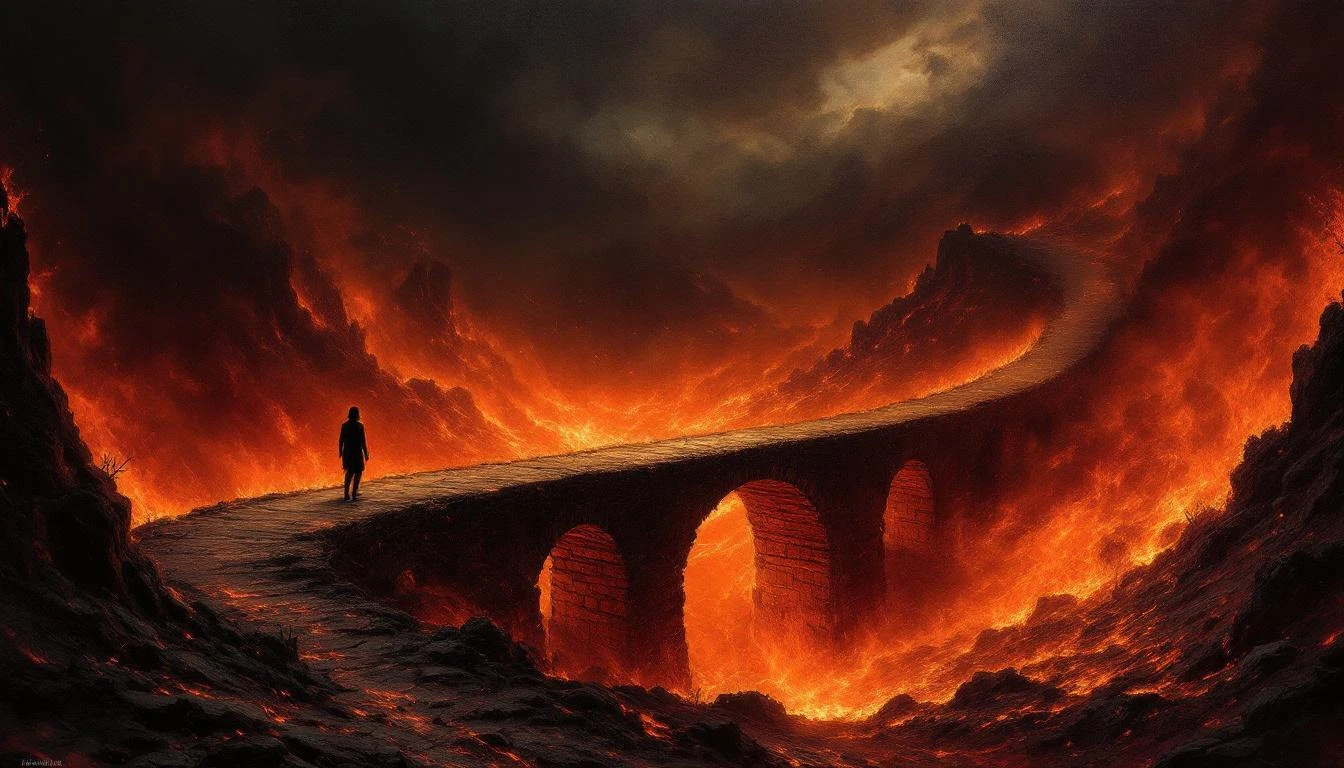
The entrance to Nav was guarded by obstacles that varied by region and by the specific tale being told. The most famous was the Smorodina River — a boundary between the living world and the dead one, described in Russian folk tales as a river of fire. The name Smorodina is sometimes translated as "currant river" (from smorodina, "currant"), but the older etymology connects it to smrad — "stench." The river stank. It burned. It was both repulsive and impassable, a barrier designed to keep the living out and the dead in.
Crossing the Smorodina required the Kalinov Bridge — a narrow span made from the wood of the kalina (guelder-rose) tree. The bridge glowed red from the heat of the river beneath it. On the far side, in many tales, a guardian waited: sometimes a multi-headed dragon, sometimes a warrior-figure, sometimes simply the darkness itself, pressing against the traveler like a physical weight.
The phrase "to cross the Kalinov Bridge" became a euphemism for dying in Russian folk speech. It carried the same resonance as "crossing the Styx" in English — except the Slavic version was louder, hotter, and more violent. The Styx was quiet. The Smorodina was on fire.
Veles: Lord of the Wet Kingdom
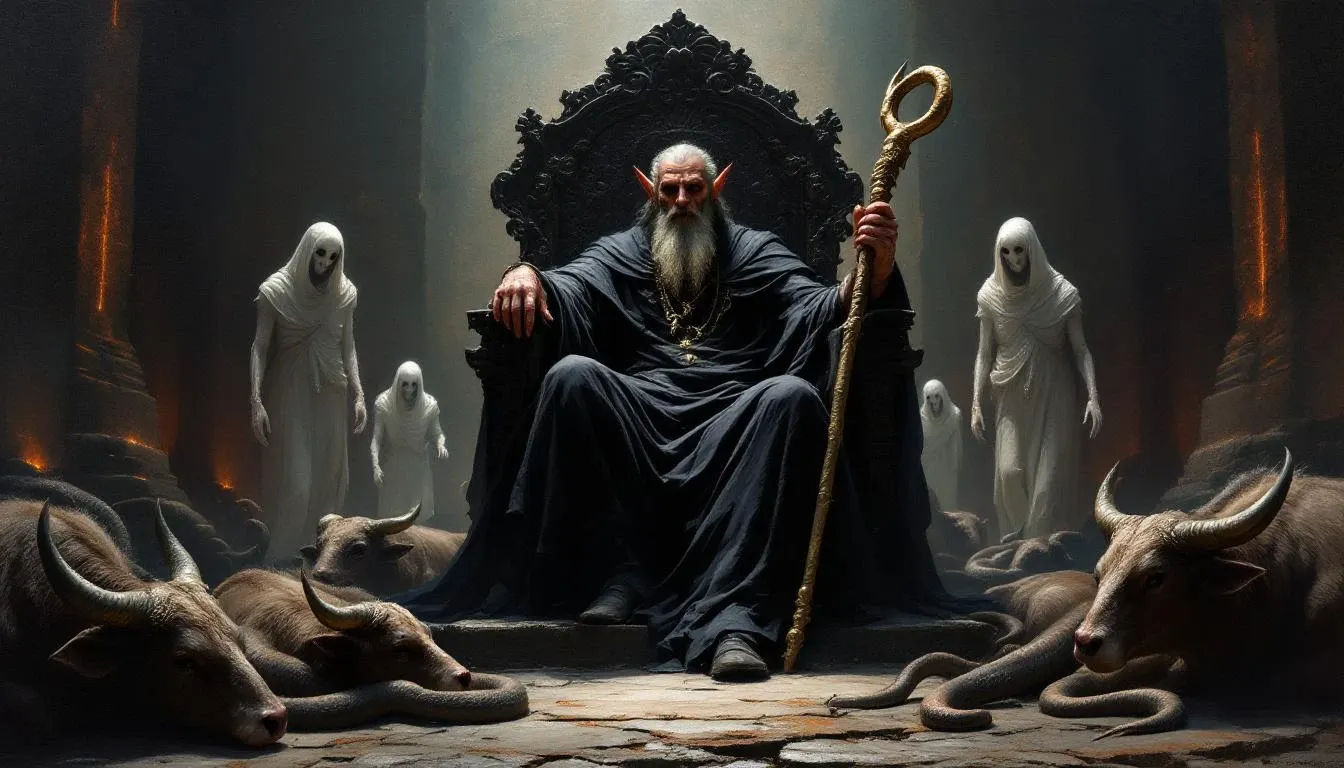
The ruler of Nav was Veles — the shaggy god of cattle, wealth, magic, music, and the dead. Veles is one of the oldest and most complex figures in Slavic mythology, and his role as lord of the underworld was central to the entire cosmological system.
Veles sat at the base of the World Tree, in the roots, in the water. His domain was wet — swamps, rivers, underground springs, the moisture that rises from the earth in the morning and sinks back into it at night. Where Perun ruled from the sky with lightning and fire — dry, bright, violent — Veles ruled from below with water and earth — dark, slow, patient. The eternal conflict between Perun and Veles was the engine of the Slavic cosmos: Perun struck down, Veles rose up, the rains fell, the rivers flowed, and the agricultural cycle continued.
Nav was Veles's kingdom, and he ruled it as a shepherd rules his flock. The dead were his cattle. This was not a metaphor chosen for poetic effect. The Slavic word for wealth (skot) and the word for cattle were cognate, and Veles was the god of both. The dead accumulated in Nav the way cattle accumulated in a pasture — as a form of wealth, a store of value, a measure of the god's power. The more dead, the richer Veles. The more souls grazing in his wet meadows, the more powerful the lord of the underworld.
This pastoral model of the afterlife is profoundly different from the judicial models of Christianity, Islam, or late Egyptian religion, where the dead are sorted by moral quality — good souls go up, bad souls go down. In the Slavic system, souls were not sorted. They were collected. Veles did not judge the dead. He received them. He kept them. He was not a punisher or a rewarder. He was a manager. His underworld was not a courtroom. It was a ranch.
The Unclean Dead: Zaloshnye Pokoyniki
Not all dead arrived in Nav properly. The Slavic folk taxonomy of death drew a hard, unforgiving line between the "clean dead" (roditelji, the ancestors) and the "unclean dead" (zaloshnye pokoyniki) — and the consequences of falling on the wrong side of that line were severe.
The clean dead were people who had died correctly. Old age. Illness that ran its natural course. Death in battle. Death after proper farewells, proper funeral rites, proper burial with the correct objects and the correct rituals. These dead crossed the Smorodina, passed over the Kalinov Bridge, entered Nav, and took their place among the ancestors. They were honored. They were fed at feast days. They were spoken to with respect. They could be called upon for help, and they responded. They were the family's invisible extension — dead, yes, but still present, still invested in the family's welfare, still watching from below.
The unclean dead were everyone else. And the list was long.
Suicides. Drowning victims. Murder victims. Women who died in childbirth. Stillborn infants. Children who died unbaptized (in the Christian period; before Christianity, likely children who died unnamed). Drunkards who died in their cups. Sorcerers and witches. Anyone struck by lightning. Anyone who died during a liminal calendar period. Anyone whose body was not found. Anyone buried without the proper rites.
These dead did not complete the journey. They were stuck — not in Nav and not in Yav, but somewhere between, in the wet and rotting borderland where the two worlds touched. They became navi, navki, mavki — spirits of the unquiet dead who could not rest and would not stay underground.
The unclean dead were dangerous precisely because they were incomplete. A proper ancestor in Nav was satisfied — fed, honored, settled. An unclean dead soul was hungry, angry, and trapped. It could not complete the journey because the rituals had not been performed, or could not be performed, or the Church refused to perform them. The soul lingered. It wandered. It appeared at the edges of villages, in swamps, at crossroads, at the boundaries between cultivated land and wilderness — all liminal spaces, all places where the border between worlds was thin.
In East Slavic tradition, the unclean dead took specific forms. Some appeared as Rusalki — the spirits of drowned women or unbaptized girls who haunted rivers and lakes, luring the living into the water. Some appeared as black birds with infant faces — the navki proper, the spirits of dead children who flew through the night demanding to be baptized. Some appeared as shadows, as cold spots, as unexplained sounds — footsteps in empty rooms, breathing in empty fields, the sense of being watched by something that stood just outside the range of vision.
The zaloshnye pokoyniki are not punished by any divine authority. Their condition is not a sentence. It is a consequence — the natural result of a death that was not completed according to the necessary forms. They are not evil. They are trapped. And their danger to the living comes not from malice but from the unbearable incompleteness of their state.
Nav Is Not Hell
This point requires emphasis because centuries of Christian influence have blurred it beyond recognition in many popular accounts of Slavic mythology.
The Christian concept of hell is a place of punishment. Sinners go there because God (or divine justice) sends them there as a consequence of moral failure. Hell is the result of judgment. It is the negative pole of a binary moral system: heaven for the good, hell for the bad.
Nav was none of these things. Nav was where the dead went because the dead had to go somewhere. It was not a punishment. It was not the result of moral failure. A hero and a coward, a saint and a murderer, a king and a beggar — all went to Nav. The moral quality of a person's life had no bearing on their destination. What mattered was how they died and whether the proper rites were performed. A virtuous man who drowned without witnesses and was never found might become a dangerous unclean spirit. A mediocre man who died peacefully in bed and received a proper funeral would take his place among the honored ancestors. The system was ritual, not ethical.
This does not mean that Nav was pleasant. It was dark. It was wet. It was cold. The dead existed there in a diminished state — not fully alive, not fully conscious (in most traditions), but present. They ate — which is why the living left food at graves on feast days. They drank — which is why libations were poured. They watched — which is why the living felt observed, especially in autumn when the boundary between worlds was thinnest. But the darkness and cold of Nav were not inflicted as punishment. They were simply the nature of the place, the way cold is the nature of winter. Winter is not punishing you. It is being winter. Nav was not punishing the dead. It was being Nav.
The Christian missionaries who arrived in Slavic lands between the 9th and 12th centuries understood the danger that Nav posed to their theology. If the dead went to Nav regardless of moral quality, then the Church's central leverage — the promise of heaven and the threat of hell — lost its force. Why behave morally if the afterlife destination is determined by funeral rites rather than by the quality of the life lived? The missionaries responded by absorbing Nav into the Christian framework: Nav became associated with hell, Prav became associated with heaven, and the moral sorting that the original system lacked was imposed retroactively. The process was not instantaneous — folk belief resisted — but over centuries, the pre-Christian Nav was overwritten by the Christian hell in popular understanding, surviving only in fragments: the rituals of feeding the dead, the fear of the unclean dead, the sense that the world below was occupied by something other than empty dirt.
Radunitsa: The Day the Living Feed the Dead
If the dead in Nav continued to exist, they continued to need nourishment. And if they needed nourishment, someone had to provide it. This logic — straightforward, practical, uninterested in theological abstraction — produced one of the most distinctive features of Slavic folk religion: the regular, calendrical feeding of the dead.
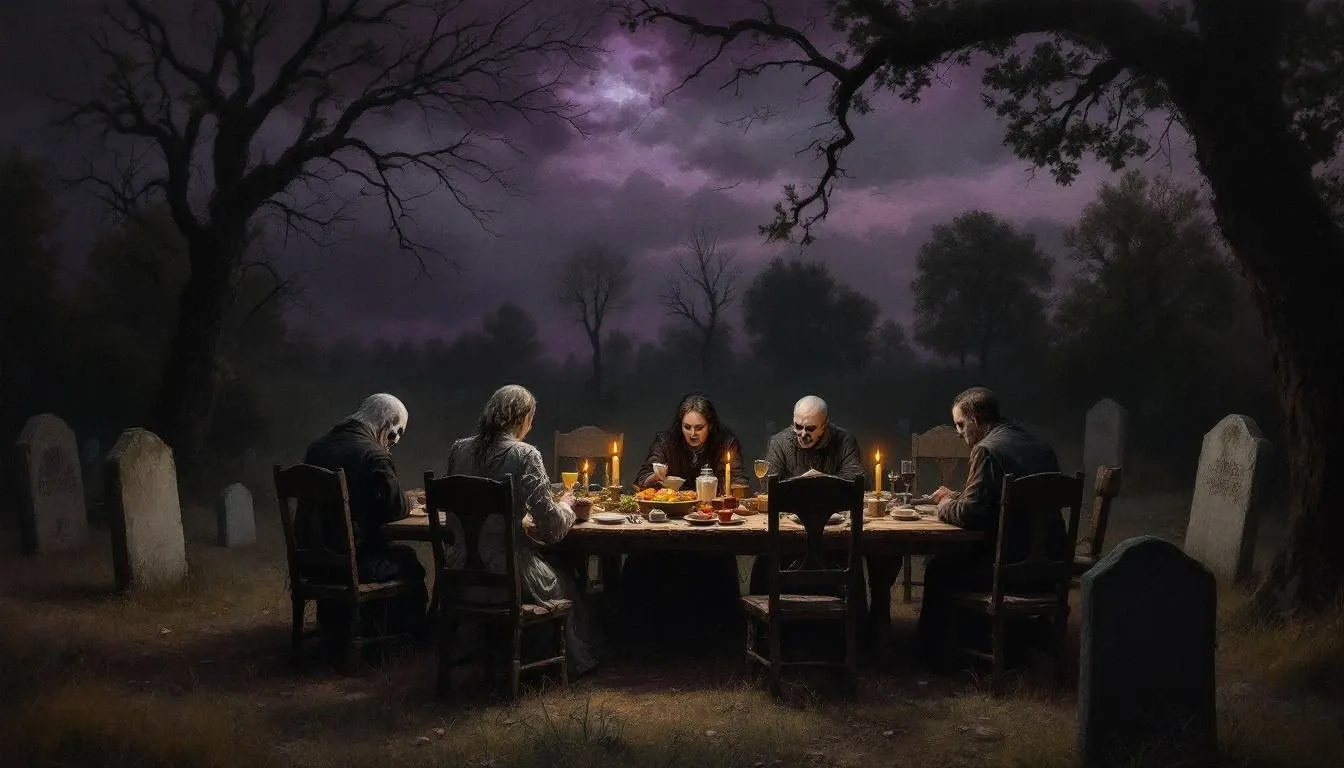
The most important of these feeding days was Radunitsa (also Radonitsa, Radunitsa), a spring feast held in the week after Easter in the Orthodox calendar. On this day, families traveled to the cemetery, spread cloths on the graves of their ancestors, and ate a meal. Not next to the graves. On the graves. The food was shared: a portion for the living, a portion for the dead. Bread was crumbled on the earth. Eggs — painted Easter eggs, in the Christian period — were placed on the grave or buried beside it. Liquor was poured on the ground. In some regions, the food was left overnight so the dead could eat in peace after the living departed.
Radunitsa was not a solemn affair. It was a feast — noisy, communal, sometimes drunken. The living talked to the dead. They told them the year's news: who had married, who had been born, who had died and joined them. They sang. They wept. They laughed. The cemetery on Radunitsa was the noisiest place in the village, because the dead were part of the family and this was the family dinner.
The Church's relationship to Radunitsa was complicated. The practice was obviously pre-Christian in origin — feeding the dead at gravesites predates Christianity in the Slavic world by centuries, if not millennia. The missionaries could not suppress it. It was too deeply rooted, too emotionally necessary, too fundamentally part of how Slavic communities understood their relationship to their ancestors. Instead, the Church absorbed it: Radunitsa was placed in the liturgical calendar, given a Christian interpretation (the living share the joy of Christ's resurrection with the dead), and allowed to continue with Christian prayers layered over the older rituals.
The older rituals persisted underneath. The pouring of liquor. The crumbling of bread on the grave. The speaking to the dead as though they could hear. These acts did not require Christian theology to make sense. They required only the belief that Nav was close, that the dead were listening, and that they were hungry.
Dedy, Dziady, Zadushnitsa
Radunitsa was not the only feeding day. The Slavic calendar contained multiple occasions for communing with the dead, each one rooted in the same fundamental conviction: the dead are present, the dead are watching, and the dead must be maintained.
Dedy (in Belarusian and Ukrainian tradition) or Dziady (in Polish tradition) were autumn commemorations of the dead — held in October or November, near the time when the agricultural year ended and the earth prepared for winter. The timing was not coincidental. The dead belonged to the earth, and as the earth went dark and cold, the dead rose closer to the surface. The boundary between Nav and Yav thinned. The ancestors pressed upward. Dziady was the response: a meal shared across the border, an acknowledgment that the dead were near and needed to be honored before the long winter sealed them away again.
In South Slavic tradition, the equivalent was Zadushnitsa (or Zadusnice) — literally "for the souls." Held multiple times per year in Serbian and Bulgarian communities, Zadushnitsa involved cemetery visits, food offerings, and the lighting of candles on graves. The food was typically kolivo — boiled wheat mixed with honey and nuts, a ritual dish whose preparation followed strict traditional rules. The wheat symbolized resurrection (the seed that dies in the earth and rises as new grain), while the honey symbolized the sweetness of paradise. The combination was an offering to the dead and a prayer for their wellbeing — a meal that said, simultaneously, "we remember you" and "we hope you are well."
Navki and Mavki: The Spirits That Leak Through
Nav was supposed to stay below. The dead were supposed to stay in their place. But the boundary was porous — sometimes by design (the feast days), sometimes by accident, and sometimes because certain dead refused to stay where they had been put.
The navki — also called mavki in Ukrainian tradition — were spirits of the unclean dead who had escaped Nav or, more precisely, had never entered it. They were the dead who had not completed the journey: unbaptized children, drowning victims, suicides, women who died in childbirth. They existed in the boundary space between Nav and Yav, and they leaked through into the living world with disturbing regularity.
In East Slavic tradition, navki appeared as black birds with infant faces — the most disturbing image in the entire Slavic spirit catalogue. They flew through the night, crying, demanding baptism. If a living person spoke the baptismal formula over them, they were released and could complete their journey to Nav. If no one spoke it, they remained trapped for seven years, after which they became permanent water spirits or worse.
In Ukrainian tradition, the mavki were pale girls with transparent backs — you could see their internal organs from behind, a detail of visceral horror that suggested their incompleteness. They had died as children, never grown up, never become full people. Their transparency was the visible mark of what they lacked: the completion of a human life. They haunted forests and swamps, appearing beautiful from the front and horrifying from behind — a being that was only half-finished, viewed from any angle.
These spirits were Nav's overflow. They were what happened when the boundary failed, when the rites were not performed, when the dead were not properly sent below. Their existence in the living world was a symptom of a broken system — an indication that someone, somewhere, had failed to do what needed to be done to keep the dead where they belonged.
The Persistence of Nav
Nav did not disappear when the Slavic lands became Christian. It could not disappear, because the beliefs it encoded — the dead are present, the dead are hungry, the dead must be fed — were not theological propositions that could be replaced by better theological propositions. They were emotional realities. They were the way grief functioned in communities where every family had lost someone and the loss never fully healed.
The feeding of the dead continues today. In Orthodox communities across Russia, Ukraine, Belarus, Serbia, and Bulgaria, cemetery visits on Radunitsa and memorial days remain common. The food has changed — fewer animal sacrifices, more candy and cigarettes left on graves — but the structure is identical. You bring food. You share it. You talk to the dead. You leave something for them.
The dead, in the Slavic understanding, never quite go away. They are below you. They are listening. The ground you walk on is the ceiling of their world, and if you put your ear to the earth on the right night — Dziady, Radunitsa, the autumn equinox — you might hear them. Not screaming. Not in torment. Just existing. Eating what you left for them. Watching through the dirt. Waiting for the next time you visit with bread and eggs and news from the world above.
Nav is still there. It has always been there. It is the oldest address in the Slavic cosmos, and its residents have not moved out.