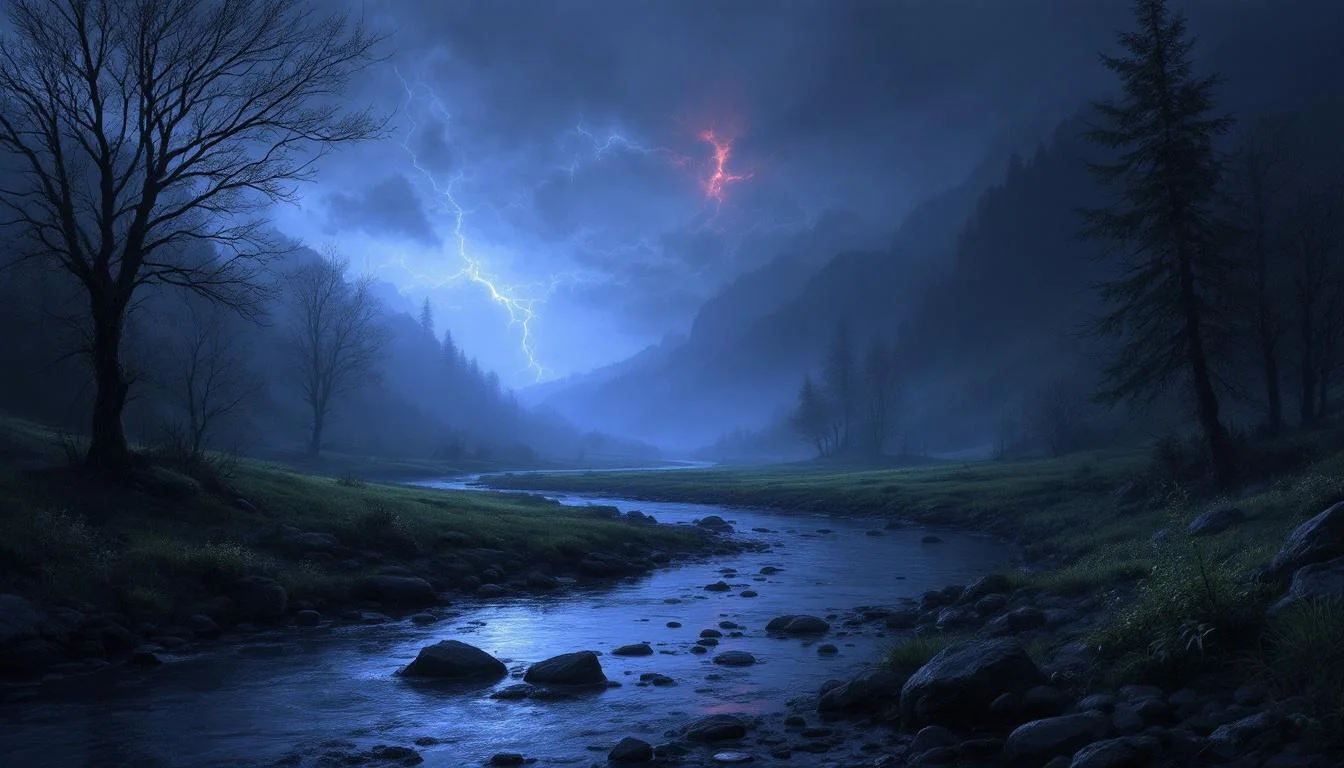
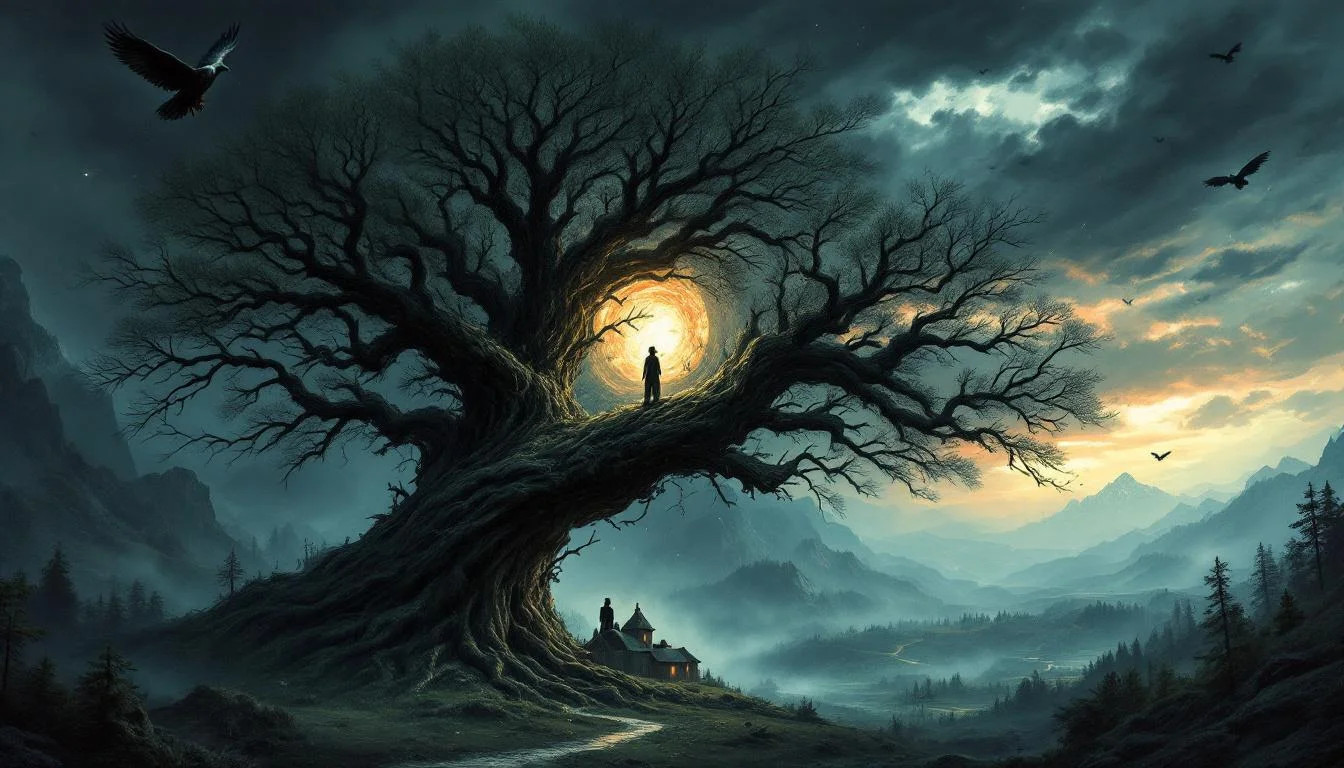
Every autumn, the birds leave. The storks fold their enormous wings into travel position and lift off from the rooftops where they nested all summer. The swallows vanish from the eaves. The cuckoo's voice, which counted out the years of your life when you asked it in May, goes silent. The geese form their wedges against a gray sky and fly south until they are specks, then nothing. The world empties. The trees go bare. The silence settles in.
Where do they go?
The modern answer is prosaic: Africa, the Mediterranean, southern Asia. Migration routes mapped by satellite, distances measured in kilometers, survival explained by the mechanics of fat reserves and prevailing winds. The ancient Slavs had a different answer, and it was better. The birds fly to Iriy.
Iriy — also called Vyraj, Iriy-sad (Iriy-garden), or Vyrei — is the Slavic paradise. Not heaven in the Christian sense, though Christianity later tried to absorb it. Not the afterlife exactly, though the dead live there. Iriy is the place where the warmth goes when it leaves the world. It is the garden beyond the edge of the known earth where springs flow with warm water year-round, where trees bear fruit in every season, where flowers bloom in colors that the northern world sees only in dreams. It is the place the birds know and humans do not, the country that every stork carries in its memory like a map written on its bones.
The word iriy is ancient. Its etymology is debated — some scholars connect it to the Iranian airya- (noble, belonging to the Aryans), others to a Proto-Slavic root related to warmth or flowing water. The variant vyraj may come from a root meaning "to boil" or "to seethe," suggesting water that is hot, that steams, that moves with life. What is not debated is the age. The concept appears in the earliest layers of Slavic thought, in the stratum that predates not just Christianity but any organized theological system — the level where observation of the natural world and mythology are the same thing.
The Slavs watched the birds leave. They watched the birds return. They built a theology around the journey.
The Garden Beyond the Sea
The location of Iriy is never precisely fixed, because paradise resists cartography. But the folk tradition provides enough coordinates to sketch a geography.
Iriy lies to the south and to the east — the direction of warmth, the direction of the rising sun. It is separated from the world of the living by water: a great sea, or a river, or sometimes both. In some traditions, Iriy is on an island — a detail that connects it directly to Buyan, the mythical island in the ocean where the sun rises, where the Alatyr stone stands, and where all the forces of the cosmos originate. Buyan and Iriy may be the same place seen from different angles, or different regions of the same otherworldly archipelago.
The garden itself is described in terms that are lush to the point of delirium. Eternal spring. Trees heavy with fruit — apples, most often, the fruit that recurs across Slavic mythology as a symbol of life, youth, and the otherworld. Flowers that never wilt. Water that is warm and clean and somehow luminous. The air smells of honey and blooming linden. There is no cold, no hunger, no sickness, no death — or rather, death is present but has been tamed, domesticated, made into something that looks like sleeping in a warm meadow rather than the grim journey across the Smorodina River.
The description of Iriy is suspiciously similar to the descriptions of the lands around the Black Sea and the Mediterranean as they might have been transmitted through centuries of oral retelling by a people who lived in the frozen north. The warm springs, the fruit trees, the flowers that bloom in winter — these are not fantasy for the inhabitants of Greece or Anatolia. They are Tuesday. The possibility that Iriy preserves a folk memory of warmer southern lands — encountered through trade, migration, or the reports of travelers — is tantalizing but unprovable. What is certain is that Iriy represents everything the Slavic winter is not: warmth, abundance, greenness, life.
The Key-Birds: Storks, Cuckoos, and Soul-Carriers
Not all birds are equal in the Iriy mythology. Certain species occupy privileged positions as mediators between the human world and paradise, and their comings and goings were watched with an attention that bordered on divination.
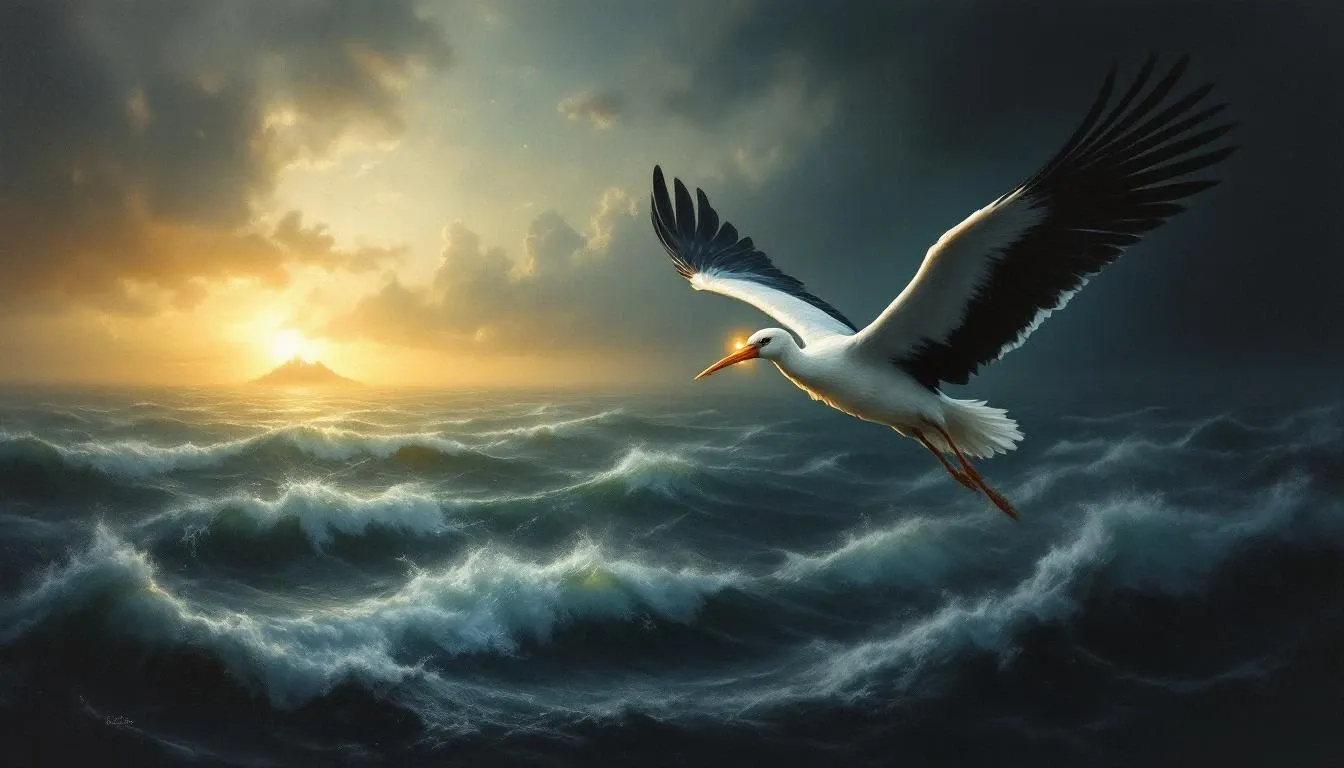
The stork is the most important of the key-birds. Across the East Slavic world, the stork was regarded as a sacred animal — it was a sin to kill one, a blessing to have one nest on your roof, and a catastrophe to have one abandon your house. The stork's annual migration was understood not as a biological imperative but as a spiritual journey: the bird traveled to Iriy in autumn and returned in spring, carrying the warmth with it. The arrival of the first stork was the arrival of spring itself. The bird did not merely correlate with the season's change — it caused it, the way a messenger causes the news they carry.
More than warmth, the stork carried souls. In widespread East Slavic belief, the stork delivered the souls of newborn children from Iriy to the world of the living. This is the deep root of the "stork brings babies" folklore that survives in sanitized form across Europe — but the Slavic original was far more specific and far more serious. The souls of the unborn waited in Iriy, in the warm garden, among the apple trees and the never-freezing springs. When it was time for a child to be born, a stork collected the soul and carried it north, delivering it to the household where the birth would occur. A house with a stork's nest on its roof was a house that the birds — and by extension, the forces of Iriy — favored. A house whose stork left and did not return was a house marked for misfortune.
The cuckoo occupied a different but equally significant role. The cuckoo was the bird of fate — the one you asked, "Cuckoo, cuckoo, how many years will I live?" and counted the calls for your answer. In some traditions, the cuckoo was the bird that held the keys to Iriy. It was the first to arrive in the garden in autumn and the first to leave in spring. It opened the gates and closed them. When the cuckoo fell silent in midsummer — typically around St. Peter's Day, June 29 — it was because the bird had already begun its journey south, carrying the keys to paradise back to their proper place. After the cuckoo's last call, summer was officially in decline. The gate to Iriy was open, and the warmth was beginning to drain from the world.
The ancient Slavs believed that the cuckoo possesses the keys to the warm land (Iriy or Vyraj), and that in autumn it is the first among all birds to fly away into that blessed country. The cuckoo unlocks Iriy in spring and locks it at midsummer, and this is why after St. Peter's Day the cuckoo ceases to sing — it has already departed for the warm land, and the keys hang at its belt.
The swallow held its own significance. The first swallow of spring was greeted across the Slavic world with specific rituals — children sang songs to welcome it, families baked special breads in the shape of birds, and the date of its arrival was noted as a predictor of the coming season's character. The swallow was Iriy's advance scout, the first sign that the garden had released its hold on the warmth and allowed it to return north.
Veles at the Gate
If Iriy is the Slavic paradise, someone must guard it. The folk tradition assigns this role to Veles — the god of the underworld, of cattle, of wealth, of the dead, the great adversary of Perun in the central myth of Slavic cosmology.
This assignment seems paradoxical. Veles is a chthonic deity, associated with the roots of the World Tree, with the realm of Nav — the world of the dead. Why would the god of the underworld guard the gates of paradise? The answer lies in the structure of Slavic cosmology itself, which does not draw the sharp line between paradise and underworld that Christianity insists upon.
In the Slavic three-world system, the realm of the dead — Nav — is located below, at the roots of the World Tree. But "below" is not the same as "bad." Nav is where the ancestors live. It is where the cattle of Veles graze on green meadows (Veles is, among other things, the divine herdsman). It is where the seeds of next year's grain wait through the winter to germinate in spring. The underworld, in pre-Christian Slavic thought, is not hell. It is the source — the dark, warm, wet place from which all life originates and to which all life returns.
Iriy, then, is not the opposite of Nav. It is Nav experienced from the inside — the underworld as its inhabitants know it, not as the living imagine it. For the living, the realm of the dead is dark and frightening, separated by fire and guarded by serpents. For the dead themselves — and for the birds who visit seasonally — it is a warm garden where the apple trees never stop bearing fruit. The Smorodina River is a border of fire when approached from the side of the living and a warm stream when approached from the side of the dead. It is the same place seen from two different directions.
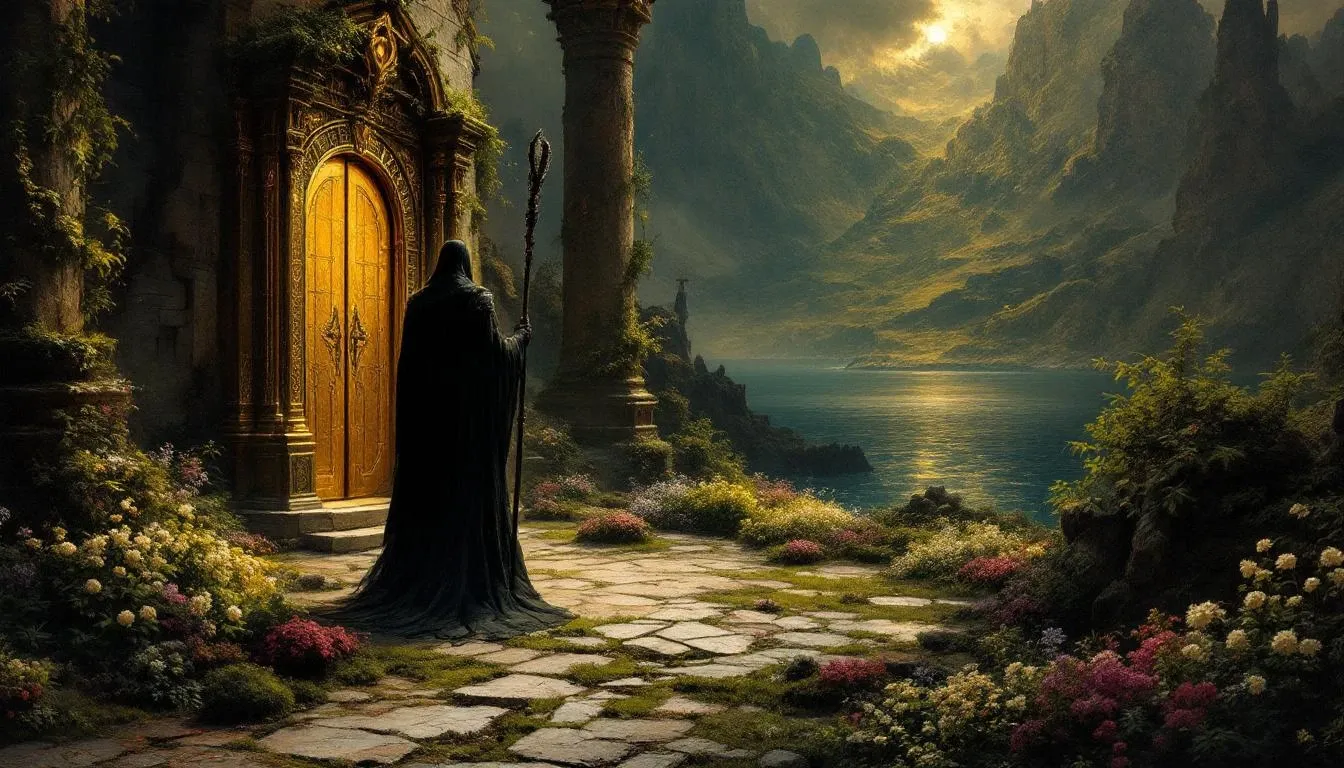
Veles guards the gate because Iriy is his domain. He is the shepherd of the dead, and the dead are his flock, grazing in the meadows of the warm land. The birds come to him in autumn and leave in spring, and his permission governs both arrivals and departures. When the stork carries a soul from Iriy to the world of the living, it is carrying something that Veles has released — a soul from his flock, sent north to be born into a new body.
This reading unifies elements of Slavic cosmology that otherwise seem contradictory. The paradise of the dead and the underworld of the dead are the same place. The god of death is the keeper of paradise. The birds that bring spring are the same birds that carry souls. Everything connects, and the connection runs through Iriy.
Seasonal Cosmology: The Engine of the Year
The Iriy mythology is not merely a story about where the birds go. It is a cosmological engine — a mechanism that explains the cycle of the seasons in terms that are simultaneously poetic and rigorously logical within their own framework.
The cycle works like this. In autumn, the warmth of the world drains south. It flows — like water, like migrating birds, like the life force itself — from the lands of the living toward Iriy. The birds are not merely traveling alongside the warmth. They are carrying it. Each migrating flock takes a portion of the world's heat with it, and when the last bird has gone, winter arrives because the warmth has physically departed. The world is cold because its warmth is elsewhere — stored in Iriy, held in trust by Veles, waiting in the garden beyond the sea.
In spring, the process reverses. Veles releases the warmth. The birds take flight from Iriy, carrying heat and life force back to the north. The storks return to their rooftops. The swallows reclaim their eaves. The cuckoo sings. With each returning bird, a portion of warmth re-enters the world. Spring is not a meteorological phenomenon — it is a homecoming. The warmth returns because the birds bring it back, the way a traveler brings gifts home from a distant country.
This seasonal cosmology has a beauty and a coherence that is easy to underestimate. It explains bird migration — the most visible and dramatic seasonal change in the natural world of northern Eurasia — in terms that make it meaningful, that give it narrative weight, that transform a biological fact into a cosmic story. The stork on your roof is not merely a bird. It is an emissary of paradise, a carrier of warmth, a bridge between the world of the living and the garden where the dead feast in eternal spring. Its departure is a minor catastrophe. Its return is a resurrection.
The Kolyada celebrations at the winter solstice and the spring festivals that marked the return of the birds were both rituals embedded in this cosmological framework. The solstice marked the turning point — the moment when the sun began its return journey, the moment when Iriy started to release the warmth back into the world. The spring festivals — Maslenitsa, the equinox celebrations, the first-stork rituals — marked the warmth's actual arrival, the moment when the theory of the solstice became the reality of melting snow and budding trees.
Iriy vs. Christian Heaven
When Christianity arrived in the Slavic lands, it brought a different paradise — one located upward rather than southward, one governed by God rather than Veles, one accessed through moral virtue rather than through the natural cycle of death and seasonal migration.
The collision between these two paradises was not violent but it was total. Over the course of centuries, Christian heaven absorbed Iriy the way a larger organism absorbs a smaller one — not by destroying it but by incorporating it, digesting its elements, redistributing its features across a new framework.
The warm garden survived. Christian descriptions of paradise in Slavic folk Christianity retained the orchards, the warm springs, the eternal greenery of Iriy. The Slavic Christian's heaven looked less like the abstract bliss of Western theology and more like a very good garden in a very warm climate — which is to say, it looked like Iriy with a cross planted in it.
The soul-carrying birds survived, transformed. The stork's role as soul-deliverer was too deeply embedded in folk practice to be eradicated, so it was tolerated, reinterpreted, and eventually made quaint. The "stork brings babies" story that every European child hears is the final echo of a Slavic cosmological system in which the birds of Iriy literally ferried souls between paradise and the mortal world.
What did not survive was the cosmological engine. The seasonal cycle — the idea that the warmth itself migrated, that paradise was a real place in the south that held the world's life force through the winter — was incompatible with Christian theology, which placed heaven outside the physical world entirely. The birds still migrated. But in the Christian framework, they migrated because God had designed them to, not because they were carrying the essence of a warm garden back to the frozen north.
The Island Connection
Iriy does not exist alone in Slavic mythical geography. It connects to — and may be identical with — Buyan Island, the most famous of all Slavic mythical locations.
Buyan is the island in the ocean where the sun rises. It is the home of the Alatyr stone, the stone from which all rivers flow and upon which all the world's magic is written. It is the place invoked in Russian healing charms and love spells — "On the sea-ocean, on the island of Buyan, there stands..." — the opening formula of hundreds of folk incantations. Buyan is the center of everything, the navel of the world, the point from which all sacredness radiates.
The overlap with Iriy is extensive. Both are islands (or island-like places) surrounded by water. Both are located in a vaguely southern or eastern direction. Both contain springs that are the sources of the world's rivers. Both are paradisiacal — warm, fertile, abundant. Both are connected to the realm of the dead. The possibility that Buyan and Iriy are two names for the same mythical location — or two aspects of a single, complex otherworld — is strong.
If this identification is correct, then Iriy-Buyan is the central location in all of Slavic cosmology: the paradise, the source, the place where the dead feast and the birds winter and the rivers begin and the sun rises and the magic works. It is the Slavic answer to Eden, Avalon, Tir na nOg, and the Isles of the Blessed — a place of perfection located just beyond the edge of the known world, accessible to the dead and to birds but not to the living, visible only in its effects: the returning warmth, the arriving stork, the soul of a newborn child delivered to a waiting family.
What the Birds Remember
Iriy survives in fragments. No Slavic scripture preserves its full description. No temple was built to house its mysteries. No priesthood maintained its theology through the centuries. What survives are the scraps: a folk song about the cuckoo's keys, a grandmother's warning not to harm the stork, a healing charm that invokes the island beyond the sea, a feeling — shared by every person who has ever watched the autumn migration — that the birds know something we do not.
That feeling is the last echo of Iriy. It is the residue of a cosmological system that made the visible world make sense — that took the most obvious question a northern people could ask ("where does the warmth go in winter?") and answered it with a story so beautiful and so internally consistent that it survived a thousand years of Christianity, survived the age of reason, survived the mapping of every migration route on the planet.
The birds still leave in autumn. They still return in spring. And somewhere in the deep architecture of Slavic culture — beneath the Christianity, beneath the modernity, beneath the satellite tracking and the ornithological papers — there is still a garden. Warm water flows from beneath the roots of an oak tree. Apple trees bear fruit in every season. The dead rest in meadows greener than any meadow in the north. And in spring, when the first stork appears on the rooftop and the first cuckoo calls from the forest and the air softens and the ice begins to crack, something returns from Iriy that is not merely temperature.
It is the life of the world, coming home.