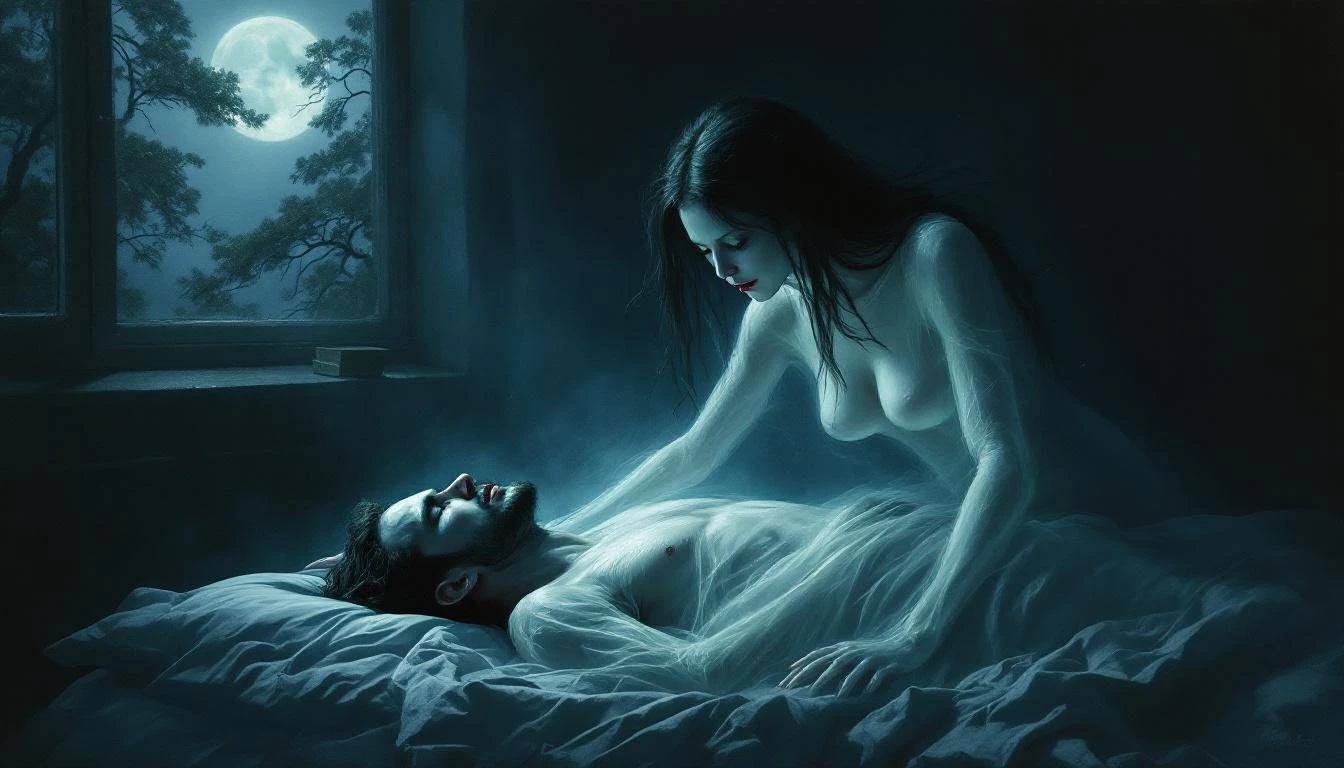
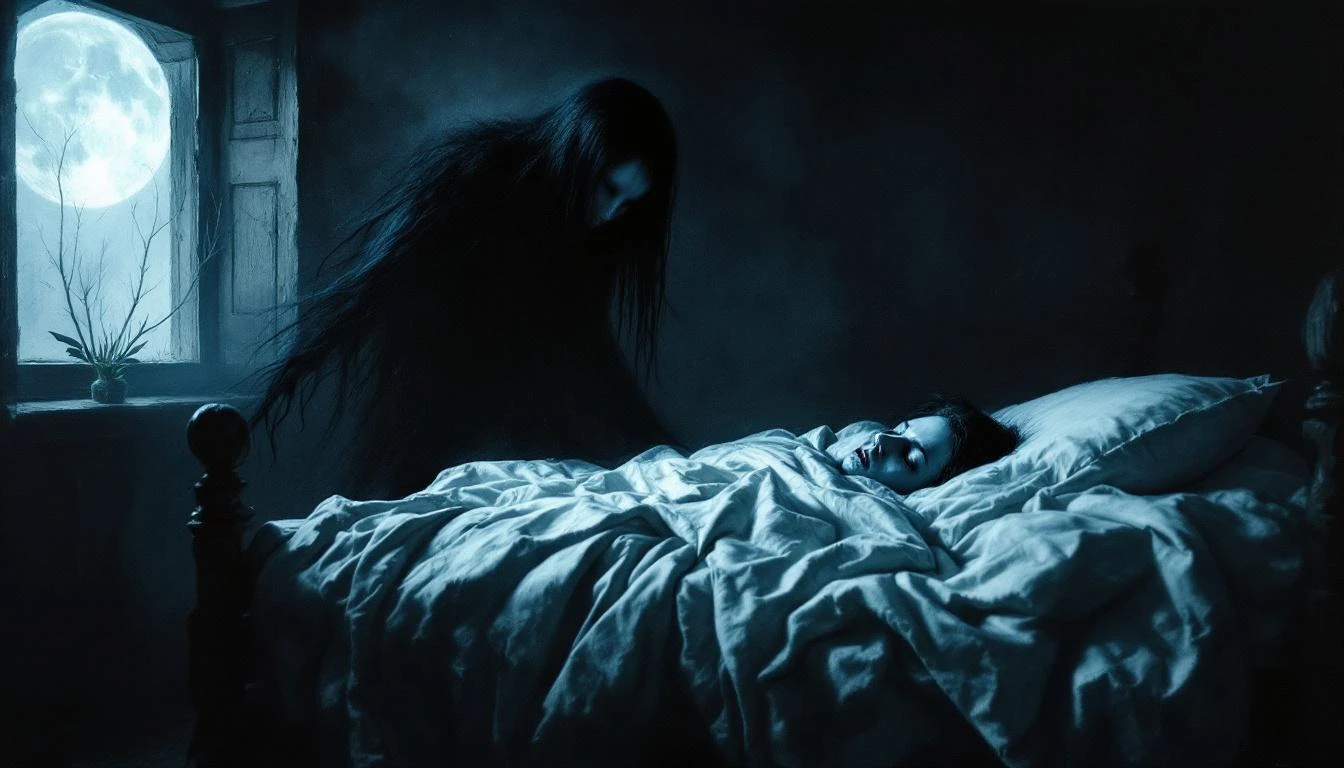
You fall asleep healthy. You wake up shaking. Your teeth chatter so violently that you can hear them cracking against each other. Your skin burns. Your eyes hurt in their sockets. You cannot keep food down, cannot keep water down, cannot keep your thoughts in a line. The fever rolls through you in waves — hot, cold, hot, cold — and between the waves there are moments of terrible clarity where you understand that something is inside you, something that was not there when you closed your eyes.
In the East Slavic folk tradition, this was not a metaphor. The fever was a person. Specifically, a woman. More specifically, one of twelve sisters who lived in a swamp, who emerged at night, who walked the roads in single file wearing white, and who entered your body through your open mouth while you slept.
They were called the Likhomanki. And each one brought a different kind of suffering.
The Twelve Names
The number twelve is fixed. Across all recorded variants — from northern Russia to Ukraine to Belarus — the Likhomanki always appear as twelve sisters. The names vary by region, but each name describes a specific symptom, a particular flavor of misery. The sisters are not interchangeable. They are specialized. Each one does one thing to the human body, and she does it thoroughly.
The most commonly recorded roster, drawn from East Slavic folk charms (zagovory) and ethnographic collections, runs as follows:
Tresya (Тресея) — "The Shaker." She enters first. She makes the body tremble. The word comes from tresti, to shake. Tresya is the chill, the rigor, the involuntary convulsion of muscles that have lost the ability to hold still.
Ogneya (Огнея) — "The Burner." She is fire. She follows the Shaker and replaces cold with heat so intense that the sick person throws off their blankets and begs for water. Her name comes from ogon', fire. Ogneya is the fever proper — the core temperature rising past what the body can safely sustain.
Ledeya (Ледея) — "The Freezer." Named from lyod, ice. She alternates with Ogneya, plunging the body back into cold. The classic malarial pattern — burning and freezing in cycles — was attributed to the sisters taking turns.
Gnetuya (Гнетуха) — "The Crusher." She presses on the chest. She makes breathing difficult. She sits on the ribcage the way the Mora sits on sleepers, but her purpose is not to steal breath — it is to make each inhalation a deliberate, exhausting effort.
Glukhaya (Глухая) — "The Deaf One." She takes hearing. Sounds become muffled, distant, wrong. The sick person calls out and cannot hear the response. She isolates.
Lomea (Ломея) — "The Breaker." She is pain in the joints and bones. Her name comes from lomat', to break. Every joint aches. Every bone feels like it is being bent in a direction it was not designed to go. She is the body-wide soreness that makes movement a negotiation between the will and the pain.
Pukhneya (Пухнея) — "The Sweller." She brings swelling — of the limbs, the face, the throat. Her name derives from pukhnut', to swell. She distorts the body's shape, makes it unrecognizable.
Zhelteya (Желтея) — "The Yellower." She turns the skin yellow. Jaundice. Her name from zholtiy, yellow. She attacks the liver, turns the whites of the eyes the color of old parchment.
Korchea (Корчея) — "The Twister." She brings convulsions and cramps — the body bending involuntarily, muscles locking in positions that the conscious mind did not choose. Her name from korchit', to contort.
Gludea (Глядея) — "The Watcher." She takes sleep. She holds the sick person's eyes open through the night, forcing a state of exhausted wakefulness where the boundary between reality and delirium dissolves. Some variants call her Bezsonnitsa — "Sleeplessness" — linking her to the Nocnitsa, the night spirit who steals rest from children and adults alike.
Nevea (Невея) — "The Dead One." She is the last sister. She does not bring a symptom — she brings death. Her name comes from nav', the Slavic world of the dead. Nevea arrives when all the other sisters have finished their work and the body has nothing left. She closes the eyes that Gludea held open.
The twelfth sister varies most between sources. Some charms name her Sukhaya (Сухая) — "The Dry One," who drains all moisture from the body until the skin cracks and the lips split. Others call her Khripusha (Хрипуша) — "The Hoarse One," who destroys the voice so the victim cannot call for help. The inconsistency is itself revealing: the twelfth position in the roster was a slot that communities could fill with whichever symptom they most feared.
The Swamp, the Night, the Open Mouth
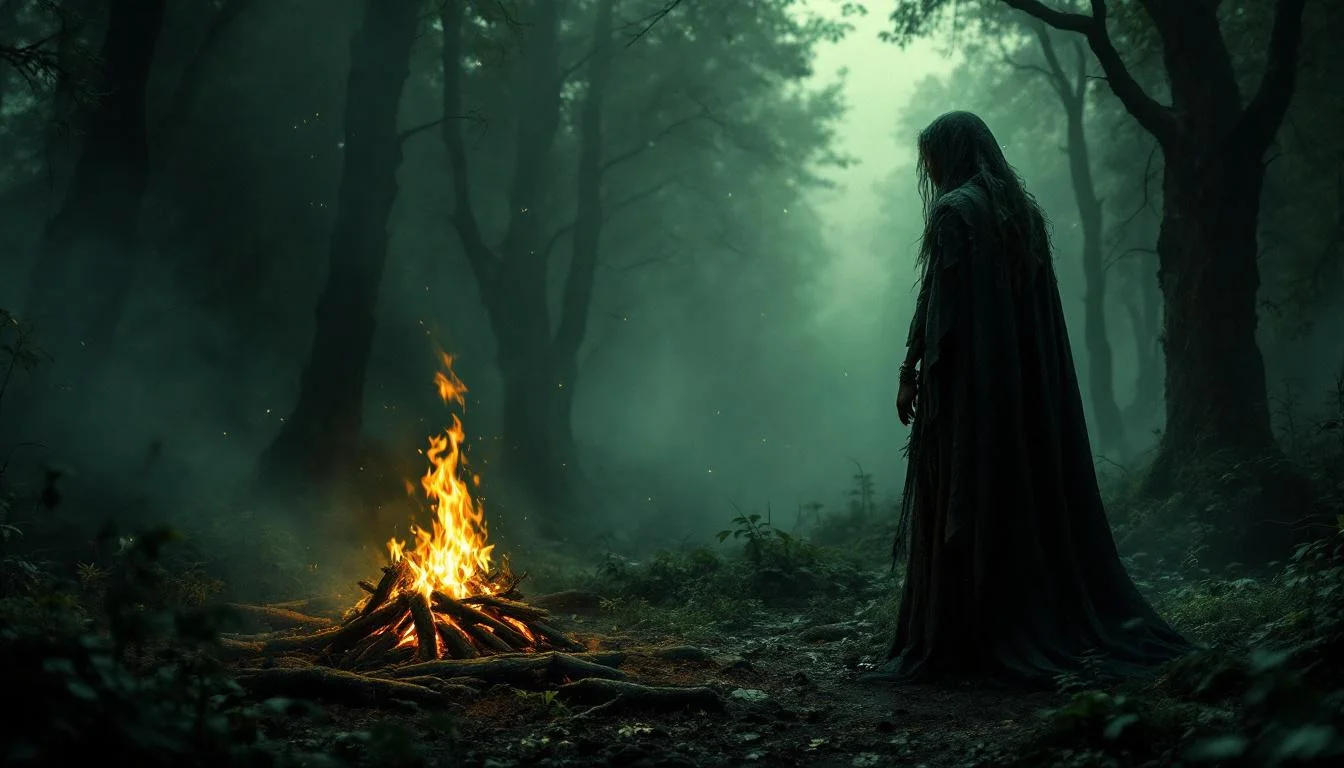
The Likhomanki originate in the swamp. This is consistent across all recorded variants, and the attribution makes epidemiological sense in ways the original believers could not have articulated. Malaria — the fever disease par excellence of pre-modern Eastern Europe — was endemic to swampy regions. The mosquitoes that carried the Plasmodium parasite bred in standing water, in marshes, in exactly the terrain that folk belief assigned to the Likhomanki. The sisters came from the swamp because the disease came from the swamp. The mythology was an accurate observation wrapped in supernatural language.
They traveled at night. They walked in single file along roads, dressed in white — some accounts say in tattered white shrouds, like the wrappings of the dead. They were thin, gaunt, with hollow eyes and long hair that hung loose and wet. They did not speak to one another. They simply walked, in silence, toward the sleeping village.
Their method of entry was the mouth. This detail is precise and consistent: the Likhomanki entered the human body through the open mouth of a sleeping person. A closed mouth was protection. A person who slept with their mouth open — as people with fevers and congestion often do — was inviting the sisters in. The folk logic is clear: disease enters through openings in the body. The mouth is the largest opening. Close it, and you close the door.
This belief generated a practical defensive measure that persisted in Russian villages well into the nineteenth century: sleeping with a hand over the mouth or a cloth tied around the jaw. Mothers would tie scarves around their children's faces at night — not as a medical measure, but as a supernatural one. The fabric was a barrier against the sisters. Its effectiveness against actual illness was incidental but real: a cloth over the face reduced inhalation of cold night air and the insects that carried disease.
The Zagovor: Speaking Disease Away
The primary defense against the Likhomanki was the zagovor — the spoken charm, the incantation, the word that carried power not through meaning but through form and delivery. East Slavic magical practice was fundamentally verbal. Written charms existed, but the spoken word was the primary technology of folk healing, and the zagovory against the Likhomanki constitute one of the richest and most extensively documented categories of Slavic incantatory literature.
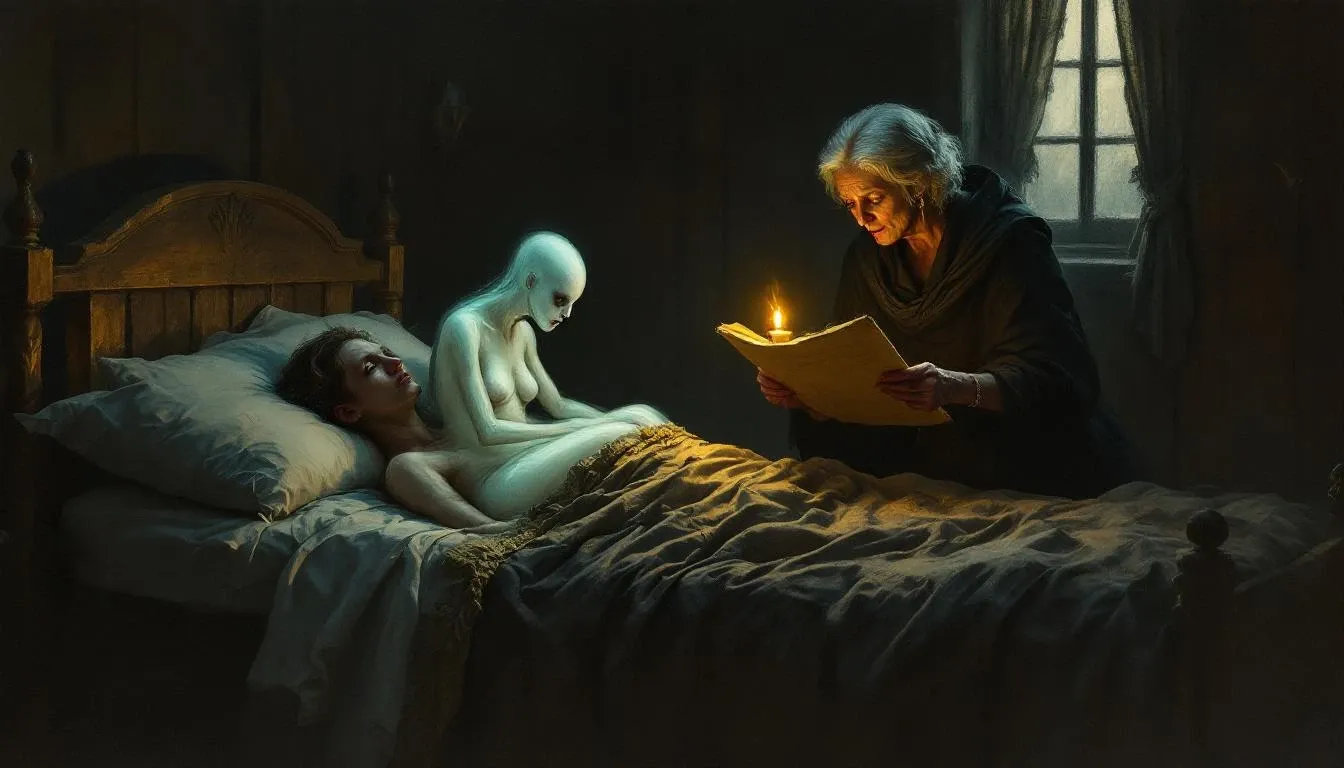
A typical anti-Likhomanki zagovor worked by naming the sisters — all twelve, in order, without hesitation or error — and then commanding them to depart. The naming was the crucial act. In the Slavic magical worldview, knowing a spirit's name gave you power over it. An unnamed fever was beyond control. A fever with a name — Tresya, Ogneya, Ledeya — was a fever that could be addressed, challenged, expelled. The healer did not ask the sisters to leave. The healer told them to leave, using a formula that combined their names with a destination — usually back to the swamp, or to a distant land across the sea, or into a specific tree or stone where they could be trapped.
"On the ocean-sea, on the island of Buyan, there lies a stone Alatyr, and under that stone dwell the twelve sisters, the Likhomanki, and they go out onto the holy earth to shake and burn and twist the baptized people. I command you, fever-sisters: go from this servant of God, go back to your swamp, go back to your damp places, where the human voice does not reach, where the church bell does not ring."
The invocation of the Alatyr stone and the island of Buyan is standard incantatory geography — the mythical landmarks that appeared in hundreds of East Slavic charms regardless of their specific subject. Buyan was the island at the center of the world-ocean, and Alatyr was the sacred stone upon which all reality rested. By invoking these cosmic coordinates, the healer was not just talking to the fever sisters — they were placing the act of healing within the framework of the entire Slavic universe, anchoring the human command in the structure of creation itself.
The zagovory often included material actions alongside the verbal formula. The healer might tie twelve knots in a cord — one for each sister — and then untie them as each name was spoken, releasing the fever symbolically as the knot released physically. Or the healer would write the names of the sisters on a piece of birch bark, wrap the bark around a stone, and throw the stone into a river, sending the disease downstream with the current.
The Iron Nail
The zagovor was the cure. The iron nail was the prevention.
Iron, across the entire Slavic folk magical system, was the universal ward against supernatural intrusion. Domovoy feared iron. Rusalki could not cross running water that flowed over iron. The Leshy would not approach a clearing where an iron axe had been driven into a stump. And the Likhomanki could not enter a house where an iron nail had been driven into the threshold.
The threshold nail was a specific and widespread practice. An iron nail — not a steel nail, not a copper nail, but a forged iron nail — was hammered into the bottom of the doorframe, at the point where the door met the floor. The Likhomanki, walking their nightly road from the swamp, would reach the threshold and be unable to cross. The iron burned them, or blinded them, or simply presented a barrier that their nature could not overcome.
Variations on the iron defense included hanging iron scissors above the bed (open, forming a cross shape — doubling the protective symbolism), placing an iron knife under the pillow, and wearing iron rings or bracelets during fever season. The overlap between anti-Likhomanki practices and general anti-spirit defenses in Slavic magical tradition is nearly total — a reminder that the folk system did not compartmentalize its threats the way academic taxonomy does. An iron nail on the threshold protected against fever sisters, night hags, household imps, and wandering dead with equal efficiency, because all of them were made of the same supernatural substance, and iron was hostile to all of it.
Daughters of Herod: The Christian Overlay
As Christianity absorbed and reinterpreted East Slavic folk belief, the Likhomanki acquired a biblical genealogy. They became the daughters of Herod — the same King Herod who ordered the Massacre of the Innocents in the Gospel of Matthew. According to this Christianized version of the myth, Herod's daughters were cursed by God for their father's sins and transformed into fever demons, condemned to wander the earth and afflict the faithful as punishment for the slaughter of Bethlehem's children.
This identification appears in manuscript charm collections (travniki and lechebniky) from the seventeenth and eighteenth centuries, where Christian and pre-Christian elements coexist with no apparent sense of contradiction. The healer who named the Likhomanki as Herod's daughters in one breath would invoke the pagan Alatyr stone in the next, and neither the healer nor their patient saw any inconsistency. The Christian overlay was not a replacement for the older belief — it was a supplement, an additional layer of authority that strengthened the charm by adding the weight of biblical narrative to the pre-existing folk structure.
The number twelve also acquired Christian resonance. Twelve apostles, twelve fever sisters — the symmetry was too neat to ignore, and some charms explicitly framed the confrontation as an inversion: the twelve apostles of health against the twelve sisters of disease, the holy dozen versus the profane one.
Disease Personification and Folk Epidemiology
The Likhomanki represent one of the most sophisticated examples of disease personification in European folklore. They are not vague "plague spirits" or generic "demons of sickness." They are specialists. Each sister has a name, a symptom, a personality, and a position in a sequence. The Likhomanki model of disease is, in its own way, a diagnostic framework — a system for classifying symptoms, identifying the stage of illness, and selecting the appropriate response.
When a healer encountered a patient with fever and joint pain, they knew they were dealing with Ogneya and Lomea. When the patient's skin turned yellow, Zhelteya had arrived. When convulsions began, Korchea was at work. The system allowed the healer to track the progress of the disease through the sisters' roster and to adjust their treatment — both magical and herbal — accordingly. The zagovor against Tresya alone would differ from the zagovor against all twelve sisters working together.
This is not to suggest that the Likhomanki system was scientifically accurate. It was not. But it was internally consistent, it provided a vocabulary for describing symptoms that patients and healers shared, and it gave the sick person a way to understand what was happening to them that was more useful than "you are dying and no one knows why." The sisters provided agency — a cause, a mechanism, an enemy. And an enemy, unlike a mysterious illness, could be fought.
The parallel with modern medicine is closer than it might appear. Contemporary physicians classify diseases by symptom clusters, assign them names, track their progression through stages, and select treatments based on which stage the patient has reached. The technology is different. The structure is the same.
The Likhomanki and the Slavic Night
The Likhomanki belong to a broader category of nocturnal threat-spirits that populated the East Slavic night. They share the darkness with the Nocnitsa (who steals sleep from children), the Mora (who sits on chests and suffocates sleepers), and the Nav' spirits who wander from the world of the dead into the world of the living during the boundary hours between midnight and dawn.
All of these beings share a common operating principle: they come when you are unconscious, when your defenses are down, when the protective vigilance of the waking mind has been surrendered to sleep. The Slavic night was not a time of rest. It was a time of vulnerability. Every open window was an invitation. Every open mouth was a door. Every unprotected threshold was a road.
The Likhomanki fit into this nocturnal ecosystem as the disease vector. The Nocnitsa stole rest. The Mora stole breath. The Likhomanki stole health. Between them, they divided the night's dangers into a comprehensive taxonomy of things that could go wrong between sunset and sunrise, and they ensured that the darkness — the real, deep, pre-electric darkness of a world without artificial light — was understood not as empty space but as occupied territory.
Why They Endured
The Likhomanki persisted in Russian folk belief longer than most pre-Christian supernatural figures. References to the twelve fever sisters appear in ethnographic field reports from the 1890s and early 1900s, by which time many other folk beliefs had been eroded by literacy, urbanization, and the spread of scientific medicine. The reason for their persistence is simple: fevers did not stop. Malaria, typhus, influenza, and the dozens of other fever-inducing diseases that plagued pre-modern Eastern Europe continued to strike with the same regularity that they always had, and the medical infrastructure of rural Russia was, well into the twentieth century, inadequate to address them.
When the doctor is a three-day journey away and the fever is here now, the zagovor against the twelve sisters was not superstition. It was the available treatment. It provided psychological comfort — the sense that something was being done, that the disease had been identified and challenged. It provided a framework for prognosis — if only Tresya and Ogneya have arrived, the patient may recover; if Nevea is near, prepare for the worst. And it provided community — the healer who spoke the charm was a social figure, a person whose role was to stand between the sick and the thing making them sick, to say the names aloud, and to command the sisters back to the swamp.
The twelve fever sisters walked the roads of the East Slavic world for a thousand years. They stopped walking not because they were defeated, but because the swamps were drained, the mosquitoes were killed, and the fevers they carried became treatable by means that did not require knowing their names. The sisters went back to the swamp. But their names are still written in the charm books, and the charm books are still in the archives, and anyone who reads them aloud on a winter night can still feel, at the back of their throat, something that tastes like the beginning of a fever.