He is the third son. He is always the third son. His brothers are stronger, older, better connected, closer to the throne. They have beards and horses and the confidence of men who have never been underestimated. They ride out first. They return first. And they fail.
Then Ivan goes.
Ivan Tsarevich — Prince Ivan, the youngest son of the tsar, the heir nobody expected and nobody wanted — is the most frequently recurring protagonist in all of Russian fairy tales. He appears in more stories than any other character, across more centuries, in more regional variants, than Baba Yaga or Koschei or any of the monsters he defeats. Alexander Afanasyev collected hundreds of tales in the mid-19th century, and Ivan Tsarevich walks through the pages of that collection the way water runs through a river system: inevitably, persistently, touching everything.
He is not a warrior like Ilya Muromets. He is not a nobleman-diplomat like Dobrynya Nikitich. He is not even particularly clever, at least not in the way that trickster heroes in other traditions are clever. Ivan Tsarevich succeeds not because he is the strongest or the smartest but because he is the most open — to help, to strangeness, to the advice of animals and old women and creatures that his brothers would have ridden past without a second glance. His victories are earned not through power but through a quality that has no single English word: a combination of humility, mercy, and the willingness to be led by forces he does not fully understand.
This is the hero who defined Russian storytelling. This is why he always wins.
The Name and the Pattern
Tsarevich means "son of the tsar" — a prince, not by courtesy but by blood. The name Ivan is the Russian form of John, and it was for centuries the most common male name in the Russian-speaking world. The combination — Ivan Tsarevich — is therefore deliberately paradoxical: the most ordinary name attached to the highest possible rank. He is the Everyman Prince, the common man on the throne, the figure who bridges the gap between the peasant audience listening to the tale and the royal world the tale describes.
This is not an accident of naming conventions. In the logic of the fairy tale, Ivan Tsarevich must be both extraordinary and ordinary simultaneously. He must be high-born enough that his quests matter — a prince's marriage affects the kingdom, a prince's quest can save a nation — but common enough that the listeners recognize themselves in him. When Ivan sits by the fire in despair because his father has given him an impossible task, every youngest son in every peasant hut across Russia understood that feeling.
The structural pattern of his tales is remarkably consistent across hundreds of variants. A tsar has three sons. The two elders are competent, practical, and self-assured. The youngest — Ivan — is quieter, sometimes mocked, sometimes ignored. A crisis arises: a Firebird steals golden apples from the royal garden, a princess is abducted by an immortal sorcerer, a magical object must be retrieved from the edge of the world. The elder brothers set out. They fail — sometimes through arrogance, sometimes through cruelty, sometimes simply because they lack the quality the quest demands. Ivan sets out last, with the lowest expectations, and returns with everything.
The Grey Wolf: The Companion Who Changes Everything
The most famous Ivan Tsarevich tale — and the one that most clearly illuminates his character — is Tsarevich Ivan, the Firebird, and the Grey Wolf, collected by Afanasyev as tale number 168-169. It is the defining text of the Ivan Tsarevich cycle, and it begins with a failure.
A tsar owns a garden with a tree that bears golden apples. Every night, one apple disappears. The tsar sets his three sons to guard the tree. The eldest watches and falls asleep. The middle son watches and falls asleep. Ivan watches — and stays awake. In the small hours before dawn, the Firebird descends in a blaze of gold and snatches an apple. Ivan lunges. He grabs the bird's tail. A single blazing feather tears free and remains in his hand. The bird escapes.
The tsar sees the feather and is consumed by desire for the whole creature. He sends all three sons to find it. The eldest rides out with a retinue. The middle son rides out with provisions. Ivan rides out with nothing but his horse and the feather.
At a crossroads, Ivan finds a stone pillar with three inscriptions. One road: the rider will be cold and hungry. Second road: the rider will live but his horse will die. Third road: the horse will live but the rider will die. Ivan — and this is the detail that matters — chooses the road where his horse will die. Not the safe road. Not the road of self-preservation. The road of sacrifice, where something he loves will be lost.
The horse dies. A grey wolf appears.
The wolf is enormous, intelligent, and inexplicably generous. It has eaten Ivan's horse — some versions state this outright — and now, out of guilt or admiration or some older debt that the tale does not explain, it offers to carry Ivan on its back, faster than any horse, to wherever he needs to go.
This is the partnership that structures the entire tale: Ivan provides the moral direction, and the wolf provides the power. Ivan decides what is right — whom to spare, whom to trust, what to refuse — and the wolf makes it physically possible. They are not equals. The wolf is smarter, faster, and more experienced. But the wolf follows Ivan, not the other way around, because Ivan possesses the one quality the wolf cannot manufacture: the instinct for mercy.
The Three Violations
The Grey Wolf carries Ivan to the kingdom where the Firebird is kept and gives him explicit instructions: take the bird, but do not touch the golden cage.
Ivan takes the bird. He reaches for the cage. An alarm sounds. Guards swarm. Ivan is captured.
The king who owns the Firebird offers a deal: bring me the Horse with the Golden Mane from a neighboring kingdom, and I will give you the bird and the cage. The wolf carries Ivan to the second kingdom and gives him the same instruction: take the horse, but do not touch the golden bridle.
Ivan takes the horse. He reaches for the bridle. Alarm. Guards. Capture.
The second king offers another deal: bring me Elena the Beautiful from a third kingdom, and I will give you the horse and the bridle.
This cascading structure — each failure creating a larger obligation, each new quest harder than the last — is the engine of the Ivan Tsarevich tales. Ivan is not a hero who learns from his mistakes. He is a hero who makes the same mistake three times, each time escalating the consequences, and yet he is still the hero. Why?
Because the mistakes are not failures of character. They are failures of restraint — the inability to resist beauty, to leave the golden cage untouched, to take the practical thing and leave the ornamental one behind. Ivan reaches for the cage because the cage is beautiful. He reaches for the bridle because the bridle is beautiful. He is a man who cannot stop reaching for the thing that glitters, and this flaw — this hunger for the excessive, the unnecessary, the gorgeous — is both his greatest weakness and the quality that makes him worth following.
A hero who never reached for the cage would be sensible. He would also be boring. The fairy tale needs Ivan to fail because failure is what generates the story. And the wolf, sighing, picks up the pieces every time.
"'Did I not tell you not to touch the cage?' said the Grey Wolf. 'Why did you not heed my words?' 'Forgive me, Grey Wolf,' answered Ivan Tsarevich. 'I am guilty before you.' 'Guilty, indeed,' said the Wolf. 'Well — sit upon my back. What is done cannot be undone.'"
Ivan-Durak: The Fool Who Knows Something
There is another Ivan in Russian fairy tales, and the two are often confused — sometimes deliberately, sometimes by the tales themselves. Ivan-Durak, Ivan the Fool, is the village idiot, the simpleton, the youngest brother who sits on the stove all day and pokes at the ashes while his clever brothers go out into the world. He is dirty, lazy, and apparently stupid.
He wins everything.
Ivan-Durak is not actually the same character as Ivan Tsarevich, but they share the same structural position: the youngest of three brothers, the one nobody believes in, the one who triumphs through qualities that the conventional world does not recognize as strength. The difference is one of class. Ivan Tsarevich is a prince — his victories restore royal order. Ivan-Durak is a peasant — his victories overthrow it. Tsarevich confirms the hierarchy. Durak subverts it.
But the mechanism of victory is identical. Both succeed because they are kind to animals, respectful to old women, and willing to follow instructions from supernatural helpers that their smarter, stronger brothers would dismiss as nonsense. Both are underestimated by everyone around them. Both prove that the qualities the world values — strength, cunning, ambition — are less important than the qualities it ignores: patience, mercy, and the capacity to be surprised.
The Russian word durak does not map perfectly onto the English "fool." A durak in the fairy tale tradition is not stupid. He is uncalculating. He does not weigh costs and benefits. He does not strategize. When he meets a talking pike in a frozen river, he does not think about how to exploit it — he simply does what the pike asks. When Baba Yaga tests him, he does not try to outsmart her — he answers honestly and waits. His foolishness is a form of radical sincerity in a world where everyone else is performing cleverness, and the tales insist, over and over, that sincerity is the more powerful force.
Ivan Tsarevich occupies the space between the prince and the fool. He has the Tsarevich's birth and the Durak's instincts. He is noble enough to matter and naive enough to stumble. The combination makes him the most versatile protagonist in the Russian tradition — capable of appearing in tales of high romance and low comedy, of cosmic battles and kitchen-sink domestic crises, without ever seeming out of place.
The Death and Resurrection
In The Firebird and the Grey Wolf, Ivan's brothers murder him.
This is not a metaphor. It is not a symbolic death or a temporary setback. His own brothers — the elder sons who failed the quest and returned home empty-handed — find Ivan sleeping in a field with the Firebird, the Horse with the Golden Mane, and Elena the Beautiful beside him. They cut him into pieces and divide the spoils. The eldest takes Elena. The middle takes the horse. They leave the Firebird and ride home to their father, claiming they accomplished the quest.
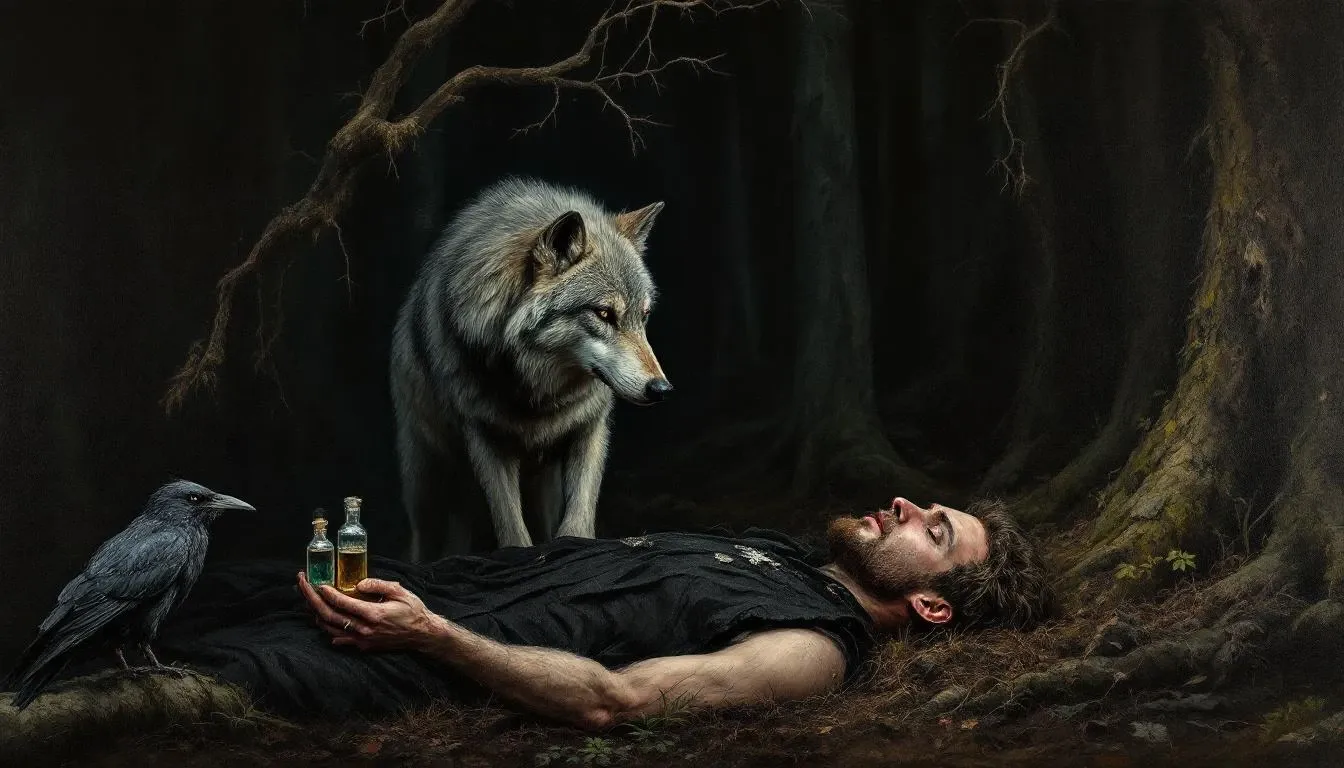
Ivan lies in a field, dead, for thirty days. Crows circle. The Grey Wolf finds the body, chases down a raven and its chick, and forces the mother raven to bring the Water of Death and the Water of Life — two substances that appear across dozens of Russian fairy tales and form one of the most distinctive motifs in Slavic storytelling.
The Water of Death heals the wounds. It reassembles the pieces, closes the cuts, restores the body to wholeness. But it does not restore life — the corpse lies intact but still dead, a mended vessel with nothing inside. Then the Water of Life is sprinkled, and Ivan opens his eyes.
This double resurrection — death undone in two stages, first the body, then the spirit — is unique to Slavic tradition. It reflects the pre-Christian Slavic concept of death as a process rather than an event, a journey through the three worlds that can, under exceptional circumstances, be reversed. The Water of Death addresses the physical destruction. The Water of Life addresses the metaphysical absence. Both are necessary. Neither is sufficient alone.
Ivan returns to the palace. The brothers are exposed and punished. Elena chooses Ivan — or rather, confirms the choice she already made before the murder. The Firebird takes its place in the royal garden. The tsar, having learned nothing about the dangers of coveting beautiful things, is presumably delighted.
The Grey Wolf disappears into the forest. The tale never says whether Ivan thanked it properly.
Why the Youngest Son Always Wins
The question that echoes through every Ivan Tsarevich tale — why the youngest? — has no single answer, but it has several good ones.
The first is structural. The youngest son goes last, which means he benefits from the information generated by his brothers' failures. He knows which roads lead to disaster. He knows which kings are treacherous. He knows, because the tale has already demonstrated it, what not to do. The youngest son's advantage is not innate superiority but temporal position: he has watched two demonstrations of how to fail before he takes his turn.
The second is social. In the medieval Russian system of inheritance, the youngest son received the least. The eldest inherited the title. The middle inherited the land. The youngest got whatever was left — sometimes a horse, sometimes a cat, sometimes nothing. The fairy tale, told largely by and for the landless and the dispossessed, inverts this hierarchy. The son who gets nothing in the real world gets everything in the story. Ivan Tsarevich is a fantasy of justice for every younger brother who watched his inheritance divided above his head.
The third is psychological, and it is the most interesting. The eldest brothers fail because they are complete. They know who they are. They have plans, expectations, a fixed sense of how the world works. When the world presents them with something that does not fit their model — a talking wolf, a witch in a hut on chicken legs, a quest that requires mercy instead of force — they cannot adapt. They are too finished, too solid, too themselves.
Ivan succeeds because he is unfinished. He does not know who he is. He has no plan. He walks into the dark forest with no fixed idea of what he will find or how he will handle it, and this emptiness — this openness to whatever comes — is exactly what the forest requires. The supernatural helpers who populate these tales — the wolves, the eagles, the talking fish, the Baba Yagas and the Vasilisas — do not help heroes who arrive with certainty. They help heroes who arrive with questions.
The Pattern That Never Breaks
Ivan Tsarevich has been walking through Russian stories for at least five hundred years. He has married frog princesses and warrior queens. He has ridden grey wolves and flying carpets. He has descended to the bottom of the sea and climbed to the top of glass mountains. He has been cut to pieces by his own brothers and reassembled by the Water of Life. He has faced Koschei the Deathless and broken the needle that held the sorcerer's mortality. He has stood before Baba Yaga's hut on chicken legs and answered her questions without flinching.
And he has done all of this not because he is the hero the story deserves, but because he is the hero the story needs: someone small enough to seem insignificant, brave enough to keep walking, and kind enough to spare the creatures that everyone else would kill without thinking. In a mythology populated by thundering gods like Perun and cunning shape-shifters like Veles, Ivan Tsarevich is the mortal at the center of the wheel — the ordinary human through whose eyes the entire supernatural world becomes visible.
He is the youngest son. He is always the youngest son. And in the Russian fairy tale, the youngest son is the one who walks into the forest last, with the least, expecting nothing — and comes back carrying everything the world tried to hide from him.
That is why he wins. Every time. Without exception. Not because the tale is rigged in his favor, but because the tale understands something about the world that the elder brothers, with all their strength and certainty, never will: that the door at the end of the road does not open for the man with the biggest key. It opens for the man who knocks.