The Brothers Grimm cleaned up their fairy tales for publication. Disney softened them further. By the time a European folktale reaches a modern audience, it has been scrubbed, sterilized, and stripped of everything that made it powerful. The original version — the one told in a dark room, by firelight, in a language most Westerners cannot read — was never meant to comfort. It was meant to warn.
Eastern European dark folklore is not entertainment. It is a survival manual written in the language of nightmares. Every creature, every spirit, every ritual burial described in these stories exists because people were dying and no one could explain why. The folklore did not emerge from imagination. It emerged from terror.
These are the real stories. The ones that kept entire villages awake. The ones that made communities dig up their own dead, drive stakes through bloated bodies, and sew the mouths of corpses shut with iron wire. The sanitized versions are lies. Here is the truth.
The Striga: The Child Who Ate Its Own Family
Of all the creatures in Slavic dark folklore, the striga may be the most horrifying — because she begins as someone's daughter.
In Polish folk belief, a strzyga was born with two souls, two hearts, and two rows of teeth. The second row was nearly invisible — small, sharp, and hidden behind the first, noticed only by midwives who had seen the signs before. The child appeared normal. She grew up normal. She married, bore children, lived an unremarkable life. Nobody knew what she was until she died.
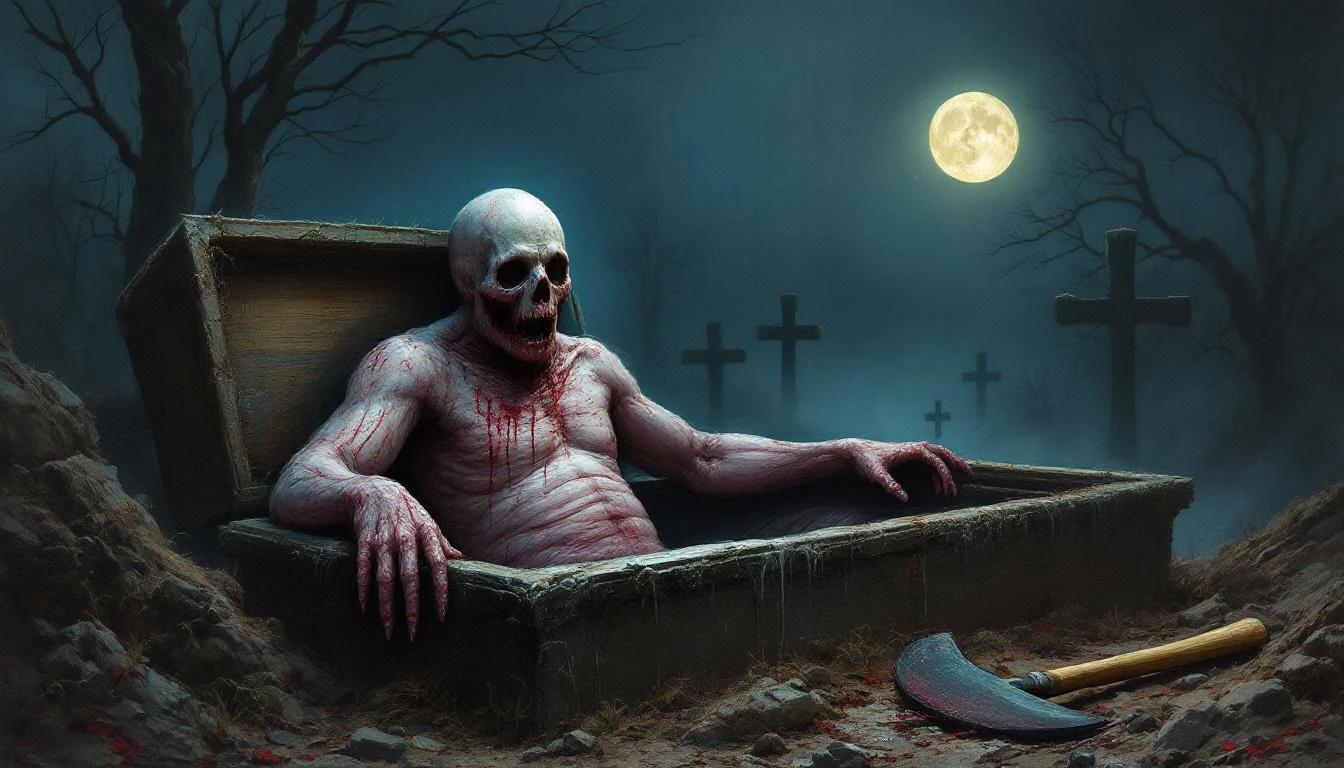
Then the first soul departed as nature intended. The second — the hungry one — stayed. It woke the corpse. It opened the dead eyes in the coffin. And it clawed its way out of the earth to feed on the blood of the people the woman had loved in life.
The striga fed on family first. That is the detail that separates this creature from every Western vampire story ever written. Dracula attacked strangers. The striga attacked the people who had mourned at her funeral. Her husband. Her children. Her neighbors who had washed her body for burial. One by one, they sickened and died, and the village understood what had happened only when it was almost too late.
The countermeasures were not gentle. The corpse was exhumed. Its head was severed and placed between its legs. A piece of paper with the name of Jesus was stuffed under the tongue. If the village had access to iron, a sickle was laid across the throat — blade facing inward, so that if the body tried to rise, it would decapitate itself. The logic was brutal and practical: you cannot feed if you have no head.
Buried With Sickles: Archaeology of Fear
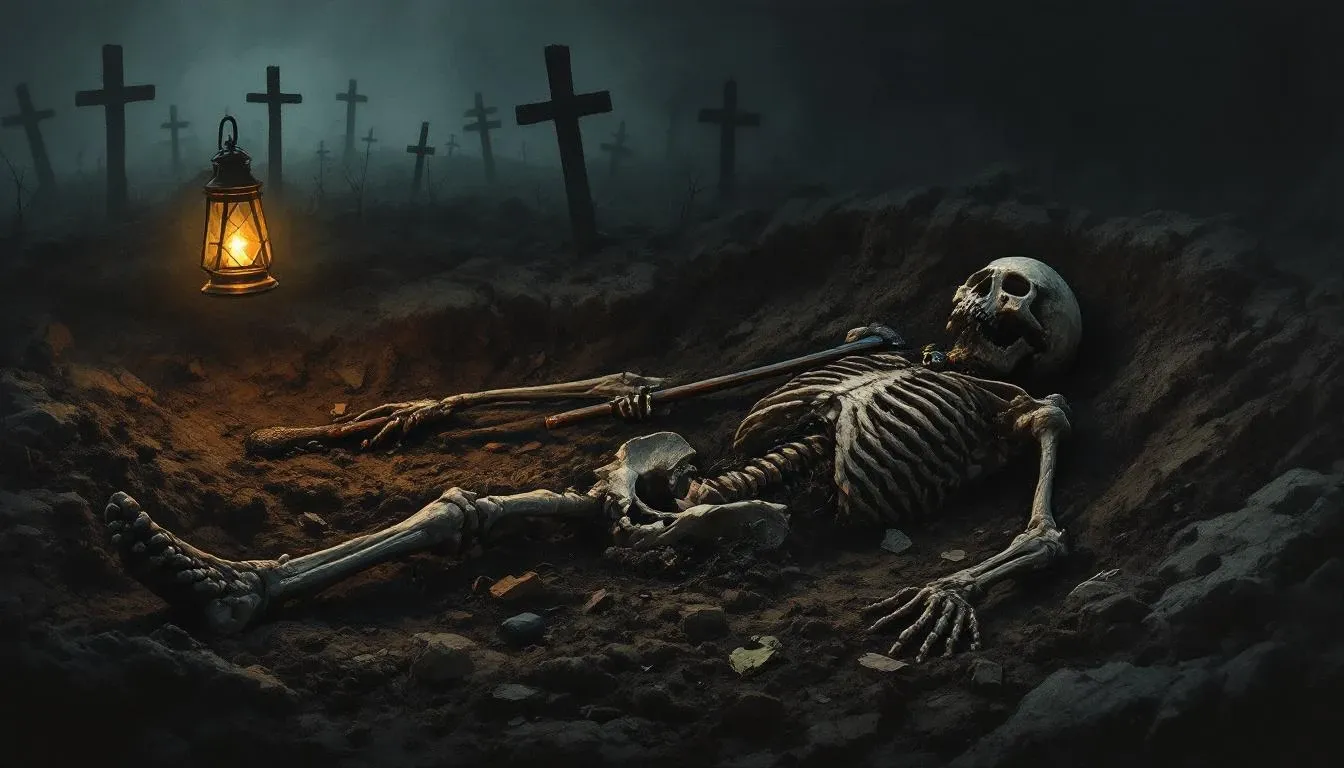
In 2022, archaeologists excavating a 17th-century cemetery in the Polish village of Pien unearthed the skeleton of a young woman buried with an iron sickle pressed tight across her throat and a padlock fastened to the big toe of her left foot. The sickle was positioned so that if the corpse attempted to rise, the blade would sever its own neck. The padlock was meant to chain the dead woman to her grave for eternity.
She was wearing a silk cap — an expensive garment indicating high social status. She was not a criminal or an outcast. She was someone important. And yet her community feared her enough to pin her to the ground with iron.
This was not an isolated case. At Drawsko, near Poznan, archaeologists found multiple "deviant burials" from the same era — skeletons buried with sickles across their throats or stones wedged into their open mouths. Biogeochemical analysis proved these were not outsiders or immigrants. They were locals. Members of the community. People whose neighbors had loved them enough to bury them, and feared them enough to make sure they stayed buried.
The deviant burials at Drawsko are not reflective of social outsiders or immigrant newcomers to the community. Instead, apotropaic practices were afforded to locals whose social identity, physical appearance, or manner of death may have marked them with suspicion in some other way.
The archaeology confirms what the folklore always said: the greatest danger came not from strangers, but from the people you already knew. From the dead who refused to stay dead.
Rusalka Week: When Swimming Meant Death
Every year in early June, during the week before Pentecost, the rivers of Eastern Europe became forbidden zones. This period was called Rusalka Week — Rusal'naia Nedelia — and for the Slavic peasant, it was the most dangerous week of the year to be near water.
The rusalki were the spirits of women who had died badly — drowned, murdered, or driven to suicide by betrayal. They were not mermaids. They were not beautiful sirens singing from rocks. They were the unquiet dead, pale and cold and furious, and during Rusalka Week they left the rivers and climbed into the birch trees along the banks, swinging from the branches by night, their wet hair dripping onto the grass below.
A man who wandered near the river during this week would see a beautiful girl at the water's edge. She would call to him. She would laugh, and the laughter would enter his mind like a hook, and he would step forward, and then forward again, and then the water was at his chest and her hands were around his ankles, pulling him under. Her body became slippery as a fish, impossible to grip, and she held him below the surface with a patience that only the dead possess.
Swimming was strictly forbidden during Rusalka Week. Working in fields near rivers was done only in groups, never alone. Women hung offerings — ribbons, linen, food — on the birch trees near water to appease the spirits. At the end of the week, the villages performed a ritual banishment: an effigy of the rusalka was carried to the river and thrown in, or burned and its ashes scattered, driving the dead back below the surface for another year. This tradition survived in Russia, Belarus, and Ukraine into the 1930s.
The rusalki were not evil for the sake of evil. They were dead women who had been wronged — and their rage was directed not at random victims but at the living who continued to enjoy what had been stolen from them. That is what makes the rusalka scarier than any creature invented by modern horror: she has a reason.
The Poludnitsa: Death at High Noon
Western horror lives in the dark. Slavic folklore knows better. The most dangerous hour in Eastern European dark folklore is not midnight. It is noon.
The Poludnitsa — Lady Midday — appeared in the grain fields at the peak of summer heat, when the air shimmered above the wheat and the workers' heads were heavy with exhaustion. In Polish and Serbian accounts, she was young and beautiful — a tall woman in a white dress walking slowly between the rows of grain. In Czech and Slovak tradition, she was a hunched crone carrying a scythe.
The mechanism of death was the same in every version. She approached a lone worker and began asking questions — about farming, about the harvest, about anything at all. The questions never stopped. If the worker answered correctly, she asked another. If the worker's attention wandered, if a single answer faltered, if they tried to flee, she killed them. In some versions she twisted their neck. In others she cut off their head with her scythe. In the most common accounts, she simply drove them mad — their mind broke under the relentless interrogation, and they collapsed in the field, raving, burning with heat, unable to recognize their own family.
The Poludnitsa was not metaphor. She was the explanation for sunstroke, for the strong man who walked into the field at dawn and was carried out at one o'clock, delirious and dying. She was a fact of agricultural life given a face and a name — and the name was enough to keep harvesters working in pairs, never alone, never during the noon hour, for centuries.
The Vampire Epidemic of 1725
In the Serbian village of Kisilova (then under Austrian administration), a peasant named Petar Blagojević — recorded in German documents as Peter Plogojowitz — died in 1725. Within eight days of his burial, nine more villagers died after extremely short illnesses lasting roughly 24 hours each.
On their deathbeds, the victims reported the same thing: Blagojević had come to them at night and throttled them. His widow added a detail that made the Austrian authorities take notice — her dead husband had visited her at home and demanded his shoes. She was so terrified that she fled to another village entirely.
The villagers demanded an exhumation. The Austrian Imperial Provisor, Ernst Frombald, attended as an official witness. When the coffin was opened, the body showed none of the expected signs of decomposition. The hair and beard had grown. New skin and nails had appeared beneath the old, peeled layers. And there was fresh blood visible at the mouth.
Frombald watched as the villagers drove a sharpened stake through the chest. According to his official report — a government document, not a folk legend — fresh blood erupted from the ears, nose, and mouth of the corpse. The body was then burned to ashes.
This was not folklore. It was bureaucracy. Frombald filed his report with the Austrian administration, and it was translated into German, French, and English. Together with the similar case of Arnold Paole in 1726, the Plogojowitz report triggered the great vampire panic that swept Western Europe in the 18th century — and eventually, a century and a half later, gave Bram Stoker the raw material for Dracula.
The Slavic vampire predates Stoker's novel by at least eight centuries. The word vampire itself is Slavic. The creature is Slavic. Everything that came after — the aristocratic fiends, the romantic undead, the sparkle-skinned teenagers — is a dilution. The original was a bloated corpse with blood at its mouth and a village full of dead neighbors.
Baba Yaga's Fence of Human Bones
Every child in Russia knows Baba Yaga — the old woman in the hut on chicken legs, deep in the forest. Most of them have been told a version where she is mischievous, or funny, or secretly helpful. That version is a lie invented by children's publishers.
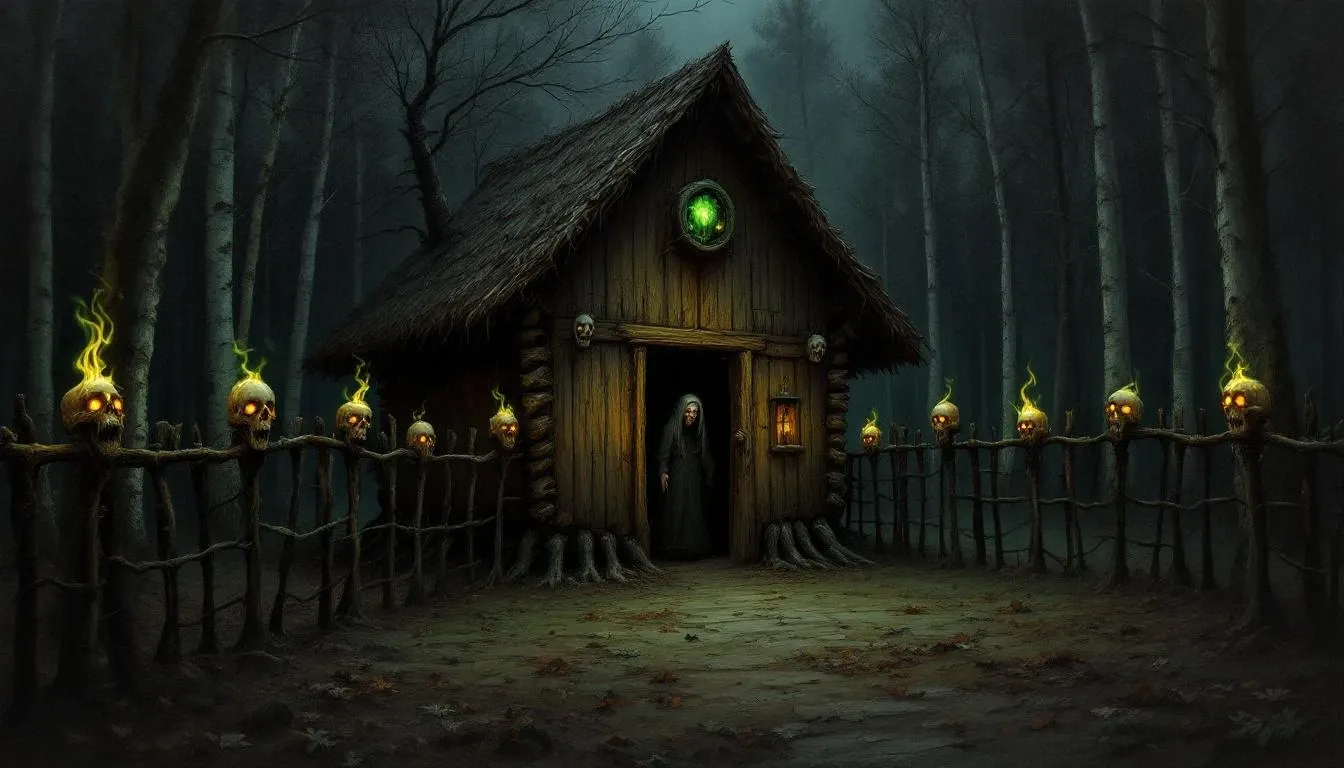
In the original folk accounts — the ones collected by Alexander Afanasyev in the 1850s and 1860s, before anyone thought to sanitize them — Baba Yaga's dwelling is surrounded by a fence made entirely of human bones. The fence posts are leg bones and arm bones. The gate is fastened with human hands instead of bolts. The lock is a mouth full of sharp teeth. And on top of every post sits a human skull, eye sockets still intact, glowing with an inner fire that illuminates the clearing at night like a ring of lanterns.
In Vasilisa the Beautiful, the heroine arrives at the fence and counts the skulls. One post is empty. Baba Yaga tells her, with no particular emotion, that the empty post is reserved for her head.
The hut itself — the famous izbushka na kur'ikh nozhkakh — is not whimsical. Russian archaeologists in 1948 discovered that ancient Slavic peoples practiced cremation in small raised structures elevated on stilts, surrounded by circular fences. Baba Yaga's hut is a grave. Her fence is a graveyard. When a hero approaches her domain, they are walking into the territory of death itself — and the three-world cosmology of the Slavs placed her squarely at the border between Yav (the world of the living) and Nav (the world of the dead).
She is not a witch. She is a gatekeeper. And the bones are not decoration. They are credentials.
The Navi: Dead Children Who Return as Birds
The Navi are the spirits of the "unclean dead" — people who died wrong. Unbaptized infants. Suicides. Drowning victims. Women who died in childbirth. Anyone whose death violated the natural order, whose soul could not pass properly into Nav, the underworld ruled by Veles.
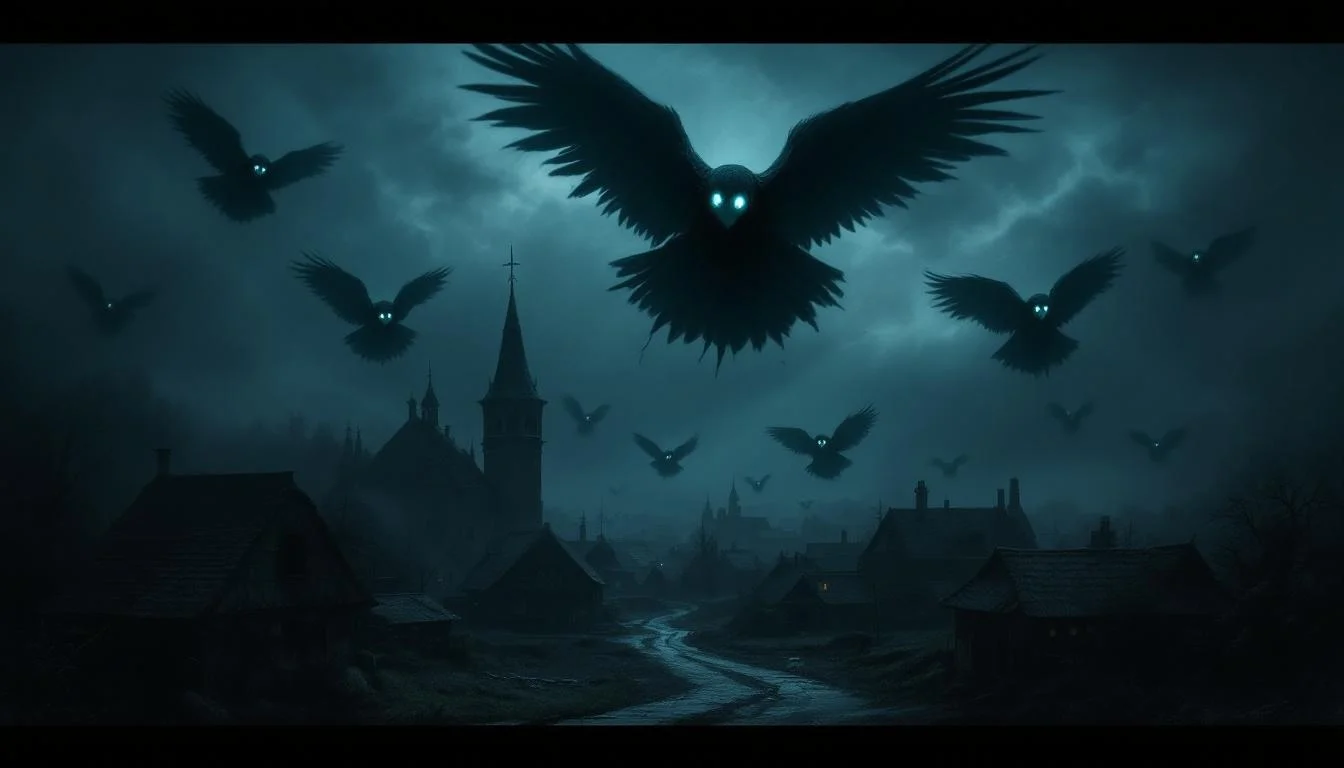
They returned as black birds with the faces of infants. They flew over villages at night, and their cries sounded like babies wailing. If they landed on a house, someone inside would sicken and die. If they touched a person, the mark of their fingers left wounds that festered and never healed.
The Ruthenian Primary Chronicle — the oldest East Slavic historical text — records an event from 1092 in the city of Polotsk. At night, a great noise filled the streets: the sound of invisible horsemen galloping through the darkness. During the day, wounds appeared on the living — inflicted by something that could not be seen, wounds that killed. The chronicler wrote that the people of Polotsk were "devoured by the dead." He called the attackers navii.
This was recorded by a literate monk writing official history, not a peasant telling ghost stories. The distinction matters. The Navi were not campfire entertainment. They were a documented threat, recorded with the same matter-of-fact tone used to describe wars and famines.
The Bannik: The Spirit Who Scalds You to Death
The bathhouse — banya — stood at the edge of every Slavic homestead, deliberately separated from the house and from the icons. There was a reason for that distance. The banya did not belong to the family. It belonged to the Bannik.
The Bannik was a small, naked old man covered in dirt and the remnants of used birch leaves. He lived behind the stove. He watched. And he had one absolute rule: humans bathe in two rounds. The third round belongs to him. During the third steam, the Bannik washed himself with the dirty water left behind by the bathers, and he invited his guests — forest spirits, demons, and the unquiet dead — to share the heat.
Anyone who entered the banya during the third round was trespassing. The consequences were described with graphic consistency across centuries of ethnographic records. The Bannik threw boiling water. He hurled heated stones from the stove. He strangled intruders. The most feared punishment was zaparit' do smerti — "steamed to death" — the Bannik pressing the trespasser against the scorching stones of the upper bench and holding them there until they stopped moving.
This was not metaphor. Unexplained deaths in bathhouses — from carbon monoxide poisoning, scalding accidents, or heart attacks in extreme heat — were attributed to the Bannik's wrath. The domestic spirits of the Slavic household each controlled a territory: the Domovoy guarded the hearth, the Kikimora haunted the spinning wheel, Leshy ruled the forest. The Bannik controlled the threshold between clean and unclean, human and otherworldly, the living and the dead.
Why Dark Folklore Matters
Modern horror invents its monsters. Slavic dark folklore did not have that luxury. Every creature described in these stories corresponds to a real danger that killed real people: cholera epidemics explained by vampires, sunstroke personified as the Poludnitsa, carbon monoxide deaths attributed to the Bannik, drowning victims who became rusalki, stillborn children who became Navi.
The folklore was not fiction. It was forensic science practiced by people who had no microscopes, no germ theory, no understanding of why their families were dying. They did the best they could with what they had. They named the danger. They described its habits. They developed countermeasures — sickles, stakes, padlocks, ritual banishments, iron and fire. Some of those countermeasures worked, by accident: burning a plague-era corpse did, in fact, reduce the spread of disease.
The real dark folklore of Eastern Europe is not scary because someone invented good monsters. It is scary because the monsters were the only explanation available for things that were genuinely, incomprehensibly deadly. That is why these stories survived for a thousand years. Not because they were entertaining. Because they were necessary.
If you want to explore the full bestiary, start with our complete guide to Slavic mythology or browse the creature encyclopedia.