The Slavic world was never empty. Every river had a keeper. Every forest answered to a lord. Every house sheltered something behind the stove that watched the family sleep, something that could bless or curse depending on how the bread was baked and whether the floors were swept clean. The fields had their own spirits. The bathhouse had its own demon. Even the threshing barn — dark, grain-dusty, forgotten by everyone except the mice — belonged to something that did not appreciate visitors after sundown.
This was not superstition in the way modern people understand the word. For the pre-Christian Slavs, these beings were the operating system of reality. They explained why milk soured, why children drowned, why the harvest failed, why a hunter walked into the birch forest one morning and never came back. Every misfortune had a name. Every patch of wilderness had a guardian. And the relationship between humans and these spirits was not worship — it was negotiation. You gave offerings. You followed rules. You did not whistle indoors, you did not swim alone at midsummer, you did not curse the wind. And if you broke the rules, you paid.
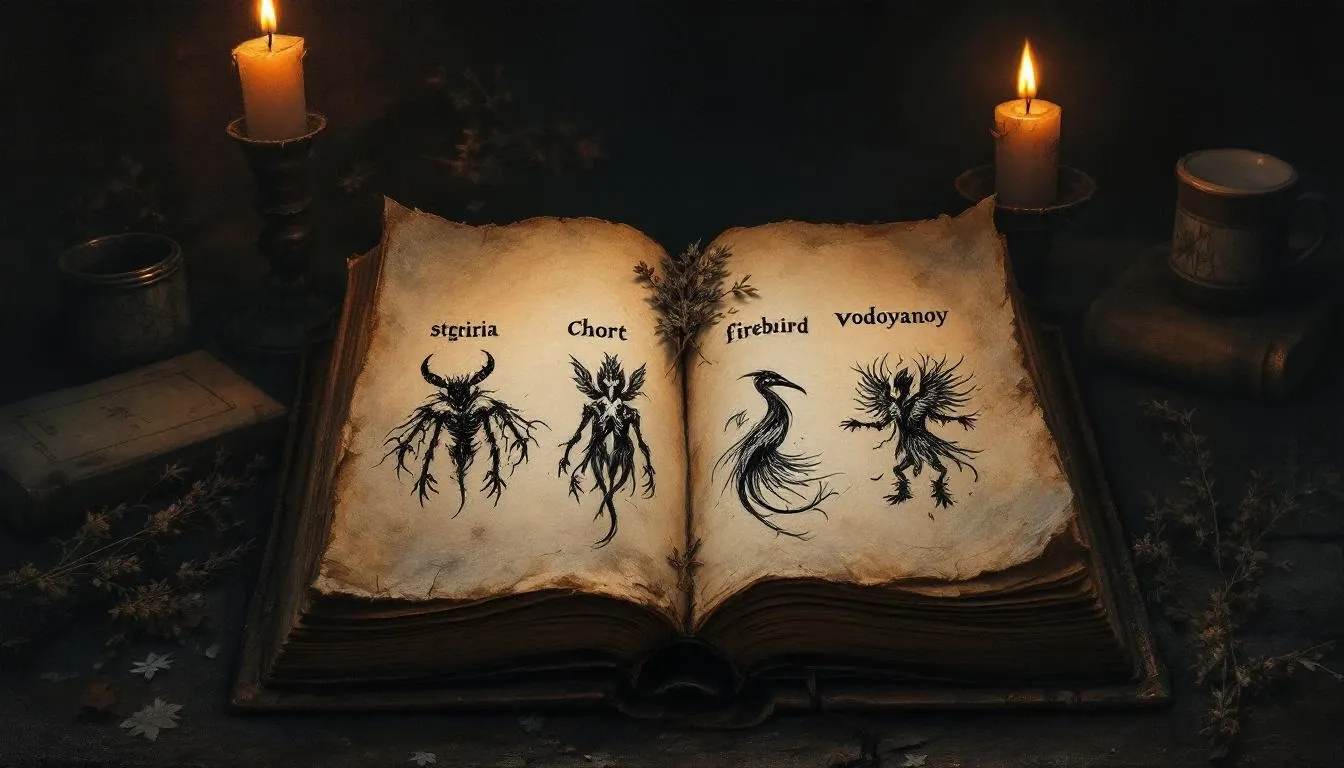
What follows is every major creature, spirit, and supernatural being in Slavic mythology — organized by the domain they ruled. This is the bestiary that Christianity tried to burn.
Forest Spirits: Masters of the Wild
The forest was the single most important — and most dangerous — landscape in Slavic life. Villages were clearings carved into endless woodland. Step beyond the last fence and you entered a world governed by forces that did not think like humans, did not care about human needs, and had their own laws.
Leshy — The Forest Lord
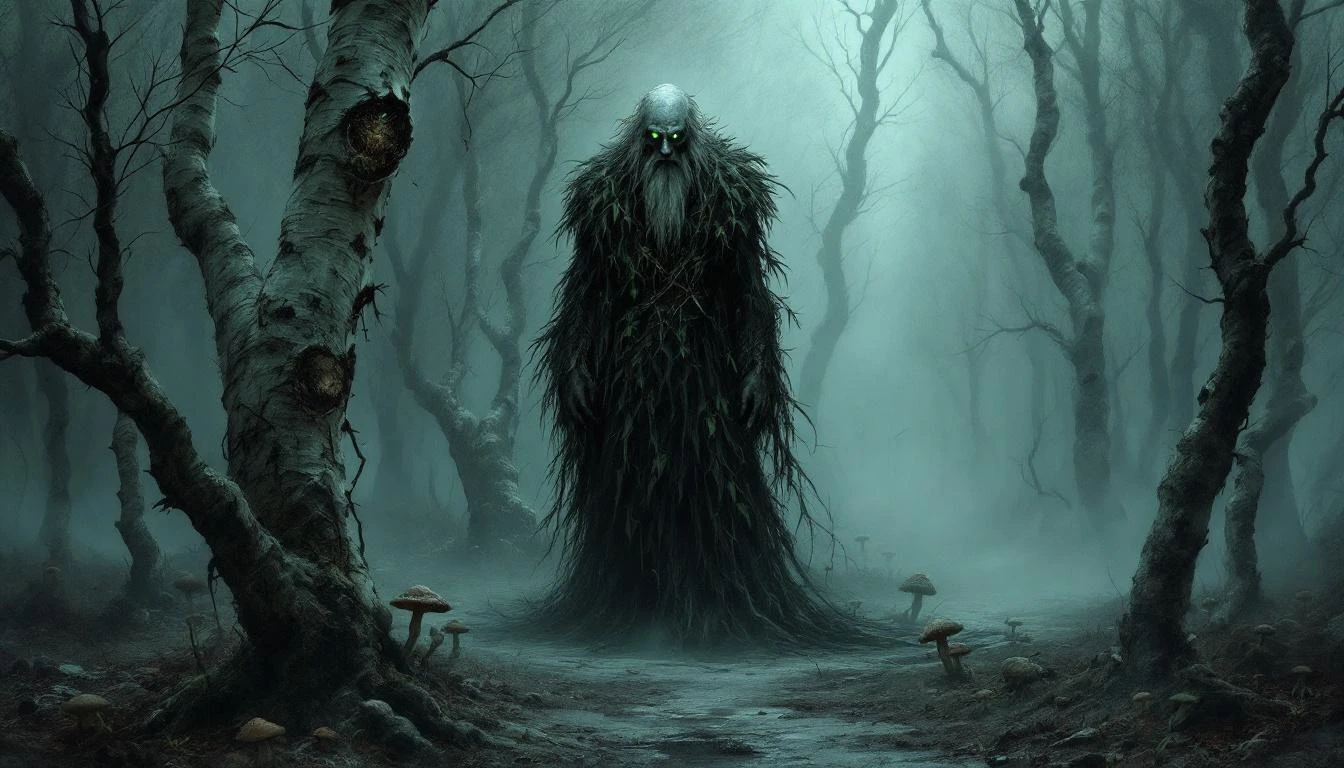
The Leshy is the undisputed sovereign of the Slavic forest. His name comes from les (лес), the word for forest, and he is not a creature that lives in the woods — he is the woods made conscious. Every animal, every tree, every path belongs to him. Hunters who failed to leave offerings — bread on a stump, salt at a crossroads — found themselves walking in circles for days, unable to find a trail they had known since childhood. The Leshy could appear as a towering figure taller than the pines, or shrink to the size of a blade of grass. He wore his belt on the wrong side, his shoes were reversed, and his shadow fell in the wrong direction. Peasants said you could recognize him because he cast no shadow at all in some versions, or because the wind always followed him.
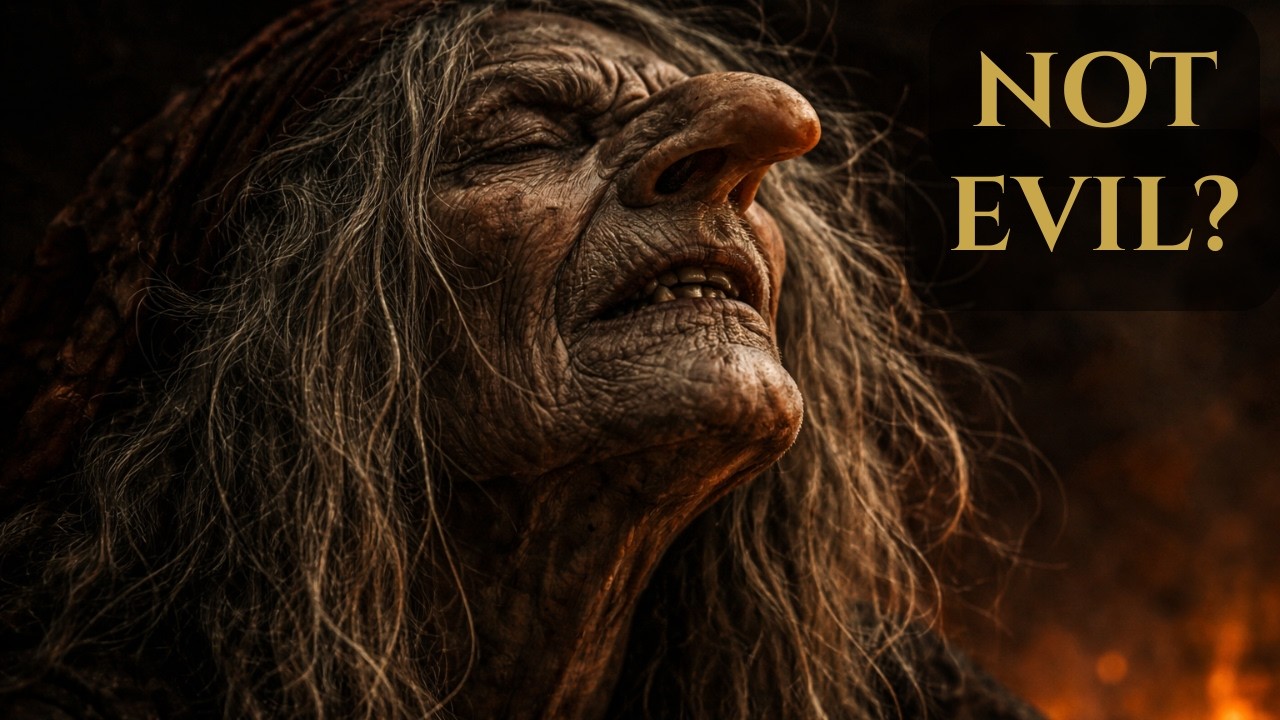
He was not evil. He was territorial. The distinction matters. Leave the Leshy's forest alone, and he might guide your cattle home. Disrespect it — cut trees without asking, hunt more than you need, boast about your kills — and he would lead you into a swamp and leave you there.
Vila — The Storm Dancers
The Vila (plural: vile) are among the most beautiful and most lethal beings in the entire Slavic canon. Found across South and West Slavic traditions — Serbian, Croatian, Bulgarian, Slovenian, Polish, Czech — the Vila appears as a young woman of supernatural beauty, dressed in white, with loose hair that shimmers like sunlight on water. She dances in forest clearings and on mountaintops, and woe to any mortal who watches.
Vilas control the weather. They can summon storms, freeze rivers, and hurl lightning. In Serbian epic poetry, vilas are warrior spirits — they shoot arrows with deadly accuracy and have been known to befriend heroes. The hero Marko Kraljevic had a Vila as his pobratim (blood-sister). But their friendship was conditional. Betray a Vila, break a promise made to one, or stumble upon their dance uninvited, and they would kill without hesitation — usually by dancing the intruder to death, his feet moving against his will until his heart stopped.
Poludnitsa — Lady Midday
The Poludnitsa haunts the fields at noon — the hour when the sun stands directly overhead and shadows disappear. She appears as a tall woman in white, shimmering in the heat haze, and she approaches farmworkers who have not stopped to rest during the hottest part of the day. She asks questions. Difficult questions, often about agriculture or philosophy, and she demands answers. Hesitate, contradict yourself, or try to run, and she will twist your neck, drive you mad, or give you a sunstroke that kills within hours.
The Poludnitsa is a uniquely Slavic fear — the terror of the open field under a merciless sun, where there is no shade and no escape. Czech composer Antonin Dvorak wrote a symphonic poem about her in 1896. In The Witcher games, she appears as the Noonwraith. Neither version captures how deeply this spirit was feared by people who actually worked the land.
Water Spirits: The Drowners
Water in Slavic cosmology was a boundary — a membrane between the world of the living and the world of the dead. Rivers flowed toward Nav, the underworld. Lakes had no bottoms; they opened into darkness. Every body of water was a potential doorway, and every doorway had a guardian who decided who passed through.
Vodyanoy — The Water Master
The Vodyanoy is the ruler of rivers, lakes, and ponds — an old man covered in mud and slime, with a fish tail, a frog face, and a long green beard tangled with water weeds. He sits on the bottom, surrounded by the drowned. In some traditions, the drowned do not die — they become the Vodyanoy's servants, tending his underwater herds of fish the way a peasant tends cattle on land.
Millers feared him most. Every mill sat on a river, and every river belonged to a Vodyanoy. Millers would toss offerings into the water — a black rooster, tobacco, a cup of vodka — before the first grinding of the season. The truly desperate were rumored to push a passing stranger into the millpond as a sacrifice. The Vodyanoy's price for cooperation was always steep.
Rusalka — The Drowned Maidens
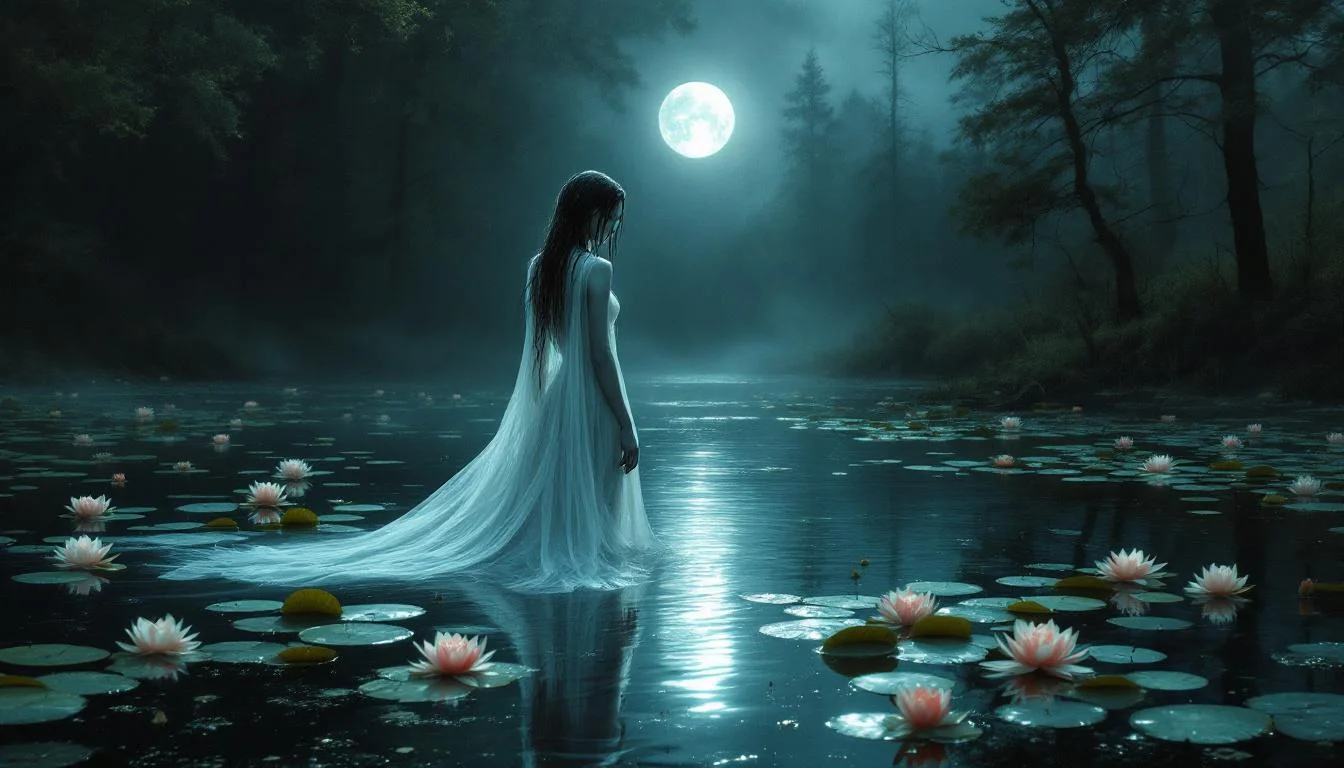
The Rusalka is perhaps the most tragic figure in Slavic mythology. She is the ghost of a young woman who died by drowning — sometimes by suicide, sometimes by murder — and whose soul cannot rest. She rises from the water during Rusalka Week (the week after Pentecost), sits in the branches of riverside willows and birches, and sings. Her voice is heartbreaking. Her beauty is the beauty of something that should be dead but is not. Men who hear her song follow it into the river and do not come back.
Rusalki are not seductresses by choice. They are trapped. Their unfinished lives bind them to the water, and the only way they can interact with the living is through the hunger of the dead. In some villages, during Rusalka Week, women would leave linen shirts on the riverbank for the rusalki — clothing for the naked dead, a gesture of compassion toward spirits that everyone understood were suffering.
Bukavac — The Swamp Horror
The Bukavac comes from Serbian folklore — a six-legged creature with gnarled horns that lives in lakes and rivers and emerges at night to strangle anything that comes too close to the water's edge. Its name derives from bukati, meaning to roar or bellow. Of all the water spirits in Slavic mythology, the Bukavac is the least negotiable. There are no offerings that appease it, no rituals that ward it off. It is pure predation — the swamp reaching out to grab you.
Household Spirits: Guardians Behind the Stove
The Slavic house was not merely a building. It was a sacred space — a miniature cosmos with its own spirits, its own rules, and its own invisible inhabitants. The threshold was a boundary between worlds. The stove was the heart, the axis mundi of the home. And behind that stove, or under the floorboards, or in the attic rafters, something lived.
Domovoy — The House Spirit
The Domovoy is the most important household spirit in East Slavic tradition — a small, hairy, bearded creature that lives behind the stove and protects the family. When the Domovoy is content, the house prospers: bread rises, livestock stays healthy, children sleep peacefully. When displeased, he breaks dishes, tangles the horses' manes, sits on sleeping family members' chests (causing nightmares), and pinches people in the dark.
Every house had one. When a family moved, they carried coals from the old stove to the new one and invited the Domovoy to follow. To move without bringing your Domovoy was to abandon a member of the family — and to face the wrath of the one you left behind. The Domovoy was not a pet or a servant. He was the spirit of the family line itself, the accumulated will of every ancestor who had lived in that house.
Bannik — The Bathhouse Spirit
The Bannik ruled the banya — the Russian bathhouse, a small detached building where families bathed in steam. The Bannik was one of the most dangerous household spirits because the bathhouse existed at the edge of the domestic world, a liminal space where people were naked, vulnerable, and separated from the protections of the main house. He appeared as a small, filthy old man with long claws.
The critical rule: you bathed in three shifts. The fourth shift belonged to the Bannik and his guests — forest spirits, the dead, whatever else he chose to invite. Anyone who entered the bathhouse during the fourth shift risked being scalded to death, flayed alive, or smothered. Young women would visit the bathhouse at midnight on certain holidays to receive fortune-telling from the Bannik: they would back through the door and extend one bare hand. If the Bannik touched it with a smooth palm, the year would be good. If he touched it with claws, suffering lay ahead.
Dvorovoy and Ovinnik — Yard and Barn Spirits
The Dvorovoy protected the farmyard — the space between the house and the fields. He resembled the Domovoy but was wilder, more unpredictable, and closely associated with livestock. A Dvorovoy that disliked a particular animal would torment it at night, tangling its mane, refusing it rest, sometimes killing it.
The Ovinnik haunted the ovin, the drying barn where grain sheaves were dried over a fire before threshing. He was coal-black, eyes like embers, and extremely dangerous — because the ovin was a fire hazard, and the Ovinnik's displeasure could manifest as the entire structure burning to the ground with the harvest inside.
Kikimora — The Unwanted Guest
The Kikimora is the dark mirror of the Domovoy. Where the Domovoy rewards a well-kept home, the Kikimora punishes a slovenly one. She is a thin, hunched spirit — sometimes described as a woman, sometimes as something not quite human — who spins thread at night, tangles yarn, breaks looms, and keeps the household awake with scratching and tapping sounds. In some traditions, a Kikimora was placed in a house through sorcery — a curse embedded in the foundation during construction that could never be removed.
Dark Creatures: The Adversaries
Not every being in the Slavic world could be bargained with. Some were enemies of human life by nature — beings of such age, power, or malice that the only rational response was avoidance.
Baba Yaga — The Bone-Legged Witch
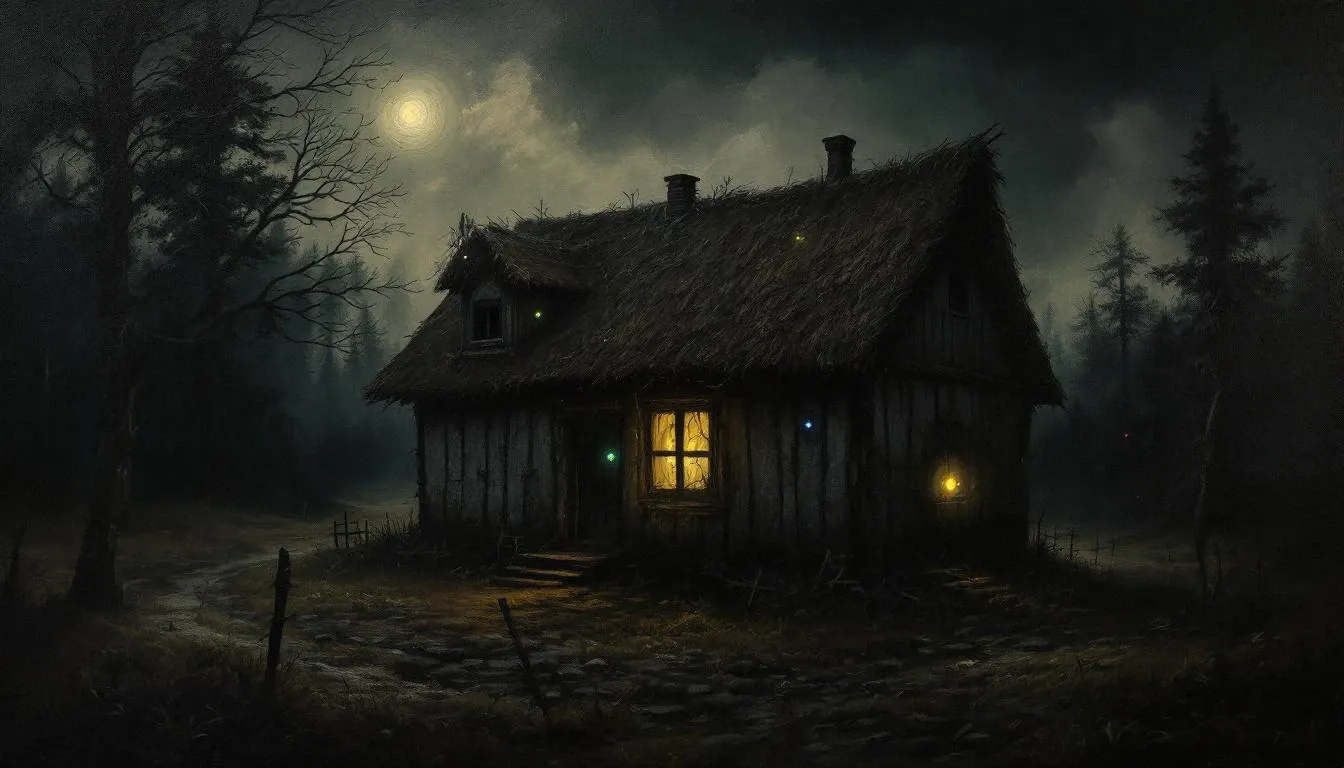
Baba Yaga defies simple classification. She is not a goddess, not a demon, not a witch in the Western sense. She is an ancient woman who lives in a hut that stands on chicken legs, surrounded by a fence made of human bones topped with glowing skulls. She flies through the sky in a giant mortar, steering with a pestle, sweeping her tracks away with a birch broom. She tests heroes with impossible tasks, feeds them the ritual meal of the dead, and either devours them or sends them onward with magical gifts. Vladimir Propp argued she is a remnant of a pre-Slavic death goddess — the guardian of the passage between Yav and Nav.
Koschei the Deathless — The Undying Tyrant
Koschei is the supreme villain of East Slavic fairy tales — an emaciated, skeletal sorcerer who cannot be killed because his death is hidden outside his body. His death (smert') is contained inside a needle, inside an egg, inside a duck, inside a hare, inside an iron chest, buried under a green oak on the island of Buyan. Each layer of protection must be broken in sequence. Koschei kidnaps young women — most famously Marya Morevna — and holds them in enchanted captivity. He is the embodiment of death that refuses to die, power that feeds on itself, the tyrant whose reign never ends because he has removed himself from the cycle.
Striga — The Night Eater
The Striga is a creature born from the fusion of Slavic and Roman demonology — a being, often female, that appears human during the day but transforms at night into a predatory spirit that feeds on human flesh and blood, with a particular appetite for children. The word connects to the Latin strix (screech owl) and survived into Romanian as strigoi. In Polish tradition, a striga might be born with two hearts or two rows of teeth — marked from birth as something that would eventually turn.
Chort — The Slavic Devil
The Chort is the closest thing Slavic mythology has to a universal demon — a creature with goat legs, horns, a tail, and a talent for striking bargains that always end badly for the human side. After Christianization, the Chort absorbed characteristics of the Christian Devil, but his roots are older. He haunts crossroads, swamps, and abandoned buildings. He gambles. He drinks. He is cunning but not invincible — in countless folk tales, clever peasants outwit him through wordplay, legal technicalities, or sheer stubbornness.
Anchutka — The Bathhouse Demon
Anchutka is a small, malicious demon — sometimes described as having no heels, sometimes as entirely bodiless. He inhabits swamps, bathhouses, and mill ponds, and he is summoned by his name. This is why Slavic peasants used euphemisms for demons: to speak the name was to invite the presence. Anchutka is petty, vindictive, and fond of drowning people in shallow water. He is the gnat-sized evil — the minor demon whose danger lies in being underestimated.
"The peasant does not doubt for a moment that behind his shoulder there always stands a dark, hostile force — invisible, persistent, tireless. This force cannot be destroyed. It can only be held at a distance through knowledge of its rules and constant, unbroken vigilance."
Dragons and Beasts: The Primordial Monsters
Beyond the spirits of field and forest, Slavic mythology contains creatures of titanic scale — beings that belong not to the everyday world of village life but to the mythic time before the world was fully ordered.
Zmey Gorynych — The Three-Headed Serpent
Zmey Gorynych is the dragon of East Slavic epic — a fire-breathing serpent with three heads (sometimes seven, sometimes twelve, always an odd number) who terrorizes the land and can only be defeated by a bogatyr, a Slavic folk hero. He guards the Kalinov Bridge over the Smorodina River — the boundary between the world of the living and the world of the dead. To cross the bridge, the hero must fight the dragon. This is not adventure. It is initiation — the passage through death.
Firebird — The Burning Prize
The Firebird (Zhar-ptitsa) is a creature of radiant plumage that glows with golden light. A single feather from its tail can illuminate a dark room. It eats golden apples that grant youth and beauty. The Firebird is never the antagonist — it is the object of the quest, the prize that lures heroes into forests, across oceans, and into the courts of enemy kings. Finding a Firebird feather is the beginning of every trouble.
Indrik — The Beast Beneath the Earth
The Indrik is the king of all animals — a massive, horned beast that lives underground, causing earthquakes when it moves and creating springs where its horn strikes the earth. The Indrik appears in the Golubinaya Kniga (The Book of the Dove), one of the most important Russian spiritual folk poems. It is the master of the subterranean world, the counterpart of the eagle that rules the sky. Some scholars trace the Indrik to distant cultural memory of the mammoth — an enormous horned creature that once walked the earth and now exists only beneath it.
Psoglav — The Dog-Headed One
The Psoglav belongs to Serbian and Balkan folklore — a creature with a human body, horse legs, iron teeth, and the head of a dog with a single cyclopic eye. Psoglavs dwell in caves or in a land of perpetual darkness filled with gemstones. They dig up graves and eat the dead. The name means literally "dog-head" (pso-glav), and scholars have connected the figure to the broader European tradition of cynocephali — dog-headed peoples mentioned by Herodotus, Marco Polo, and medieval cartographers.
The Undead: Those Who Would Not Stay Buried
The Slavic world had the most elaborate and terrifying taxonomy of the undead in all of European folklore. Long before Bram Stoker, long before any Western vampire novel, Slavic villagers were digging up graves and driving stakes through corpses.
Upyr — The Original Vampire
Slavic vampires predate every Western vampire by centuries. The upyr (or upir) appears in East Slavic sources as early as 1047 AD — a priest in Novgorod was recorded with the name "Upir Likhyi" (Wicked Vampire). The Slavic vampire was not a suave aristocrat. It was a bloated, ruddy-faced corpse that climbed out of its grave at night and drained the blood of livestock and family members. The cause was usually a "bad death" — suicide, murder, excommunication, or violation of burial rites. The cure was exhumation, decapitation, and burning.
Vukodlak — The Wolf-Skin Walker
The Vukodlak is the South Slavic werewolf-vampire hybrid — a figure that blurs the line between lycanthropy and vampirism in ways that the Western tradition never managed. In Serbian tradition, a person could become a vukodlak by being born with a caul, by dying unbaptized, or by having a cat or dog jump over the unburied corpse. The vukodlak rises from the grave, swollen and dark-skinned, and wanders the village at night. Some traditions say vukodlaks devour the sun and moon during eclipses — the darkness that swallows light.
Nav Spirits — The Unclean Dead
The Navi are the most disturbing category of Slavic undead — the spirits of those who died "unclean" deaths: unbaptized infants, suicides, drowning victims, women who died in childbirth. They are described as black birds with the faces of babies, and they attack the living with a fury born not from malice but from deprivation. They were never properly mourned, never given the funeral rites that allow passage to Nav. They are stuck between worlds — not ghosts seeking revenge, but ghosts seeking completion. The Primary Chronicle records a plague of navi in the city of Polotsk in 1092, killing people in the streets.
Mythic Birds: Voices of Paradise and Doom
Slavic mythology includes a triad of prophetic birds — beings that sit in the branches of the World Tree and sing songs that carry the knowledge of past, present, and future.
Alkonost and Sirin — Joy and Sorrow
The Alkonost and Sirin are two sides of the same mystery. The Alkonost sings songs of joy so beautiful that anyone who hears them forgets everything — their name, their home, their hunger, their fear. The Sirin sings songs of sorrow so piercing that the listener loses the will to live. Both are depicted as birds with the heads and torsos of women. The Alkonost nests in Iriy, the Slavic paradise. The Sirin sits at the boundary between worlds, luring souls toward the edge. In Russian medieval art, they are almost always depicted together — one cannot exist without the other, because joy without sorrow is amnesia, and sorrow without joy is death.
Gamayun — The Prophet Bird
The Gamayun is the bird of prophecy — she knows everything that has ever happened and everything that will happen. She falls from the sky when a great storm approaches, and her falling is an omen of upheaval. Unlike the Alkonost and Sirin, whose songs affect the emotions, the Gamayun speaks in words. She tells the truth. The problem is that the truth she tells is often unbearable.
The Forgotten Ones
Beyond the major spirits, Slavic folklore is populated by dozens of lesser-known beings — creatures that survived only in regional traditions, in the notes of nineteenth-century ethnographers, in the memories of villages that no longer exist.
Polewik — the field spirit of Polish tradition, a short, dirt-covered man who wandered between the furrows and led travelers astray. He was said to have eyes of different colors and skin the color of turned earth.
Bereginya — a protective female spirit associated with riverbanks and shorelines, possibly one of the oldest Slavic spiritual concepts, predating the more elaborate spirits that replaced her. Some scholars believe she was a primordial mother-spirit whose worship fragmented into the rusalki, vilas, and other female spirits.
Drekavac — a South Slavic creature born from the souls of unbaptized children, described as a small, hairy being with elongated claws that screams in a voice mixing a child's cry with a wolf's howl. Its name comes from dreka — a scream. Hearing one near your home meant death was close.
Zduhac — a person born with a caul whose spirit leaves their body during sleep to fight storms, defend their village's crops from hail, and battle the zduhacs of enemy villages in the clouds. Found in Serbian and Montenegrin traditions, the zduhac is one of the few Slavic supernatural beings who is unambiguously heroic.
Why This Matters
The creatures in this bestiary are not fiction. They are the vocabulary of a civilization — the words that the Slavic peoples used to describe forces they could feel but not see: the cruelty of winter, the indifference of the forest, the terror of drowning, the grief of a child who died too young, the suspicion that the dead do not stay dead. Every spirit in this list is an answer to a question that mattered urgently to the people who told these stories. And the questions have not changed. We still fear the forest. We still mourn the drowned. We still leave the lights on at night.
The difference is that the Slavs gave those fears names. And the names had teeth.
Explore individual creatures in depth throughout the Dark Slavic Lore encyclopedia. For the cosmological framework these beings inhabit, begin with The Three Worlds and The World Tree. For the fate of these beliefs after Christianity arrived, read Christianization and the Death of the Old Gods.