The word for truth in Russian is pravda. The word for law is pravo. The word for rule is pravilo. The word for correct is pravil'nyy. The word for justice is pravosudie. The word for government is pravitel'stvo. To steer a boat is pravit'. To rule a kingdom is pravit'. To correct a child is popravit'.
Every one of these words descends from the same root. And the root was not a concept. It was a place.
The ancient Slavs called it Prav. It was the highest of the three worlds that composed their universe — above Yav, the visible realm where humans lived and died; above Nav, the wet darkness where the dead drifted under Veles's watch. Prav was the crown of the World Tree, the sky beyond the sky, the realm where cosmic order originated and from which it descended like light through branches into the tangled world below.
Prav was not heaven in the Christian sense. No saved souls lived there. No reward awaited the righteous. It was something stranger and, in its way, more demanding: the structure of reality itself, the pattern according to which the universe was woven, the law that even gods obeyed.
The Etymology of Order
The Proto-Slavic root *pravъ meant "straight, correct, right." Its deeper ancestor is Proto-Indo-European *proh₂-wo-, from the root *proh₂-, which carried meanings of "forward," "first," and "before" — both temporally and spatially. What is prav is what stands in front, what came first, what proceeds in a straight line without deviation.
This is not a root that was ever abstract. In the oldest layers of Slavic language, pravъ described a physical quality — the straightness of a plank, the correctness of a course, the rightness of a direction. A road that goes straight is pravyy. A hand that is strong and true is the pravaya ruka — the right hand. The progression from "physically straight" to "morally correct" to "cosmically true" happened naturally, because the Slavic mind did not separate these categories. A universe that ran straight ran right. A law that was right was straight. The cosmos was either aligned or it was not, and the word for that alignment was prav.
When the Slavs looked up at the crown of the World Tree and named what they saw there, they named it with this word. Prav was the realm of straightness — the place where the lines of the universe ran true, where cause produced its proper effect, where the order that should govern all things actually did govern them, uncorrupted by the mess and deviation of the mortal world below.

The Crown of the World Tree
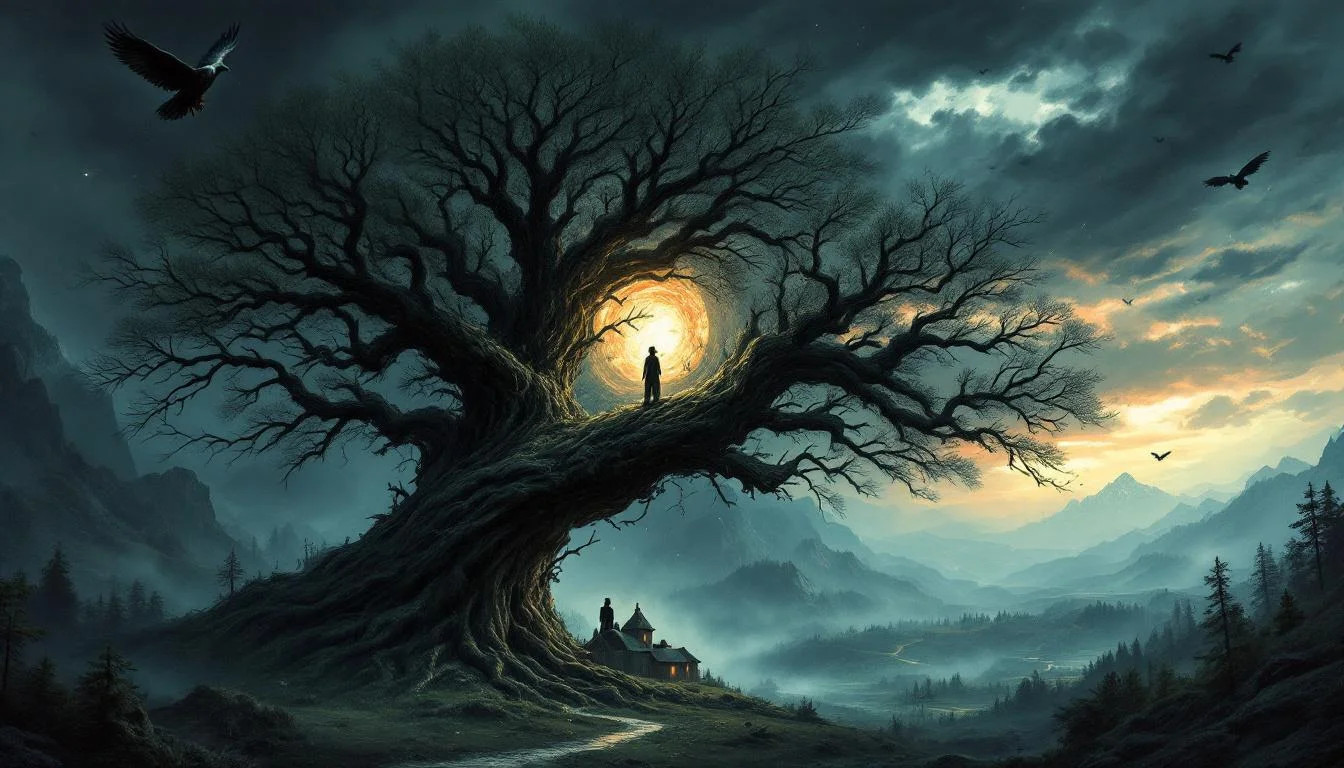
In Slavic cosmology, the universe was organized vertically along the axis of the World Tree — a colossal oak whose roots descended into Nav, whose trunk stood in Yav, and whose crown extended into Prav. This three-tier model appeared in folk embroidery, carved wooden architecture, Easter egg designs, and ritual songs from the Balkans to the Urals. The lower register showed serpents, roots, water. The middle showed animals, humans, plants. The upper showed birds, the sun, and divine figures radiating light.
Prav occupied the top. It was where the eagle sat — the bird that in Slavic tradition was Perun's sacred animal, the creature of the heights, the one that looked down on everything and saw the true shape of the world. The eagle's view was Prav's perspective: total, unobstructed, incapable of being deceived by the partial angles available to creatures who lived among the roots and trunks.
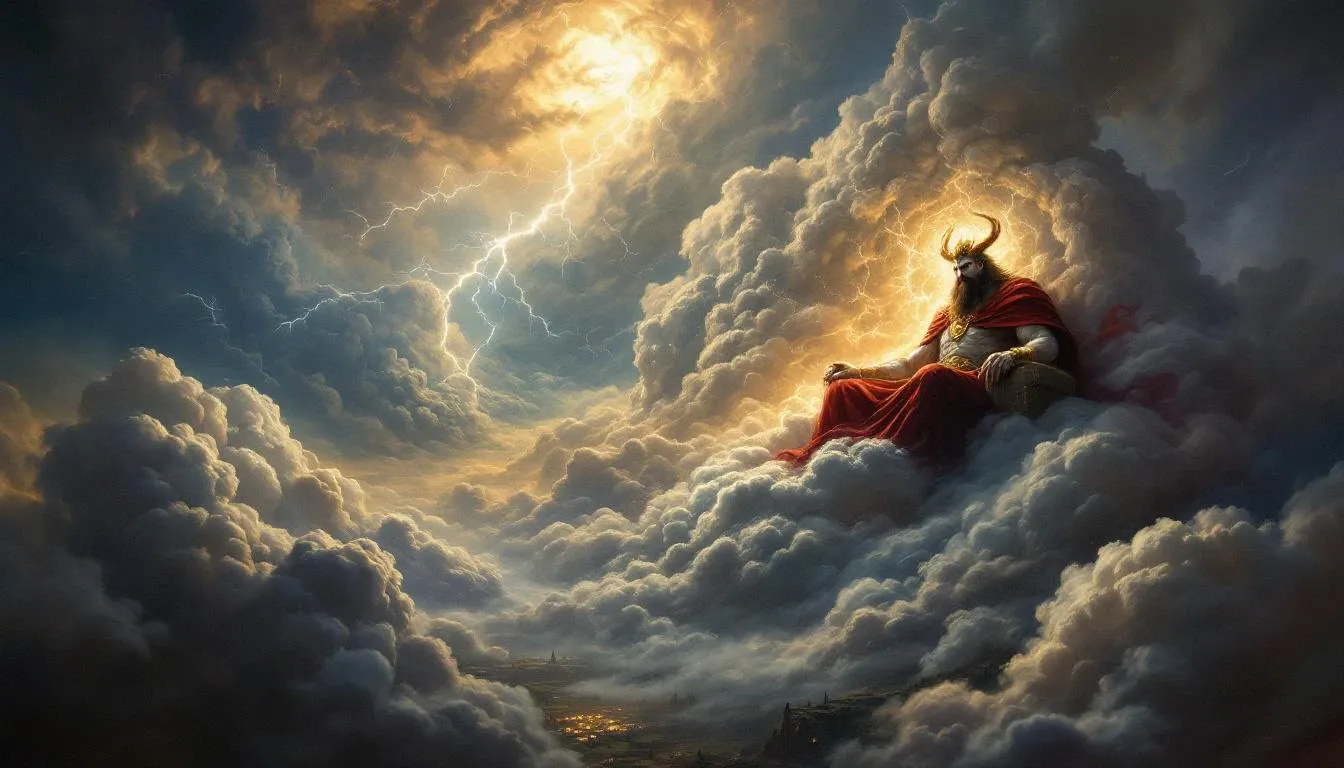
But to call Prav simply "the place where the gods live" would be to reduce it. The gods inhabited Prav in the way that judges inhabit a courtroom — they did not create the law, they administered it. Perun sat in the crown of the World Tree and hurled lightning not because he was angry but because Prav required it. When Veles stole the cattle, the waters, the sacred fire — when the serpent climbed the tree and disrupted the order of things — Perun responded because the cosmic law demanded response. The thunder god was not a tyrant. He was an instrument of Prav, the enforcer of a pattern older than himself.
Prav and Rod: The Origin Before the Gods
If Prav was the cosmic law, the question arises: who made the law? The Slavic answer, preserved in fragmentary sources and reconstructed by scholars including Boris Rybakov and Vyacheslav Ivanov, points to Rod — the supreme creative force, the ancestor of everything, the being whose name literally means "birth," "clan," "origin."
Rod was not a god in the way that Perun or Veles were gods. He did not intervene in human affairs, did not demand sacrifice, did not take sides in the storm myth. Rod was the generative principle itself — the force that produced the universe and its laws before producing the gods who would enforce them. The relationship between Rod and Prav was not one of creator to creation but something closer to the relationship between a musician and the music: the pattern emerged from the source, and once it existed, it had its own authority.
This meant that Prav was, in a sense, pre-divine. It existed before the gods existed. When Svarog forged the sky or when Perun took his seat on the mountaintop, they were not establishing the cosmic order — they were taking their positions within an order that was already there. Prav was the script. The gods were the actors. And the audience — the mortals living in Yav — could not see the script directly, but they could observe its effects in the turning of the seasons, the falling of rain, the fact that the sun rose every morning and set every evening without fail.
This theological structure has parallels in other Indo-European traditions. The Vedic concept of ṛta — cosmic order, truth, the right way of things — functions almost identically to Prav. Both are impersonal principles that govern the gods as well as mortals. Both preexist the current world order. Both are linguistically related: the Sanskrit ṛta and the Slavic prav- share the Indo-European root system that produced words for rightness and order across the entire family of languages.
The Sun's Journey Through Prav
One of the most vivid expressions of Prav in folk tradition involves the sun. In the Slavic understanding, the sun — embodied as the god Dazhbog or Khors, depending on the tradition — traveled across the sky during the day and then descended into Nav at night, passing through the underworld before rising again at dawn. This daily journey was not the sun's own choice. It was the path that Prav dictated.
The sun's arc across the sky was the most visible proof that Prav functioned. When the sun rose at the appointed hour, crossed the sky in the appointed direction, and set at the appointed place, the cosmic order was demonstrably intact. An eclipse, by contrast, was a moment of terror — not because the Slavs did not understand the mechanics of celestial bodies, but because any interruption of the sun's path represented a violation of Prav, a crack in the law of the universe.
The sun's nightly passage through Nav was equally significant. The dead existed in perpetual twilight, but the sun brought moments of warmth and light even to the underworld. This was Prav's reach extending below — the cosmic order touching even the kingdom of death, ensuring that the dead were not entirely abandoned, that even Nav was subject to the turning of the cosmic wheel.
The relationship between the sun and Prav explains why so many Slavic rituals are organized around solar events. The winter solstice (Kolyada), the spring equinox, the summer solstice (Kupala Night), the autumn equinox — these were the hinges of the cosmic year, the moments when Prav's machinery visibly shifted gears. Rituals performed at these times were not mere celebrations. They were acts of participation in the cosmic order, human contributions to the maintenance of a system that required cooperation between all three worlds to function.
Prav vs. Christian Heaven
The difference between Prav and the Christian heaven is fundamental, and the confusion of the two after Christianization explains much about how Slavic cosmology was distorted in the medieval and modern periods.
Christian heaven is a destination. You live, you die, you are judged, and if you are worthy, you go to heaven. It is personal. It is reward-based. It is populated by saved souls who have earned their place through faith and virtue.
Prav is none of these things. No human soul goes to Prav after death. The dead go to Nav — all of them, righteous and wicked alike, into Veles's wet meadows below the roots. Prav does not select. Prav does not judge individuals. Prav is the principle that makes judgment possible in the first place, the law that defines what "righteous" means, but it is not the place where righteousness is rewarded.
This is a critical distinction that the Orthodox Church's missionaries either did not understand or deliberately obscured. When Slavic converts were told about heaven — a bright realm above, where God sits in judgment — they naturally mapped it onto Prav. The bright realm above the clouds where the divine authority resides: the description fits both concepts on the surface. But beneath the surface, the theology is radically different.
Christian heaven is grace — it is given by God to those He chooses. Prav is structure — it exists whether the gods choose it or not. Christian heaven can be lost through sin. Prav cannot be lost, only temporarily obscured. Christian heaven is the endpoint of a linear story: creation, fall, redemption, paradise. Prav is the constant in a cyclical story: winter, spring, summer, autumn, winter again, forever.
When the Slavs accepted baptism but continued to set wreaths on the river at Kupala Night and pour offerings on graves at Radonitsa, they were not being "incompletely Christianized." They were maintaining a cosmological system in which Prav still functioned — in which the cosmic order still required human participation, regardless of what the new priests said about faith and salvation.
Among the Slavs, a remarkable custom prevails. At their feasts, they pass around a drinking bowl, over which they utter words — I should not say of consecration but of execration — in the name of their gods, of the good god and of the evil god, saying that all favorable fortune is brought about by the good god and all ill fortune by the evil god. Therefore in their language they call the evil god Diabol or Zcerneboch, that is, black god.
Iriy: The Garden at the Edge of Prav
Within or adjacent to Prav — the sources are not precise enough to fix the geography — lay Iriy (also spelled Vyraj or Irij). This was the Slavic paradise, but paradise in the vegetative sense rather than the spiritual one. Iriy was the place where the birds went in winter — the warm land beyond the edge of the world, where the rivers never froze and the trees bore fruit year-round.
Iriy was closely associated with Prav without being identical to it. If Prav was the law, Iriy was the garden that the law maintained — the ideal landscape, the perfected version of the earthly world, where everything grew as it was supposed to grow, unbothered by frost or drought or the depredations of the underworld. Migratory birds traveled to Iriy when winter came and returned from it in spring, carrying the warmth of that perfect garden back to the mortal world. The stork, the swallow, and the cuckoo were all considered messengers of Iriy — birds that knew the route between the worlds.
In some traditions, the souls of the dead could reach Iriy — not all of them, and not through Christian-style judgment, but through the mechanisms of proper burial and ancestor veneration. The souls that received correct funeral rites, whose descendants continued to honor them at the proper feast days, could ascend from Nav's wet twilight to Iriy's green warmth. This was not salvation. It was maintenance — the continued functioning of the three-world system, in which the dead moved upward as the living moved them through ritual.
Pravda: The Word That Survived the World
The gods of Prav are gone. Perun's idol was thrown into the Dnieper in 988. The sacred groves were felled. The World Tree was replaced by church spires. But the word survived.
Pravda — truth. Pravo — law. Pravitel' — ruler. Spravedlivost' — justice. Ispravit' — to correct, to set right. The entire Slavic vocabulary of order, governance, and moral correctness grows from the same root that named the highest world in the pre-Christian cosmos. Every time a Russian speaker says pravda, they are — unknowingly, etymologically — invoking the cosmic order that sat in the crown of an oak tree before Cyrillic existed.
This linguistic survival is not sentimental. It reveals something about the depth at which Prav was embedded in the Slavic worldview. The gods could be toppled because they were specific — individual figures with names and attributes that could be targeted and replaced. But Prav was not specific. It was the grammar of the moral universe. You cannot destroy a grammar by burning its textbooks. As long as people speak the language, the grammar persists.
The modern Russian courtroom operates under pravo — law. The newspaper claims to print pravda — truth. The government is a pravitel'stvo — a body that steers things in the right direction. None of these institutions acknowledge the oak tree or the eagle or the three worlds stacked along a vertical axis. But the word they all use to describe what they do — to make things right, to set them straight, to align them with the way things should be — is the same word the Slavs used a thousand years ago to name the place where the gods administered the pattern of the universe.
Prav is gone as a place. As a word, it governs everything.