Under a stone. Always under a stone.
In a cave beneath a mountain, or in a barrow at the edge of the steppe, or in a chamber beneath the roots of an ancient oak, or sealed in a wall of a ruined fortress that no living person remembers building — the sword waits. It has been waiting since before the hero was born. It has been waiting since before the hero's grandfather was born. It may have been waiting since the world was made, because the sword-kladenets does not operate on human time. It operates on the time of stories, and stories say: the weapon is found when the weapon is needed, and not one day before.
The sword-kladenets — mech-kladenets in Russian — is the great enchanted weapon of East Slavic folklore. It appears in fairy tales, in byliny (heroic epics), in folk songs, and in the kind of half-remembered village tradition where a grandparent describes an object with such specificity that you cannot tell whether they are quoting a story or reporting a personal observation. The sword cuts through any armor. It kills any enemy. In its most remarkable form, it swings itself — the blade fights independently of the hand that holds it, a weapon with its own intelligence and its own will, as if the steel itself remembers how to kill and does not need human guidance to do it.
It is, by any measure, the Slavic Excalibur. But it is not a copy of Excalibur, and the differences between the two swords illuminate the differences between the cultures that forged them.
The Name: Treasure in the Earth
The word kladenets is the key, and it unlocks more than a sword.
It derives from klad — a word that every Russian speaker knows, a word that means "treasure" in the specific sense of buried treasure, hidden treasure, treasure concealed in the earth. A klad is not the gold in a king's treasury, displayed on shelves and counted by clerks. A klad is the gold in the ground — the hoard buried by someone who died before they could retrieve it, the fortune sealed in a pot and lowered into a hole in the forest floor, the wealth that the earth has swallowed and refuses to give back.
The suffix -enets transforms the root into something between an agent noun and an adjective. The kladenets is "the buried one," "the hidden one," "the thing of the earth." The sword-kladenets is the sword that was buried, the sword that was hidden, the sword that belongs to the earth until the right person comes to claim it.
This etymology is not merely a linguistic curiosity. It encodes the entire mythology of the weapon. The sword-kladenets is always found underground. It is always concealed — not lost, not abandoned, but deliberately hidden by someone or something that understood its power and chose to seal it away. The act of finding the sword is always an act of excavation, of breaking through barriers, of descending into spaces where the living do not normally go. The hero goes underground. The hero lifts the stone. The hero reaches into the dark earth and pulls out something that glows.
The Self-Swinging Blade
The most extraordinary property of the sword-kladenets is not its sharpness or its indestructibility. It is its autonomy.
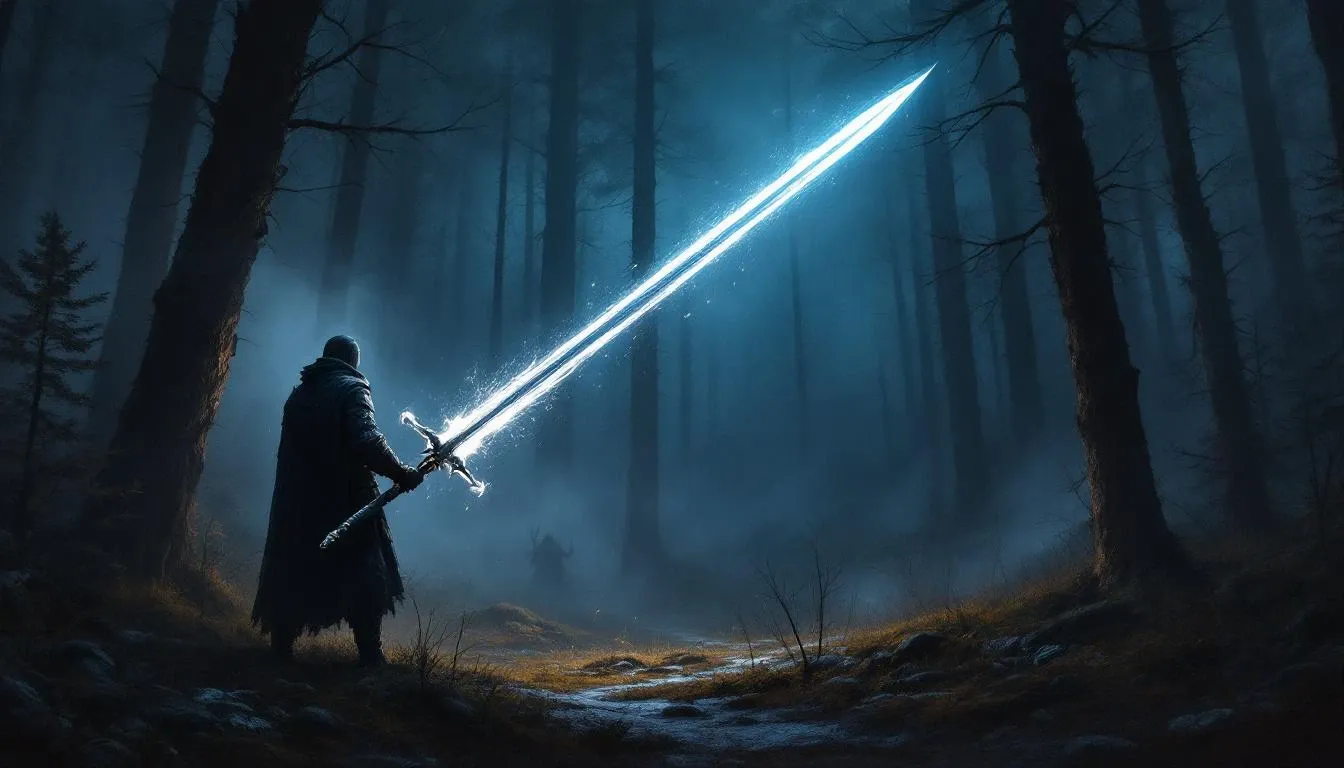
In Russian fairy tales, the sword-kladenets is frequently described as samo-syok — "self-swinging," "self-striking." The word is precise: samo (self) + syok from sech' (to cut, to hack). The sword cuts by itself. It does not require the hero's arm to direct it. Once drawn from its hiding place and raised in battle, the blade knows what to do. It finds the enemy's neck. It finds the gap in the armor. It severs the heads of the many-headed dragon without the hero needing to aim. The hero holds the sword, but the sword fights the battle.
This property elevates the kladenets above the category of "very good weapon" and into the category of "supernatural agent." The sword is not a tool. It is a partner — a being with intelligence and will, embedded in a steel body, that collaborates with the hero rather than merely serving him. In some variants, the sword is described as knowing who its true owner is, refusing to cut for the wrong hand, growing heavy as a mountain when grasped by an unworthy person and light as a feather when held by the destined hero.
The self-swinging quality connects the kladenets to a broader tradition of enchanted objects in Slavic folklore: the self-setting tablecloth (skatert'-samobranka) that produces food from nothing, the self-flying carpet (kover-samolyot), the self-playing gusli (a stringed instrument that plays music without a musician). The prefix samo- — self — is the mark of enchantment in the Russian fairy tale vocabulary. An object that operates by itself has crossed the line from the mundane into the magical, from the made into the living.
The Finding: Under Stone, Under Earth
The retrieval of the sword-kladenets follows patterns that recur across dozens of fairy tales and byliny, with variations that reveal different aspects of the weapon's mythology.
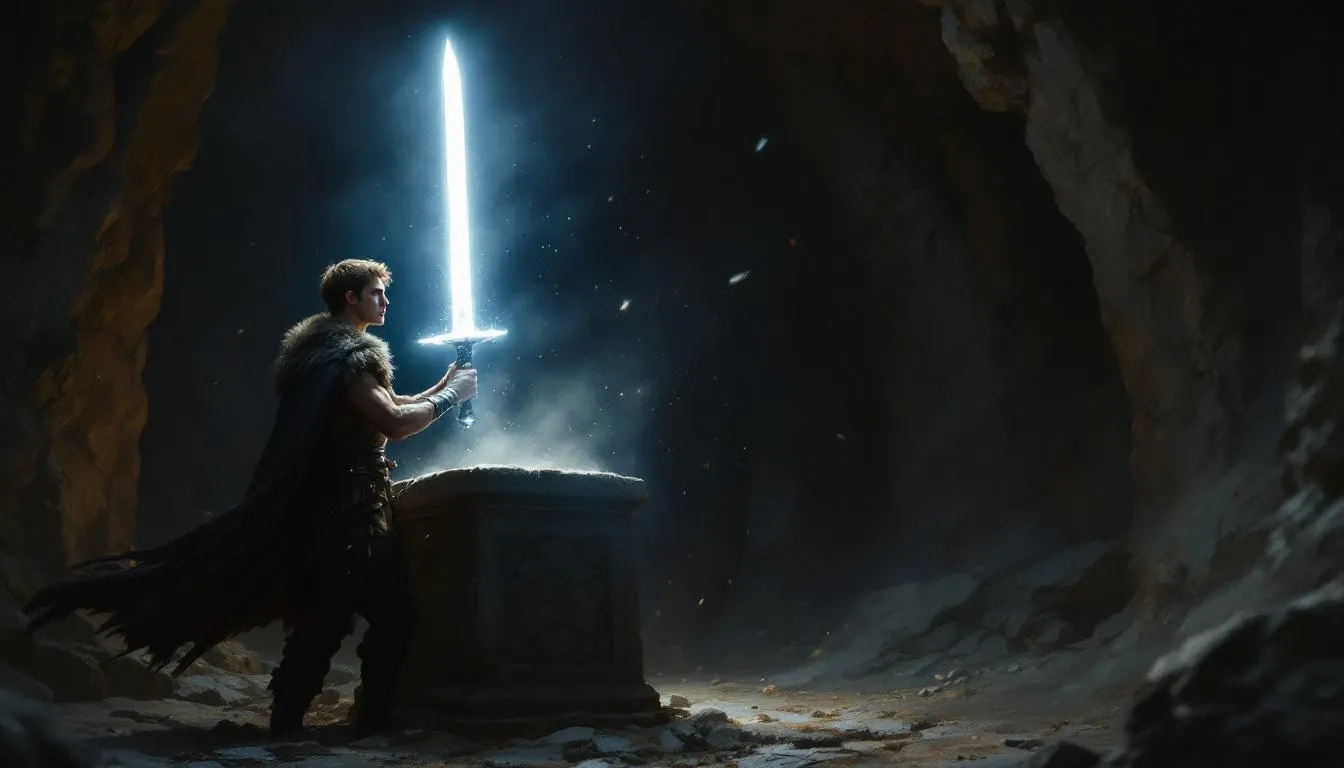
Under the stone. The most common location is beneath a large stone — sometimes described as an Alatyr stone (connecting the sword to the sacred center-stone of Slavic cosmology), sometimes simply as a boulder so heavy that no ordinary person can lift it. The hero arrives at the stone. He lifts it — and the lifting itself is the first test, the proof that his strength is sufficient for the weapon that waits below. Beneath the stone, in a chamber or a hollow in the earth, the sword lies waiting, sometimes still bright, sometimes covered in the rust of centuries that falls away at the hero's touch.
In the barrow. In some stories, the sword is found in a kurgan — a burial mound, the grave of an ancient warrior. The hero must enter the tomb, confront whatever guards it (the dead warrior's spirit, a serpent, a supernatural fire), and take the sword from the skeleton's hand. This variant is the most explicitly archaeological: the kladenets is inherited from the heroic past, a weapon that belonged to a previous era's champion and has been waiting in the grave for a new generation's need.
From the dying hero. In the byliny, the sword-kladenets is sometimes passed directly from one bogatyr to another. The dying hero bequeaths the sword to his successor, or describes its location so that the young warrior can find it after the old one is gone. Svyatogor, the giant bogatyr whose strength was too great for the earth to bear, passes his sword to Ilya Muromets in a scene that explicitly transfers the weapon's power from the mythic past to the heroic present.
At the crossroads. In certain fairy tale variants, the sword is found at a crossroads — the place where paths divide, where choices are forced, where the chort waits and the world's boundaries grow thin. The crossroads-finding connects the kladenets to the broader Slavic geography of the liminal: the sword belongs to the spaces between, the thresholds, the places where the ordinary world opens onto something else.
And Svyatogor said to Ilya: 'Take my sword-kladenets, for my hand has no more strength to hold it, and a sword that was forged for battle should not rust in a dead man's coffin. It will know your grip. Take it and use it, and when your hand in turn grows weak, find a man worthy and pass it on, for the sword is older than both of us and will outlive us both.'
The Bogatyr Swords
The sword-kladenets is inseparable from the bogatyrs — the heroic champions of the Russian byliny — and their individual weapons define their characters as much as their deeds do.
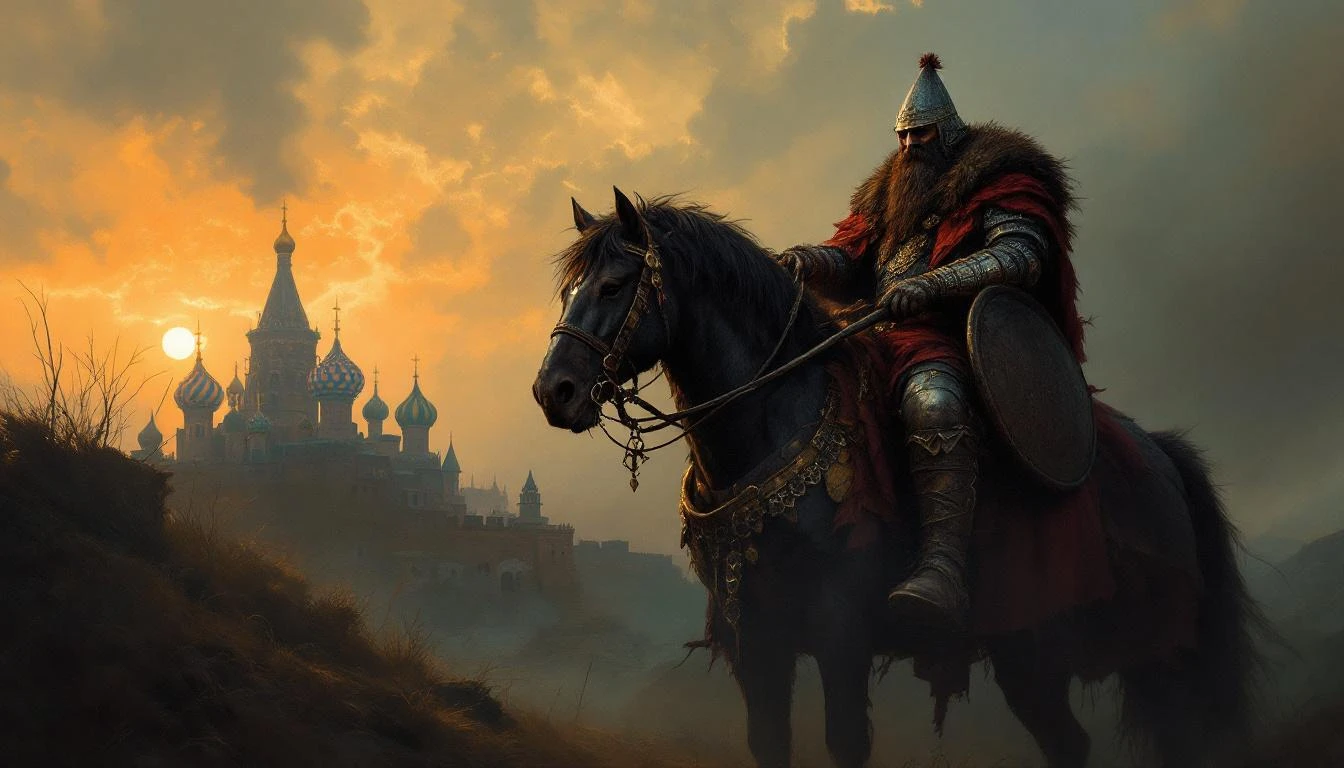
Ilya Muromets, the greatest of the bogatyrs, wields the sword-kladenets as an extension of his legendary strength. In the byliny, Ilya's sword is not merely a weapon but a symbol of his role as defender of the Russian land. He receives it from Svyatogor, or finds it in a barrow, or is directed to it by a prophecy — the specifics vary, but the meaning is constant. The sword chooses Ilya because Ilya is the champion. The weapon and the hero are matched by fate.
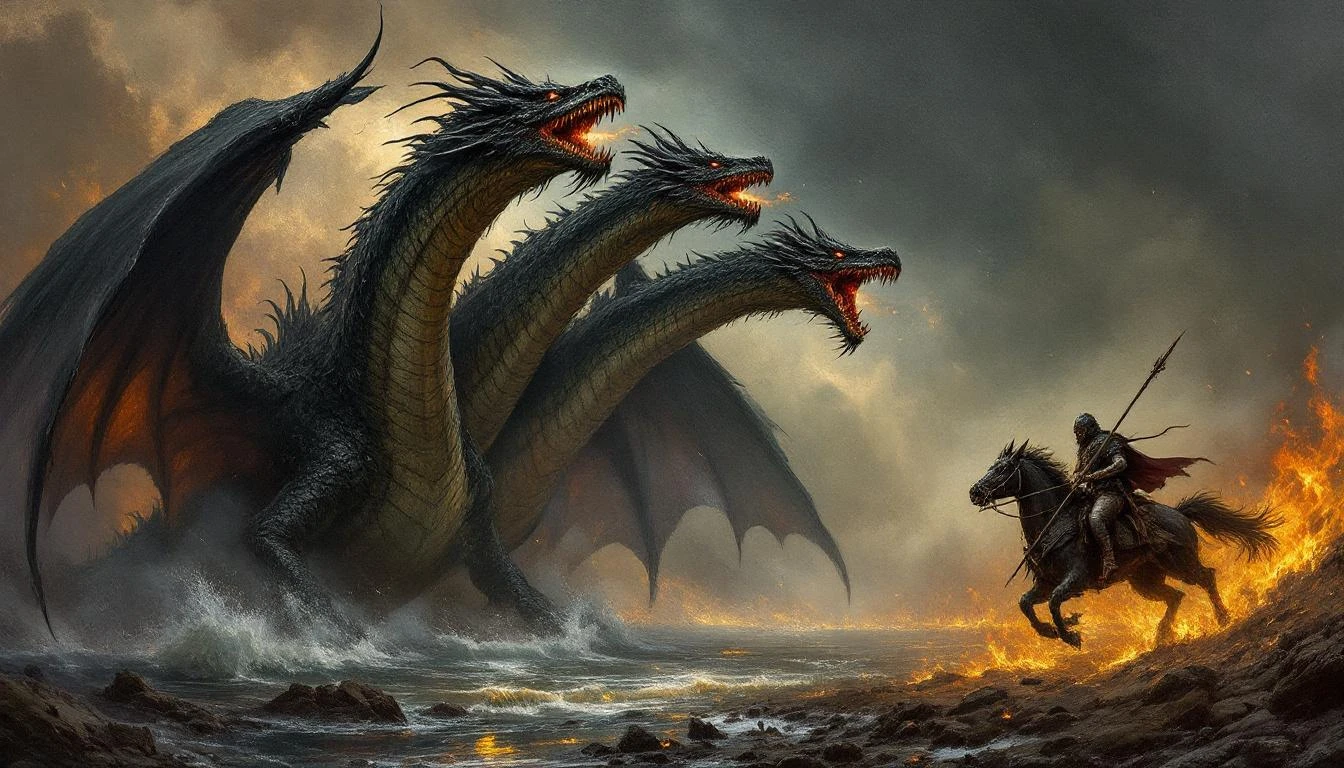
Dobrynya Nikitich, the second bogatyr, is more closely associated with the sword than any other hero in the byliny. His most famous battle — against the Zmey Gorynych, the multi-headed dragon — involves a sequence in which his ordinary weapons fail and only the kladenets can finish the job. In some versions, Dobrynya's sword speaks to him, or the sword's spirit appears to him in a dream and tells him where to find it. The relationship between Dobrynya and his sword is more intimate than Ilya's — more like a partnership between equals than a tool in the hand of a master.
In the fairy tales — as opposed to the byliny — the sword-kladenets belongs most often to Ivan Tsarevich, the generic prince-hero of the Russian fairy tale. Ivan finds the sword in the course of his quest, and the finding marks the transition from the helpless, youngest-brother phase of the story to the triumphant, dragon-slaying phase. Before the kladenets, Ivan is passive, carried by helpers and guided by advice. After the kladenets, he acts. The sword is the catalyst that transforms the hero from a character to whom things happen into a character who makes things happen.
Kladenets vs. Excalibur
The comparison is inevitable, and it reveals more differences than similarities.
Excalibur is a sword of sovereignty. It confers the right to rule. Arthur draws it from the stone (or receives it from the Lady of the Lake, depending on which tradition you follow) and the act proves he is the rightful king of Britain. The sword is a credential, a divine appointment letter forged in steel. Its function is political: it legitimizes Arthur's authority in a land torn by competing claims.
The sword-kladenets is a sword of capability. It does not confer the right to rule — the Russian fairy tale hero is rarely interested in thrones. It confers the ability to fight — specifically, the ability to fight enemies that cannot be defeated by ordinary weapons. The dragon. Koschei the Deathless. The multi-headed guardian at the Kalinov Bridge. The kladenets exists because these enemies exist, and without it the hero cannot complete the quest. It is a practical necessity, not a political symbol.
The Norse Gram — the sword of Sigurd/Siegfried — is perhaps a closer relative. Gram was reforged from the shards of a broken weapon, it was specifically destined for a specific hero, and it was used to kill a dragon (Fafnir). The kladenets shares these features: it is always destined for its hero, it is always used against a supernatural enemy, and it is always found rather than forged. But Gram carries a curse — it belongs to a doomed lineage, and its every appearance is shadowed by the coming tragedy. The kladenets carries no curse. It is a gift from the earth, offered to the worthy, and its story ends in triumph, not in doom.
The Irish Fragarach — the sword of Manannan mac Lir, later carried by Lugh — could compel truth from anyone it was held against and could pierce any armor. The kladenets' self-swinging ability recalls Fragarach's independence: both swords operate partially under their own power, both cut with a precision that exceeds human skill. But Fragarach belongs to the gods. The kladenets belongs to the earth. It is buried in soil, hidden under stones, sealed in the bones of the landscape. It is chthonic rather than divine — a weapon of the underworld, waiting in the dark.
The deepest difference is in the finding. Arthur draws Excalibur from a stone in a churchyard, in front of witnesses, as a public spectacle. The hero of Russian folklore finds the kladenets alone, underground, in silence. There is no audience. There is no coronation. There is only a man in the dark, lifting a stone, reaching into a hole in the earth, and pulling out something that glows. The Slavic hero does not need witnesses to prove his worth. The sword knows. That is enough.
Fairy Tale Appearances
The sword-kladenets appears in dozens of Russian fairy tales collected by Alexander Afanasyev, the great nineteenth-century folklorist whose volumes of Narodnye russkie skazki (Russian Folk Tales) form the bedrock of the published tradition.
In "Marya Morevna," Ivan Tsarevich uses the kladenets to fight Koschei the Deathless — and even the self-swinging blade cannot kill Koschei permanently, because Koschei's death is hidden elsewhere (in a needle, in an egg, in a duck, in a hare, in a chest, on an island — the famous nested-death of Slavic folklore). The kladenets can wound Koschei, can drive him back, can buy time — but it cannot end him. This limitation is important. The sword is powerful but it is not omnipotent. Even the greatest weapon in Russian folklore has enemies it cannot finally defeat.
In "The Firebird and the Gray Wolf," the sword appears as part of the impossible quest — one of three magical objects the hero must obtain (along with the Firebird and a golden-maned horse). The sword is guarded, the theft is perilous, and the hero's success depends not on his strength but on his willingness to follow instructions precisely. The kladenets in this context is not merely a weapon. It is a test-object — a thing whose acquisition proves the hero's courage, obedience, and luck.
In the tales of Baba Yaga, the kladenets sometimes belongs to the witch herself — hidden in her hut on chicken legs, locked in a chest bound with iron chains. The hero must steal it, which means surviving Baba Yaga's hospitality (which can kill you), passing her tests (which can kill you), and escaping her pursuit (which can definitely kill you). The sword belonging to the witch connects the kladenets to the chthonic feminine — to the earth-mother in her terrifying aspect, the goddess of death who holds the power of life in her withered hand.
The Sword and the Earth
The sword-kladenets belongs to the earth the way a seed belongs to the soil. It is planted, not stored. It grows in power during its time underground, absorbing something from the darkness and the silence and the weight of stone above it. The hero who finds it is performing an act of harvest — pulling from the ground something that was sown there long ago, something that has been ripening in the dark, waiting for the season of its use.
This reading connects the kladenets to the broader Slavic understanding of buried things. In Russian folk belief, the earth is not merely a surface to walk on. It is a power — Mat Zemlya, Mother Earth, one of the oldest and most venerated forces in the Slavic spiritual world. The earth holds the dead. The earth holds the seeds. The earth holds the treasure. The earth holds the sword. Everything that is planted in it comes back transformed: the dead become ancestors, the seeds become grain, the treasure becomes legend, and the sword becomes magic.
What the Sword Remembers
The sword-kladenets is a repository. Not of magic in the abstract, but of memory — of the accumulated skill and will of every hand that held it before the current hero's. The self-swinging blade knows how to fight because it has fought before, in other hands, in other ages, against enemies whose names the current hero does not know. The steel remembers. The cutting edge carries knowledge that the hero's muscles have not earned — knowledge of angles, of timing, of the precise force needed to sever a dragon's head at the joint where scale meets vulnerable skin.
This is what makes the kladenets different from a merely powerful weapon. A sharp sword cuts well because it is sharp. The kladenets cuts well because it knows. It is an expert in the form of an object — a master swordsman compressed into steel, available to anyone worthy of holding the hilt. The hero does not need to be a great fighter to use the kladenets. He needs to be worthy, which is a different quality entirely. Worthiness is moral and destined. Fighting skill is learned and practiced. The kladenets bridges the gap between the two, giving the worthy hero the skill he has not had time to acquire.
This is the sword's deepest gift and its deepest mystery: it compensates for the hero's youth. The fairy tale hero is almost always young — often the youngest son, the one with the least experience, the one nobody expects to succeed. The kladenets gives this untested boy the fighting knowledge of centuries. It is the past arming the present, the earth lending its stored power to the surface, the dead equipping the living for a battle that both worlds need won.
Under a stone. Always under a stone. The sword waits in the dark, patient as the earth that holds it, sharp as the moment it was forged. It has been waiting longer than the hero has been alive. It will wait longer than the hero's children will remember his name. And when the right hand lifts the stone and reaches into the hollow and closes its fingers around the hilt, the blade will know. It always knows.
The sword swings itself. The hero holds on.