Every language has a word for the thing in the dark. English has "demon." Arabic has "jinn." The Slavic languages have bies — and the word is so deeply embedded in the everyday speech of two hundred million people that most of them use it without knowing they are invoking the oldest name for evil in their vocabulary.
In Russian: бес (bes). In Ukrainian: біс (bis). In Polish: bies. In Czech: běs. In Old Church Slavonic — the liturgical language of medieval Slavdom, the Latin of the Orthodox East — the word appears as бѣсъ in manuscripts that predate the Mongol invasion by centuries. Every Slavic language has it. Every Slavic culture knows what it means. And the meaning has been the same since before Christianity arrived in the lands of the eastern Slavs: a spirit of evil, a creature of chaos, a thing that enters the world through the cracks in human attention and does not leave willingly.
But the bies is not a specific demon. It is not a named character with a biography and a set of stories, the way Koschei is a character or Baba Yaga is a character. The bies is the category — the genus, not the species. It is the word the Slavic mind reaches for when it needs to say "demon" and does not care which one. It is the bucket into which everything unclean gets thrown. And because it is a category rather than an individual, it has infiltrated the language itself, colonizing words and phrases and idioms so thoroughly that a Russian speaker cannot get through a single irritating day without summoning it.
The Word Before the Cross
The etymology of bies reaches back into Proto-Slavic as *běsъ, and the scholars who have spent careers tracking its origin have found something remarkable: the word appears to predate any contact with Christianity. It is not borrowed from Greek daimon or Latin daemon. It is not a translation of a Biblical concept. It is native — a genuinely Slavic word for a genuinely Slavic idea.
The most widely accepted reconstruction connects *běsъ to a Proto-Indo-European root *bhoidh-so-, related to fear and terror. The Lithuanian cognate baisus means "terrible, frightening." The Old Irish baes means "madness." Under this reading, the original bies was not a moral category but an emotional one: a bies was a thing that causes fear, a thing that drives you mad, a thing that disrupts the normal operation of the human mind. The demonization came later. The fear came first.
This matters because it tells us something about the pre-Christian Slavic understanding of evil. Evil was not, in the oldest layer of Slavic thought, a theological abstraction. It was not the rebellion of a fallen angel or the corruption of a perfect creation. Evil was experiential — it was the thing that made you afraid when there was nothing visible to be afraid of, the force that turned a sane person raving, the pressure in the dark that you could feel on your skin but could not explain. The bies was fear itself, given a name and a shape so that humans could talk about it, warn each other about it, develop strategies against it.
When the Christian missionaries arrived — in 988 for the Kievan Rus, gradually over the preceding centuries for the western and southern Slavs — they needed a word for "demon" in the local languages. They found bies already waiting. The word was drafted into Christian service and assigned the role of translating the Greek daimonion in the Slavic versions of Scripture. The original meaning — fear, madness, spiritual disruption — was overwritten with the Christian meaning: a fallen angel, a servant of Satan, an enemy of God. But the older meaning never fully disappeared. It lingered in the language like groundwater, invisible but present, shaping everything that grew above it.
Nechistaya Sila: The Unclean Force
To understand where the bies fits in Slavic demonology, you need to understand the system it belongs to. That system has a name: nechistaya sila — the unclean force.
Nechistaya sila is the collective term for every supernatural being in Slavic folk belief that stands in opposition to the clean, the sacred, the consecrated. It includes the chort (the devil), the leshy (the forest spirit), the vodyanoy (the water spirit), the domovoy (the house spirit in its darker aspects), the rusalka (the water maiden), the kikimora (the malevolent female spirit), the mora (the nightmare), the anchutka (the heelless imp), and dozens of others. It is an enormous, sprawling, contradictory taxonomy of beings that ranges from the merely mischievous to the genuinely murderous.
The bies occupies a peculiar position in this taxonomy. It is simultaneously a member of the category and a synonym for the category itself. You can say "the biesy attacked him" and mean "specific demonic beings attacked him." You can also say "he was overcome by bies" and mean "he was overcome by the unclean force in general" — madness, possession, spiritual corruption, the entire undifferentiated mass of evil. The word functions as both a singular noun and a collective one, both a specific creature and an abstract principle.
This ambiguity is not a flaw in the folk system. It is the system. The Slavic peasant did not draw sharp lines between one demon and another in the way that a theologian might. The darkness was the darkness. Sometimes it had a specific face — the leshy's green beard, the vodyanoy's bloated body, the chort's hooves and tail. Sometimes it was faceless, nameless, a pressure without a source, a dread without an object. When the darkness was faceless, the word for it was bies.
Bies vs. Chort: The Eternal Confusion
The relationship between the bies and the chort is one of the most tangled problems in Slavic folk demonology, and the confusion is not accidental — it reflects a real ambiguity in the tradition itself.
In the strictest theological usage, inherited from the Christian Slavonic translations, bies means demon and chort means devil — a distinction that mirrors the Greek daimon versus diabolos. The devil is a specific entity: the adversary, the tempter, the prince of darkness. A demon is a member of his army, a foot soldier in the war against the sacred. Under this reading, there are many biesy but only one chort, the way there are many demons but only one Satan.
Folk usage, however, demolished this distinction within a generation. In actual village speech across the East Slavic world, bies and chort became interchangeable. Both meant "demon" in the generic sense. Both were used as curses and exclamations. Both referred to the same shapeless dread that haunted crossroads and swamps and the spaces behind the bathhouse after dark. The theological hierarchy — one devil at the top, many demons beneath — was too abstract for everyday life. The peasant did not need to know the organizational chart of hell. The peasant needed a word to spit when the milk went sour, and either word would do.
There is, however, a subtle difference that survives in certain regions and certain contexts. The chort tends to appear in stories as a character — individuated, with dialogue, with schemes, with a personality that can be outwitted. The bies tends to appear as a force — plural, anonymous, swarming. You bargain with the chort. You are overwhelmed by the biesy. The chort is the trickster you can defeat. The biesy are the tide you can only endure.
Pushkin's Blizzard: "Besy"
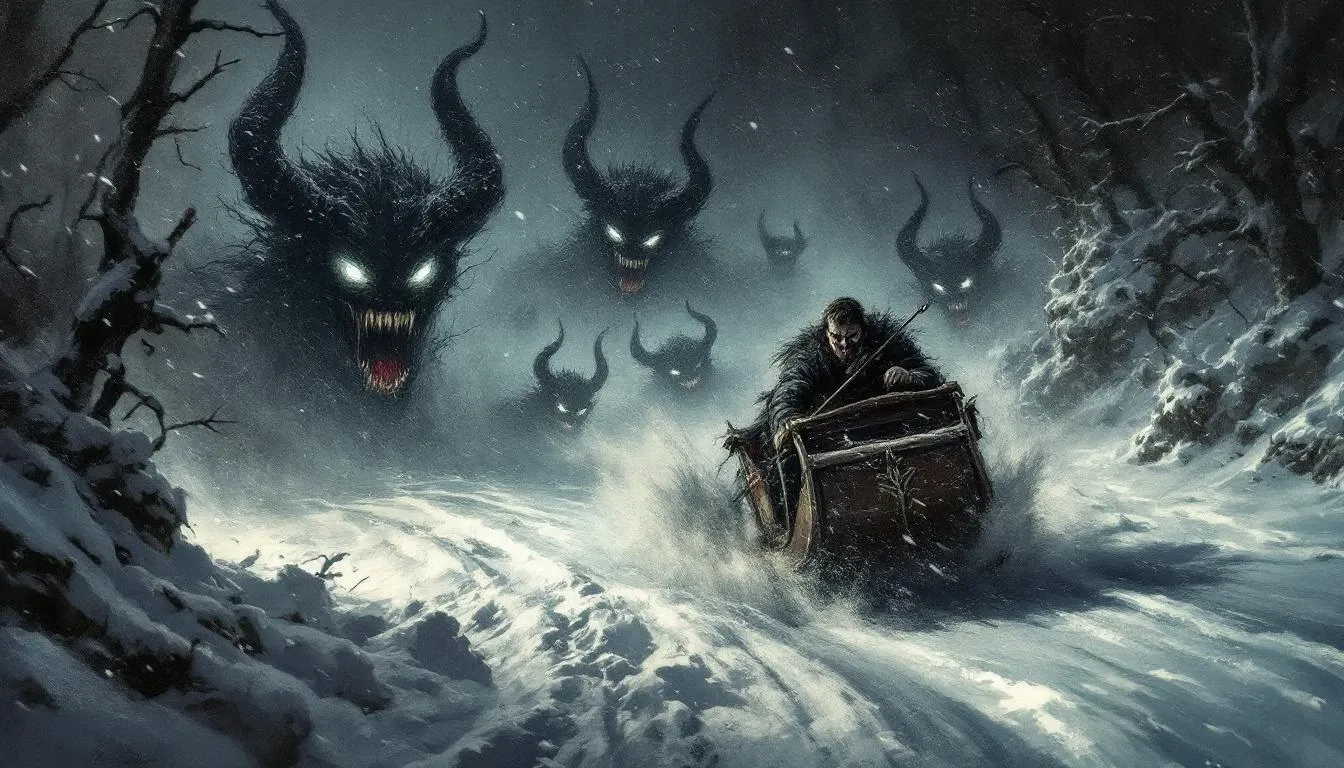
The most famous appearance of the biesy in Russian literature is not in a folk tale collection or a church chronicle. It is in a poem by Alexander Pushkin, written in 1830, titled simply "Besy" — "The Demons."
The poem describes a sleigh ride through a blizzard. The narrator and his driver are lost. The snow is blinding. The road has vanished. And in the whirling white chaos, shapes appear — the biesy, spinning, diving, filling the air with their wailing.
Boundless are the plains surrounding, / through the blizzard the snow flies, / and the pallid moon is drowning / in the wild and murky skies. / On and on the troika races — / jingling bells go ding-ding-ding... / Lord above! Among these spaces / myriad demons are a-wing! / In the nebulous, deformed, / limitless and gray expanses, / demons — multitudes that swarmed — / whirled their eerie dances...
Pushkin's biesy are not the demons of Christian theology. They are not fallen angels or servants of a master plan. They are the blizzard itself — the snow become conscious, malevolent, playful in a way that kills. They lead the traveler in circles. They fill the air with sounds that might be wind or might be laughter. They are indistinguishable from the storm, which is exactly the point.
The poem captured something that centuries of folk belief had always known: the bies is not a creature you see clearly. It is the thing at the edge of vision, the shape in the snowstorm that might be a demon or might be a drift of snow, the sound in the dark that might be the wind or might be something with intent. The bies lives in the ambiguity — in the space between perception and imagination, between what is really there and what the terrified mind constructs from raw material of darkness and cold and solitude.
Pushkin's poem became, paradoxically, the most accurate ethnographic document of the bies experience. Better than any folklorist's field report, it conveys the phenomenology of the thing: the disorientation, the circling, the inability to distinguish the natural from the supernatural, the creeping suspicion that the storm is not random but directed, that something in the white chaos is watching and steering.
The Linguistic Haunting
The bies does not merely appear in folk tales and poems. It lives in the Russian language itself — embedded in words and phrases so common that their demonic origin has been entirely forgotten by the people who use them daily.
Besit' (бесить) — to enrage, to infuriate. Literally: to demon someone, to inflict the bies upon them. When a Russian says "Eto menya besit" — "This infuriates me" — they are using a verb that originally described demonic possession. Irritation, in the deep grammar of the language, is a mild form of being inhabited by evil spirits.
Besnovatiy (бесноватый) — possessed, frenzied. The adjective form of the noun, applied to people in states of violent agitation. The word survived Soviet atheism intact. A school principal describing an unruly classroom might say the children are besnovatiye without any awareness that she is diagnosing them with demonic inhabitation.
Bespokoyniy (беспокойный) — restless, anxious. The etymology is disputed, but the folk association is clear: the prefix bes- sounds identical to bies, and in the folk mind the connection was real. Restlessness was the bies moving inside you, the demon that would not let you sleep.
Bessmertny (бессмертный) — immortal, literally "without death." Here the prefix is genuinely just the negation bez- (without), but the phonetic overlap with bies is so complete that folk etymology frequently contaminated the meaning. The immortal was the one the demons could not take. Or, alternatively, the immortal was the one who was a demon — a being like Koschei the Deathless whose immortality was itself a mark of the unclean.
Besputa — a person without path or purpose. Beskhozny — ownerless, abandoned. Bestolkoviy — senseless, stupid. The bes- prefix in Russian means "without," but it is phonetically indistinguishable from the demon's name, and this is not a coincidence the folk mind ignores. In the world of Russian folk etymology — which operates by sound rather than by scholarly derivation — every word that begins with bes- carries a trace of the demonic. The language itself is haunted. The demon is in the dictionary.
The Category System of Slavic Demons
If the bies is the generic demon, what are the specific ones? The Slavic system is vast, but it can be roughly organized into categories that the folk tradition itself recognized, even if it never wrote them down in a taxonomy.
Demons of place are tied to specific locations. The leshy belongs to the forest. The vodyanoy belongs to the water. The polevoy belongs to the field. The bolotnik belongs to the swamp. The domovoy belongs to the house. The bannik belongs to the bathhouse. The dvorovoy belongs to the yard. Each has a territory, a personality, a set of rules for how it interacts with humans. These are the aristocracy of the unclean force — named, individuated, respected enough to be addressed and bargained with.
Demons of condition are tied to states of being rather than places. The mora causes nightmares. The nocnitsa steals children's sleep. The likhomanki — the fever sisters — bring specific diseases. The kikimora infests the home with misfortune. These are specialists, each responsible for a particular form of human suffering.
Demons of the dead form their own category. The rusalka is a drowned girl who haunts the waterways. The nav spirits are the restless dead in general — souls that did not receive proper burial, that died violently, that refuse to complete the journey to the afterlife. These beings blur the line between ghost and demon, between the dead who were once human and the spirits that never were.
And then there is the bies — the residual category, the unnamed mass, the demons who do not belong to any specific place or condition or origin story. They are the proletariat of Slavic demonology: numberless, faceless, defined only by their collective capacity for harm. When the folk tradition needed a demon and could not or would not specify which one, it reached for the bies the way a speaker reaches for a pronoun. The bies is the "it" of the spirit world.
Possession and Exorcism
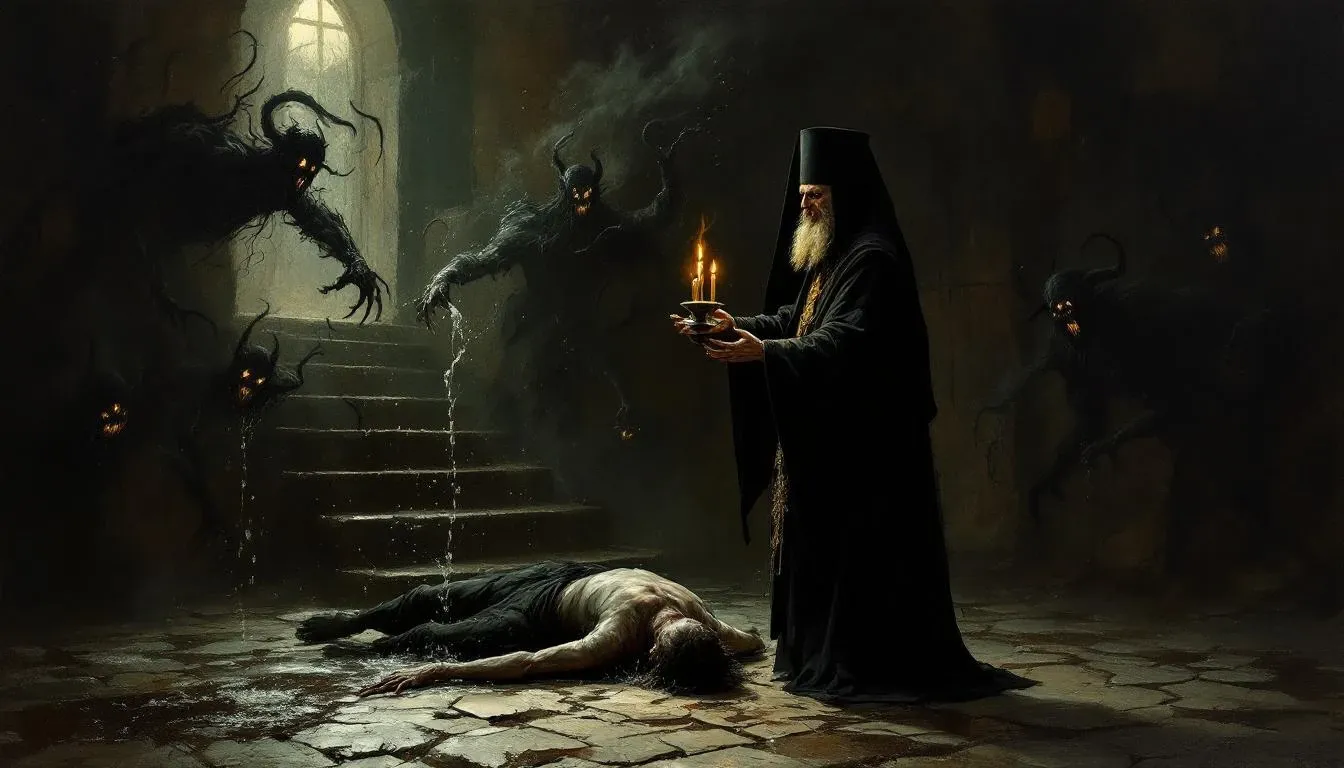
The biesy are most dangerous when they get inside.
Demonic possession — besnovatost' — was a recognized condition across the East Slavic world, distinct from both ordinary madness and physical illness. The possessed person exhibited a specific set of symptoms that the folk tradition catalogued with clinical precision: speaking in voices other than their own, displaying knowledge of events they could not have witnessed, reacting violently to the presence of holy objects (icons, crosses, holy water), exhibiting physical strength that exceeded their normal capacity, and sometimes levitating or contorting their bodies into positions that human anatomy should not permit.
The treatment was exorcism — otchitka in Russian church practice — and it was performed by priests, monks, or in some cases by folk healers who blended Christian prayer with pre-Christian ritual. The procedure involved the reading of specific prayers over the possessed person, the application of holy water and consecrated oil, the touching of relics, and sometimes prolonged fasting imposed on the patient to weaken the demons' hold on the body. The process could last hours, days, or weeks, depending on how deeply the biesy had embedded themselves.
The distinction between voluntary and involuntary possession points to a deeper feature of the bies concept. The biesy are not merely external threats. They are a potential inherent in every human body — a darkness that can be invited in or can find its own way in through carelessness, misfortune, or spiritual weakness. The human being, in the Slavic folk understanding, is not a sealed vessel. It is a house with doors, and the doors can be opened from either side. The biesy wait outside, but they wait patiently, and the doors are not always locked.
The Demons That Language Keeps Alive
The bies does not survive in modern Slavic culture as a belief. Very few people in Moscow or Kyiv or Warsaw literally believe that demonic entities swarm in the shadows and enter the bodies of the unprepared. What survives is the language — and language, it turns out, is more durable than belief.
Every time a Russian says "bes poptal" — "the demon got confused," meaning someone made a stupid mistake — the bies is invoked. Every time a Ukrainian says "bis z nym" — "to hell with him" — the bies is named. Every time a Pole says "do biesa" — "to the demon," an exclamation of frustration — the oldest word for evil in the Slavic vocabulary takes another breath.
The bies has outlived the world that created it. It has outlived the pre-Christian cosmology that first gave it a name. It has outlived the medieval theology that drafted it into Christian service. It has outlived the Soviet project that declared all supernatural beings nonexistent. It persists because it occupies the only truly immortal habitat available to a word: everyday speech, the thing people say without thinking, the reflex language of frustration, surprise, and fear.
There is something appropriate in this. The bies was always the generic demon — the demon without a face, without a name beyond its category, without a story beyond its function. It was the word for the thing you felt but could not identify, the evil that had no specific source, the dread that attached to no particular object. It was, in the oldest sense, the demon of language itself — the thing that lives in the space between the word and the meaning, between what you say and what you summon by saying it.
And in that space it remains, two thousand years after the first Slav whispered bies into the dark, and the dark whispered back.