Every culture on earth invented monsters. Not because people were stupid or superstitious — but because the world was dark, the forests were deep, the ocean was endless, and children needed to be taught what to fear. The creatures that emerged from this collective imagination are not random. They are diagnostic. Tell me what a culture's monsters look like, and I will tell you what that culture was afraid of.
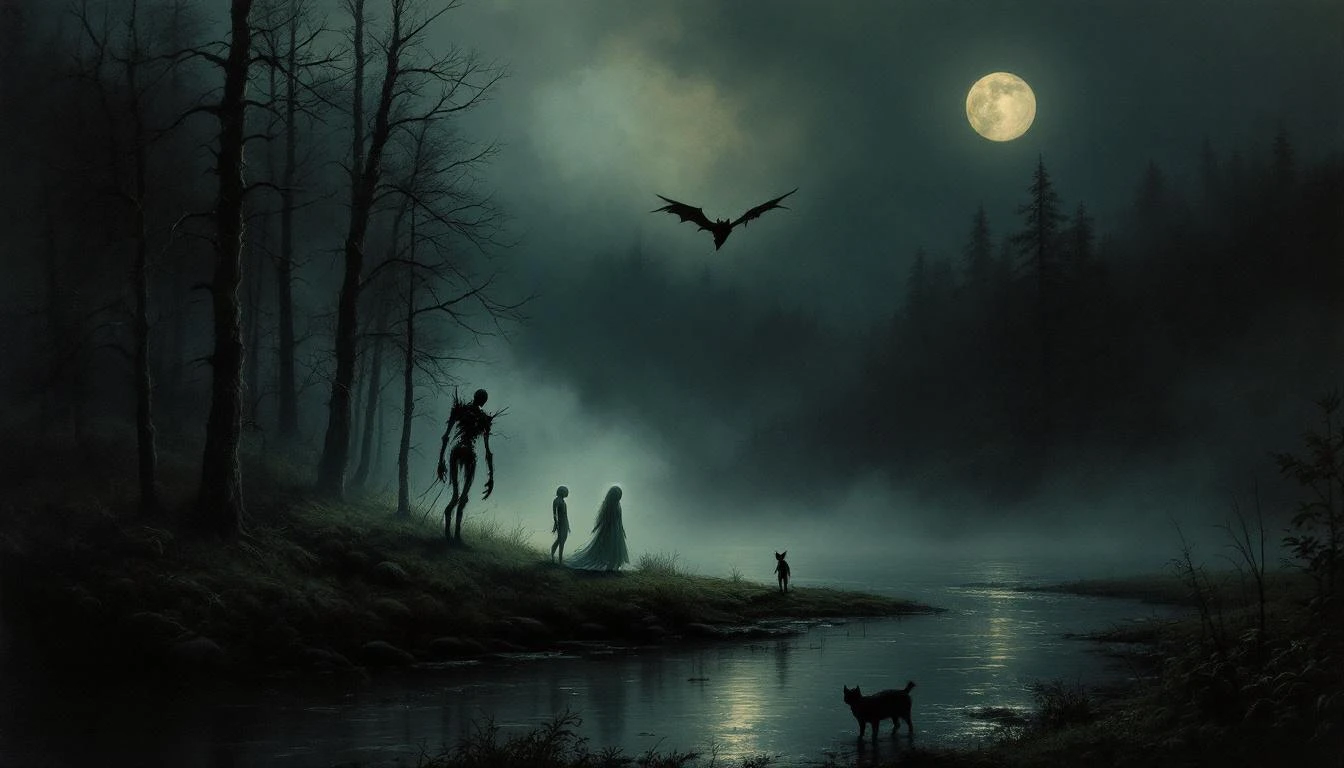
The Greeks feared hubris and divine punishment, so they invented Medusa and the Minotaur. The Norse feared the end of all things, so they built Ragnarok and the wolf that would swallow the sun. The Japanese feared the consequences of dishonor and neglect, so their folklore crawls with vengeful spirits and shapeshifting foxes. And the Slavs — the Slavs feared the forest, the river, the crossroads after dark, and the dead who refused to stay dead. Their creatures are not distant mythological beasts. They lived in the bathhouse. They sat behind the stove. They waited in the wheat field at noon.
What follows is one hundred creatures from folklore traditions spanning every inhabited continent. This is not an encyclopedia — it is a map. A map of what frightened humanity, organized by the geography that shaped the fear. And the Slavic section comes first, because it is the tradition this site exists to preserve, and because it contains more creatures you have never heard of than any other mythology on earth.
Slavic Folklore Creatures (1–25)
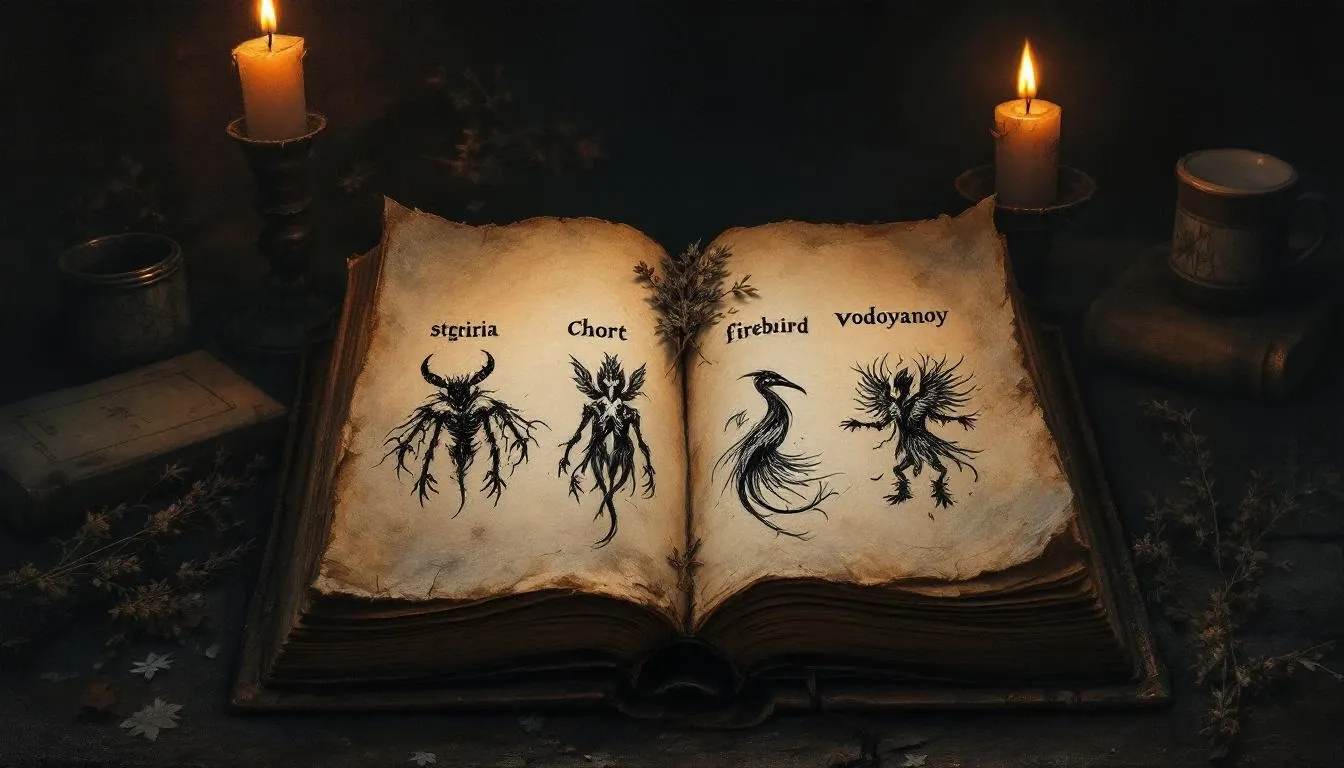
The Slavic bestiary is the least known and the most populated of any European tradition. While Greek mythology gave us a handful of famous monsters and Norse mythology contributed a dozen memorable beasts, Slavic folklore produced hundreds of distinct creatures — each tied to a specific location, season, time of day, or human transgression. The reason you have never heard of most of them is not that they are minor. It is that the people who believed in them were systematically converted, their oral traditions suppressed, their sacred groves cut down. What survived did so through folk songs, fairy tales, and the stubborn memory of grandmothers who refused to stop telling the old stories.
For the complete Slavic bestiary, see our dedicated guide. What follows is the essential roster.
Forest & Nature Spirits
1. Leshy — The absolute sovereign of the Slavic forest. The Leshy is not a creature that lives among the trees — he is the trees made conscious. He appears as a towering figure who can grow taller than the pines or shrink to the size of a grass blade. His shoes are reversed, his shadow falls the wrong way, and he commands every animal in his domain. Hunters who entered the forest without leaving an offering — bread on a stump, salt at a crossroads — found themselves walking in circles for days, unable to locate paths they had known since childhood. The Leshy was not evil. He was territorial. The distinction cost many peasants their lives.
2. Vila — Among the most beautiful and most lethal beings in Slavic folklore. The Vila appears as a young woman of supernatural beauty who dances in mountain clearings and controls the weather — summoning storms, hurling lightning, freezing rivers at will. In Serbian epic poetry, vilas are warrior spirits who form blood-bonds with heroes. But stumble upon their dance uninvited, and they will force you to dance until your heart stops beating.
3. Poludnitsa — The Lady Midday, or Poludnitsa, haunts wheat fields at the hottest hour. She appears as a beautiful woman in white or as a dust whirlwind and approaches field workers with impossible questions about crop cultivation. If you cannot answer — or if you stop working before the conversation ends — she drives you mad or cuts off your head with her scythe. She is the Slavic explanation for heatstroke and sunstroke, personified as a spirit who punishes laziness during harvest.
4. Devana — The Slavic goddess of the hunt, sometimes called the Slavic Diana. A wild, untameable deity of forests and wild animals who rejected her father Perun's authority and had to be subdued by force. In some traditions she is less a goddess and more a forest spirit — a presence that protects the wilderness from human encroachment.
5. Indrik — The Indrik is the king of all animals in Russian folklore — a massive beast with a horn on its forehead that lives underground and controls the flow of all the world's waters. When the Indrik moves, the earth shakes. When it rises to the surface, floods follow. It appears in the Golubinaya Kniga, a medieval Russian spiritual verse collection.
Water Spirits
6. Rusalka — The Rusalka is not a mermaid, despite what the internet tells you. She is the unquiet dead — the spirit of a young woman who drowned (murdered, suicidal, or unbaptized), who now haunts rivers, lakes, and birch groves near water. During Rusalka Week in early summer, these spirits leave the water entirely and swing from birch branches, singing songs that lure young men to drowning. They are beautiful, pale-skinned, with loose wet hair, and they are utterly without mercy.
7. Vodyanoy — The Vodyanoy is the master of rivers, lakes, and ponds — an old, bloated, frog-faced man covered in slime and algae who sits on the river bottom amid broken pottery and drowned bodies. Millers kept him appeased with offerings because he controlled the water that turned their wheels. Fishermen poured vodka into the river before the first cast of spring. Those who forgot to pay respect drowned — or found their nets mysteriously empty for an entire season.
8. Bukavac — A six-legged lake monster from Serbian folklore that lives in deep water and emerges at night to strangle people and animals with its massive body. Its name comes from bukati — to roar — because it announced itself with a deafening bellow before attacking. One of the most viscerally terrifying creatures in the Slavic canon.
Household Spirits
9. Domovoy — Every Slavic home had a Domovoy — a small, bearded spirit who lived behind the stove or under the threshold and protected the household. He was not a pet. He was an ancestor spirit bound to the bloodline of the family. Feed him properly (bread and milk left out at night), keep the house clean, and he would guard against fire, warn of danger, and care for the livestock. Neglect him, and dishes would shatter at night, animals would sicken, and the family would hear scratching in the walls.
10. Kikimora — The Kikimora is the Domovoy's malevolent counterpart — a female house spirit who lives behind the stove and comes out at night to spin thread, tangle wool, and torment the household. In some traditions she is the spirit of a stillborn child or a woman who died in the house. She sits on your chest while you sleep and presses the air from your lungs — the Slavic explanation for sleep paralysis.
11. Bannik — The Bannik rules the bathhouse, the most spiritually dangerous room in any Slavic homestead. The bathhouse was where women gave birth, where the dead were washed, where fortune-telling was done — a liminal space between the clean human world and something else. The Bannik appears as a small, filthy old man who scalds you with boiling water, suffocates you with steam, or tears the skin from your back if you bathe at the wrong hour (usually the third firing of the stove was his).
12. Dvorovoy — The Dvorovoy is the spirit of the yard and outbuildings — essentially the Domovoy's outdoor counterpart. He protects livestock and farm equipment, but has specific preferences: he favors animals whose coat color matches the household head's hair. Animals he dislikes, he torments at night — braiding horses' manes into impossible knots, riding them to exhaustion, refusing to let cows give milk.
13. Ovinnik — The Ovinnik lives in the threshing barn and is perhaps the most dangerous of all household spirits. He appears as a black cat with burning eyes and has the unsettling habit of setting his own barn on fire if offended. On New Year's Eve, brave (or desperate) peasants would back up to the barn door and extend a bare hand inside — if the Ovinnik touched it with a warm paw, good fortune was coming. A cold, clawed touch meant death within the year.
The Undead & Dark Beings
14. Striga — The Striga (strzyga in Polish) is a person born with two souls and two rows of teeth. When a striga dies, one soul departs normally. The other reanimates the corpse into a blood-drinking revenant that hunts at night. Archaeological excavations across Poland have uncovered "anti-vampire" burials — bodies with sickles pressed against their throats or bricks jammed into their mouths — that confirm how seriously this belief was taken. The Witcher franchise's most iconic monster is a direct adaptation.
15. Vukodlak — The Slavic werewolf. The Vukodlak tradition is older and stranger than the Western version. In Serbian and Croatian folklore, a vukodlak is not just a man who transforms into a wolf — it is often a corpse that rises from the grave bloated, red-faced, and covered in blood, terrorizing villages at night. The boundary between vampire and werewolf was never clear in Slavic lands. A person born with a caul, or with teeth already showing, was suspected of becoming a vukodlak after death.
16. Koschei the Deathless — Koschei is not a creature — he is death's cheat code. An emaciated, skeletal sorcerer who cannot be killed because his soul is hidden inside a needle, inside an egg, inside a duck, inside a hare, inside an iron chest, buried under an oak tree on the mythical island of Buyan. He kidnaps beautiful women (most famously Marya Morevna) and holds them in enchanted captivity. His destruction requires finding and breaking the needle — the original Horcrux, centuries before Rowling.
17. Chort — The Chort is the Slavic devil — a black, horned, hoofed figure who appears at crossroads to make bargains for your soul. Unlike the Christian Satan, the Chort is often portrayed as foolish, easily tricked by clever peasants. He fears iron, running water, and the sign of the cross. In Ukrainian folklore, he is almost a comic figure — dangerous, yes, but outsmarted more often than not.
18. Nav Spirits — The Nav (navki, mavki) are the spirits of children who died unbaptized or were stillborn. They appear as pale, translucent figures who cry in the night and bring disease to villages. In some traditions, they are invisible from behind — you can see their internal organs if they turn around. They are among the most tragic figures in all of Slavic folklore.
Mythological Beasts & Birds
19. Zmey Gorynych — The Slavic dragon, a three-headed, fire-breathing serpent that terrorizes villages and kidnaps maidens. Unlike Western dragons who hoard gold, the Zmey is a force of elemental chaos, and it takes a bogatyr (Slavic hero-knight) like Dobrynya Nikitich to defeat him.
20. Firebird — The Zhar-Ptitsa is a blazing bird whose feathers glow with golden light. Capturing even a single feather sets a hero on an impossible quest. It brings both blessing and doom to whoever pursues it — the light that leads you deeper into the forest until you cannot find your way home.
21. Alkonost & Sirin — Twin prophetic birds from Russian folklore, both with the bodies of birds and the faces of beautiful women. The Alkonost sings songs of paradise so beautiful that anyone who hears them forgets everything else. The Sirin sings songs of sorrow that can kill. Together they represent the duality of joy and grief in the afterlife.
22. Gamayun — The Gamayun is a prophetic bird that knows everything — past, present, and future. In Russian folklore, its song foretells the future, and its falling from flight is an omen of catastrophic storms or the death of a ruler. A creature of pure knowledge, neither good nor evil.
23. Psoglav — A dog-headed monster from Serbian mythology with iron teeth, a single eye in the forehead, and horse legs. Psoglavi live in dark caves, dig up graves to eat corpses, and devour anyone foolish enough to enter their territory. One of the most purely monstrous creatures in the Slavic tradition.
24. Anchutka — A small, limbless demon from Russian folklore, the Anchutka is sometimes described as the devil's child. It is invisible, incredibly fast, and attaches itself to people who curse or mention the devil by name. Saying "chort" aloud was thought to literally summon an Anchutka to your side.
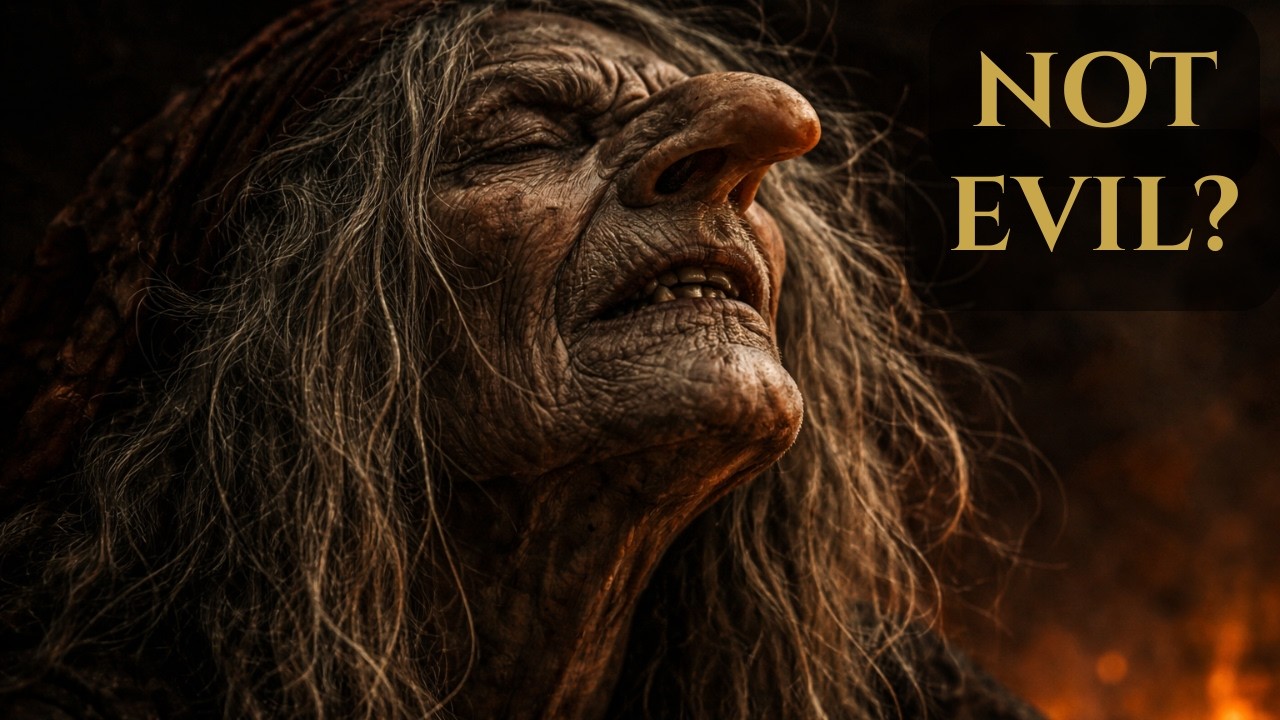
25. Baba Yaga — Baba Yaga is the most famous figure in all of Slavic folklore — an ancient witch who lives in a hut that walks on chicken legs, surrounded by a fence made of human bones topped with glowing skulls. She flies through the sky in a mortar, steering with a pestle, sweeping her tracks with a broom. She eats children — sometimes. She helps heroes — sometimes. She is neither good nor evil but something older and more complicated than either: a gatekeeper between the world of the living and the world of the dead, testing everyone who comes to her door and devouring those who fail.
Norse Folklore Creatures (26–35)
The Norse produced fewer creatures than the Slavs but gave them larger roles — their monsters are world-ending forces, woven into the architecture of the cosmos itself. For a deeper comparison, see Slavic vs Norse Mythology.
26. Fenrir — The monstrous wolf fathered by Loki, destined to devour Odin at Ragnarok. The gods bound him with a chain forged from impossible things — the sound of a cat's footsteps, the breath of a fish, the roots of a mountain — and even that will not hold him forever.
27. Jormungandr — The Midgard Serpent, so vast its body encircles the entire earth and it bites its own tail. When it releases its grip, the end of the world begins. Thor is fated to kill it at Ragnarok — and then die from its venom, staggering nine steps before falling.
28. Draugr — Norse undead warriors who guard their burial mounds with superhuman strength. They can swell to enormous size, are immune to conventional weapons, and possess a rotting stench that kills livestock. Not mindless zombies — draugr retain their intelligence and their grudges.
29. Nidhogg — A dragon-serpent that gnaws ceaselessly at the roots of Yggdrasil, the World Tree. It feeds on the corpses of murderers, oath-breakers, and adulterers in the realm of the dead. It is entropy given form — the slow destruction of everything.
30. Huldra — A beautiful forest woman with a hollow back (like a rotting tree trunk) and sometimes a cow's tail, who seduces men in the Norwegian and Swedish wilderness. She can be helpful or deadly, depending on how she is treated. If a man marries her in a church, she loses her tail and gains a human soul — but also loses her beauty.
31. Mare — The origin of the word "nightmare." A mare is a spirit that sits on your chest while you sleep, pressing the breath from your lungs and filling your mind with terror. Found across all Scandinavian traditions. She enters through keyholes and cannot be locked out.
32. Kraken — The colossal sea monster of Norwegian legend — an octopus or squid so enormous that sailors mistook its body for an island. When it submerged, the whirlpool it created dragged ships under. First described in detail by the Norwegian bishop Erik Pontoppidan in 1752.
33. Fossegrim — A water spirit who plays the fiddle with heartbreaking skill beneath waterfalls. He will teach a mortal to play with equal mastery — but only if the offering is sufficient. A white goat thrown headfirst into the waterfall on a Thursday evening is the traditional price.
34. Trolls — Not the internet kind. Norse trolls are enormous, rock-skinned creatures that live in mountains, turn to stone in sunlight, and possess a dim, grudging intelligence. Some are mountain-sized. Some are merely large. All are dangerous, and all hate the sound of church bells.
35. Valkyries — Though often romanticized, valkyries are choosing spirits of death. They ride above battlefields selecting which warriors will die and be taken to Valhalla. Their name means "choosers of the slain." They are not angels. They are executioners with a pleasant afterparty.
Celtic & British Isles Folklore Creatures (36–50)
Celtic folklore — Irish, Scottish, Welsh, Breton — is obsessed with the boundary between this world and the Otherworld, and its creatures are boundary-crossers: fairies, shapeshifters, and things that look almost human but are not.
36. Banshee — A female spirit whose keening wail foretells the death of a family member. Attached to specific Irish and Scottish bloodlines, the banshee does not cause death — she mourns it in advance. Hearing her cry means someone you love is about to die.
37. Kelpie — A shapeshifting water horse that haunts Scottish rivers and lochs. It appears as a beautiful horse, inviting tired travelers to ride. The moment you mount, its skin becomes adhesive, and it plunges into deep water, dragging you down to drown. Its mane is always dripping wet — the one warning sign.
38. Dullahan — The headless horseman of Irish folklore — a rider on a black horse who carries his own severed head under his arm. The head's eyes dart about in the dark, and when the Dullahan stops riding and speaks a name, that person dies instantly. No gate can block his path. No lock can hold.
39. Cu Sith — A massive fairy hound from Scottish Highland lore, dark green in color, the size of a bull, with a braided tail. It hunts silently and barks exactly three times. If you hear the third bark and have not reached shelter, your soul is forfeit.
40. Changeling — A fairy child left in place of a stolen human infant. The changeling is sickly, irritable, and never grows properly. Celtic folklore developed elaborate (and often horrifying) tests to identify and drive out changelings — involving fire, iron, and worse.
41. Pooka — An Irish shapeshifter — usually a black horse, goat, or hare — that leads travelers astray, ruins crops, and disrupts households. But the Pooka is not purely malevolent. On November 1st (Samhain), it is said to speak prophecy, and farmers who leave a share of the harvest for it are left in peace.
42. Bean Nighe — The Scottish washerwoman of death. She is found at streams and fords, washing the bloodstained clothes of those about to die. If you see her before she sees you, you may ask three questions and receive truthful answers. If she sees you first, you lose an arm.
43. Sluagh — The restless dead of the unforgiven — souls so wicked that neither heaven nor hell would accept them. They fly in great flocks from the west, and they enter houses through west-facing windows to steal the souls of the dying.
44. Nuckelavee — The most terrifying creature in Scottish folklore. An Orcadian sea demon with no skin — every muscle, vein, and sinew visible — riding a horse that is fused to its own body. Its single giant eye burns with red flame. Its breath wilts crops and sickens livestock. Only fresh rainwater can stop it.
45. Leanan Sidhe — A beautiful fairy woman who becomes the muse of an artist or poet, granting them extraordinary creative talent — while slowly draining their life force. The artist produces brilliant work and dies young. She is not cruel; she is addictive.
46. Merrow — Irish mermaids (and mermen) who live beneath the waves and wear magical red caps (cohuleen druith) that allow them to travel between sea and land. Female merrows are beautiful and kind; male merrows are ugly, with green teeth and scaled skin.
47. Cailleach — A divine hag who personifies winter itself across Scottish and Irish tradition. She creates mountains with her hammer, washes her plaid in whirlpools, and herds deer across frozen peaks. When spring comes, she turns to stone until the next winter calls her back.
48. Selkie — Seal-people from Scottish and Irish coastal folklore who shed their skin to walk on land in human form. A human who steals a selkie's skin can trap them on land as a spouse — but the selkie will always be drawn back to the sea, and if they find their skin, they will leave without looking back.
49. Dearg Due — An Irish vampire — a beautiful woman buried alive by her father after he sold her to a cruel husband. She rose from the grave to drain the blood of those who wronged her, and now she rises every year to feed unless stones are piled on her grave.
50. Abhartach — An Irish chieftain and sorcerer who rose from the dead multiple times until a druid advised burying him upside-down with a sword of yew wood through his heart. Some scholars consider this story a possible origin for the Dracula legend — Bram Stoker was Irish, after all.
Japanese Folklore Creatures (51–65)
Japanese folklore has the most elaborately categorized supernatural bestiary in the world. Yokai is the catch-all term, encompassing hundreds of creatures that range from the terrifying to the absurd.
51. Kappa — A river-dwelling creature the size of a child, with a turtle shell on its back and a dish-shaped depression on its head that holds water — the source of its power. If the water spills, the kappa is helpless. It drowns children, steals crops, and has an obsession with cucumbers. If you bow to a kappa, it will bow back, spilling its water.
52. Oni — Massive, horned ogre-demons, usually red or blue, wielding iron clubs. They are the wardens of hell in Buddhist-influenced Japanese folklore, punishing the wicked. But oni also raid the living world, devouring humans wholesale.
53. Tengu — Bird-men of the mountains — originally depicted as crow-like demons, later evolved into long-nosed, red-faced warrior spirits who are masters of swordsmanship and martial arts. Some tengu protect sacred mountains. Others kidnap priests and drive them mad.
54. Jorogumo — A spider that lives for four hundred years and gains the power to shapeshift into a beautiful woman. She lures men into her web, binds them in silk, and devours them. The name means "binding bride" — one of the most elegant predator names in any folklore.
55. Yuki-onna — The Snow Woman. She appears during blizzards as a tall, pale woman with white skin and black hair, floating above the snow. She breathes on lost travelers, freezing them to death, or lures them deeper into the storm. In some versions she spares those who are beautiful.
56. Kitsune — Fox spirits who gain additional tails (up to nine) as they age and grow more powerful. They are masters of illusion and shapeshifting, often appearing as beautiful women. Some kitsune are divine messengers of the rice god Inari. Others are tricksters who seduce and ruin mortal men.
57. Tanuki — Raccoon dogs with shapeshifting abilities and a reputation for mischief. In folklore, tanuki are jovial tricksters who transform leaves into money, assume human disguises, and drum on their bellies during autumn moonlight. Their depictions are deliberately and exuberantly crude.
58. Gashadokuro — A skeletal giant made from the bones of people who died of starvation, standing fifteen meters tall. It wanders after midnight, biting off the heads of lone travelers with a grinding, rattling sound. You know one is near when you hear a ringing in your ears.
59. Nure-onna — A snake-bodied woman with a human face who haunts rivers and shorelines. She carries a bundle that looks like a baby and asks passersby to hold it. The bundle grows impossibly heavy, pinning the victim in place while she drains their blood with her serpent tongue.
60. Teke Teke — The ghost of a woman who fell on a railway line and was cut in half. She drags herself on her elbows and hands at terrifying speed, making a teke-teke-teke scraping sound. If she catches you, she cuts you in half at the waist with a scythe so you become a Teke Teke yourself. A modern urban legend with roots in older yokai traditions of vengeful dismembered spirits.
61. Futakuchi-onna — A woman with a second mouth hidden at the back of her head, concealed beneath her hair. The mouth demands food constantly, and if starved, her hair transforms into serpent-like tentacles that feed the mouth independently.
62. Akaname — The "filth-licker" — a small, red goblin with an impossibly long tongue that sneaks into dirty bathrooms at night and licks them clean. Disgusting but harmless. The moral is clear: clean your bathroom or a demon will do it for you.
63. Umi-bozu — A massive, black, humanoid shape that rises from calm seas to capsize ships. It has no features except enormous eyes. It demands a barrel from the crew — and if they give it one with a solid bottom, it fills the ship with seawater. The only defense is to give it a barrel with the bottom knocked out.
64. Yamamba — A mountain witch who feeds on travelers, sometimes appearing as a kind old woman offering shelter. She is the Japanese analogue of Baba Yaga — a forest-dwelling crone who tests visitors and devours those who fail.
65. Nekomata — A cat that has lived long enough for its tail to split in two, gaining supernatural powers including necromancy, shapeshifting, and the ability to control the dead. The fear behind this creature: any house cat, given enough time, becomes a demon.
African Folklore Creatures (66–75)
African folklore contains some of the oldest supernatural traditions on earth, yet remains dramatically underrepresented in Western creature lists — a gap this section begins to address.
66. Adze — A West African vampire from Ewe tradition (Ghana, Togo) that takes the form of a firefly. In firefly form it can slip through any barrier. When caught, it transforms into a humanoid form and drinks blood. The moral: not all monsters are large.
67. Popobawa — A bat-winged entity from Zanzibar that attacks at night, associated with sleep paralysis and political anxiety. Reports of Popobawa sightings surge during election seasons — the monster as political metaphor, as real as the fear it embodies.
68. Ninki Nanka — A massive, dragon-like river creature from West African tradition (Gambia, Senegal) that inhabits swamps and mangroves. Anyone who sees it dies shortly after. Described variously as a serpent, crocodile, or horse-headed lizard.
69. Kongamato — A pterosaur-like flying creature from Zambian, Congolese, and Angolan folklore. Its name means "breaker of boats" — it capsizes canoes and attacks fishermen. Described with membranous wings, a long beak, and reddish skin.
70. Tokoloshe — A small, malevolent water sprite from Zulu and Xhosa tradition (South Africa) that can be summoned by a shaman to cause illness or death. It becomes invisible by drinking water and is said to bite off sleeping people's toes. Many South Africans raise their beds on bricks to stay above the Tokoloshe's reach.
71. Mami Wata — A water spirit venerated across West, Central, and Southern Africa, often depicted as a beautiful woman with a snake coiled around her body. She offers wealth, beauty, and spiritual power to her followers — but demands fidelity. Betray her, and everything she gave is taken back tenfold.
72. Asanbosam — An Ashanti (Ghanaian) forest-dwelling vampire with iron teeth, iron hooks for feet, and the ability to hang from trees by its legs. It sits in the canopy, dangles its hooked feet, and snags passersby from above.
73. Impundulu — The Lightning Bird from Zulu and Xhosa tradition — a bird the size of a human that summons storms and strikes with lightning. It is a vampire, feeding on human blood, and is often controlled by witches as a familiar. Its fat, when rendered, is a powerful magical ingredient.
74. Inkanyamba — A massive serpentine creature from Zulu folklore that lives in deep pools and waterfalls. It controls storms and tornadoes. When angry, it rises from the water and the sky turns black. Howick Falls in South Africa is said to be its home.
75. Yumboes — Fairies of Senegalese (Wolof) tradition — two feet tall, silver-skinned, and fond of stealing food from human feasts. They live in underground villages beneath the hills and hold elaborate banquets of their own. One of the few genuinely benign supernatural beings in African folklore.
Greek & Mediterranean Folklore Creatures (76–85)
The best-known creatures in Western culture, included here because no complete list can omit them — but briefly, because everyone already knows their names.
76. Medusa — A gorgon whose gaze turns the living to stone. Originally a beautiful woman cursed by Athena, she is less a monster than a victim — a reading that every generation rediscovers.
77. Minotaur — Half-man, half-bull, imprisoned in the Labyrinth of Crete, fed on human sacrifices until Theseus killed him. The Labyrinth is the metaphor. The Minotaur is the thing at the center of what you built to contain your shame.
78. Hydra — A multi-headed serpent that grows two heads for every one cut off. Heracles defeated it by cauterizing each stump. The Hydra is the first metaphor for problems that multiply when attacked directly.
79. Chimera — Lion's head, goat's body, serpent's tail, breathing fire. Killed by Bellerophon riding Pegasus. The word "chimera" now means any impossible hybrid — proof of how deeply this creature embedded itself in language.
80. Cerberus — The three-headed dog guarding the entrance to the underworld. Not a monster in the attack-and-devour sense — more of a bouncer. His job is to keep the dead in and the living out.
81. Lamia — A Libyan queen who became a child-eating monster after Hera killed her children in jealousy. She can remove her own eyes. She seduces young men and drains their blood. The Greek origin of the vampire myth.
82. Empusa — A shapeshifting demon in the retinue of Hecate who takes the form of a beautiful woman to seduce travelers and drink their blood while they sleep. She has one leg of bronze and one leg of a donkey. The ancient Greek catfishing demon.
83. Sphinx — Lion's body, eagle's wings, woman's face. She guards the road to Thebes and devours anyone who cannot answer her riddle. The original gatekeeper who tests with intellect rather than strength.
84. Cyclops — One-eyed giants, the most famous being Polyphemus, whom Odysseus blinded with a burning stake. In Hesiod's version, the Cyclopes forged Zeus's thunderbolts — they are cosmic craftsmen, not merely brutes.
85. Echidna — The "Mother of All Monsters" — half woman, half serpent, who birthed the Hydra, Chimera, Cerberus, Sphinx, and Nemean Lion. She is the assembly line of Greek nightmares.
Americas Folklore Creatures (86–93)
From the frozen north to the southern cone, the Americas contain folklore traditions ranging from thousands of years old (Indigenous) to hundreds (colonial blends).
86. Wendigo — An Algonquian spirit of insatiable hunger and winter starvation. A person who resorts to cannibalism becomes a Wendigo — growing larger with every meal, their hunger expanding faster than their body. It is a monster made of famine and moral collapse.
87. Skinwalker — A witch in Navajo tradition (yee naaldlooshii) who has gained the power to transform into any animal by committing a taboo act, usually the murder of a close family member. Speaking about skinwalkers is itself taboo, and most Navajo people prefer that outsiders not discuss them at all.
88. Chupacabra — A blood-drinking creature first reported in Puerto Rico in 1995, described as a reptilian biped with spines along its back. It drains livestock of blood through small circular wounds. The most modern creature on this list — folklore forming in real time.
89. La Llorona — The Weeping Woman of Mexican and Central American folklore — the ghost of a woman who drowned her children in a river and now wanders waterways at night, weeping and searching for them. Hearing her cry means death or disaster. She is the direct Latin American analogue of the Slavic rusalka.
90. Piasa Bird — A dragon-like creature from Illini (Native American) tradition, depicted in ancient petroglyphs near present-day Alton, Illinois. It has the face of a man, antlers of a deer, scales of a fish, and a tail so long it wraps around its body twice.
91. Ciguapa — A beautiful woman from Dominican folklore with backward-facing feet. She descends from mountain peaks at night to steal food and lure men into the wilderness. Her reversed footprints make her impossible to track.
92. Cadejo — Central American (Salvadoran, Guatemalan, Honduran) spirit dogs that appear in pairs — one white, one black. The white cadejo protects travelers. The black one leads them to destruction. Encountering both means a battle for your soul is in progress.
93. Curupira — A Brazilian forest guardian with flaming red hair and backward-facing feet. He protects animals and trees, punishing hunters who kill more than they need. A trickster who leads poachers in circles until they go mad — the South American Leshy.
Middle Eastern & South Asian Folklore Creatures (94–100)
94. Djinn — Pre-Islamic Arabian spirits made of "smokeless fire," with free will, their own societies, and the ability to shapeshift. Not the wish-granting genies of Western imagination — djinn are a parallel species, most of whom want nothing to do with humans. Some are devout. Some are malicious. All are powerful.
95. Manticore — Originally from Persian folklore (martichoras) — a creature with a lion's body, a human face, three rows of shark-like teeth, and a scorpion's tail that launches venomous spines. Its voice sounds like a trumpet played simultaneously with a flute.
96. Rakshasa — Shape-shifting demons from Hindu and Buddhist mythology who feast on human flesh. They can appear as beautiful women, animals, or monstrous giants with multiple heads and arms. In the Ramayana, Ravana — king of the rakshasas — is one of the great villains of world literature.
97. Naga — Serpent-beings from Hindu, Buddhist, and Jain mythology — immensely powerful, often depicted as cobras or half-human/half-serpent beings who guard treasures and waterways. They can be benevolent protectors or wrathful destroyers. Their king, Shesha, supports the entire world on his coiled body.
98. Vetala — Indian vampire spirits that inhabit corpses and hang upside-down from trees in cremation grounds. Unlike most vampires, vetala are not mindlessly violent — they possess vast knowledge and can see past, present, and future. The frame story of the Baital Pachisi (25 Tales of the Vetala) is one of the oldest story collections in human literature.
99. Peri — Persian spirits of extraordinary beauty, descended from fallen angels. They were exiled from paradise until they could complete penance. In earlier Zoroastrian tradition, peri were malevolent; in later Islamic-era folklore, they became beautiful, sympathetic beings — trapped between the divine and the mortal, belonging fully to neither.
100. Ghoul — From Arabic folklore (ghul) — a shapeshifting demon that lurks in deserts and graveyards, feeding on the flesh of the dead. It lures travelers off safe paths by mimicking familiar voices. The English word "ghoul" comes directly from this creature. In the original tradition, ghouls are a subclass of djinn — the ones who chose to eat the dead.
"Every folkloric creature is an answer to a question that was once a matter of survival. The questions differed by geography, climate, and culture — but the underlying human need to name the darkness was universal."
What This List Reveals
Lay these hundred creatures side by side and patterns emerge. Every culture has water spirits that drown the careless — rusalki, kelpies, kappa, vodyanoy, nure-onna. Every culture has shapeshifters who test the boundary between human and animal — vukodlaks, kitsune, selkies, skinwalkers. Every culture has spirits of the unjustly dead who refuse to stay buried — nav spirits, banshees, La Llorona, vetala.
But the Slavic tradition stands apart in one critical way: density. No other European mythology populates every single domestic space with its own specific spirit — a different entity for the house, the yard, the barn, the bathhouse, the field, the forest edge, the forest depths, the river, the lake, the crossroads. The Slavic world was not haunted. It was inhabited — every square meter accounted for, every threshold guarded, every hour of the day assigned to something that watched.
If this list introduced you to Slavic creatures for the first time, start with our Complete Slavic Bestiary or the Beginner's Guide to Slavic Mythology. If you came for the monsters, stay for the mythology that created them. It is darker, stranger, and more human than anything the Greeks ever imagined.